KitKat's chocolate heist turns into a marketing masterclass - but cargo theft is real
Nestlé's 413,793 stolen KitKat bars sparked a brand response campaign built on batch-code tracking and cross-brand social media trendjacking that marketers are watching closely.
Nestlé this week confirmed that 413,793 KitKat bars - weighing 12 tonnes - were stolen while in transit from a factory in central Italy to distributors in Poland, triggering a crisis response that rapidly became one of the most-watched brand marketing moments of 2026. The theft occurred on 26 March 2026. By April 1, the company had launched a purpose-built digital tracking tool. By April 2 - today - brands across multiple continents were posting their own responses on social media, and the story had spread well beyond confectionery trade press.
The numbers are specific. According to Nestlé's official statement, 12 tonnes of product - precisely 413,793 individual bars - disappeared along a European transport route. The truck and its entire cargo, according to the company, remained unlocated at the time of the initial public disclosure. No injuries were reported during the incident.
The stolen bars were not standard KitKat stock. According to The Guardian, the shipment carried KitKat's new Formula One line - chocolate bars molded after race cars, produced as part of KitKat's status as the official F1 chocolate brand partner, a relationship established in 2024. The timing compounded the commercial sensitivity of the loss: the theft occurred days before Easter, a period of peak chocolate demand across European markets.
A cargo crime that Nestlé chose to make public
Most companies absorb supply chain losses quietly. Nestlé chose a different path. According to its official statement, the company decided to go public specifically to highlight what it described as a systemic problem.
"Whilst we appreciate the criminals' exceptional taste, the fact remains that cargo theft is an escalating issue for businesses of all sizes," the company said. "With more sophisticated schemes being deployed on a regular basis, we have chosen to go public with our own experience in the hope that it raises awareness of an increasingly common criminal trend."
The decision to disclose was framed in part by a recent joint report from the International Union of Marine Insurance and the Transported Asset Protection Association - known as TAPA EMEA - which documented a sharp increase in cargo theft and freight fraud across European supply chains. Nestlé positioned its disclosure as contributing to that broader conversation, rather than simply managing reputational fallout from a supply disruption.
Nestlé also addressed consumer safety directly. According to KitKat's official Instagram statement, "there are no concerns for consumer safety, and supply is not affected." The company confirmed it is working with local authorities and supply chain partners to investigate. The distinction between consumer safety and commercial loss - clearly articulated in the public statement - is a standard element of crisis communication frameworks, but the execution here was notable for its speed and specificity.
The tracker: a technical and creative response
The most operationally interesting element of Nestlé's response was the , a purpose-built digital tool hosted on an official Nestlé corporate website and developed in collaboration with creative agency VML. The tool launched on April 1, 2026, and allows any consumer holding a KitKat bar to check whether it belongs to the missing shipment.
The mechanism is straightforward but technically grounded in Nestlé's existing product traceability infrastructure. Each KitKat bar carries an eight-digit batch code printed on the back of its wrapper. According to Nestlé, law enforcement can trace stolen products through these unique batch codes assigned to individual bars. The tracker extends this capability to the public: a consumer enters the eight-digit code into the tool's input field, and the system returns a result indicating whether that specific bar is from the stolen batch.
If the bar is not from the stolen consignment, the tool displays the message: "THIS KITKAT WASN'T STOLEN - KEEP SEARCHING AND HELP US WIDEN THE SEARCH BY SHARING." The instruction to share is significant - it incorporates social amplification directly into the product experience, transforming each individual check into a potential distribution moment.
According to KitKat's Instagram post announcing the tracker, the company was explicit about the nature of the campaign: "Just to clarify, this is not a stunt, or an April Fool's joke. Someone really stole 12 tonnes of KitKats and we really want to know where they've gone." The statement, posted on April 1 - April Fools' Day - was a calculated acknowledgment of the obvious skepticism the timing would generate.
The tracker concept draws on a well-established consumer participation mechanic that brands have used in missing-product and loyalty contexts. What distinguishes this instance is the direct integration of batch-level product data into a public-facing interface. For marketers, the construction of the tool raises questions about the underlying data architecture: maintaining real-time batch code lookups at consumer scale implies that Nestlé's supply chain management systems hold granular, queryable records at the individual product level. Whether that infrastructure pre-existed the theft or was adapted for this purpose is not addressed in the available materials.
Memes, movie posters, and brand trendjacking
Parallel to the tracker launch, KitKat's US social media account began posting content that treated the theft as a cultural event. An evidence board resembling those used in detective procedurals appeared, complete with printed headlines, maps, and a poster for the 2001 heist film Ocean's Eleven. Hamburglar - the McDonald's character - appeared crossed out as a ruled-out suspect. A photo labeled "most important moments in history" placed the "great KitKat heist" alongside the invention of the KitKat bar and the concept of the first break. At the time of publication, KitKat US had also released a faux movie poster titled The KitKat Job, produced in collaboration with OTT streaming platform Tubi, and labeled "Today only on Tubi" with hashtags #KITKATHEISTMOVIE and #TUBIORIGINAL.
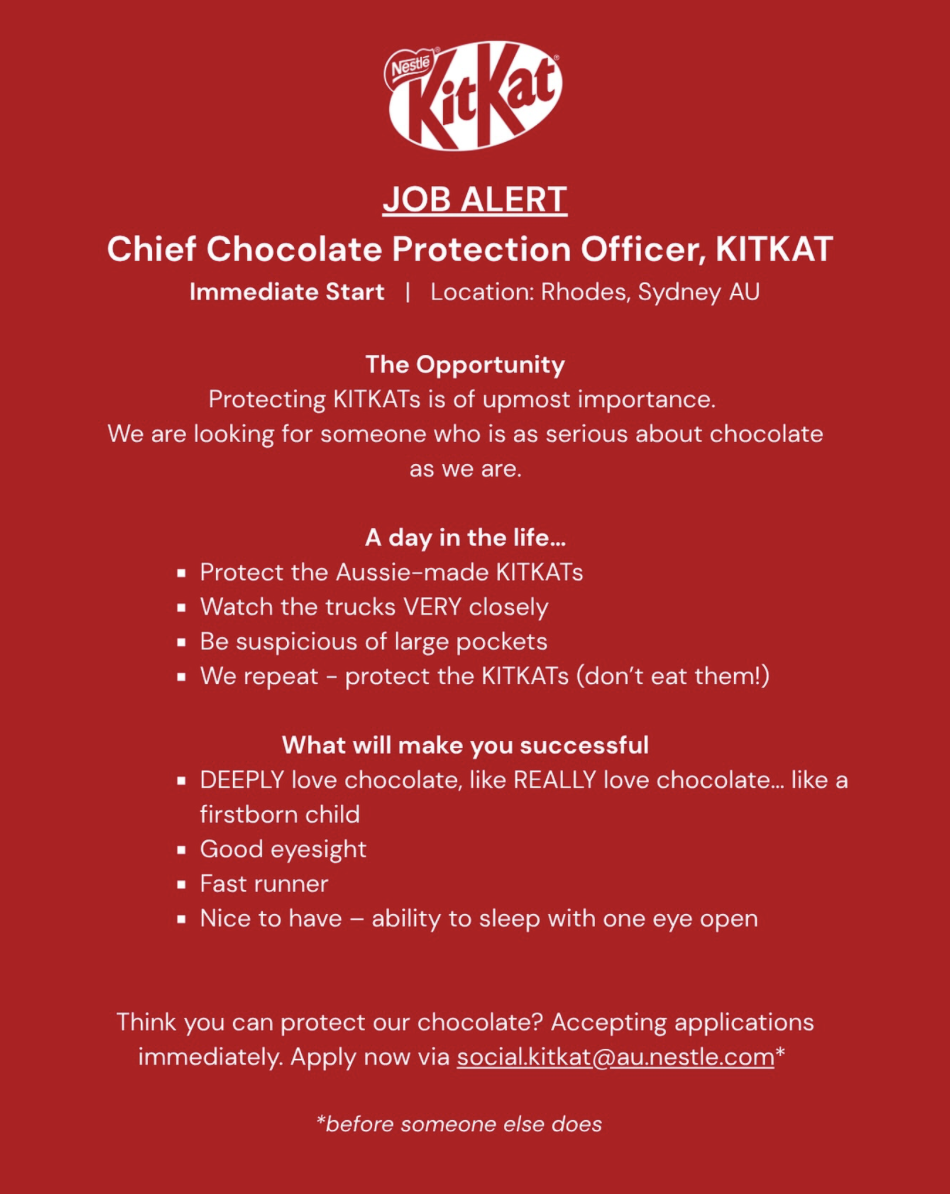
KitKat ANZ - the Australia and New Zealand account - posted a job listing for a Chief Chocolate Protection Officer. According to the post, requirements included a deep love for chocolate, good eyesight, the ability to run fast, and the capacity to sleep with one eye open. Responsibilities listed included watching trucks closely and being suspicious of large pockets. The post received 40,857 likes at the time of writing.
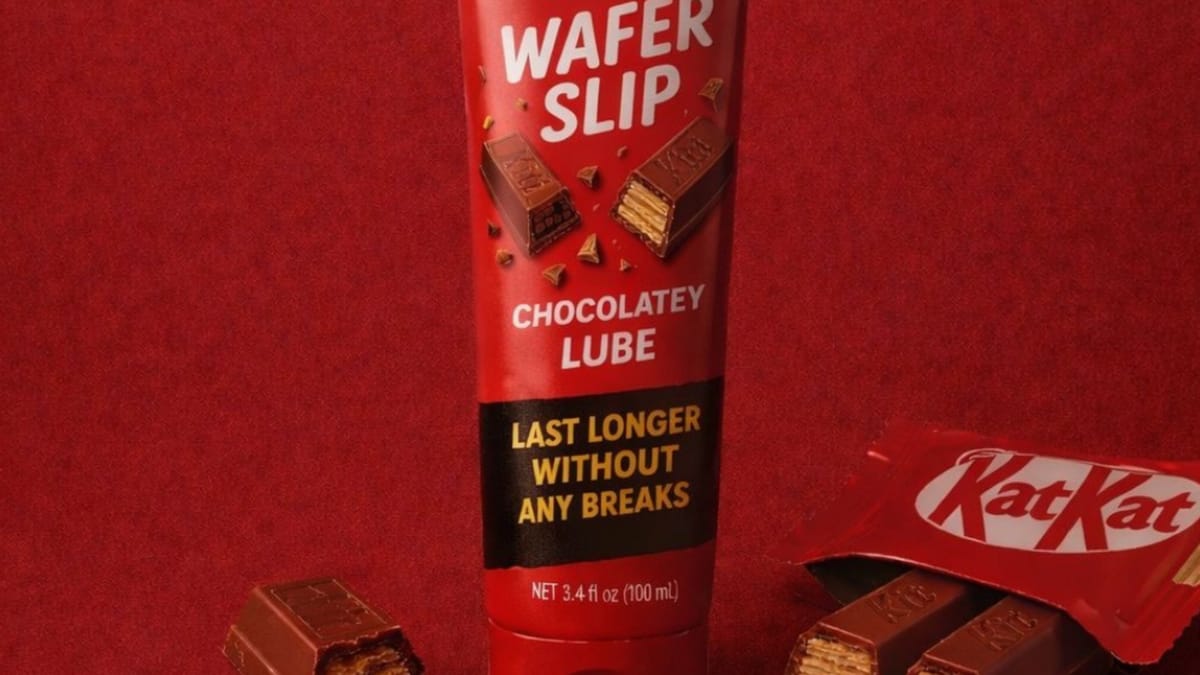
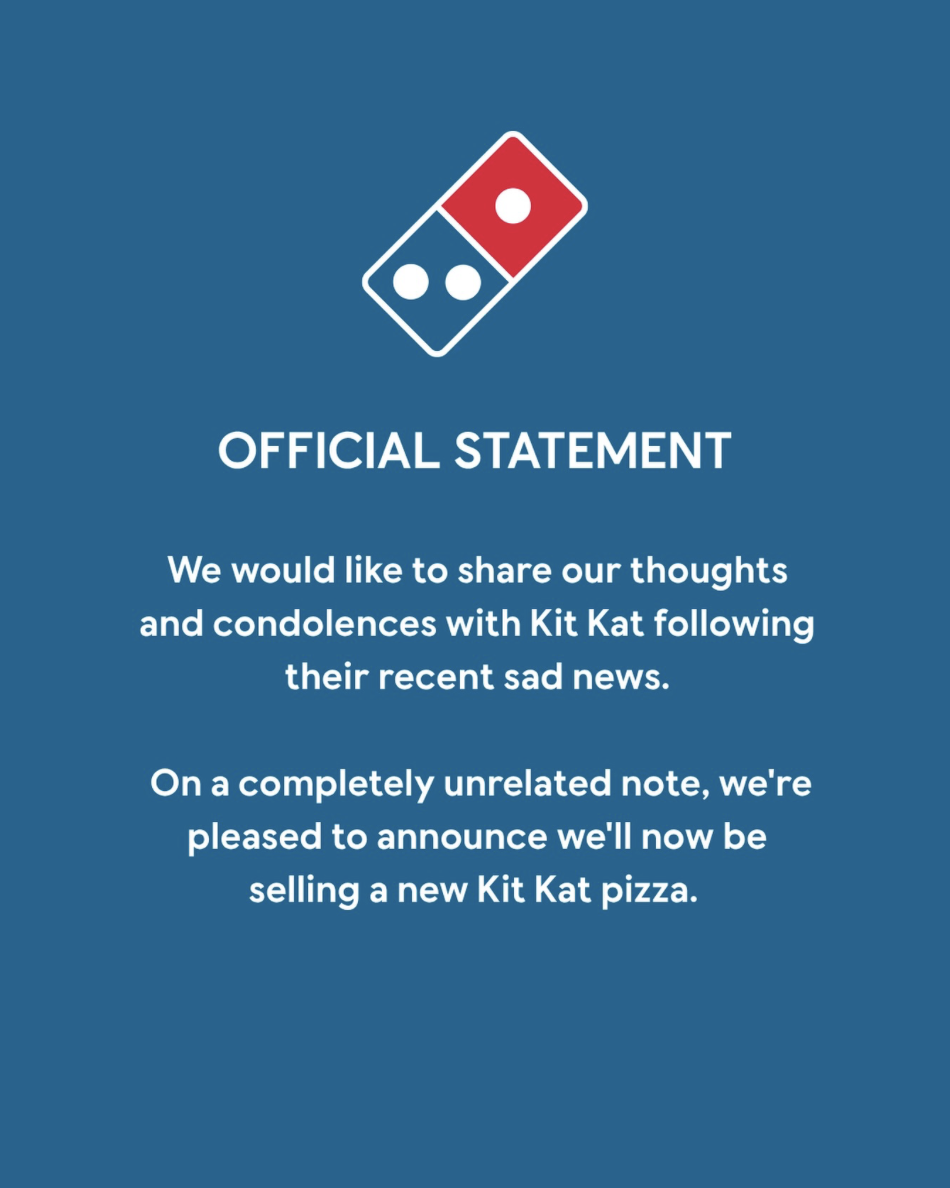
The trendjacking that followed was rapid and cross-category. Domino's UK issued what it described as an official statement expressing condolences to KitKat, then announced, as the statement put it, that "on a completely unrelated note, we're pleased to announce we'll now be selling a new Kit Kat pizza." The post received 378,244 likes. Durex Singapore introduced what it called a "Wafer slip chocolatey lube," promising a product that lasts longer without any breaks - a direct reference to KitKat's long-running "Have a break, have a KitKat" tagline. Durex framed the post with the hashtag #happyaprilfoolsday and a note that it was sorry about the missing chocolates.
Pizza Hut South Africa clarified it was not responsible for the theft but shared what it would do with 12 tonnes of KitKat bars. Cybersecurity company McAfee used the moment to note that "protecting consumers isn't something we ever 'take a break' from." Microphone brand Rode announced it would stream a special-edition ASMR session using 413,793 KitKat bars and its KitKat-Red wireless microphone. Pasta brand Barilla posted what it called an "Official Statement in Response to the Official Statement in Response to the Other Official Statements," announcing solidarity with "our F1 family." The post received 2,855 likes.
The speed at which competing and complementary brands entered the conversation - within hours of KitKat's initial disclosure - illustrates a social media response pattern that marketing teams now treat as an operational capability rather than an opportunistic one. Brands capable of producing cleared, on-brand creative content within hours of a trending cultural moment have an advantage in organic reach that paid media cannot easily replicate. The KitKat heist, coinciding with April Fools' Day, provided an unusually permissive creative environment: humor was expected, absurdity was rewarded, and the subject matter - chocolate theft - carried no reputational risk for brands that joined the conversation.
What the marketing community is watching
For the marketing and advertising industry, several dimensions of this incident merit attention. The first is the batch-code tracking mechanic as a model for consumer-facing product traceability. Nestlé's use of its existing supply chain data to build a public tool demonstrates that traceability infrastructure, typically invisible to consumers, can be surfaced as a brand engagement mechanism under specific conditions. The conditions here - a genuine theft, a traceable batch, and a public interest angle - are unusual. But the technical model is transferable.
The second is the agency execution speed. VML, the creative agency credited with the tracker, produced a functional, branded digital tool between the initial theft disclosure and the April 1 launch - a window of approximately six days. For agencies and brand teams that monitor creative production timelines, that pace is notable. It implies pre-existing technical infrastructure, a clear brief, and a client approval process capable of moving at speed.
The third dimension is the cross-brand social response. The number of brands that joined the conversation - spanning pizza chains, consumer health brands, microphone manufacturers, cybersecurity companies, and pasta makers - within a 24-hour window represents an unusual concentration of reactive content marketing. For digital marketing professionals, the episode illustrates both the opportunity and the operational requirements of brand trendjacking: the need for rapid content production, cleared legal sign-off, and tone matching to the original moment.
The KitKat Instagram post carrying the official statement on the theft had accumulated 3,100 likes and 4,100 shares at the time of writing. Kayali, a fragrance brand, commented: "So your slogan isn't 'Break in, have a KitKat'?" - a comment that received 21,137 likes.
Cargo theft, meanwhile, is not a novelty. According to reporting by 9News citing Nestlé, the company described it as "a growing issue." The framing of a consumer goods theft as a public interest story - rather than an insurance claim and a police report - is the unusual element. Whether the Stolen KitKat Tracker actually recovers any product is, in one sense, beside the point. The tool functioned as a distribution mechanism for the story, a demonstration of traceability capability, and a consumer engagement device simultaneously.
For PPC Land readers focused on digital advertising and brand marketing, the incident connects to broader themes the publication tracks: the role of social media in brand crisis response, the mechanics of consumer-facing data tools, and the measurement of organic reach against paid media benchmarks. In an environment where paid media costs continue to rise, the KitKat case offers a rare example of a crisis-driven story generating the kind of cross-platform organic reach that media buyers typically try to purchase. Whether it was planned that way is a separate question.
Timeline
26 March 2026 - 413,793 KitKat bars (12 tonnes), part of KitKat's new Formula One product line, are stolen while being transported by truck from a factory in central Italy to Poland. No injuries are reported. The vehicle and cargo are not located.
28 March 2026 - The Guardian publishes initial coverage of the theft, citing a Nestlé spokesperson confirmation and noting the stolen bars are from the new F1 line developed following KitKat's partnership as the official F1 chocolate brand.
1 April 2026 - Nestlé launches the Stolen KitKat Tracker, developed in collaboration with VML and hosted on a Nestlé corporate website. The tool allows consumers to enter the eight-digit batch code from any KitKat bar to check if it belongs to the stolen shipment. KitKat posts its official Instagram statement clarifying the situation is not an April Fools' joke.
1 April 2026 - KitKat US begins posting meme content including an evidence board, references to Ocean's Eleven, and a photo titled "most important moments in history." KitKat ANZ posts a Chief Chocolate Protection Officer job listing.
1 April 2026 - 9News publishes reporting on the tracker tool. Multiple brands including Domino's UK, Durex Singapore, Pizza Hut South Africa, McAfee, Rode, and Barilla post responses joining the social media conversation.
2 April 2026 (today) - KitKat US releases The KitKat Job faux movie poster in collaboration with Tubi. Marketing-Interactive publishes analysis of the brand response. The investigation into the theft continues, with Nestlé working with local authorities and supply chain partners.
Summary
Who: Nestlé, the parent company of KitKat, along with creative agency VML, and responding brands including Domino's UK, Durex Singapore, Pizza Hut South Africa, McAfee, Rode, and Barilla.
What: 413,793 KitKat bars weighing 12 tonnes - specifically from KitKat's new Formula One product line - were stolen from a truck in transit across Europe. Nestlé responded by publicly disclosing the theft, launching a consumer-facing batch-code tracking tool called the Stolen KitKat Tracker, and framing the incident as an example of growing cargo theft across European supply chains. The disclosure triggered a large-scale reactive social media response from competing and complementary brands.
When: The theft occurred on 26 March 2026. Nestlé disclosed the theft publicly and launched the tracker on 1 April 2026. Brand responses proliferated on 1 and 2 April 2026.
Where: The theft occurred on a transport route between central Italy and Poland. The Stolen KitKat Tracker was made available globally via a Nestlé corporate website. Social media responses were posted across Instagram accounts in the United States, Australia and New Zealand, the United Kingdom, Singapore, and South Africa.
Why: Nestlé chose to go public with the theft in order to raise awareness of what it described as an escalating pattern of cargo theft and freight fraud affecting businesses across European supply chains. The company simultaneously used the disclosure as a platform for demonstrating its product traceability infrastructure and driving consumer engagement through the tracker mechanic. The timing coinciding with April Fools' Day created an unusual media environment that amplified the story and encouraged brand trendjacking at scale.
Share this article
The link has been copied!
Your link has expired. Please request a new one.
Your link has expired. Please request a new one.
Your link has expired. Please request a new one.
Great! You've successfully signed up.
Great! You've successfully signed up.
Welcome back! You've successfully signed in.
Success! You now have access to additional content.