LiveRamp just turned its data marketplace into an AI model training hub
Data collaboration platform opens licensing infrastructure for training data, third-party models, and AI-powered applications starting January 6, 2026.


Data collaboration platform opens licensing infrastructure for training data, third-party models, and AI-powered applications starting January 6, 2026.
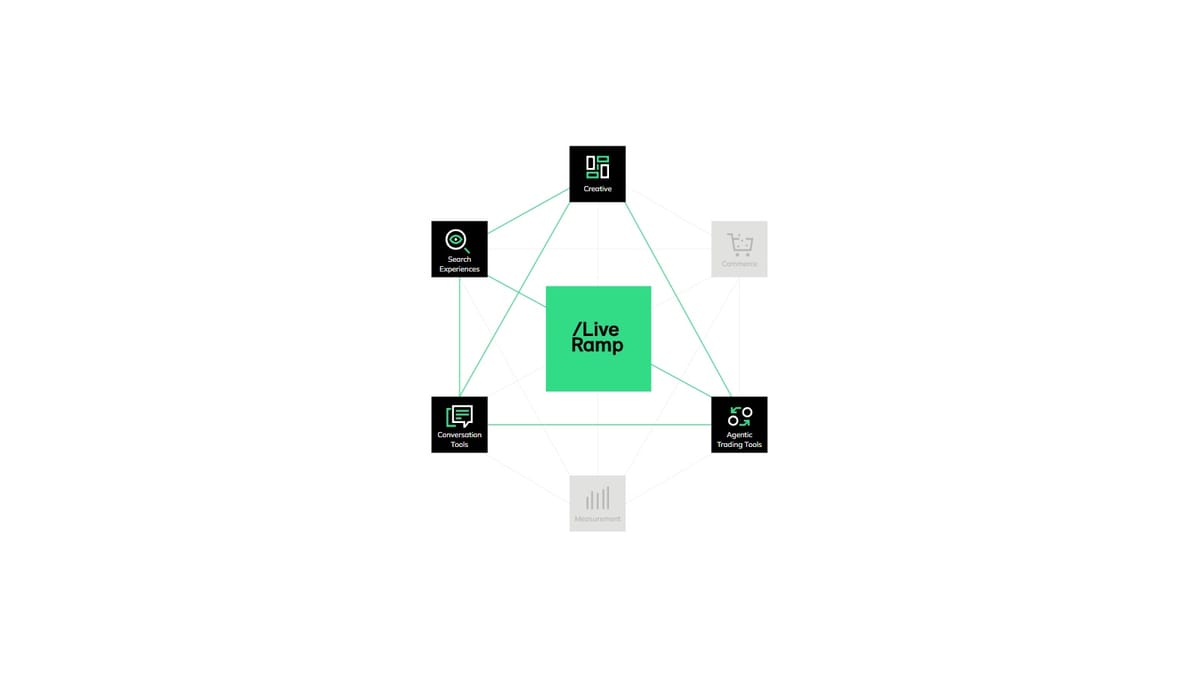
LiveRamp announced on January 6, 2026, the expansion of its Data Marketplace to include data and models specifically designed for artificial intelligence applications. The San Francisco-based data collaboration partner has transformed what began as a marketplace for advertising audiences into a centralized hub where marketers, data scientists, and developers can license training datasets, access pre-built AI models, and deploy AI-powered applications through a governed infrastructure.
The expansion addresses three distinct use cases. Clients can now license data to train and tune models, accessing what LiveRamp describes as "rich, permissioned datasets across consumer behavior, commerce, media engagement, and transaction signals." Marketers can license partners' AI models and leverage their first-party data without sensitive information moving or being exposed. Additionally, LiveRamp plans to enable access to partner applications and AI agents for use cases including audience building, measurement, and media optimization directly within the marketplace.
"Just as language is now fuel for AI reasoning, consumers and their attributes help AI drive the most effective possible ad targeting," said Adam Heimlich, CEO of Chalice, in the announcement. Heimlich noted that LiveRamp is essential for allowing Chalice AI to operate privately for advertisers in trusted execution environments like the LiveRamp Clean Room. The company's network reach enables brands to leverage owned data assets to produce better decisions and more incremental lift from advertising, according to Heimlich.
Vihan Sharma, Chief Revenue Officer at LiveRamp, characterized the expansion as fundamental to how enterprises build intelligence. "The ability for AI systems to safely and seamlessly access and leverage premium, permissioned data will redefine how enterprises build intelligence," Sharma stated. By increasing access to the data collaboration network, LiveRamp aims to empower the ecosystem with high-quality signals for what the company describes as superior, responsible performance.
The Data Marketplace expansion arrives as LiveRamp has systematically built AI capabilities throughout 2025. The company launched agentic orchestration on October 1, 2025, introducing autonomous AI agents that could access identity resolution, segmentation, activation, measurement, clean rooms, and partner network capabilities. That announcement positioned LiveRamp as the first data collaboration platform to provide AI agents with governed access to its complete suite of marketing tools.
The agentic orchestration system allows marketers to connect their own agents or partner agents through APIs. Matt Karasick, head of product at LiveRamp, explained at that time that AI agents are only as smart as the data they can access, positioning LiveRamp as uniquely capable of fueling them with superior signals at the right time to personalize in new ways. The platform introduced AI-Powered Segmentation on October 1, enabling marketers to create audience segments using natural language prompts while processing first-party, second-party, and third-party data sources.
Data Marketplace enhancements at that time included AI-Powered Search capabilities surfacing high-value segments through natural language queries. The new interface accelerated discovery of third-party audiences, reducing the time required for marketers to identify relevant data segments for campaign activation. During the quarter ended June 30, 2025, LiveRamp's Data Marketplace generated $35 million in revenue, representing a 9% year-over-year increase.
The company's move into AI model licensing responds to broader market dynamics around data access for artificial intelligence training. Data governance emerged as a critical challenge according to a September 2025 survey revealing enterprises claim AI readiness yet lack foundational infrastructure. The research found that AI projects rarely fail because of bad models but because the data feeding them is inconsistent and fragmented. In the energy sector, 63% of leaders identified poor data quality as a top barrier to drawing insights, while 51% pointed to siloed or inaccessible data as major challenges.
The marketplace operates through what LiveRamp characterizes as a user-friendly interface providing governed access to premium data and intelligence for AI use cases. Every interaction is authenticated, purpose-bound, and auditable according to the announcement. Data partners gain a transparent way to license their datasets and models with full control and visibility over how, where, and by whom their assets are used.
The training data licensing component addresses a fundamental shift in how companies collect data across platforms for AI development. TikTok emerged as the most-scraped platform in 2025 as companies dramatically increased data collection from diverse sources to train large language models and multimodal AI systems. The shift from traditional text-only scraping to comprehensive multimedia data collection reflects the need for AI models that understand context across different media types.
LiveRamp's licensing model for third-party AI models enables what the company describes as adding valuable partner intelligence and modeling to first-party data without sensitive information moving or being exposed. This architecture addresses privacy concerns while maintaining analytical capabilities, a balance that has characterized LiveRamp's approach across its platform developments.
The third component, planned access to partner applications powered by AI models, will provide clients with tools for audience building, measurement, media optimization, and additional use cases directly within the LiveRamp Marketplace. This represents an extension of the platform's existing role connecting data sellers with buyers across hundreds of marketing platforms and publishers.
Buy ads on PPC Land. PPC Land has standard and native ad formats via major DSPs and ad platforms like Google Ads. Via an auction CPM, you can reach industry professionals.
The Trade Desk launched a competing approach in September 2025 with Audience Unlimited, introducing AI-powered scoring to evaluate data segments by relevance to specific campaigns. The system analyzes thousands of curated segments from hundreds of third-party data providers, offering tiered pricing integrated directly into campaign costs rather than requiring advertisers to purchase data sources individually at unpredictable costs.
LiveRamp's announcement followed several recent product innovations that fuel AI through frictionless data collaboration. The company introduced multi-agent collaboration, AI-powered segmentation, and AI-powered search throughout 2025. In November 2025, LiveRamp donated the User Context Protocol to IAB Tech Lab, establishing an open standard for how artificial intelligence agents exchange identity, contextual, and reinforcement signals across advertising systems.
The protocol donation marked a transition from proprietary development to industry-wide governance, addressing technical infrastructure needs as autonomous agents begin managing millions of advertising decisions per second. Anthony Katsur, CEO of IAB Tech Lab, received the protocol as part of the organization's Open Source Initiative. The technology joined existing open-source projects including OM SDK, ads.cert, and Trusted Server in the IAB Tech Lab GitHub repository.
McKinsey data indicated $1.1 billion in equity investment flowed into agentic AI during 2024, with job postings related to the technology increasing 985% from 2023 to 2024. Multiple advertising technology platforms introduced AI agent capabilities throughout 2025. Adobe announced Experience Platform Agent Orchestrator on September 10 for managing agents across Adobe and third-party ecosystems. Amazon introduced agentic AI capabilities on September 17, transforming marketplace management through systems that monitor accounts, optimize inventory, and manage advertising campaigns autonomously.
The data licensing infrastructure builds upon LiveRamp's established presence in clean room technology. Uber Advertising announced Uber Intelligence on December 8, 2025, a data collaboration platform enabling brands to analyze consumer behavior patterns through LiveRamp's infrastructure while maintaining privacy controls and governance standards. The platform operates through LiveRamp's clean room infrastructure, allowing advertisers to combine their customer data with Uber's consented signals.
LiveRamp reported total revenues of $194.8 million in the first quarter of fiscal 2026, representing a 10.7% increase compared to the corresponding period of the previous year. Subscription revenue constituted the largest portion at $148.4 million, marking a 10.1% year-over-year increase, while Marketplace and Other revenue reached $46.4 million, representing a 12.8% growth from the prior year quarter.
The expanded marketplace provides what the company characterizes as seamless data access that fills blind spots in consumer intelligence and dramatically improves model scoring and real-time decisioning. This capability addresses what industry research has identified as a critical constraint on AI effectiveness. According to recent findings, the ability for AI systems to safely and seamlessly access and leverage premium, permissioned data will determine how successfully enterprises build intelligence.
Data partners can onboard AI-ready datasets immediately according to the announcement. Enterprises or AI developers can request early access at LiveRamp.com/AI-marketplace, while additional information is available through [email protected]. The company has not disclosed pricing structures for the data licensing, model access, or application usage components of the expanded marketplace.
The marketplace expansion positions LiveRamp within a competitive landscape where multiple platforms vie to become central infrastructure for AI-powered marketing. Snowflake and Acxiom announced plans in June 2025 to transform AI marketing infrastructure through a strategic initiative enabling Interpublic Group to integrate proprietary data and identity tools directly within brands' Snowflake environments, representing a departure from traditional agency-client data models.
The technical foundation centers on Snowflake's AI Data Cloud platform, which provides computational infrastructure necessary for large-scale marketing data processing. The collaboration enables brands to gain direct access to marketing tools within their own cloud infrastructure, addressing transparency concerns that have characterized agency relationships with major brands.
Intuit's SMB MediaLabs audiences arrived on The Trade Desk platform in November 2025, providing advertisers with direct access to first-party small and mid-market business audience segments. The integration operates through LiveRamp Data Marketplace infrastructure, which provides data collaboration capabilities for connecting advertiser and publisher first-party data. LiveRamp's clean room technology enables privacy-preserving data analysis by allowing aggregated insights without exposing individual-level information.
The governance framework LiveRamp has established for AI data licensing addresses regulatory considerations that have shaped data marketplace development. The platform ensures every interaction is authenticated, purpose-bound, and auditable, providing what the company characterizes as transparency for data partners over how, where, and by whom their assets are used.
This governance approach aligns with broader industry attention to data discipline in AI implementations. Recent research identified that AI won't fail for lack of models but for lack of data discipline. The gap between stated AI readiness and actual governance capability represents the primary challenge facing marketing organizations as platform consolidation accelerates and major advertising technology providers integrate AI capabilities across their ecosystems.
China unveiled a global AI governance action plan framework in August 2025, outlining a 13-point international cooperation framework addressing AI safety, infrastructure, and data standards. The plan advocates for developing high-quality datasets to provide nourishment for AI development while actively safeguarding personal privacy and data security. Marketing technology vendors will likely need to adapt their AI development strategies to align with governance framework principles as these standards influence platform development globally.
LiveRamp's expansion into AI model licensing and training data access represents a calculated bet on becoming infrastructure for how marketing organizations deploy artificial intelligence. The company has systematically built capabilities throughout 2025 that position the Data Marketplace as a comprehensive hub for AI needs rather than simply an audience data exchange.
The marketplace's governance framework addresses what has emerged as a fundamental tension in AI development: the need for high-quality, diverse data to train effective models balanced against privacy requirements and data control concerns from both consumers and data providers. By establishing authenticated, purpose-bound, and auditable interactions, LiveRamp aims to enable data monetization while maintaining transparency and control.
Whether this approach proves sufficient to address the complex dynamics of AI training data licensing, model distribution, and application deployment remains to be determined. The competitive landscape includes established cloud platforms, emerging AI infrastructure providers, and major advertising technology companies, all building their own approaches to the same challenge of connecting data providers with AI developers in governed environments.
LiveRamp operates as a publicly traded company headquartered in San Francisco, California, with offices worldwide. The company characterizes itself as shaping the future of responsible data collaboration between brands, retailers, financial services providers, and healthcare innovators. As consumers embrace new AI-driven experiences, LiveRamp positions its data collaboration network as exponentially expanding the breadth and accuracy of data on which marketing AI capabilities operate, powering deeper customer insight and measurable performance on a global scale.
Subscribe PPC Land newsletter ✉️ for similar stories like this one
Subscribe PPC Land newsletter ✉️ for similar stories like this one
Who: LiveRamp, a publicly traded data collaboration platform company headquartered in San Francisco. Key executives include Vihan Sharma, Chief Revenue Officer. The announcement involves partner Chalice AI with CEO Adam Heimlich providing supporting commentary.
What: Expansion of LiveRamp's Data Marketplace to include three new capabilities: licensing data to train and tune AI models, licensing partners' AI models for use with first-party data, and providing access to partner applications and AI agents for audience building, measurement, and media optimization. The marketplace provides governed access to premium data and intelligence with authenticated, purpose-bound, and auditable interactions.
When: Announced January 6, 2026. Data partners can onboard AI-ready datasets immediately. Enterprises and AI developers can request early access. Applications powered by AI models are described as "coming soon." The expansion follows several AI-focused product innovations throughout 2025, including agentic orchestration launched October 1, 2025.
Where: The expanded marketplace operates through LiveRamp's existing data collaboration platform accessible globally. Data partners and clients interact through what the company describes as a user-friendly interface. The infrastructure connects hundreds of marketing platforms and publishers across LiveRamp's network. Technical operations occur within LiveRamp's governed environment including clean room technology.
Why: The expansion addresses the fundamental need for AI systems to access high-quality, permissioned data to power effective marketing applications. According to the announcement, the ability for AI systems to safely access premium data will redefine how enterprises build intelligence. The marketplace transformation enables marketers, data scientists, and developers to access and deploy AI powered by real-world data while maintaining governance standards. Data partners gain transparent monetization opportunities with full control over how their assets are used. The timing aligns with industry-wide adoption of agentic AI systems and increasing demand for governed data access infrastructure.