Meta's disappearing support act leaves advertisers stranded
Meta's automated support systems create frustrating loops, preventing advertisers from reaching human assistance when technical issues require intervention.


Meta's automated support systems create frustrating loops, preventing advertisers from reaching human assistance when technical issues require intervention.
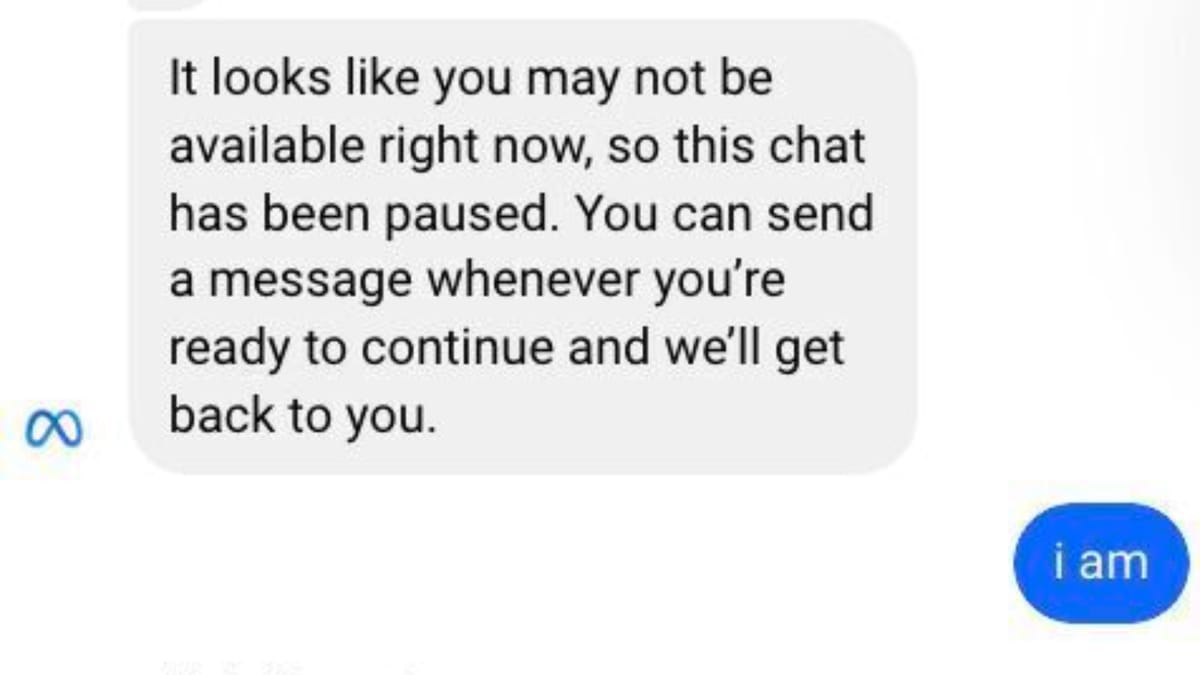
An advertiser's LinkedIn post documenting a frustrating Meta support experience has resonated across the digital marketing community, exposing systematic failures in the platform's customer service infrastructure that leave businesses unable to resolve technical problems. The post, shared by Adriaan Dekker on LinkedIn yesterday, captured a conversation where Meta's automated systems repeatedly promised assistance before abandoning the advertiser mid-conversation.
The exchange began with Meta Support acknowledging the inquiry. "Alright!" the system responded, followed by: "Please allow me 3 to 5 minutes to check the details meanwhile this chat will be paused." The advertiser responded with gratitude. What happened next illustrates a pattern that has become increasingly common across major advertising platforms.
Meta's automated system returned with a different message: "It looks like you may not be available right now, so this chat has been paused. You can send a message whenever you're ready to continue and we'll get back to you." The advertiser immediately responded "i am," demonstrating availability. The system acknowledged this with another message: "Thanks for your message. We're connecting you with an agent who can continue to provide the help you need."
Then silence. The timestamps showed 5:21 PM, followed by 5:54 PM. The advertiser sent two more messages—a question mark, then "Hello?"—before the system added a final notation: "Sent 34m ago." No human agent ever materialized. Dekker's post received 549 reactions and 70 comments within hours, indicating widespread recognition of the problem among advertising professionals.
The conversation ended with what appears to be automated courtesy text, though it's unclear if this was part of the original exchange or added by Dekker for ironic effect. The support system expressed gratitude in flowery language: "It was really nice talking to you. Before we end this chat, I wanted to show my gratitude. Can't thank you enough for being so patient and your understanding with this matter. You have been really very kind and tender throughout. I am grateful to you."
The contradiction between this effusive praise and the complete absence of actual support underscores the disconnect between Meta's automated systems and advertiser needs. Multiple commenters on the LinkedIn post shared similar experiences, with some noting they had faced identical patterns when attempting to resolve account issues, payment problems, or technical difficulties with Meta's advertising platform.
This incident adds to growing evidence that Meta's customer support infrastructure has deteriorated significantly. Nicole Pruess, a freelance presenter and educator for U of Digital with more than 26 years of experience in advertising technology, previously noted that Meta's lack of accessible customer support infrastructure for advertisers wrongly flagged as fraudulent creates additional complications. Pruess mentioned knowing "a number of people who have their legitimate Facebook accounts closed and banned and locked down because they were mistakenly flagged as fraudulent and then they can't even get them back because there's no infrastructure in place."
The support deterioration occurs as Meta continues expanding its advertising automation. The platform's Advantage+ suite now handles targeting, creative optimization, placements, and budget allocation with minimal human oversight, creating situations where advertisers face algorithmic decisions they cannot easily contest or understand. When these automated systems malfunction or produce unexpected results, the absence of responsive human support leaves advertisers without recourse.
Meta's approach contrasts sharply with competitors who maintain different support structures. Google maintains chat, email, and phone support for advertisers, though quality varies by account size and spending levels. Microsoft Advertising provides support through multiple channels. TikTok offers dedicated account managers for significant spenders. Meta's automation-first approach extends not just to advertising delivery but apparently to customer service as well.
The financial stakes are substantial. Meta generated approximately $200 billion in advertising revenue during 2024. Advertisers managing campaigns worth thousands or millions of dollars monthly encounter technical issues, policy questions, account access problems, and billing discrepancies that require human intervention. When support systems fail to connect advertisers with knowledgeable representatives, these issues can persist for days or weeks, directly impacting campaign performance and business operations.
Several patterns emerge from advertiser accounts of Meta support interactions. First, the initial automated response typically appears quickly, creating an impression of responsiveness. Second, the system frequently pauses conversations ostensibly to "check details" or "connect with an agent." Third, these pauses often result in disconnection rather than connection, with the system blaming the user for unavailability despite evidence of active participation. Fourth, when human agents do eventually respond, they often lack authority or technical knowledge to resolve complex issues.
The LinkedIn post generated discussion about comparative support quality across advertising platforms. One commenter noted: "Google ad support is best (Chat, Email, Call), all perfect. But META support is useless seriously." Another wrote: "Running one of the biggest ad platform with that sort of chat support is not acceptable." The sentiment reflects broader frustration among marketing professionals who view responsive support as a fundamental service expectation, particularly when committing substantial advertising budgets.
Some commenters reported positive experiences with Meta's premium support tier. "Meta Premium support is some of the best in the business," one wrote. "Sadly, basic level support is absolute GARBAGE." This suggests Meta operates a two-tier support structure where advertisers meeting certain spending thresholds receive preferential treatment, while smaller advertisers encounter the automated systems documented in Dekker's post. Meta has not publicly disclosed the criteria for accessing premium support or the spending levels required.
Buy ads on PPC Land. PPC Land has standard and native ad formats via major DSPs and ad platforms like Google Ads. Via an auction CPM, you can reach industry professionals.
The support infrastructure problems coincide with broader scrutiny of Meta's advertising practices. Internal documents revealed in November 2025 showed Meta's platforms expose users to an estimated 15 billion "higher risk" scam advertisements daily, with the company internally projecting approximately 10% of 2024 annual revenue from advertisements promoting scams and banned goods. When legitimate advertisers encounter support failures, it creates an environment where platform resources appear allocated toward revenue generation rather than advertiser assistance.
Account suspension and policy enforcement represent particularly problematic areas when combined with inadequate support. Advertisers whose accounts are suspended for suspected policy violations—sometimes erroneously—find themselves unable to reach human representatives who can review their cases. The automated systems provide generic explanations and appeal processes that often loop back to the same automated determinations. For businesses dependent on Meta advertising for customer acquisition, these suspensions can be existential threats.
The support quality issues affect advertisers across spending levels and business sizes. Small businesses running modest campaigns encounter the same automated barriers as mid-market companies and agencies managing multiple clients. Enterprise advertisers with dedicated account representatives report better experiences, but these relationships are limited to the largest spenders. The vast majority of Meta's advertiser base operates without access to responsive human support.
Platform complexity exacerbates the support problem. Meta's advertising interface spans Facebook, Instagram, Messenger, Audience Network, and Threads. The system includes numerous campaign types, objective options, placement combinations, and optimization features. When issues arise—whether technical glitches, unexpected charges, policy clarifications, or performance anomalies—advertisers reasonably expect access to knowledgeable support representatives who can investigate and resolve problems. The automated systems cannot provide this level of assistance.
Third-party agencies and consultants have emerged as informal support infrastructure. Advertising professionals share knowledge through community forums, LinkedIn groups, Reddit threads, and industry conferences. When Meta's official support fails, advertisers turn to peers who have encountered similar issues. This crowdsourced troubleshooting fills the gap left by inadequate official support but places burden on advertisers to solve problems Meta's systems created.
The conversation Dekker documented represents a specific failure pattern: promise of assistance followed by abandonment. This differs from support systems that honestly acknowledge wait times or clearly state when human assistance is unavailable. By creating the expectation of imminent help—"We're connecting you with an agent"—then failing to deliver, Meta's automated systems generate frustration beyond what straightforward acknowledgment of limitations would produce.
Meta's support infrastructure decisions reflect broader strategic choices about resource allocation. The company invests heavily in advertising technology, algorithm development, and platform expansion. Customer support apparently receives lower priority. This approach works when automated systems function perfectly and advertisers encounter no problems. It fails when real-world complexity produces situations requiring human judgment, investigation, and problem-solving.
The documented support failures carry implications beyond individual frustration. They erode trust in Meta as an advertising partner. When businesses cannot obtain assistance resolving problems, they naturally question whether to maintain or increase their Meta advertising investment. Competitors offering superior support—even if their advertising platforms deliver somewhat lower performance—become attractive alternatives. For Meta, excellent support could be a competitive advantage; poor support represents a strategic vulnerability.
Some observers argue that Meta's market position allows it to maintain inadequate support without consequence. With over 3 billion monthly active users across Facebook, Instagram, and WhatsApp, the platform offers reach that advertisers cannot easily replicate elsewhere. This logic suggests advertisers will tolerate poor support because they need access to Meta's audience. However, this calculation assumes no viable alternatives emerge and that advertiser tolerance for frustration is unlimited—neither assumption is certain.
The support quality problem intersects with concerns about Meta's AI advertising automation. As the platform removes manual controls and pushes advertisers toward fully automated campaigns, the need for responsive support actually increases. When algorithms make decisions humans don't understand, and those decisions produce unexpected results, advertisers need support representatives who can investigate, explain, and if necessary intervene. Automated support cannot fulfill this function.
Several commenters on Dekker's post noted the irony of Meta, a company positioning itself as a leader in artificial intelligence, deploying automated support systems that fail at basic tasks. The conversation demonstrated limitations that any competent AI system should handle: maintaining context across a single conversation, recognizing user availability through explicit messages, and escalating to human agents when automated responses prove insufficient. The failure of these basic functions raises questions about Meta's AI capabilities more broadly.
For marketing professionals, the support infrastructure problems create operational challenges. Campaign managers who encounter issues must allocate additional time for repeated support attempts, workarounds, and community-based troubleshooting. This overhead increases the effective cost of Meta advertising beyond the stated platform fees and media spend. Agencies factor these support friction costs into their pricing and platform recommendations.
The broader pattern extends beyond Meta. Shopify merchants reported similar escalating AI support issues in September 2025, with a detailed account documenting a 20-attempt effort to reach human support through multiple AI interfaces that repeatedly redirected users back to automated systems. The Shopify incident involved a straightforward technical issue requiring an Authorize.net payment gateway update. Like Meta's support failures, the problem stemmed not from particularly complex technical challenges but from automated systems preventing access to human assistance.
These parallel failures across major technology platforms suggest a broader trend. Companies deploy AI-powered support systems promising efficiency and scalability. When these systems work as intended, they handle routine inquiries quickly. When they fail—whether through technical limitations, poor training, or inadequate escalation protocols—they trap users in loops that prevent problem resolution. The cost savings from automation accrue to the platforms; the frustration costs transfer to users.
Meta has not publicly addressed the specific support failure Dekker documented or the broader pattern of support complaints across the advertising community. The company did not respond to requests for comment about its support infrastructure or planned improvements. This silence compounds advertiser frustration, as businesses cannot determine whether Meta recognizes the problem or intends to address it.
The advertising industry has seen support quality vary significantly over time. Google Ads support quality deteriorated during periods of rapid growth, then improved following advertiser complaints and competitive pressure. Facebook support in the platform's early advertising years was notably responsive, with advertisers praising accessibility and helpfulness. The current state represents a decline from that earlier standard.
For Dekker and the 549 people who reacted to his post, the support failure represents more than individual inconvenience. It symbolizes a relationship imbalance between platforms and advertisers. Meta controls access to billions of users; advertisers need that access; and the platform apparently feels no compulsion to provide responsive support in return for the billions in revenue advertisers generate. This dynamic persists until either competitive alternatives emerge, regulatory requirements mandate support standards, or advertiser tolerance reaches breaking points.
The post's viral spread—reaching hundreds of thousands of advertising professionals through LinkedIn—indicates the support problem resonates broadly. Dekker's documentation struck a nerve precisely because it represents a common experience rather than an isolated incident. The conversation he captured crystallized widespread frustration that typically remains diffused across individual complaints and private conversations.
Meta's automated support systems will likely continue evolving. The company invests heavily in AI development and may eventually deploy more capable support automation. However, the fundamental question remains whether automation should handle all support interactions or whether certain situations require human judgment and intervention. The conversation Dekker documented suggests current systems cannot adequately substitute for human support in even straightforward scenarios.
For advertising professionals navigating Meta's platforms, the support infrastructure reality shapes operational decisions. Experienced practitioners build redundancy into campaigns, maintaining careful documentation of settings and performance, developing workarounds for common issues, and establishing community networks for troubleshooting. These defensive measures consume resources that could otherwise focus on optimization and growth.
The broader implications extend to platform power dynamics. When a platform commands sufficient market share, support quality becomes less critical to maintaining advertiser relationships. Advertisers tolerate poor support because alternatives offer less reach or inferior targeting. This suggests market concentration, rather than technology limitations, drives support infrastructure decisions. Platforms invest in support quality only when competitive pressure or business necessity demands it.
Subscribe PPC Land newsletter ✉️ for similar stories like this one
Subscribe PPC Land newsletter ✉️ for similar stories like this one
Who: Adriaan Dekker, an advertiser documented his interaction with Meta's automated support system on LinkedIn. His post resonated with hundreds of advertising professionals who shared similar frustrating experiences attempting to reach human assistance from Meta's customer service infrastructure.
What: A Meta support conversation that promised human assistance multiple times but ultimately abandoned the advertiser without resolution. The automated system acknowledged the inquiry, paused to "check details," claimed the advertiser was unavailable despite active participation, promised to connect with a human agent, then went silent for extended periods before the conversation ended without any actual support provided.
When: The LinkedIn post was shared yesterday, documenting a support conversation that occurred the same day. The timestamps showed the conversation beginning at 5:21 PM, with the advertiser's final unanswered messages sent at 5:54 PM and marked "Sent 34m ago," indicating at least 30 additional minutes passed without response.
Where: The incident occurred within Meta's advertising support system, which serves businesses across Facebook, Instagram, Messenger, Audience Network, and Threads platforms. The documentation spread through LinkedIn, reaching hundreds of thousands of advertising professionals globally and generating 549 reactions and 70 comments from the digital marketing community.
Why: The support infrastructure failure reflects Meta's strategic prioritization of automation over human customer service, creating systematic barriers to assistance that leave advertisers unable to resolve technical problems. This approach works when automated systems function perfectly but fails when real-world complexity requires human judgment, investigation, and problem-solving that current AI systems cannot provide.