
Most TV viewers distrust AI search results, Gracenote study finds
Gracenote's 2026 study of 4,003 U.S. users finds AI chatbots gaining ground fast in TV content discovery, but 75% of all users still verify chatbot results.

Gracenote's 2026 study of 4,003 U.S. users finds AI chatbots gaining ground fast in TV content discovery, but 75% of all users still verify chatbot results.
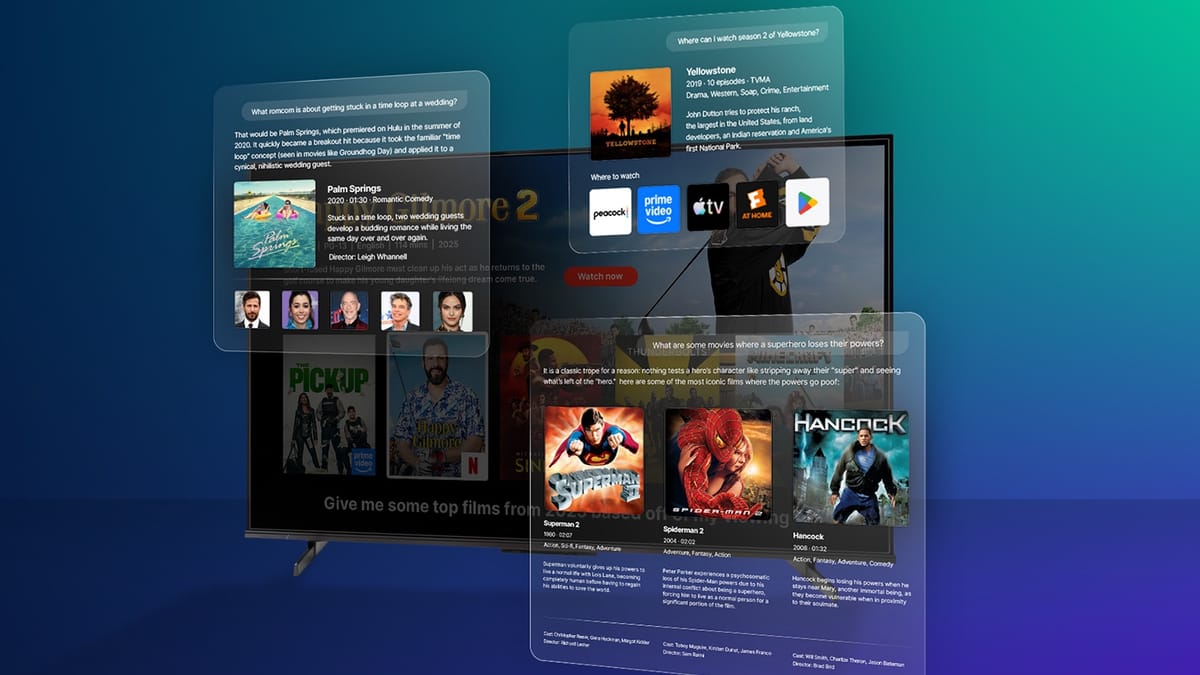
Three in four Americans verify what AI chatbots tell them about TV shows, movies and sports - even as the same chatbots become the fastest-growing tool for finding content to watch. That is the central tension running through a new report published on April 8, 2026 by Gracenote, the content data unit of Nielsen, titled "TV Search and Discovery in the AI Era."
The study draws on two surveys. The primary one, the Gracenote 2026 generative AI usage study, covered more than 4,000 internet and AI chatbot users in the U.S. between the ages of 13 and 79. Fieldwork ran from January 23 to February 4, 2026. A second dataset, the Gracenote 2025 streaming consumer survey, polled 3,000 streaming TV consumers across Brazil, France, Germany, Mexico, the U.S. and the U.K. between July 28 and August 1, 2025. The findings, taken together, sketch a content landscape where audiences are moving toward AI-powered discovery faster than the industry has managed to make AI reliable enough to satisfy them.
The divide between generations is stark. According to the Gracenote 2026 generative AI usage study, 80% of Gen Alpha respondents - those born between 2010 and 2024, represented here by 13- and 14-year-olds - say their use of AI chatbots has increased over the past 18 months. More than half say they use them every day. Across all age groups, 66% reported increased usage over the same period, and 75% say they use chatbots daily or multiple times each week.
For context, the Pew Research Center found in the fall of 2025 that a majority of U.S. teenagers were already using AI chatbots, with 30% doing so daily. In the months since, the Gracenote data suggests usage frequency accelerated sharply, particularly among the youngest cohort.
Generational preference for AI over traditional search also follows a clear gradient. According to the Gracenote 2026 generative AI usage study, 46% of Gen Alpha prefer AI for its familiarity - only 34% prefer traditional search. Among Boomers, those numbers flip: 57% prefer traditional search and just 18% prefer AI. The overall average sits at 53% for traditional search and 26% for AI, suggesting that AI is still the minority choice in aggregate but dominant among the youngest users the industry most needs to retain.
The backdrop matters here. According to the report, connected TV (CTV) accounted for 54% of U.S. TV usage as of late 2025, measured in Q4 by Nielsen NPOWER and Nielsen Media Impact. Among people aged 18 to 34, CTV accounts for 80% of TV time. The shift from linear to connected viewing has been rapid and, for content providers, complicated.
As of February 2026, Gracenote's own database recorded more than 1.8 million program titles across nearly 350 subscription video on demand (SVOD) catalogs, along with almost 210,000 program titles across nearly 2,100 individual free ad-supported streaming television (FAST) channels. Those totals sit on top of traditional TV channels with their own extensions across virtual multichannel video programming distributor (vMVPD) services. PPC Land has been tracking the infrastructure behind this metadata layer, including Gracenote's September 2025 launch of a Video Model Context Protocol Server designed to connect large language models to verified entertainment data in real time, and the Samsung and Google deals announced in February 2026 that made Gracenote's metadata the foundation for LLM-driven search on two of the world's largest consumer platforms.
The scale of that catalog creates a genuine navigation problem. According to the 2025 Gracenote streaming consumer survey, 51% of Americans say it is getting too hard to find the content they want to watch because too many services are available. A separate figure from the same survey: 26% of Americans say they know what they want to watch and still cannot find it. The average viewer spends 14 minutes searching for something to watch. Among people aged 18 to 34, that rises to 16 minutes - time that competes directly with actual viewing.
The stakes are financial as well as experiential. According to the report, 54% of people aged 18 to 34 say they would cancel a streaming subscription if they cannot find something to watch, four points higher than the same sentiment among those aged 34 to 54. Half of all U.S. TV viewers say they would consider cancelling a service that does not provide content that interests them, according to the 2025 Gracenote streaming consumer survey. Deloitte's 2025 Digital Media Trends report, cited in the Gracenote paper, found that 41% of streaming subscribers say their services are not worth what they pay. Monthly churn rates reached 5.5% last year, according to Broadband TV News, up from 2% just five years earlier.
Large language models are probability algorithms: they do not retrieve stored facts so much as synthesize plausible responses from patterns in training data. The Gracenote report describes this as making them "prone to hallucinations" - responses that look correct but are not. To function reliably, LLMs must be "grounded," meaning connected to verified, real-world data sources that sit outside their training corpus.
Even with grounding, accuracy is not guaranteed. The report cites a study by researchers at the University of Southern California finding that up to 38% of common-sense "factual" data used in two separate AI databases was biased, meaning more than one-third of foundational training data in those systems reflected an inaccurate view of real-world facts before any query was run.
A separate 2025 Veed Analytics study of four major chatbots - ChatGPT, Claude, Gemini and Perplexity - tested their ability to identify where to find a specific TV program. Only two-thirds of results were correct. More telling: only 31% of the chatbots provided a deep link to the title. For anyone trying to get from a chatbot answer to an actual viewing decision, that is a significant gap.
The Gracenote 2026 generative AI usage study quantifies the trust deficit. Three in four respondents - 75% - say they verify the results AI chatbots produce because they worry the results are incorrect. Fact-checking rates vary only slightly by age. Among Gen Alpha, 74% verify chatbot results; among Gen Z, it is 78%; among Millennials, 78%; among Gen X, 70%; and among Boomers, 58%. The most common verification method, somewhat paradoxically, is running a traditional internet search to cross-check what the chatbot said.
Across age groups, 77% of Americans say they have concerns about AI results. The most common concern is the currency of information - whether results reflect what is actually available to watch right now - followed by plausibility. For entertainment, these concerns are acute: streaming availability windows change, sports schedules shift, and catalog composition varies by region and by month.
Despite the trust deficit, audiences are already using AI chatbots for entertainment-specific searches. According to the Gracenote 2026 generative AI usage study, 65% of Gen Alpha uses AI to find information about sports. Among the same group, 68% use it to find out where to watch a specific program or game, and 70% use AI for general content recommendations. Comparable figures among Boomers are 21%, 33% and 33% respectively - lower, but not negligible.
On accuracy perception, traditional search still holds an advantage. Overall, 92% of respondents rated internet search accuracy for entertainment queries as good or excellent. For AI chatbots, that figure was 85%. The gap narrows sharply among the youngest respondents: 99% of Gen Alpha rate traditional search accuracy favourably, while 95% say the same of AI. The near-parity in that cohort is notable; it suggests the trust gap is in part a familiarity effect that may narrow as younger audiences age and AI tools improve.
Audiences are clearer about what chatbots are better at. According to the Gracenote 2026 generative AI usage study, respondents prefer AI over traditional search for complex questions (68% vs. 19%), follow-up questions (69% vs. 18%), direct answers (54% vs. 31%) and comprehensive results (50% vs. 30%). Traditional search retains leadership on trustworthiness (50% vs. 27%) and accuracy (46% vs. 33%). The pattern is consistent: AI wins on capability, traditional search wins on confidence.
"People are rapidly embracing AI as a new way to search, discover and decide what to watch, especially Gen Alpha audiences, who already expect easy-to-use, conversational interfaces," said Tyler Bell, SVP of Product at Gracenote, in the April 8 announcement. "But adoption alone is not the story: trust is. The winning platforms will be those that can deliver viewing experiences people can actually rely on - grounded in vetted, timely and high-quality data."
The entertainment industry presents particular challenges for AI grounding. Unlike general knowledge, entertainment availability is both highly fragmented and constantly changing. A program may be on one platform in one country and unavailable in another; a sports game may move between broadcasters; a series may be removed from a catalog without notice.
According to the Gracenote report, PwC's most recent entertainment and media outlook projects that consumer spending on over-the-top services and pay TV will reach $318.5 billion in 2029, with OTT spending set to eclipse pay TV by 2027. That commercial scale makes the accuracy of AI-powered discovery commercially significant, not merely a user experience concern.
The five streaming services tracked in the Gracenote Data Hub grew their catalogs a collective 20% over the past year, according to the report. Meanwhile, library content - existing titles rather than new originals - is a major driver of overall viewing time. In 2025, according to Nielsen Streaming Content Ratings cited in the report, the top 10 most-watched TV shows distributed by streamers after their original broadcast run drove 81% more viewing minutes than original streaming programs. Bluey, Grey's Anatomy, NCIS and Spongebob Squarepants led the licensed list. Stranger Things led originals with 40 billion viewing minutes. Finding library content is precisely where AI could help - and precisely where current chatbot accuracy remains weakest.
Gracenote's December 2025 launch of Content Connect, which opened program-level metadata to agencies, brands, supply-side platforms and demand-side platforms, extended the same data infrastructure into advertising. The company's September 2025 MCP Server addresses the LLM hallucination problem directly, connecting any large language model to verified entertainment data covering 40 million titles across 260 streaming catalogs in real time. The Gracenote report argues that connecting an LLM to industry-validated data via the Model Context Protocol is what keeps a knowledge base from going stale - a persistent weakness of models trained on fixed datasets with cutoff dates.
For advertisers and media buyers, the Gracenote findings add a layer of complexity to CTV investment decisions. The same content discovery problem that drives subscriber churn also shapes how audiences encounter advertising. A viewer who cannot find what they want to watch is not watching ads either. Conversely, accurate AI-powered discovery that surfaces library content increases viewing time and, with it, advertising inventory.
The report's finding that Gen Alpha already prefers AI chatbots over streaming service interfaces and program guides for TV recommendations (49% to 41%) points toward a shift in how audiences enter the content consumption funnel. If chatbot recommendations precede platform visits rather than following them, the platform's own recommendation algorithms - and the advertising they surface - become secondary. The entity that controls the chatbot's grounding data controls the first point of contact.
PPC Land's coverage of the Gracenote and Index Exchange integration in September 2025 showed how the same metadata powering content search has been extended into programmatic ad targeting, with brand safety controls and program-level transparency flowing through the same content identifiers. The advertising and discovery layers are, increasingly, the same infrastructure.
Tyler Bell is scheduled to discuss the report's findings and their implications for content discovery at the NAB Show 2026 in Las Vegas from April 20 to 22. He is participating in a Streaming Summit panel titled "Creating Extraordinary UX: The Role of Content Discovery, UIs, LLMs and Personalization." The report itself is available for download from Gracenote.
Who: Gracenote, the content data unit of Nielsen, led by Tyler Bell, SVP of Product. The study covers U.S. consumers aged 13 to 79, with particular focus on Gen Alpha (ages 13-14), Gen Z (15-28), Millennials (29-44), Gen X (45-60) and Boomers (61-79).
What: A report titled "TV Search and Discovery in the AI Era," based on a survey of 4,003 U.S. AI chatbot users conducted in January and February 2026, supplemented by a 2025 streaming consumer survey of 3,000 respondents across six countries. The report examines how AI chatbot adoption is reshaping TV content discovery, and where trust deficits remain.
When: The primary survey ran from January 23 to February 4, 2026. The report was published on April 8, 2026.
Where: The survey covered U.S. consumers. Related findings from the 2025 streaming consumer survey were drawn from Brazil, France, Germany, Mexico, the U.S. and the U.K. The NAB Show presentation is scheduled for April 20-22, 2026 in Las Vegas.
Why: Streaming fragmentation has created a content discovery problem severe enough to drive subscriber churn - 54% of 18- to 34-year-olds say they would cancel a service if they cannot find something to watch. AI chatbots are gaining ground as the preferred discovery tool among younger audiences, but a persistent trust gap - 75% of users verify chatbot results - means the technology's commercial potential depends on improving the accuracy and reliability of the data powering it.