News publishers across Latin America, Asia-Pacific, and Europe are uploading social video content at the times that generate the least audience engagement, according to a global analysis published on March 13, 2026, by Tubular Labs. The findings, drawn from Tubular Intelligence data covering November 2025 through February 2026, document a systematic mismatch between posting schedules and peak viewer attention across platforms and regions - a pattern with direct implications for media brands and the advertisers who buy against their content.
The report covers video length, posting time, trending hashtags, and top-performing stories across APAC, LATAM, EMEA, and North America. Its core message is blunt: audience behavior in News & Politics on social video is measurable, and many publishers are ignoring what the numbers show.
The 12-hour timing gap in LATAM
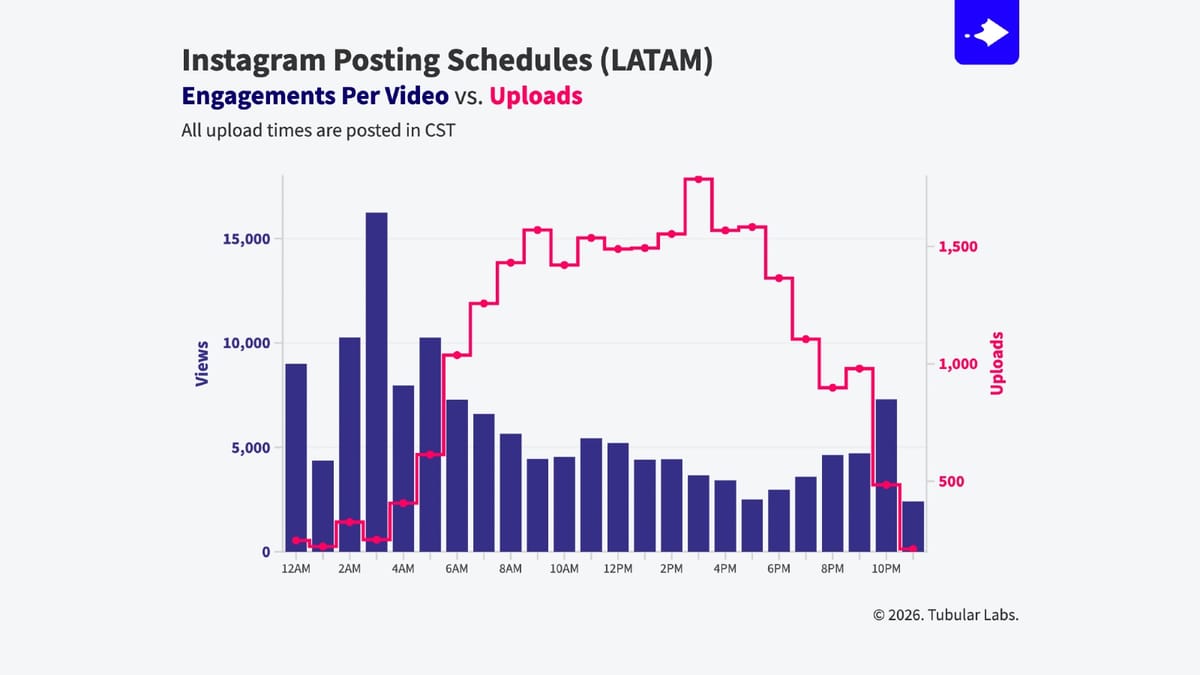
The most striking finding concerns Instagram posting habits among LATAM media publishers. According to Tubular Labs, there is a 12-hour gap between when publishers in the region are posting the most and when their audience is engaging the most.
The data shows that peak upload activity occurs between 3:00 and 3:59 PM CST. Engagement per video, however, peaks between 3:00 and 3:59 AM CST - the same hour, but on the opposite side of the clock. Publishers are flooding the platform at a time when per-video engagement is comparatively low, while the early-morning window sits largely uncontested.
According to the report, this "timing mismatch suggests an opportunity: publishers who shift distribution toward early-morning windows could capture stronger per-video engagement while facing less competition." That logic applies not only to editorial teams making scheduling decisions, but also to brands and agencies whose programmatic campaigns run against publisher inventory - engagement patterns affect the environment in which ads appear.
The LATAM finding arrives at a moment when publishers across all regions are under pressure to extract more value from existing content rather than simply increasing output volume. Search referral traffic to news properties has fallen sharply. As PPC Land has documented, Google Web Search dropped from sending 51% of traffic to news publishers in 2023 to just 27% by the fourth quarter of 2025, while the Discover feed climbed to account for roughly 68% of Google-driven news referrals. Against that backdrop, optimizing social video distribution timing costs nothing and could recover meaningful engagement ground.
APAC: short clips and long explainers, not the middle
The video length analysis for APAC focuses on YouTube and reveals a counterintuitive split. According to Tubular Labs, News & Politics publishers in Asia-Pacific see audiences engage most with either ultra-short updates running zero to 30 seconds, or deep-dive long-form content running 15 to 20 minutes. The segment in between - videos running two to five minutes - dominates upload volume but performs poorly on a per-video engagement basis.
The data covers APAC media publishers uploading to YouTube between November 2025 and February 2026. The pattern suggests that publishers are producing the format that is easiest to make in volume, rather than the formats that readers actually consume. Mid-length videos may represent a reasonable production workflow - they require more effort than a 30-second clip but less than a 20-minute explainer - but the engagement returns do not justify that middle-ground position.
According to Tubular Labs, "the success of quick-hit clips that capture immediate attention and long-form explainers that generate deeper engagement show us that publishers relying heavily on mid-length content may be optimizing for output at the expense of impact." That framing is precise. Output and impact are different metrics. The industry habit of measuring success by upload frequency, rather than engagement per upload, may be reinforcing the wrong behavior.
The APAC finding connects to a broader shift in how advertisers evaluate publisher video environments. Tubular Labs itself has played a direct role in expanding measurement access: in September 2025, the company restored Instagram Reels view counts through a Meta Business Discovery API update, enabling marketers to track platform-verified metrics across more than 27.5 billion data points. More granular measurement makes format-level performance differences visible in ways that blunt volume metrics do not.
The distinction between 0-30 second and 15-20 minute formats also maps onto different advertiser needs. Short-form inventory tends to support awareness objectives; long-form content generates the kind of sustained attention that supports brand recall and consideration. Publishers who concentrate uploads in the 2-5 minute band may actually be producing content that fits neither brief cleanly.
In EMEA, Tubular Labs analyzed the most-viewed News & Politics hashtags on Instagram among media publishers over the same November 2025 to February 2026 window. The results show a blend of global political flashpoints - #trump, #ICE, and #venezuela featured prominently - alongside major broadcaster branding tags such as #bbcnews, and country-specific identifiers that extend international discoverability.
According to the report, publishers are using hashtags for more than categorization. The combination of political figures, geopolitical event tags, branded newsroom identifiers, and country labels serves a layered function: boosting search visibility, reinforcing institutional authority, and helping global audiences locate coverage of events beyond their own borders. The data does not reveal whether this hashtag strategy is deliberate policy or emergent behavior at individual account level, but the pattern is consistent enough across publishers to suggest the former.
The EMEA hashtag picture matters for advertising because it reveals the content context in which ads appear. Programmatic campaigns running against News & Politics inventory in European markets are landing alongside content organized around politically charged tags. That has implications for brand safety strategy and for the contextual targeting signals that platforms and third-party tools use to classify inventory. Advertisers using keyword blocklists that include political terms could inadvertently exclude high-engagement publisher inventory in EMEA. The data from Tubular Labs puts specific shape on what that inventory actually looks like.
North America: 180 million views versus 63.5 million engagements
The North America section of the Tubular Labs analysis focuses on TikTok and draws a clear line between viewership and engagement as distinct success metrics - a distinction that has significant consequences for how publishers and advertisers plan content.
According to the report, the most-viewed piece of News & Politics content from US publishers during the analysis period generated 180 million views in 30 days. That video, posted by Reuters, showed British heavyweight champion Anthony Joshua in the days following his fight with Jake Paul, after a fatal car crash in Nigeria. The story combined two pre-existing points of audience attention - a major boxing event and a tragic incident - into a single news package that the platform's recommendation system amplified at scale.
The most-engaging video in the same period tells a different story. A clip from NowThis Impact generated 63.5 million engagements in just seven days - a shorter window, a smaller view count, but a far higher engagement ratio. The video showed a man at an ICE protest stating that he had bought his first AR-15 in response to ICE activity. According to Tubular Labs, although the post was serious in intent, "many commenters online instead mocked the interview, driving engagement." The comment section, not the editorial content itself, was the engine of performance.
That distinction carries real weight for content teams and their advertising partners. The Reuters clip performed on scale; the NowThis clip performed on reaction. TikTok audiences, according to Tubular Labs, "don't engage with hard news the same way they do on other social platforms." Breaking global stories drive viewership; emotional or cultural reactions - particularly humor - drive engagement spikes. Publishers that treat viewership and engagement as interchangeable may be missing which of their videos actually generate the interaction signals that platform algorithms reward.
For advertisers running campaigns against News & Politics content on TikTok, the implication is that high-view inventory and high-engagement inventory are not the same pool. A brand optimizing for reach may find the Reuters-style breaking news clips more useful. A brand seeking to activate social conversation may find the NowThis-style reactive content more valuable, assuming brand safety parameters allow it.
The Tubular Labs Q1 2026 report arrives during a period of structural adjustment for news publishers and the advertisers who fund them. Publishers are navigating declining search referral traffic, unpredictable algorithmic distribution, and pressure to demonstrate engagement to justify ad rates. Advertisers, for their part, are trying to buy against publisher content that actually reaches people - not just content that exists.
Timing optimization, video length calibration, and hashtag strategy might appear to be editorial concerns rather than advertising ones. But publisher engagement rates directly affect the value of the inventory advertisers purchase. A publisher whose videos generate strong per-video engagement produces a more defensible audience than one uploading at high volume into low-attention windows.
The vertical video format, which platforms including Instagram and TikTok have built their content ecosystems around, has pushed several technology providers to offer publishers tools for distributing and monetizing social-adjacent video on their own properties. In February 2026, JWX launched a product allowing publishers to embed swipeable, social-style video on owned sites using a single line of JavaScript - a direct response to the engagement patterns that social platforms have demonstrated, and a way to recreate those patterns in premium, editorially controlled environments.
The Spotter-Comscore partnership announced in January 2026 brought broadcast-caliber audience measurement to creator content on YouTube, applying television measurement methodologies to digital video for the first time at scale. That infrastructure matters precisely because the kind of format and timing insights Tubular Labs is surfacing need standardized measurement to translate into budget allocation decisions. Advertisers cannot move money toward high-engagement publisher windows unless they can verify what engagement actually looks like across platforms.
Reddit has also moved into publisher distribution. On March 30, 2026, the platform opened its publisher toolkit to any news organization or trade publication with a verified domain, following six months of beta testing that showed median post views up 46% among participating outlets. That development extends the set of distribution channels publishers can use to reach audiences - but it also adds another platform whose engagement patterns differ from Instagram, TikTok, and YouTube.
The Tubular Labs data does not tell publishers which platform to prioritize. It tells them that each platform has its own logic, and that ignoring those mechanics costs engagement that is, in principle, recoverable without additional content production.
The data parameters
The analysis covers media publishers in News & Politics content categories across four geographic regions. APAC data draws on YouTube performance metrics for creator country APAC, covering video duration patterns against uploads and engagements per video between November 11, 2025, and February 8, 2026. LATAM data covers Instagram posting schedules for the same publisher category and time window. EMEA data examines Instagram hashtag performance by engagements. The North America data uses TikTok, covering top videos by views and engagements from US-based media publishers in the same period.
All data comes from Tubular Intelligence, the company's platform tracking social video performance. Tubular Labs describes its database as covering more than 15 billion videos and 45 million creators across YouTube, Instagram, Facebook, Twitch, and other platforms.
Timeline
- November 11, 2025 - Tubular Labs data collection period begins for the Q1 2026 global news insights report, covering APAC, LATAM, EMEA, and North America.
- September 25, 2025 - Tubular Labs restores Instagram Reels view counts through a Meta Business Discovery API update, enabling marketers to access platform-verified metrics across more than 27.5 billion data points.
- December 23, 2025 - NewzDash analysis of over 400 publishers confirms Google Web Search traffic to news publishers fell from 51% to 27% between 2023 and Q4 2025, while Discover climbed to 68%.
- January 6, 2026 - Spotter and Comscore announce TV-style independent measurement for YouTube creator content.
- February 8, 2026 - Tubular Labs data collection period for the Q1 2026 report ends.
- February 19, 2026 - JWX launches Vertical Video, giving publishers a one-line JavaScript tool to deploy swipeable, social-style video on owned properties.
- March 13, 2026 - Tubular Labs publishes its Q1 2026 global news insights report, authored by Jack Neary, covering video length, posting time, hashtag trends, and top-performing stories across four global regions.
- March 30, 2026 - Reddit opens its publisher toolkit to all verified news organizations following a six-month beta that showed median post views up 46%.
Summary
Who: Tubular Labs, a social video intelligence company, published the analysis. The report was authored by Jack Neary and covers media publishers in the News & Politics content category across four global regions: APAC, LATAM, EMEA, and North America.
What: A data report revealing systematic mismatches between publisher posting behavior and audience engagement patterns on Instagram, YouTube, and TikTok. Key findings include a 12-hour posting gap for LATAM Instagram publishers, a bimodal video length preference (0-30 seconds and 15-20 minutes) among APAC YouTube audiences, hashtag-driven discovery patterns in EMEA, and a divergence between viewership and engagement in North American TikTok content - where 180 million views did not outperform 63.5 million engagements as measures of audience activation.
When: The underlying data covers November 11, 2025, through February 8, 2026. The report was published on March 13, 2026.
Where: The analysis covers social video performance across Instagram (LATAM, EMEA), YouTube (APAC), and TikTok (North America). The report was published on the Tubular Labs blog.
Why: News publishers compete for audience attention against algorithmic factors including relevance, timing, and format precision. The report documents that many publishers are misaligned with actual audience behavior - posting at peak competition times rather than peak engagement times, producing mid-length content that neither format extreme rewards, and misreading the distinction between views and engagement. For advertisers, publisher engagement rates directly affect the quality and value of the inventory they purchase.
Share this article
The link has been copied!