Nextdoor's AI click optimisation cut cost per click by 75% in UK beta
Nextdoor launches AI-powered click optimisation for UK advertisers, cutting cost per click by 75% and quadrupling clicks for the same budget in beta tests.


Nextdoor launches AI-powered click optimisation for UK advertisers, cutting cost per click by 75% and quadrupling clicks for the same budget in beta tests.
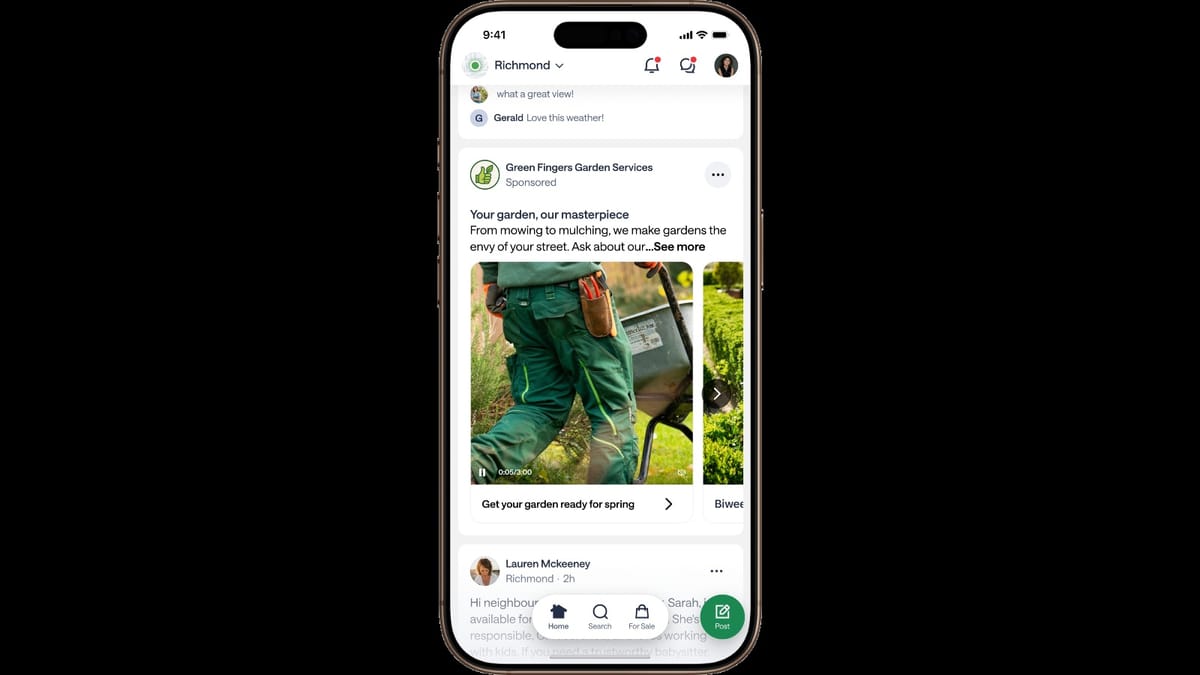
Nextdoor today launched AI-powered click optimisation for UK advertisers, a machine learning feature built into its proprietary Nextdoor Ads Manager that delivered a median 75% reduction in cost per click and a median 75% improvement in click-through rate during beta testing. The announcement, dated March 10, 2026, marks the most significant expansion of the platform's self-serve advertising capabilities since the Nextdoor Ads Manager first rolled out in the UK during Q3 2025.
The numbers are stark. Advertisers in the beta programme recorded a median CTR increase of over 75% compared to cost per thousand (CPM) bidding - close to doubling their previous engagement levels, according to the company. The cost-per-click reduction of 75% means, in practical terms, that the same media budget now generates four times the number of clicks. For a UK market where digital advertising competition continues to intensify, that kind of efficiency gain is not trivial.
Click optimisation works within Nextdoor's AI-driven Ads Manager infrastructure. Rather than billing advertisers on a CPM basis - charging for every thousand impressions regardless of whether a user acts - the system shifts budget allocation toward placements that machine learning models predict will generate actual clicks. The algorithm continuously analyses signals across Nextdoor's verified user base to identify which neighbourhoods, user segments, and ad placements are most likely to produce engagement, then bids accordingly.
This bidding logic sits at the heart of a broader industry shift that PPC Land has tracked extensively, as platforms move away from impression-based models and toward outcome-oriented automation. The transition is not unique to Nextdoor. Google has been systematically deprecating manual bidding controls in Display & Video 360 since at least April 2025, pushing advertisers toward automated strategies that rely on machine learning rather than human bid adjustments.
What distinguishes Nextdoor's implementation is the contextual layer. The platform's network is built on verified residential addresses. Users are confirmed to their neighbourhood, meaning the data underpinning the optimisation system reflects real household geography rather than inferred location from IP addresses or device signals. According to the company, Nextdoor reaches over 10 million verified neighbours across the UK - equivalent to 1 in 4 UK households. That is the audience pool against which the click optimisation algorithms are trained.
The most concrete evidence of the feature's performance comes from Verisure, a home security company that participated in the beta programme. According to Andrew Miller, AI and Emerging Tech Lead at Verisure, "Verisure prioritises reaching the right audience with precision. With Nextdoor's new click optimisation, we've seen a transformation in our campaign performance. The AI-powered tools have significantly boosted our click-through rates and overall engagement, allowing us to connect with local communities more effectively. This innovation has made significant improvements to our cost per lead and ROI."
Miller's comments highlight two distinct outcomes: improvements in top-of-funnel engagement (click-through rates) and a measurable reduction in cost per lead downstream. The combination matters because CTR gains do not always translate into lead quality improvements - optimising for clicks can, in some systems, attract lower-intent traffic. Verisure's reported improvement in cost per lead suggests the Nextdoor audience targeting is maintaining quality alongside volume.
Home security advertising is notably dependent on local relevance. A burglar alarm campaign works best when it reaches homeowners in specific postcodes, not users browsing from offices or commuting. Nextdoor's neighbourhood-level precision is structurally better suited to this kind of advertiser than platforms where geography is approximated.
Click optimisation does not arrive in isolation. Today's announcement packages it alongside several other new capabilities that collectively reposition Nextdoor's advertising product.
Max impression optimisation is new. Advertisers can now explicitly instruct the platform to maximise the number of impressions delivered within a defined target audience, rather than accepting whatever reach the algorithm determines. This gives brand advertisers - those focused on awareness rather than direct response - a lever that pure click-based optimisation does not provide.
Expanded video formats add flexibility. New options include a 1x1 (square) aspect ratio and a Carousel format. Square video is already a standard format on Instagram and TikTok, and its inclusion in Nextdoor's offering removes a friction point for advertisers who produce social content and want to redistribute it without reformatting. Carousel formats enable sequenced storytelling across multiple frames within a single ad unit, a format that has demonstrated higher engagement on other platforms.
The AI tools pilot is perhaps the most technically ambitious element of today's launch. The pilot makes available a full suite of AI capabilities covering targeting and delivery, as well as copy and image generation. The image generation component is powered by OpenAI's ChatGPT and draws from a library of more than 3 million photos from Pexels - all with commercial-friendly licensing. Copy generation uses the same underlying model. The intent is to allow advertisers, particularly smaller businesses without dedicated creative teams, to build complete ad creative from within the Ads Manager interface without requiring external design or copywriting resources.
OpenAI's entry into advertising infrastructure - both through its own ChatGPT advertising product and through partnerships like this one with Nextdoor - signals how the company is positioning its technology across the commercial stack. Criteo became the first ad tech partner in OpenAI's ChatGPT advertising pilot just over a week ago, on March 2, 2026. Nextdoor's use of ChatGPT for creative generation is a separate arrangement but reflects the same dynamic: OpenAI's models are becoming embedded in the advertising production layer at multiple points simultaneously.
Personalised business and industry insights are also included in the pilot, surfacing campaign setup recommendations based on the advertiser's sector. This kind of contextual guidance - essentially telling a local restaurant what bidding strategy and creative format has worked for similar businesses nearby - is a feature that platforms including Google and Meta have built into their AI-powered campaign advisors over the past year.
Nextdoor's scale in the UK is meaningful but not dominant. Reaching 1 in 4 UK households is significant, yet it is a fraction of the reach available through Meta's family of apps or Google Search. The platform's value proposition rests not on breadth but on the specificity and verifiability of its audience data.
Gareth Walton, Head of EMEA Sales at Nextdoor, framed it directly: "What distinguishes Nextdoor from other social media platforms is our unique focus on verified neighbours and targeted advertising at the neighbourhood level. This precision and local engagement offer a compelling alternative to other platforms, delivering strong performance at scale. Brands can connect directly with household decision-makers, offering precision and efficiency for those aiming to engage locally at scale."
The "household decision-maker" framing is deliberate. Nextdoor's demographic skews toward homeowners and primary household shoppers - a segment that is expensive to reach precisely on broader platforms because it cannot be easily filtered from a general population. For categories including home improvement, insurance, broadband, utilities, and local services, the ability to target verified homeowners by specific postcode represents meaningful incremental value.
For UK marketing professionals, the more significant development may be the self-serve improvements rather than click optimisation itself. The Nextdoor Ads Manager, which launched in the UK only in Q3 2025, is still a relatively new interface. The addition of AI-powered creative generation, impression maximisation, and new video formats in a single update substantially increases what a small or mid-sized advertiser can execute without agency support. Research from PPC Land in January 2026 noted that 54% of marketers planned to increase AI media investment, while 42% struggled with data quality issues preventing broader AI implementation. Platforms that reduce the technical lift required to run AI-optimised campaigns are directly addressing that second barrier.
Nextdoor's move comes at a moment when AI integration across advertising platforms is accelerating rapidly. Amazon unified its DSP and sponsored ads platforms in November 2025. Google has rolled out AI-powered bidding enhancements across Performance Max and AI Max campaigns throughout the past year. Meta reported in Q1 2025 that 30% more advertisers were using its AI creative tools in a single quarter. The advertising technology industry is not asking whether AI should be embedded in campaign management - that question has been settled. The current competition is over which platform can demonstrate the most measurable, verifiable performance gains from that integration.
Nextdoor's beta metrics - 75% CTR improvement, 75% CPC reduction, four times more clicks per pound spent - are the kind of figures that marketing directors present to budget holders. They are also unusually specific. Most platform announcements of new AI features stop short of quantified median outcomes, preferring directional language. Nextdoor has released median figures from beta testing, which invites scrutiny but also provides a concrete performance baseline against which actual campaign results can be compared.
Whether those figures hold at scale, across diverse advertiser categories, and outside the controlled conditions of a beta programme is a separate question. Beta participants are often among the more sophisticated advertisers on a platform, and early-adopter campaigns tend to be more carefully constructed than average. Results in the general release phase will tell a more complete story.
What is clear today is that Nextdoor has meaningfully updated its UK advertising stack, tied it to verified hyperlocal data that competitors cannot easily replicate, and backed the launch with real performance numbers from a recognisable brand participant. For advertisers weighing platform diversification beyond the dominant duopoly of Google and Meta, that combination merits examination.
Who: Nextdoor (NYSE: NXDR), the neighbourhood social network used by 1 in 4 UK households, announced the launch with statements from Gareth Walton, Head of EMEA Sales, and beta participant Andrew Miller of Verisure.
What: The company launched AI-powered click optimisation within its Nextdoor Ads Manager platform, a machine learning feature that delivered a median 75% improvement in click-through rate and a median 75% reduction in cost per click during beta testing - translating to four times more clicks for the same advertising budget. The announcement also included max impression optimisation, expanded video formats (1x1 square and Carousel), and an AI tools pilot covering targeting, delivery, copy generation, and image generation via OpenAI's ChatGPT and Pexels.
When: The launch was announced on March 10, 2026, building on the UK rollout of the Nextdoor Ads Manager in Q3 2025.
Where: The feature is available to UK advertisers through the Nextdoor Ads Manager platform, targeting Nextdoor's UK user base of over 10 million verified neighbours across the country.
Why: Nextdoor's click optimisation shifts advertisers from CPM-based bidding - which charges for impressions regardless of engagement - to an AI-optimised system that allocates budget toward placements most likely to generate actual clicks. The launch positions Nextdoor as a performance advertising platform, not merely a reach vehicle, at a moment when the broader advertising industry is rapidly integrating machine learning into campaign optimisation across all major platforms.