
Programmatic audio shifts to curation, identity, and video in 2026
Triton Digital CRO predicts programmatic audio will prioritize curated supply and brand fit over scale while integrating with omnichannel platforms in 2026.

Triton Digital CRO predicts programmatic audio will prioritize curated supply and brand fit over scale while integrating with omnichannel platforms in 2026.
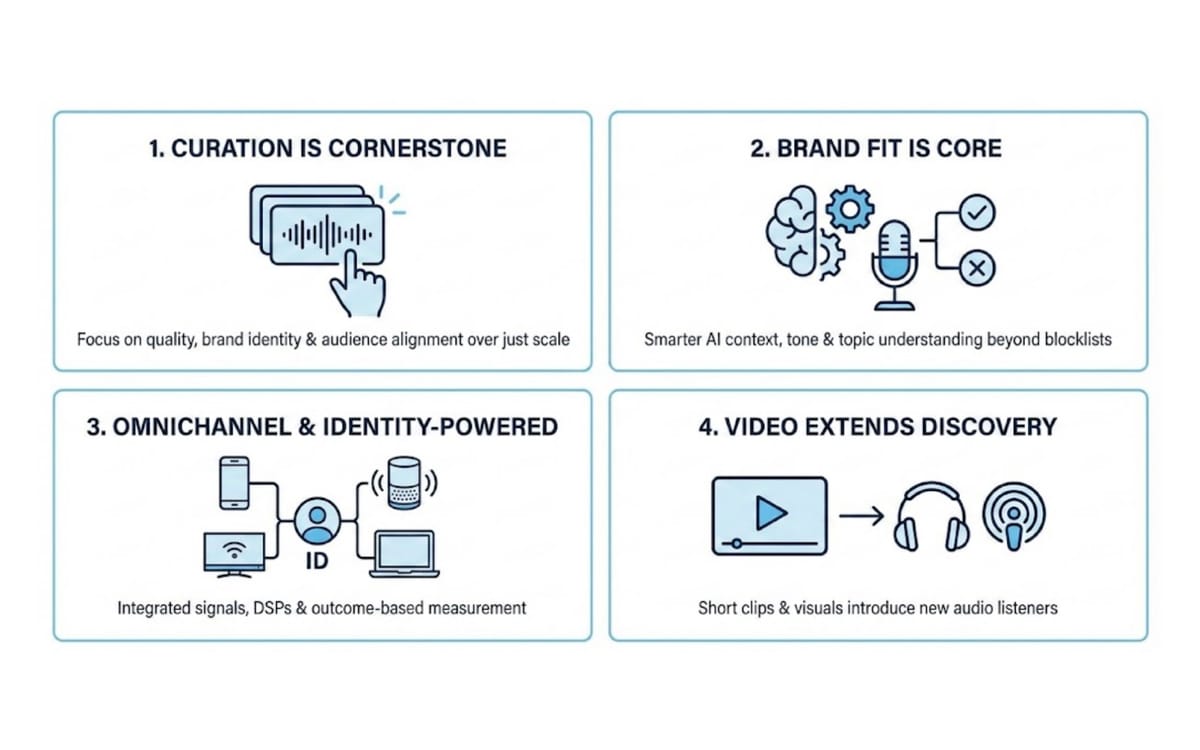
Programmatic audio advertising stands at an inflection point. Sharon Taylor, Chief Revenue Officer at Triton Digital, shared predictions on December 5, 2025, outlining how the digital audio landscape will transform throughout 2026, with fundamental changes to how advertisers buy inventory, measure brand suitability, and integrate audio into broader marketing strategies.
The predictions arrive at a moment when programmatic audio has demonstrated substantial growth but remains underinvested relative to consumer attention. Audio accounts for 31% of consumers' total media time but receives only 9% of advertising budgets, creating a 22% gap that represents untapped potential for marketers. That measurement gap has driven sustained innovation across the programmatic audio ecosystem throughout 2025.
Curation will become the cornerstone of programmatic audio in 2026, according to Taylor. The industry has evolved from content and audience-based automation to intention-based optimization. Scale matters, but quality and alignment matters more. Successful buyers will focus on curated supply that both reflects their brand identity and audience targets. The platforms that make it easier to build curated, brand-fit plans will set the standard for how digital audio gets bought and sold.
Subscribe PPC Land newsletter ✉️ for similar stories like this one
This prediction aligns with broader infrastructure developments across programmatic audio. StackAdapt integrated iHeartMedia broadcast radio inventory into its programmatic platform on November 10, 2025, enabling marketers to plan, forecast, purchase, measure, and report on AM/FM broadcast alongside digital audio, streaming, and podcast inventory within a single platform. That integration eliminated manual workflows and enabled data-driven campaign execution across multiple audio formats simultaneously.
Amazon DSP and SiriusXM Media expanded programmatic audio reach in September 2025, providing marketers access to SiriusXM Media's digital audio portfolio, including Pandora and SoundCloud. The partnership leveraged Amazon's first-party insights paired with clean room technology to bring advertisers and publishers closer together, increasing efficiency and improving performance through sophisticated artificial intelligence that delivers impactful ads to relevant audiences.
Brand fit will become the core matter in 2026, moving beyond blunt keyword blocklists toward smarter contextual understanding. Content relevance will be measured by brand alignment rather than avoidance. AI-driven models interpret tone and topic both at the podcast program and episode level, helping brands match their message with the right environments. This shift will turn suitability into a planning advantage instead of a defensive tactic.
The emphasis on brand suitability rather than simple brand safety reflects a maturation in how advertisers approach content adjacency. Amazon DSP launched brand suitability settings in November 2025, allowing advertiser-level and ad-group level customization of content adjacency preferences through API controls. The feature expanded beyond Twitch to third-party inventory, enabling advertisers to align ad placements with brand values beyond baseline brand safety protections.
Brand suitability represents an evolution beyond basic brand safety protections. While brand safety establishes baseline filters against inappropriate content, brand suitability enables advertisers to align campaigns with specific brand values and campaign objectives. The programmatic advertising industry has increasingly prioritized contextual relevance as third-party cookie deprecation accelerates.
Contextual targeting represents 60% of all global targeting dimensions on AdsWizz platforms, providing relevant and privacy-first solutions that align with evolving consumer expectations. This approach has become the cornerstone of digital advertising strategies worldwide, particularly as privacy regulations limit third-party data usage.
Triton Digital itself has advanced brand suitability capabilities through technology partnerships. The Washington Post selected Triton Digital on November 13, 2025 to power its podcast advertising and measurement infrastructure. The agreement grants Triton Digital control over The Post's entire podcast technology stack, including the Demos+ targeting system for demographic segmentation that enables advertisers to purchase inventory based on listener characteristics.
Audio will become a fully omnichannel, identity-powered medium by 2026. Audio will no longer modernize in isolation but will be fully integrated into omnichannel, identity-powered platforms. Instead of evolving audio-specific metrics, advertisers will measure audio using the same commerce, behavioral, and cross-device signals that power connected television, retail media, and video. Streaming, podcasts, and even broadcast radio will become identity-infused and programmatically available through enterprise demand-side platforms, enabling true deduplicated reach and unified frequency control.
Audio will inherit advanced measurements such as closed-loop attribution, clean-room verification, and AI-driven optimization rather than building parallel systems. This shift will move audio buying from impressions to outcomes, making it a seamless, data-driven component of broad omnichannel strategies.
The omnichannel integration prediction reflects substantial platform consolidation throughout 2025. DeepIntent launched its HealthFirst Audio Package on September 30, 2025, marking what the company characterized as the first major healthcare DSP to unify connected television and audio under a single suite. The package provided access to premium digital audio inventory from iHeartMedia, SiriusXM Media, and other streaming publishers through the DeepIntent demand-side platform.
That unification enables precision targeting of patients and healthcare providers during what the company described as high-attention, screen-free moments. More than 69% of healthcare providers can be reached through the premium inventory included in the package, according to DeepIntent's internal analysis.
The technical infrastructure supporting omnichannel integration has advanced significantly. iHeartMedia and Magnite launched an omnichannel audio advertising marketplace in January 2024, bringing together broadcast radio, streaming radio, and podcast assets for inclusion in omnichannel programmatic media buys. The partnership provided advertisers with a direct path to iHeartMedia's vast audio inventory, including over 860 live local broadcast stations, the iHeartRadio digital service, and podcast offerings.
Identity resolution capabilities enable the deduplicated reach and unified frequency control that Taylor identified as critical for 2026. These capabilities allow advertisers to recognize individual consumers across multiple devices and platforms, preventing wasteful duplicate ad exposure while maintaining campaign frequency across audio formats.
Buy ads on PPC Land. PPC Land has standard and native ad formats via major DSPs and ad platforms like Google Ads. Via an auction CPM, you can reach industry professionals.
Video will extend discovery across the audio landscape in 2026. Video will become a major discovery channel for audio, with short clips, livestreams, and companion visuals introducing new listeners to shows and creators. As this shift accelerates, the podcast industry will grapple with how to manage content that is increasingly consumed in modular, out-of-context formats.
Brands will use high-impact video moments to build awareness, while audio deepens engagement and maintains the ongoing relationship. Rather than fully merging or directly competing, the two formats will create parallel paths for advertisers to connect with audiences across different modes of attention.
The video podcast phenomenon has generated substantial momentum throughout 2025. Audioboom reported record Q3 revenue with 18% growth on October 16, 2025, with video expansion driving growth as over 13% of business came from video revenue. The company hosted 12 of the top 100 video podcasts in the United States and ranked number one on Podscribe's video chart.
Video consumption patterns reflect significant changes in how audiences engage with podcast content. Research published in August 2025 revealed that Edison Research began incorporating data from individuals whose sole podcast consumption occurred through video platforms. This measurement shift affected shows with substantial video components and highlighted the growing importance of multi-format distribution strategies.
The technical infrastructure supporting video podcast advertising has advanced considerably. Audioboom's platform includes Dynamic Ad Insertion capabilities for video content, enabling automated advertising placement across video podcasts. This technology has become increasingly valuable as programmatic podcast advertising expands across the industry.
Triton Digital's Omny Studio announced support for video podcast creation, distribution, and monetization on December 4, 2025, alongside existing audio content capabilities. The expansion acknowledges that video has become essential infrastructure rather than an experimental format within the podcast ecosystem.
Video podcast monetization has demonstrated strong financial returns. Spotify's video podcast revenue jumped 300% in January 2025 following the launch of the Partner Program, which introduced dual revenue streams combining audience-driven payouts with advertising monetization. The dramatic increase illustrated advertiser willingness to allocate budgets toward video podcast inventory when programmatic access becomes available.
The relationship between video and audio reflects broader consumption patterns. Research from AdRoll and WBR Insights revealed that 78% of marketers view third-party podcasts as significant opportunities, while 37% of organizations plan significant video and connected television spending increases for 2026. Those parallel investment trends suggest video and audio will indeed create complementary paths for reaching audiences.
However, the modular, out-of-context consumption that Taylor identified presents challenges for podcast producers and advertisers. When audiences consume short video clips extracted from longer podcast episodes, the surrounding context that provides meaning and brand safety assurance may be absent. Advertisers must develop new frameworks for evaluating brand suitability when content appears in fragmented, algorithmically distributed formats rather than complete episodes.
The podcast industry has demonstrated strong financial performance that validates continued investment in both audio and video formats. Podcast advertising spending surged 26% year-over-year in the third quarter of 2025, with nearly 1,700 brands testing the channel for the first time. That growth occurred despite the persistent gap between consumer engagement with audio content and advertiser investment.
Triton Digital has positioned itself at the center of these transformations through technology partnerships and product launches. The company launched AdBuilder AI on October 30, 2025, a self-serve audio advertising platform with AI-powered creative generation supporting more than 60 languages for publishers. The white-labeled solution aims to automate the entire workflow from creative production to campaign delivery, addressing small and mid-sized business advertisers that have historically been difficult to serve through traditional sales channels.
The platform includes a creative builder that generates broadcast-quality audio advertisements in seconds from simple text prompts. Advertisers describe their business and call-to-action, and the system produces professional copy, voiceover narration, and audio mastering automatically. Small business marketers have struggled with audio advertising production barriers, often requiring professional voice talent, recording studios, and multi-week production cycles. AdBuilder AI compresses this timeline to seconds for creative generation and under five minutes for complete campaign launch.
Triton Digital also partnered with ekoz.ai to bring voice cloning technology to the Spreaker platform, enabling programmatic delivery of host-read podcast advertisements through AI-powered voice cloning. The integration launched in March 2025 through private marketplace deals, with the official announcement made on July 15, 2025. The solution addresses the traditional choice between programmatic efficiency and host-read effectiveness in podcast advertising, enabling marketers to achieve scale while maintaining the authenticity and higher engagement rates associated with host endorsements.
Industry research shows that 72% of marketers plan to increase programmatic advertising investment in 2025, with audio and podcast advertising growing from 7% to 9% of total programmatic spending. That planned investment increase provides the foundation for the transformations that Taylor outlined in her predictions.
The measurement infrastructure supporting programmatic audio has advanced substantially. Triton Digital launched enhanced podcast ranking data on August 19, 2025, introducing audience intelligence features that enable advertisers to target specific demographic segments and purchase intent behaviors. The methodology combines traditional download measurements with survey data collected in collaboration with Signal Hill Insights, creating what Triton Digital described as a more comprehensive view of podcast audiences.
The enhanced measurement capabilities address a fundamental challenge in audio advertising attribution. Unlike digital display advertising, podcast consumption occurs across multiple platforms and devices, making traditional conversion tracking difficult to implement. The survey-based approach captures listening behavior across all platforms and applications, including consumption that occurs through video platforms.
The programmatic audio infrastructure has attracted substantial publisher adoption. Consumers dedicate 31% of their media time to audio platforms, while advertisers allocate only 9% of their budgets to audio advertising, creating a 22% gap. AM/FM radio continues to hold 64% of all daily ad-supported audio listening, driven largely by local programming that resonates in rural and remote communities.
That sustained audience attention combined with improving measurement capabilities and omnichannel integration creates the conditions for the transformations Taylor predicted. Curation will enable more efficient matching between advertiser objectives and inventory quality. Brand suitability tools powered by artificial intelligence will help advertisers find appropriate environments rather than simply avoiding inappropriate ones. Identity-powered measurement will connect audio exposure to outcomes across channels and devices. Video discovery will introduce new audiences to audio content while creating complementary advertising opportunities.
The technical capabilities required to support these predictions already exist across the programmatic audio ecosystem. Platforms have demonstrated ability to integrate broadcast radio, streaming audio, and podcasts within unified buying interfaces. AI-driven creative generation has reduced production barriers for small business advertisers. Voice cloning technology has enabled programmatic access to host-read advertising inventory. Measurement systems have incorporated survey data to provide demographic insights beyond simple download counts.
The question for 2026 is not whether these capabilities will be available but rather how rapidly they will be adopted across the marketing community. Taylor's predictions suggest that competitive pressure will accelerate adoption as advertisers recognize that audio can deliver omnichannel outcomes when integrated properly into broader marketing strategies.
Subscribe PPC Land newsletter ✉️ for similar stories like this one
Subscribe PPC Land newsletter ✉️ for similar stories like this one
Who: Sharon Taylor, Chief Revenue Officer at Triton Digital, the global technology and services provider to the digital audio, podcast and broadcast radio industries.
What: Taylor shared four predictions for programmatic audio in 2026 covering curation as the cornerstone of programmatic buying, brand fit becoming the core matter beyond keyword blocking, audio integration into omnichannel identity-powered platforms, and video extending discovery across the audio landscape.
When: The predictions were shared on December 5, 2025, addressing trends expected to materialize throughout 2026.
Where: The predictions apply to the global digital audio advertising ecosystem, spanning programmatic audio platforms, demand-side platforms, streaming services, podcast networks, and broadcast radio infrastructure.
Why: The predictions matter because programmatic audio faces a substantial opportunity gap, with audio accounting for 31% of consumer media time but receiving only 9% of advertising budgets. Addressing this gap requires fundamental changes to how advertisers buy audio inventory, measure brand suitability, integrate audio into omnichannel strategies, and leverage video for audience discovery. These transformations will determine whether programmatic audio captures its proportional share of marketing budgets in 2026 and beyond.