Reach last week became the latest major publisher to deploy generative AI technology directly on its websites, selecting DeeperDive from Taboola to provide conversational search capabilities across properties including Express and Daily Star. The UK and Ireland's largest commercial news publisher joins a growing roster of media organizations implementing on-site AI answer engines as traditional search referral traffic continues deteriorating.
The announcement represents Taboola's expansion beyond its initial DeeperDive launch partnerships in June 2025, when Gannett | USA TODAY Network and The Independent first deployed the technology. Since that launch, publishers including India Today Group, BuzzFeed Asia, and The Bangkok Post have implemented the system, attempting to retain readership as AI-powered search engines increasingly provide answers without requiring clicks to source websites.
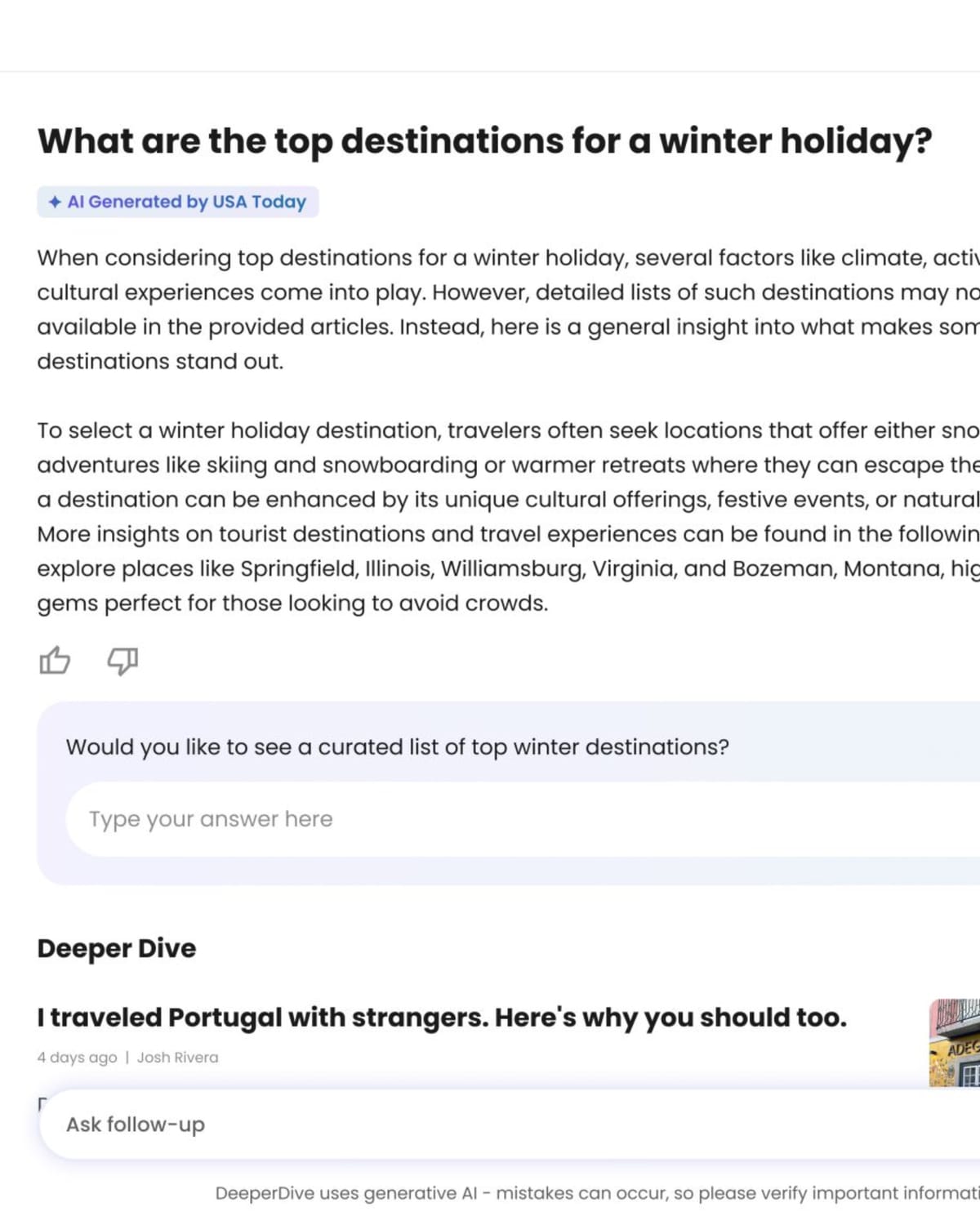
DeeperDive operates by processing natural language queries from readers and generating responses using content exclusively from the publisher's archive. The system taps into Taboola's data from 600 million daily active users across 9,000 publisher partners to identify trending topics and suggest relevant questions. Readers can ask questions about topics they're interested in and receive AI-generated answers instantly, sourced from the publisher's content rather than from multiple external sources.
The technology confines all interactions within the publisher's website rather than redirecting traffic to external platforms. Traditional AI search engines aggregate content from multiple sources and present synthesized answers that reduce the need for users to visit original websites, a dynamic that threatens publisher business models built on advertising or subscription revenue tied to traffic volume.
"This is an important step for us as we focus on how to reach readers where they are, with conversational search becoming increasingly common," said Terry Hornsby, Chief Product & Technology Officer at Reach PLC. "DeeperDive gives us the ability to continue that focus, giving readers the ability to learn more and explore topics they care about. Taboola has been a great partner for us as we continue to harness generative AI and apply to our everyday user journey."
According to Adam Singolda, CEO and Founder of Taboola, "Reach PLC is taking their rich history of delivering quality content and with DeeperDive, offering it to readers in a completely new, appealing and innovative way. Publishers who adopt DeeperDive aren't just keeping up with the GenAI revolution, they're leading it, on their terms. We're creating a new user habit, one where readers lean in, ask follow-up questions, and stay to explore. We're also giving publishers the potential to unlock even more ways to grow."
Technical architecture and revenue mechanisms
DeeperDive processes queries in real-time using advanced language models trained on the publisher's content database. The system draws from years of proprietary content created by journalists and editors, providing answers sourced from trusted editorial teams rather than aggregated web content. Each answer includes links to relevant articles from the same publisher site, maintaining user engagement within the publisher's digital environment.
The technology differs from conventional AI search engines by leveraging Taboola's "pulse of the internet" - real-time insights from over 600 million daily active users actively reading and engaging with content across topics, geographies, and moments. Unlike traditional generative AI engines that rely on static training data, Taboola understands what people are currently engaging with, allowing DeeperDive to surface timely, contextual answers and suggest questions based on current trends.
Revenue generation mechanisms include contextually relevant advertisements integrated within AI-powered results pages. According to Taboola, this creates search-like advertising revenue within publishers' own environments, turning user inquiries into commercial opportunities while maintaining reader experience. Publishers can capture advertising revenue typically associated with search engines, but within their own properties where they control the user experience and data relationships.
DeeperDive also prompts questions that may be of interest to readers, delivers direct responses, and surfaces additional context and stories from the same publisher site. This approach aims to increase time on site and reader loyalty by providing immediate, relevant answers while encouraging deeper content exploration across the publisher's archive.
Publisher traffic challenges drive adoption
Publishers face mounting pressure from AI-powered search features that provide answers directly in results pages. Google's AI Overviews now operate in 200 countries and 40 languages as of May 2025, while research has documentedclick-through rate decreases of 34.5% to 54.6% for websites when AI summaries appear in search results.
The shift affects publisher economics fundamentally. According to IAB Tech Lab framework released in August 2025, AI-driven search summaries reduce publisher traffic by 20-60% on average, with niche sites experiencing losses up to 90%. The organization estimates publishers face $2 billion in annual advertising revenue losses as AI systems provide answers directly without directing users to source websites.
Research from Similarweb cited by IAB Europe showed that referrals from AI platforms increased 357% year-over-year in June 2025, reaching 1.13 billion visits compared to 191 billion visits from organic Google search. However, these traffic increases don't translate uniformly to revenue, as AI platforms often scrape publisher content without compensation while reducing the direct traffic that publishers monetize through advertising or subscriptions.
Reach operates more than 120 brands across the UK and Ireland, reaching 70% of the UK online population monthly and 10% of the US population. The company's portfolio includes household names like Mirror, Express, Daily Record and Daily Star, alongside local titles including MyLondon, BelfastLive and the Manchester Evening News, plus growing US brands like the Irish Star. With over 100 million social followers globally, Reach maintains substantial distribution but faces the same traffic pressure affecting all digital publishers.
Competitive landscape and strategic implications
The deployment by Reach occurs as publishers experiment with various strategies to address AI-driven traffic declines. Some major publishers have secured direct compensation agreements with Google for AI-powered article overviews, creating a two-tier system where large publishers receive payments while smaller outlets face traffic declines without similar financial arrangements. Google partnered with The Washington Post, The Guardian, Der Spiegel, and others for AI-generated story previews, though compensation amounts remain undisclosed.
Other publishers have pursued content licensing agreements with AI platforms. IAB Europe released a framework in September 2025 proposing three monetization models: per-query charges for retrieval-augmented generation, revenue-sharing subscriptions where platforms distribute user fees based on engagement metrics, and collective licensing schemes similar to music rights societies. Perplexity distributes 80% of user fees to participating publishers based on engagement, though this model concentrates benefits among publishers with direct platform relationships.
DeeperDive represents an alternative approach - implementing AI functionality directly on publisher sites rather than negotiating with external platforms. This strategy maintains publisher control over user experience and data relationships while creating new advertising opportunities within AI-powered interfaces. For marketers, these on-site AI implementations potentially alter how consumers discover products and services through editorial content, creating opportunities for contextual advertising within conversational interfaces.
Taboola's broader platform expansion provides context for DeeperDive's development. The company expanded its Realize advertising platform in October 2025 with deepened partnerships including TIME, Weather Channel Digital, and Gannett | USA TODAY Network. Realize reaches approximately 600 million daily active users across publisher partners including NBC News, Yahoo, and original equipment manufacturers such as Samsung and Xiaomi.
The company introduced Predictive Audiences in June 2025, an AI-powered targeting capability that achieved conversion improvements up to 270% for early adopters. Taboola also partnered with LG Ad Solutions in December 2025 to connect connected television exposure with measurable digital outcomes, and launched Performance Multiplier with Paramount Advertising in October 2025 to help small businesses measure and extend connected TV advertising campaigns.
Marketing implications and optimization considerations
The proliferation of on-site AI answer engines creates new considerations for content optimization strategies. Traditional search engine optimization focused on ranking individual web pages based on relevance signals. AI systems instead synthesize information from multiple sources to generate comprehensive responses that directly answer user questions, requiring different approaches for content visibility.
Content creators must now consider how AI systems interpret content structure and meaning when developing optimization strategies. Structured data implementation gains increased importance in AI environments because it helps systems understand context and relationships within content. For DeeperDive specifically, comprehensive, authoritative content that performs well in conversational AI contexts may receive priority, as the system draws from publisher archives to construct answers.
The technology potentially alters search marketing economics. Publishers implementing DeeperDive can capture search-like advertising revenue within their own environments, competing directly with traditional search advertising. Brands maintaining relationships with major publishers may find new opportunities for contextual advertising within AI-powered interfaces, where user inquiries signal high intent for specific product categories or services.
However, optimization for on-site AI answer engines differs from external platform optimization. Publishers control DeeperDive's access to their content and can prioritize specific articles or topics within the system. Marketers should monitor which publishers in their vertical implement these technologies and consider how branded content, sponsored articles, or native advertising might perform within AI-generated responses.
The shift also affects measurement strategies. Traditional metrics like page views and click-through rates may become less relevant as users receive answers without visiting multiple pages. Time on site and engagement depth gain importance as publishers attempt to keep users interacting with AI interfaces rather than leaving after receiving quick answers. Publishers implementing DeeperDive must balance providing comprehensive answers that satisfy user queries against maintaining engagement that drives advertising exposure and subscription conversions.
Industry trajectory and future developments
Taboola indicated potential integration with AI agent technologies for automated commerce transactions, suggesting DeeperDive could evolve beyond information delivery to facilitate direct purchases. This aligns with broader industry trends toward agentic commerce, where AI assistants complete transactions autonomously on behalf of users. Microsoft's advertising playbook published January 6, 2026, addressed Answer Engine Optimization and Generative Engine Optimization as agentic systems reshape discovery patterns.
The deployment by Reach demonstrates that on-site AI answer engines are moving beyond early adopter testing toward mainstream publisher adoption. Publishers face a strategic choice: partner with external AI platforms through licensing agreements and accept reduced control, implement proprietary on-site systems like DeeperDive to maintain user relationships, or pursue hybrid approaches that include both external partnerships and internal capabilities.
Regulatory developments may influence these decisions. The European Commission launched a formal antitrust investigation of Google on December 9, 2025, examining whether the company violated EU competition rules by using publisher content for AI purposes without appropriate compensation. Similar regulatory scrutiny could accelerate publisher adoption of on-site AI technologies as a defensive strategy against external platform dominance.
For marketing professionals, the fragmentation of search behavior across traditional search engines, external AI platforms, and on-site publisher AI systems requires diversified visibility strategies. Brands must maintain presence across multiple discovery pathways rather than relying predominantly on traditional search engine optimization. The effectiveness of each channel depends on user behavior patterns that continue evolving as AI-powered search gains adoption.
The competitive dynamics between on-site publisher AI systems and external AI platforms remain unresolved. Publishers implementing DeeperDive bet that readers will prefer receiving answers from trusted editorial sources within familiar publisher environments rather than from aggregated external platforms. The success of this strategy depends on whether conversational search becomes predominantly a publisher-controlled experience or whether external platforms like ChatGPT, Perplexity, and Google's AI features capture the majority of information-seeking behavior.
Reach's implementation across Express and Daily Star provides a significant test case given the publisher's scale and audience reach. The deployment's impact on reader engagement, time on site, and advertising revenue will influence whether other major publishers accelerate their own AI answer engine implementations or pursue alternative strategies for addressing traffic challenges.
Timeline
- June 11, 2025: Taboola announces DeeperDive with launch partners Gannett | USA TODAY Network and The Independent
- August 20, 2025: IAB Tech Lab launches Content Monetization Protocols working group, estimating $2 billion annual publisher losses from AI search
- September 14, 2025: IAB Europe releases framework for AI publisher compensation proposing per-query charges and revenue-sharing models
- October 15, 2025: Taboola expands Realize platform partnerships with TIME, Weather Channel Digital, Gannett
- October 22, 2025: Taboola partners with Paramount Advertising introducing Performance Multiplier for small businesses
- November 18, 2025: Bangkok Post adopts DeeperDive, becoming first Southeast Asian publisher to deploy the technology
- December 3, 2025: LG Ad Solutions and Taboola announce Performance Enhancer connecting CTV exposure to digital conversions
- December 10, 2025: Google launches AI article summaries with select publishers including The Washington Post and The Guardian
- January 6, 2026: Microsoft publishes AEO and GEO playbook for retailers addressing agentic commerce
- February 5, 2026: Reach selects DeeperDive for Express and Daily Star
Summary
Who: Reach PLC, the UK and Ireland's largest commercial news publisher with over 120 brands including Express and Daily Star, selected DeeperDive from Taboola, a generative AI answer engine developed by the advertising technology company. Terry Hornsby, Chief Product & Technology Officer at Reach, and Adam Singolda, CEO and Founder of Taboola, announced the partnership.
What: DeeperDive is a generative AI answer engine that operates directly on publisher websites, processing natural language queries and generating responses using content exclusively from the publisher's archive. The system leverages data from Taboola's network of 600 million daily active users across 9,000 publisher partners to identify trending topics and suggest relevant questions. Revenue generation occurs through contextually relevant advertisements integrated within AI-powered results pages, creating search-like advertising opportunities within publisher environments. The technology aims to increase readership engagement and unlock new monetization channels while maintaining user interactions within publisher websites rather than redirecting traffic to external platforms.
When: Reach announced the selection of DeeperDive on February 5, 2026, joining other publishers including Gannett | USA TODAY Network, The Independent, India Today Group, BuzzFeed Asia, and The Bangkok Post who have implemented the technology since Taboola's initial launch on June 11, 2025.
Where: Implementation will occur across Reach properties including Express and Daily Star, part of the publisher's portfolio of more than 120 brands that reach 70% of the UK online population monthly, 10% of the US population, and over 100 million social followers globally. The deployment extends DeeperDive's geographic presence beyond initial UK, US, and Southeast Asian implementations.
Why: Publishers face mounting pressure from AI-powered search engines that scrape content and provide answers directly in results pages without directing traffic to source websites. Research shows AI-driven search summaries reduce publisher traffic by 20-60% on average, with IAB Tech Lab estimating $2 billion in annual advertising revenue losses for publishers. DeeperDive addresses these challenges by keeping AI interactions within publisher websites, maintaining user engagement and data relationships while creating new advertising revenue opportunities. The system allows publishers to compete with external AI platforms by providing conversational search capabilities using their own content, attempting to retain readership as traditional search referral traffic deteriorates. Reach's implementation represents a strategic response to fundamental changes in information discovery patterns that threaten publisher business models built on search engine traffic.
Share this article
The link has been copied!