Recipe creators clash with Google over AI plagiarism and photo theft
Recipe publishers report Google's AI features display complete recipes with errors, plagiarized content, and stolen photos without proper attribution.


Recipe publishers report Google's AI features display complete recipes with errors, plagiarized content, and stolen photos without proper attribution.
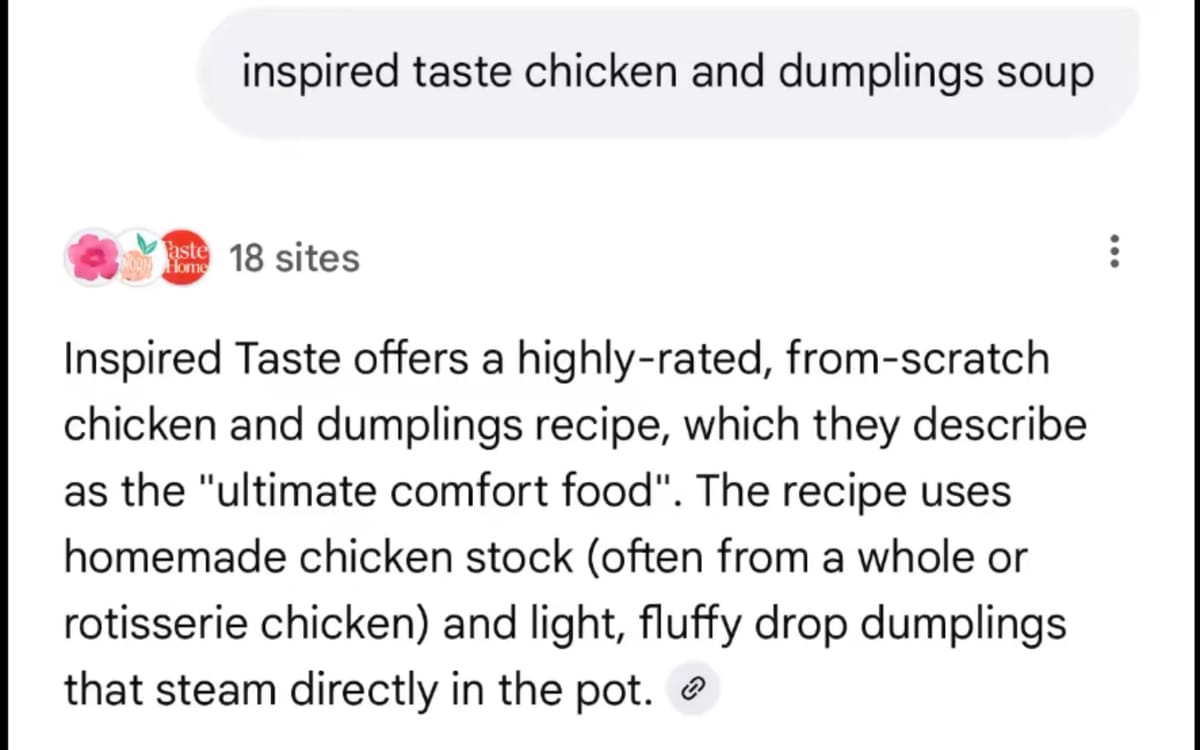
Nick Fox stood at the center of a brewing controversy on December 2, 2025, when Adam Gallagher, co-founder of Inspired Taste, posted a public complaint highlighting what recipe creators characterize as systematic content appropriation by Google's artificial intelligence systems. The LinkedIn exchange between Gallagher and Fox, Senior Vice President of Knowledge & Information at Google, exposed tensions between publishers who spend years building content libraries and the AI features that increasingly display their work without generating website visits.
Gallagher detailed specific problems affecting Inspired Taste and numerous other recipe publishers. "However, we would like to point out that we are still seeing branded searches for us and multiple recipe sites with full plagiarized recipes riddled with errors, using our photos (Gemini Thinking model), our videos, using our brand name, with no citations to our domain recipe page at all, or the citations are incorrect altogether," Gallagher wrote in his December 2 comment.
Subscribe PPC Land newsletter ✉️ for similar stories like this one
The complaint arrived one day after Fox announced expanded features designed to support publishers. Fox posted December 1 about shipping Preferred Sources globally, a feature allowing users to select sites they want to see more frequently in Top Stories. "We've heard really positive feedback on this feature from users and websites since launching it in the U.S. and India and are expanding it globally," Fox wrote. "In fact, we've found when people select a preferred source, they click to that site twice as often."
Gallagher's response identified a fundamental disconnect between Google's announced publisher support initiatives and the daily experiences of content creators. "This is happening to us and other high domain authority sites as well as a wide range of sites," he stated. "This needs to be fixed and we need an official channel to resolve it."
The LinkedIn exchange referenced a Twitter post by Barry Schwartz, a prominent search industry commentator. Schwartz shared Gallagher's original complaint on Twitter December 2, titling it "This is just not right Google :(" The post generated substantial engagement, accumulating 18,900 views and extensive discussion among search marketing professionals.
This is just not right Google :( https://t.co/Iag0rkC4wZ
— Barry Schwartz (@rustybrick) December 2, 2025
Inspired Taste operates as a recipe blog created by Adam Gallagher and Joanne Gallagher. The couple has published recipes for over 15 years, building a content library and brand recognition within the competitive food publishing sector. "We have been working hard on our site and brand for over 15 years," Gallagher wrote in the Twitter thread. "Never in a million years did we ever consider that Google would ever turn on us and the entire web by doing anything like this."
The technical mechanics involve Google's Gemini AI models accessing recipe content, processing photographs, analyzing videos, and displaying results within Google's interface rather than directing users to original publisher websites. Gallagher specifically identified the Gemini Thinking model as responsible for using Inspired Taste's photographs without proper attribution.
Fox announced December 1 that Google was "launching a new feature that highlights links from your news subscriptions so you can get more value from your subscriptions – coming soon to the Gemini App, AI Overviews, and AI Mode." He also noted Google was "increasing the number of inline links in AI Mode responses and adding a short explanation so you get more context on why the links might be helpful to visit."
These features address different problems than those Gallagher identified. Subscription highlighting benefits users who already pay for content access, while inline link increases apply to AI Mode rather than standard search results or branded queries where recipe publishers report issues. The explanation additions provide context about link utility but don't resolve fundamental concerns about AI systems displaying complete recipes without requiring clicks to source websites.
Google announced a new commercial partnership pilot program December 10 with news publishers globally including Der Spiegel, El País, Folha de S. Paulo, Infobae, Kompas, The Guardian, The Times of India, The Washington Examiner, and The Washington Post. The pilot program involves payments to participating publishers, though Google has not disclosed specific compensation amounts. Recipe publishers were not mentioned in the partnership announcement.
Fox also referenced Web Guide upgrades in his December 1 post. "We've upgraded Web Guide, which uses AI to help you discover new angles to explore and organize links on Search into topic groups (especially helpful for complex queries)," he wrote. "We've made Web Guide twice as fast and are expanding it to more search results in the 'All' tab."
The December 1 announcement followed Google's August 12 launch of Preferred Sources in the United States and India. According to Product Manager Duncan Osborn, the feature allows users to "select your favorite sources and stay up to date on the latest content from the sites you follow and subscribe to." Implementation requires users to search for news topics, locate a Cards star icon near Top Stories, and select preferred publications.
Technical specifications indicate Preferred Sources applies specifically to Top Stories sections rather than all search results. "Once you select your sources, they will appear more frequently in Top Stories or in a dedicated 'From your sources' section on the search results page," Osborn wrote in the August 12 announcement. "You'll still see content from other sites, and can manage your selections at any time."
Recipe content falls outside typical Top Stories categorization, which focuses on current news events rather than instructional or reference content. This limitation means Preferred Sources functionality likely provides minimal benefit for recipe publishers facing AI appropriation concerns.
The broader publishing community has reported substantial traffic impacts from Google's AI features. IAC's Dotdash Meredith disclosed during first quarter 2025 earnings that "AI Overviews appear on roughly a third of search results related to DDM's content" with observable performance declines. CEO Neil Vogel stated the company saw "a little performance decline on those pages" during the May 5 earnings call.
Buy ads on PPC Land. PPC Land has standard and native ad formats via major DSPs and ad platforms like Google Ads. Via an auction CPM, you can reach industry professionals.
Research analyzing publisher experiences documents measurable business consequences. Seer Interactive research found organic click-through rates for informational queries featuring AI Overviews dropped 61 percent since mid-2024. Studies examining specific implementations showed AI Overviews reducing organic clicks by 34.5 percent to 54.6 percent when present in search results.
Google launched Quick View testing for recipes October 10, 2024. The feature appears as a button overlaid on recipe images in search results. When clicked, it displays recipe summaries including ingredients, instructions, and sometimes user comments, all within Google's interface rather than directing users to original websites. Google Search Central confirmed the "early-stage experiment" testing with select creators.
Barry Schwartz expressed concerns about Quick View leaving "little reason to click over to your site" when the feature was announced. Content creators worried about long-term implications for businesses dependent on website visits. Questions arose about test agreement terms and whether participating creators received compensation.
Twitter responses to Schwartz's December 2 post reflected widespread frustration among digital publishers. Mike, using the handle Mikeg71729766, commented "Imagine publishing 10k recipes and pictures and Google taking it all word for word and showing it on their page and giving you no views. These creators are right to be pissed." The comment received 127 likes.
Marcus Anthony Cyganiak wrote "Google is killing SEO. It's going to be on site creators and bloggers to establish a true destination on their domains, and to use social media optimization (SMO) in ways they haven't before." His observation received 391 likes.
Webistics scandal commented "SEOs that spent years publicly defending Google are now learning that it's not about them, it's not about empowering site owners/creators, and it's not about the community or their own policies. It's yet another instance of cavalier disregard for the community that helped build." The statement accumulated 781 likes.
Copyright concerns appeared throughout the discussion. Wordmetrics wrote "The US is a clown show. US copyright law is embarassingly lacking. The US has literally zero enforceable copyright protection for nonregistered work. (Statistically 99.9% of works). Yes, Google and OpenAI are violating copyright. No, they don't care, there's no penalty." This comment received 607 likes.
Vechtsport Info questioned "How about copyrights? Google is scraping sites for their info and using the AI excuse for it. This can't be right." The comment received 430 likes. Renee Dobbs compared digital and physical products: "Imagine if Amazon gave away all the products in their warehouses for free. Digital products should be treated the same as physical products."
Shaun Anderson, using the handle Hobo_Web, simply stated "It's sad to see" in response to the original complaint. His comment received 299 likes. David, using the handle DigDocsDirect, asked "Yeah that's wrong. Isn't this guy @sundarpichai in charge?" referencing Google CEO Sundar Pichai.
The technical implementation of Google's AI features involves what Robby Stein, Vice President of Product for Google Search, described as a "query fanout technique" during an October 30, 2025 interview. The system receives questions from users and immediately breaks them into dozens of related queries. "It's literally using Google search as a tool like doing googling under the hood," Stein explained.
For recipe queries, AI systems tap into multiple data sources simultaneously. This approach differs fundamentally from traditional search algorithms that rank individual web pages based on relevance signals. The AI reasoning model executes multiple simultaneous searches across Google's information systems, synthesizing results into comprehensive responses displayed within Google's interface.
Infrastructure supporting these capabilities includes Google's product graph containing 50 billion items and location databases with continuously updated information. The systems process queries typically three times longer than traditional searches, according to John Mueller's November 17, 2025 announcement. AI Mode enables conversational follow-up questions within the same session.
Google executives disclosed during third quarter 2025 earnings calls that AI Mode reached more than 75 million daily active users following global rollout across 40 languages. Chief Executive Officer Sundar Pichai stated October 29 that AI Overviews drive meaningful query growth, with effects becoming "even stronger in Q3 as users continue to learn that Google can answer more of their questions."
The company reported October 29 that consolidated revenue reached $102.3 billion in third quarter 2025, representing 16 percent year-over-year growth. Philipp Schindler, Senior Vice President and Chief Business Officer, confirmed "our investments in new AI experiences, such as AI Overviews and AI Mode, continue to drive growth in overall queries, including commercial queries, creating more opportunities for monetization."
Monetization developments include AI Max in Search, which Schindler described as "already used by hundreds of thousands of advertisers, currently making it the fastest-growing AI-powered Search Ads product" during the analyst call. Google began testing ads in AI Mode during third quarter 2025. "We're testing ads in AI Mode, and we'll continue to test and learn before we expand this any further," Schindler stated.
Liz Reid, VP and head of Google Search, addressed publisher concerns during an October 10, 2025 interview with The Wall Street Journal's Bold Names podcast. Reid emphasized Google's unique stake in web health. "From the Search side, we really care about the health of the web more than anybody else. It is essential not simply for AI overviews, but for the product," she stated.
Reid described several features supporting publishers. Inline links within AI Overviews highlight sources with "according to" attributions. These prominent links build brand awareness while providing click-through opportunities. Recent initiatives include personalization features allowing users to designate trusted sources. "So that we can strengthen the connection between sites and creators and the audiences they like," Reid explained.
The gap between Google's stated publisher support objectives and Gallagher's reported experiences highlights implementation challenges. While Google announces features designed to increase publisher visibility and maintain web ecosystem health, recipe creators report AI systems displaying complete content with errors, using photographs without attribution, and providing incorrect or missing citations.
Gallagher's request for "an official channel to resolve it" identifies a procedural gap. Publishers experiencing content appropriation issues lack clear mechanisms for reporting problems or receiving responses. The LinkedIn comment directed at Fox represents an attempt to escalate concerns to executive leadership after presumed failures of standard support channels.
Fox's December 1 announcement included instructions for publishers to encourage their followers to select preferred sources. "Publishers can encourage their followers and subscribers to select their website as a preferred source on Google by using resources found in this dedicated help center," Fox wrote. The implementation places responsibility on publishers to educate audiences about starring functionality rather than addressing the fundamental concern that AI systems display complete content without requiring clicks.
The controversy arrives as Google faces broader scrutiny about its relationship with content creators and publishers. Judge Leonie Brinkema expressed considerable hesitation during November 21, 2025 closing arguments about ordering Google to divest its advertising exchange following the company's illegal monopolization of digital advertising markets. The case centers on different technology systems than those affecting recipe publishers but reflects broader tensions between Google's market power and content ecosystem participants.
Recipe publishers occupy a particularly vulnerable position within the content ecosystem. Their content follows standardized formats—ingredient lists, preparation instructions, cooking times, serving sizes—that AI systems can readily extract, process, and reproduce. Photographs documenting finished dishes provide visual appeal but create additional appropriation concerns when AI systems use images without proper attribution.
The economics depend on advertising revenue generated by website visits. Publishers invest resources in recipe development, food photography, content writing, and technical infrastructure. Revenue models require users to visit publisher websites where they view advertisements, potentially subscribe to email lists, or purchase related products. AI systems displaying complete recipes within Google's interface eliminate these revenue opportunities while maintaining Google's ability to show advertisements adjacent to AI-generated content.
Gallagher's reference to "15 years" working on Inspired Taste emphasizes the time investment required to build content libraries and audience relationships. Recipe publishers typically operate on modest margins, relying on accumulated content depth and search visibility to generate sustainable traffic volumes. Disruptions to this model threaten business viability for independent publishers lacking diversified revenue sources.
The branded search concern represents a particularly acute problem. When users specifically search for "Inspired Taste" combined with recipe terms, they demonstrate existing awareness of the publisher and intent to visit its website. AI systems intercepting these branded queries and displaying complete content without directing users to the actual website undermine even the most direct publisher-audience connections.
Photo usage without attribution creates additional concerns beyond traffic loss. Professional food photography requires specialized skills, equipment, and resources. Publishers invest in creating distinctive visual content that builds brand recognition. AI systems using these photographs without proper attribution not only appropriate creative work but also potentially confuse users about content sources.
Error propagation compounds the appropriation problem. When AI systems display recipes "riddled with errors" according to Gallagher, they damage publisher reputations by associating brands with inaccurate information. Users encountering problematic recipes in AI-generated summaries may attribute failures to original publishers rather than recognizing AI system errors in content processing or synthesis.
Video appropriation extends concerns to multimedia content. Recipe videos require production resources including filming equipment, editing software, and distribution infrastructure. Publishers create videos to enhance user engagement and provide additional value beyond text-based instructions. AI systems using these videos without proper attribution appropriate substantial production investments.
Citation accuracy matters for both attribution and user experience. Incorrect citations prevent users from finding original content even when they want to access full recipes or explore additional publisher resources. Missing citations eliminate attribution entirely, preventing publishers from receiving any recognition for content AI systems reproduce.
The "high domain authority sites" reference in Gallagher's comment indicates the problem affects established publishers with strong search visibility, not just smaller or newer websites. This suggests AI appropriation represents a systematic issue across the recipe publishing sector rather than isolated incidents affecting individual sites.
Geographic scope remains unclear from available documentation. Fox's announcements reference global Preferred Sources expansion, while Gallagher's complaint doesn't specify whether appropriation issues affect searches across all markets or concentrate in specific regions where particular AI features operate.
Language considerations may influence the problem's scope. Google rolled out AI Mode to over 40 countries and territories by October 2025, processing queries in multiple languages. Recipe content exists across numerous language markets, creating potential for similar appropriation concerns affecting non-English publishers.
The timing of Gallagher's December 2 complaint, one day after Fox's December 1 announcement, suggests publishers view Google's stated publisher support initiatives as disconnected from their actual experiences. Rather than celebrating new features designed to increase visibility, recipe creators express frustration about fundamental content appropriation issues requiring resolution.
Industry observers note the parallel to previous content appropriation concerns. Google Cloud's November 2025 technical guideline on agentic AI systems established frameworks for autonomous AI agents capable of independent problem-solving and task execution. The document projects the agentic AI market could reach approximately $1 trillion by 2035-2040, with over 90 percent of enterprises planning integration within three years. These autonomous systems differ from conventional automation through their ability to independently reason, decide, and act.
The recipe publisher controversy occurs within broader content ecosystem transformations. Travel content creators Dave Bouskill and Debra Corbeil experienced 90 percent traffic reduction after AI Overviews began reproducing their specialized knowledge about Canadian slang. Their situation exemplifies how AI systems extract value from niche expertise while eliminating incentives for users to visit original websites.
Google maintains that clicks from AI Overviews deliver superior engagement quality despite reduced volume. Company representatives argue that users arriving from AI summaries demonstrate higher intent and spend more time on destination sites compared to traditional search visitors. John Mueller, Google Search Advocate, stated July 2025 that "when people click to a website from search results pages with AI Overviews, these clicks are of higher quality, where users are more likely to spend more time on the site."
Quality arguments provide limited comfort to publishers experiencing substantial traffic declines. Reduced impression volumes affect programmatic advertising revenue regardless of engagement quality improvements for remaining visitors. Publishers relying on consistent traffic levels to meet revenue targets face business sustainability challenges when AI systems reduce overall visitor counts even if individual visitor quality increases.
The absence of compensation mechanisms for recipe publishers contrasts with Google's announced partnerships with major news organizations. December 10 announcements included AI-powered article overviews for select publishers with payment involved, though Google has not disclosed specific compensation amounts. Recipe publishers lack similar partnership opportunities or payment structures despite AI systems displaying their content.
Technical solutions might include enhanced attribution requirements, mandatory link displays, or restrictions on complete content reproduction. Publishers could benefit from standardized mechanisms to report content appropriation issues and receive responses. Compensation frameworks similar to news partnerships might address economic concerns about traffic displacement.
The controversy highlights tensions between technological capabilities and content ecosystem sustainability. Google's AI systems possess technical ability to extract, process, and display recipe content comprehensively. Publishers argue this technical capability shouldn't override considerations about content creator livelihoods and ecosystem health.
Resolution pathways remain uncertain as the controversy continues developing. Gallagher's request for official communication channels suggests publishers seek structured processes rather than ad hoc social media exchanges. Google's response to the specific concerns raised, if any, has not been publicly documented beyond Fox's original December 1 announcements about unrelated features.
The recipe publishing sector represents one segment within broader publisher communities experiencing similar challenges. News publishers, travel bloggers, instructional content creators, and reference material providers all face variations of the fundamental question: how should AI systems balance comprehensive answer generation against content creator sustainability and attribution requirements?
Subscribe PPC Land newsletter ✉️ for similar stories like this one
Subscribe PPC Land newsletter ✉️ for similar stories like this one
Who: Adam Gallagher, co-founder of Inspired Taste recipe blog, confronted Nick Fox, Google's Senior Vice President of Knowledge & Information, about systematic content appropriation affecting recipe publishers. Barry Schwartz amplified the complaint through social media, generating widespread discussion among search marketing professionals and digital publishers. The controversy involves Google's AI development teams, recipe content creators who have invested years building content libraries, and the broader publishing community experiencing similar traffic and attribution challenges.
What: Recipe publishers report Google's AI features display complete recipes with errors, use photographs and videos without proper attribution, employ brand names incorrectly, and provide missing or incorrect citations to original content. The complaint identifies specific problems with the Gemini Thinking model appropriating visual content while generating text summaries riddled with inaccuracies. Publishers describe AI systems intercepting branded searches where users specifically seek their content, eliminating website visits and associated advertising revenue. The issue extends beyond individual incidents to affect high domain authority sites and wide ranges of recipe publishers systematically.
When: The public controversy emerged December 2, 2025, when Gallagher commented on Fox's December 1 LinkedIn announcement about Preferred Sources global expansion and subscription highlighting features. The timeline reflects accumulated frustration from publishers who have experienced these issues across months as Google expanded AI features including Quick View testing beginning October 2024, AI Mode rollout across 40 languages throughout 2025, and various AI Overview implementations affecting search results globally.
Where: The appropriation affects recipe publishers operating across Google Search globally, with particular impact on branded searches where users specifically seek individual publisher content. Technical implementation involves Google's AI infrastructure including the Gemini Thinking model, AI Mode conversational interfaces, AI Overviews in standard search results, and experimental features like Quick View for recipes. The controversy plays out across social media platforms including LinkedIn and Twitter, where publishers lack official channels to report content appropriation issues to Google.
Why: The controversy matters because it exposes fundamental tensions between Google's AI development priorities and content ecosystem sustainability. Publishers invest years developing recipes, creating professional photography, producing videos, and building audience relationships. Revenue models depend on website visits generating advertising impressions. AI systems displaying complete content within Google's interface eliminate these visits while Google maintains advertising opportunities adjacent to AI-generated summaries. Recipe publishers seek official communication channels to resolve content appropriation, accurate attribution for their work, and economic sustainability as AI features reshape search traffic patterns across the digital publishing industry.