
Spotify brings music storytelling directly into your listening feed with new feature
Spotify today launched About the Song in beta, offering Premium users in six markets swipeable story cards that reveal song meanings and creative context.

Spotify today launched About the Song in beta, offering Premium users in six markets swipeable story cards that reveal song meanings and creative context.
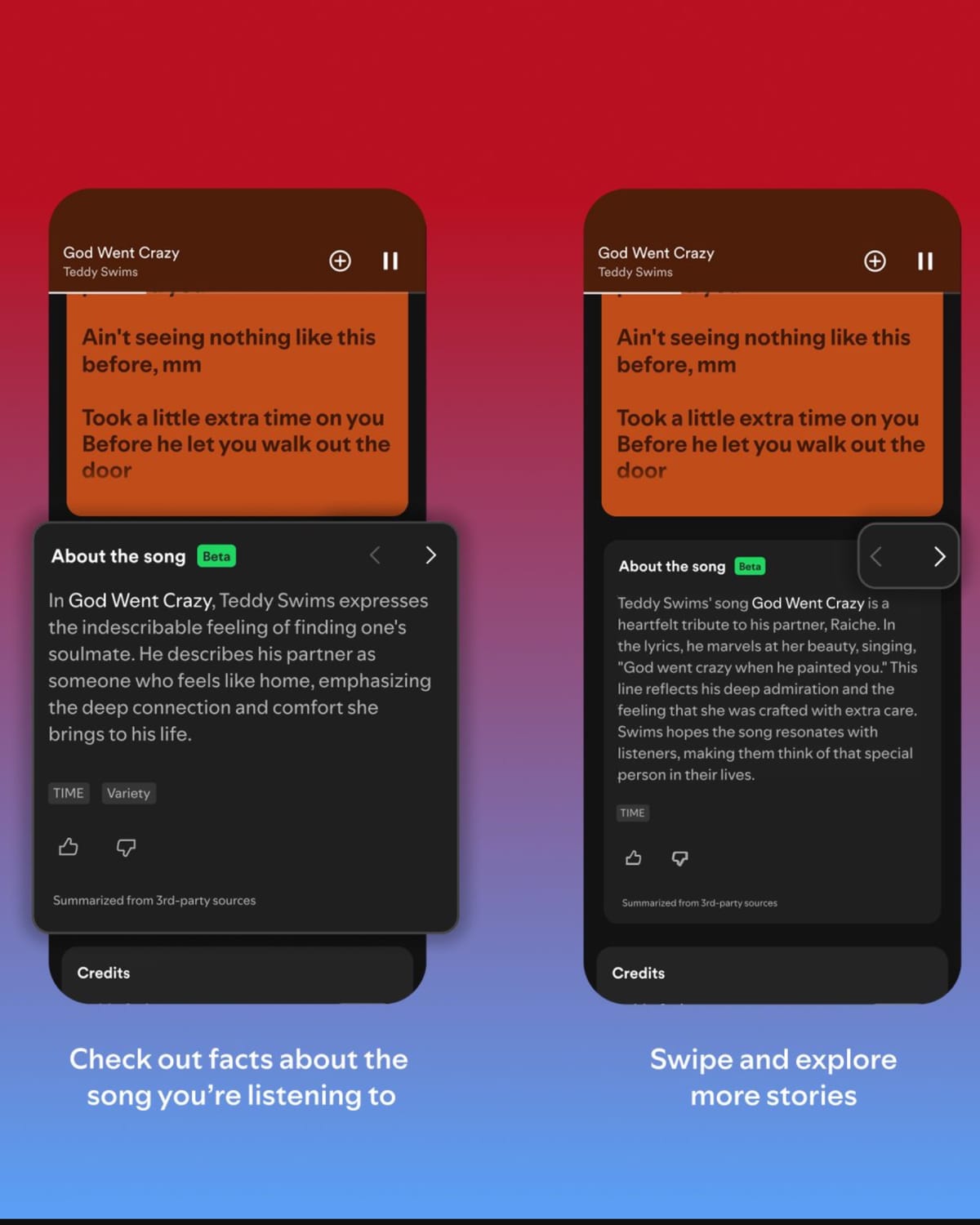
Spotify today introduced About the Song, a beta feature that delivers contextual storytelling directly within the mobile listening experience, marking the streaming platform's latest effort to deepen listener engagement beyond passive consumption. The feature integrates short, swipeable story cards into the Now Playing View, presenting details about song meanings, creative processes, and behind-the-scenes moments sourced from third-party publications.
The rollout targets Premium subscribers across the United States, United Kingdom, Canada, Ireland, New Zealand, and Australia through iOS and Android mobile applications. According to Spotify's announcement, the feature addresses a fundamental listener behavior: the desire to immediately understand what inspired a song that captures attention. "We believe that understanding the craft and context behind a song can deepen your connection to the music you love," the company stated.
The feature manifests through an "About the Song" card positioned below the Now Playing View controls. Users scroll down to access the card on supported tracks, then swipe horizontally through multiple story fragments. Each card presents summarized information extracted from third-party sources including TIME and Variety, with attribution displayed beneath the content. The interface includes a "Credits" link that presumably connects to Spotify's expanded Song Credits system, which the company enhanced through its November 19, 2025 acquisition of WhoSampled.
The announcement specifies that stories are "summarized from third-party sources to surface interesting details and behind-the-scenes moments." This approach suggests content curation rather than original editorial production, distinguishing the feature from artist-generated content or platform-produced documentaries. The summarization process raises questions about content selection methodology, source licensing arrangements, and editorial standards for determining which songs receive story cards.
Beta participants can submit feedback directly through the card interface, enabling Spotify to refine both content accuracy and feature usability before broader deployment. The company provided no timeline for general availability beyond the current beta designation.
About the Song represents the third component of Spotify's expanded music attribution infrastructure announced November 19, 2025. The company simultaneously launched SongDNA, an interactive visualization mapping connections between songs through collaborators, samples, and covers, powered by WhoSampled's database tracking 622,026 samples across 1.2 million songs. The company also expanded Song Credits beyond performance, songwriting, and production to include engineers, featured artists, and other contributors.
These initiatives reflect a broader industry pattern of streaming platforms enhancing discovery and engagement through contextual information rather than relying exclusively on algorithmic recommendation. Amazon Music launched Fan Groups on November 11, 2025, creating dedicated communities where listeners discover and discuss music recommendations without leaving the application. Amazon subsequently released 2025 Delivered on December 2, positioning itself as a direct competitor to Spotify Wrapped by transforming streaming history into personalized insights.
The competitive dynamics extend to artificial intelligence applications in content discovery. While Spotify emphasizes human-curated editorial content summarized from established publications, other platforms experiment with AI-generated explanations and conversational search capabilities. The distinction suggests Spotify prioritizes perceived authenticity and source credibility over automated content generation for features designed to explain artistic intent.
The feature arrives as Spotify's advertising business faces persistent execution challenges. The company reported on July 29, 2025, that ad-supported revenue fell 1% year-over-year to €453 million in Q2, despite ad-supported monthly active users growing 10% to 433 million. CEO Daniel Ek characterized these challenges as "execution" issues rather than strategic problems during the earnings call.
Engagement-enhancing features like About the Song serve dual purposes within Spotify's business model. For Premium subscribers who generate 89% of total revenue through subscriptions, deeper content engagement supports retention metrics that reduce churn. Higher engagement and listening duration create increased advertising inventory opportunities for the ad-supported tier while improving campaign performance through better audience attention.
The platform has pursued aggressive advertising technology modernization throughout 2025. Spotify launched its programmatic Spotify Ad Exchange (SAX) on April 3, enabling real-time auction-based buying of audio and video ad inventory. The company subsequently expanded automated podcast buying to 170 million listeners across 12 markets on July 11. These infrastructure investments aim to capture proportional advertising investment as digital audio commanded 20% of all time spent with digital media while representing only 2.9% of total digital advertising revenue.
The About the Song feature exists within complex relationships between streaming platforms, artists, labels, and music publishers regarding proper attribution and compensation. According to producer Mike Dean's statement in Spotify's November 19 announcement, "Back in the record and CD era, people read liner notes and it was a big thing to do while you listened. We used to listen, read, and dream of being listed one day. Later in my life, when my career started, people discovered me through the credits long before the internet was popular."
This nostalgic framing positions expanded attribution features as restoring historical practices disrupted by digital streaming's transition from physical media. However, the economic implications differ substantially. Physical album liner notes represented fixed costs absorbed during production, while streaming platform attribution features require ongoing content licensing, summarization resources, and interface maintenance across millions of tracks.
Mix engineer Manny Marroquin emphasized recognition's professional value: "So many incredible creatives contribute to a track, and recognizing them publicly can be life-changing. Accurate credits open doors, whether it's new work, new relationships, or simply being seen." This perspective highlights how attribution features extend beyond listener curiosity to affect creator career trajectories and professional networking opportunities.
Jacqueline Ankner, Spotify's Head of Songwriter & Publisher Partnerships, stated: "Every song is a collaboration, and every contributor should be seen. With expanded Song Credits, SongDNA, and About the song, we're giving fans a deeper look at the people and creative threads behind the music they love and giving creators the recognition they deserve."
The announcement provides minimal technical detail about source selection methodology, licensing arrangements, or content refresh schedules. The summarization approach raises several operational questions: how Spotify determines which publications provide source material, whether licensing agreements compensate publishers for content use, how frequently stories update to reflect new interviews or revelations, and whether artists or labels can influence or dispute presented information.
The reliance on third-party sources like TIME and Variety suggests Spotify prioritizes established media credibility over platform-generated content or unverified fan contributions. This editorial approach contrasts with WhoSampled's community contribution model, where contributors earn points for approved submissions of samples, covers, remixes, facts, and stories about musical connections.
The integration with Song Credits, which labels and artist distributors provide, creates potential synchronization challenges. Credits data flows through distribution agreements and metadata standards, while About the Song content derives from journalistic publications with independent editorial processes. Ensuring accuracy and consistency across these parallel information streams requires ongoing content management resources.
The placement within the Now Playing View addresses a specific user behavior pattern: active listening moments when curiosity about a track peaks. However, the scroll-and-swipe interaction model introduces friction compared to algorithmic recommendations that surface automatically. Users must recognize the feature's presence, scroll to access it, and actively engage rather than passively receiving information.
This design choice aligns with Spotify's broader interface philosophy emphasizing user-initiated discovery over algorithmic imposition. The company adjusted shuffle algorithms in November 2025 to reduce song repetition by considering recent listening history, demonstrating attention to perceived randomness in automated playback. About the Song extends this pattern by providing contextual information upon request rather than interrupting listening flow.
The beta feedback mechanism embedded within cards represents standard product development practice for pre-release features. Both artists and listeners can share feedback directly through the interface, enabling Spotify to gather qualitative insights about content relevance, interface usability, and feature value before committing development resources to general availability.
Music streaming platforms increasingly differentiate through features that extend beyond catalog comprehensiveness and audio quality. Amazon Music's Fan Groups enable direct community discussion and music sharing within the application. Apple Music emphasizes artist interviews, exclusive content, and spatial audio capabilities. YouTube Music leverages video content integration and user-generated uploads unavailable on licensed streaming services.
Spotify's approach through About the Song emphasizes editorial curation and third-party journalism rather than social features or technical audio enhancements. The strategy aligns with the platform's historical emphasis on playlist curation, Spotify Wrapped personalization, and artist-facing tools like Spotify for Artists analytics.
The WhoSampled acquisition cost, disclosed as undisclosed sum in the November 19 announcement, suggests Spotify assigned strategic value to music connection data that extends beyond what collaborative filtering algorithms provide. SongDNA's ability to map concrete, verifiable connections between songs based on musical relationships rather than listening patterns differentiates the feature from algorithmic playlist generation.
The announcement contains no information about data collection practices associated with About the Song usage. Standard analytics would track which songs users view story cards for, how long they engage with content, whether they swipe through multiple cards, and correlation between story card engagement and subsequent listening behavior.
This engagement data potentially informs both content creation decisions and advertising targeting capabilities. Higher engagement rates on specific story types could guide future editorial selection. Listening patterns following story card interaction could indicate whether contextual information influences music discovery or repeat listening.
The feature operates within Spotify's existing privacy framework, which enables deterministic user identification through logged-in accounts rather than probabilistic cookie-based tracking. This authentication advantage, shared by other logged-in platforms like Amazon and Meta, provides more accurate attribution and frequency management compared to open web advertising environments.
The February 6, 2026 announcement arrives during a period of significant transformation in digital audio and streaming media. Spotify's advertising revenue grew 8% in Q1 2025 driven by automated buying tools, with over 10,000 advertisers utilizing new automation features. The company distributed more than $100 million to podcast publishers and podcasters globally in Q1 through its Partner Program for video podcast creators.
Connected television and audio streaming continue gaining advertising investment as traditional linear television viewership declines. Industry analysis indicates CTV's share of media budgets projected to double from 14% in 2023 to 28% in 2025, underscoring importance of unified measurement capabilities across television and streaming platforms.
These market dynamics create pressure on streaming platforms to demonstrate engagement metrics that justify advertising rates and support subscription retention arguments. Features enhancing time spent with content directly affect both business model components: longer listening sessions create more advertising inventory opportunities while demonstrating subscription value that reduces churn probability.
Extending About the Song beyond English-language markets in six countries presents substantial operational challenges. Content summarization requires language-specific expertise, cultural context understanding, and access to local music journalism sources. The current limitation to Premium users in English-speaking markets suggests either licensing constraints, content availability issues, or strategic prioritization of high-value subscriber segments.
Scaling to Spotify's full catalog of tens of millions of tracks would require either substantial content team expansion or automated summarization technologies. The announcement's emphasis on "third-party sources" rather than internal editorial production suggests outsourced content operations or licensing arrangements with existing publishers rather than building comprehensive in-house music journalism capabilities.
The WhoSampled integration through SongDNA demonstrates one scalability approach: acquiring existing databases with community contribution models rather than creating content from scratch. WhoSampled's platform documents samples from movies and television shows beyond music-only samples, providing infrastructure for attributing cultural references and audio snippets used in music production.
The announcement included perspectives from producers, engineers, and Spotify executives emphasizing creator recognition and listener engagement. These curated statements frame the features as benefiting both audiences seeking deeper understanding and creators deserving proper attribution.
However, the announcement contained no independent artist reactions, label perspectives, or music publisher comments. This selective sourcing pattern is standard for company announcements but leaves questions about stakeholder alignment regarding implementation details, revenue implications, and editorial control.
The timing coincides with ongoing industry discussions about streaming economics, fair compensation, and creator visibility. Spotify raised premium subscription prices across multiple markets in August 2025, increasing monthly costs from €10.99 to €11.99. The company reached 276 million Premium subscribers as of Q2 2025 while operating with 650 million users globally across free and paid tiers.
Spotify provided no specific metrics defining About the Song's success criteria during the beta period. Standard measurement approaches would evaluate engagement rates (percentage of listeners accessing story cards), session duration changes correlated with feature usage, and qualitative feedback sentiment analysis.
The feature's impact on music discovery remains uncertain. Whether story cards influence subsequent listening behavior - such as exploring artists' back catalogs, discovering sampled tracks through SongDNA connections, or investigating collaborators mentioned in credits - represents a key question for evaluating strategic value beyond engagement time.
For advertisers, improvements in listener retention and engagement duration potentially affect campaign performance metrics including viewability, completion rates, and brand recall. The integration of advertising platforms like Smartly with Spotify Ads Manager demonstrates ecosystem expansion enabling cross-platform campaign management and unified measurement.
The beta designation suggests Spotify anticipates refinement before broader deployment. Potential expansion vectors include additional language support, geographic market expansion, integration with podcast content beyond music tracks, and enhanced interactivity such as linking story card mentions to related artists or tracks.
The WhoSampled acquisition creates opportunities for deeper integration between About the Song content and SongDNA visualizations. Stories mentioning samples could link directly to sample source tracks, while cover version discussions could trigger SongDNA's interactive relationship mapping.
The feature could evolve toward AI-generated summaries rather than curated third-party content, though such a shift would represent significant strategic repositioning given current emphasis on established publication sources. Spotify's November 16, 2025 launch of AI-powered audiobook summaries demonstrates the company's comfort with automated content generation in specific contexts.
Who: Spotify launched About the Song feature developed in collaboration with third-party publication partners including TIME and Variety. The feature targets Premium subscribers in the United States, United Kingdom, Canada, Ireland, New Zealand, and Australia using iOS and Android mobile devices.
What: About the Song presents swipeable story cards within the Now Playing View that explain song meanings, creative processes, and behind-the-scenes moments. Content is summarized from third-party journalistic sources rather than generated by Spotify or contributed by artists. The feature complements SongDNA's interactive connection mapping and expanded Song Credits showing all contributors from producers and engineers to songwriters and featured artists.
When: Spotify announced the beta launch on February 6, 2026, with no specified timeline for general availability beyond the current testing phase. The feature follows the November 19, 2025 announcement of SongDNA and expanded Song Credits, creating a coordinated music attribution infrastructure.
Where: The feature operates exclusively within Spotify's mobile applications on iOS and Android platforms, accessible through the Now Playing View by scrolling down to find the About the Song card on supported tracks. Current availability restricts access to Premium subscribers in six English-speaking markets.
Why: Spotify aims to deepen listener connections to music by providing immediate access to contextual information about songs that capture attention. The company believes understanding craft and context enhances engagement with music, supporting both Premium subscriber retention and ad-supported user session duration. The feature addresses competition from platforms like Amazon Music while differentiating Spotify through editorial curation rather than social features or technical audio enhancements. For creators, the expanded attribution infrastructure provides professional recognition and career development opportunities through public visibility of their contributions.