Spotify finally lets you spy on what your friends are listening to right now
Spotify launches listening activity and Request to Jam in Messages on January 7, 2026, enabling real-time music sharing for 40 million messaging users.


Spotify launches listening activity and Request to Jam in Messages on January 7, 2026, enabling real-time music sharing for 40 million messaging users.
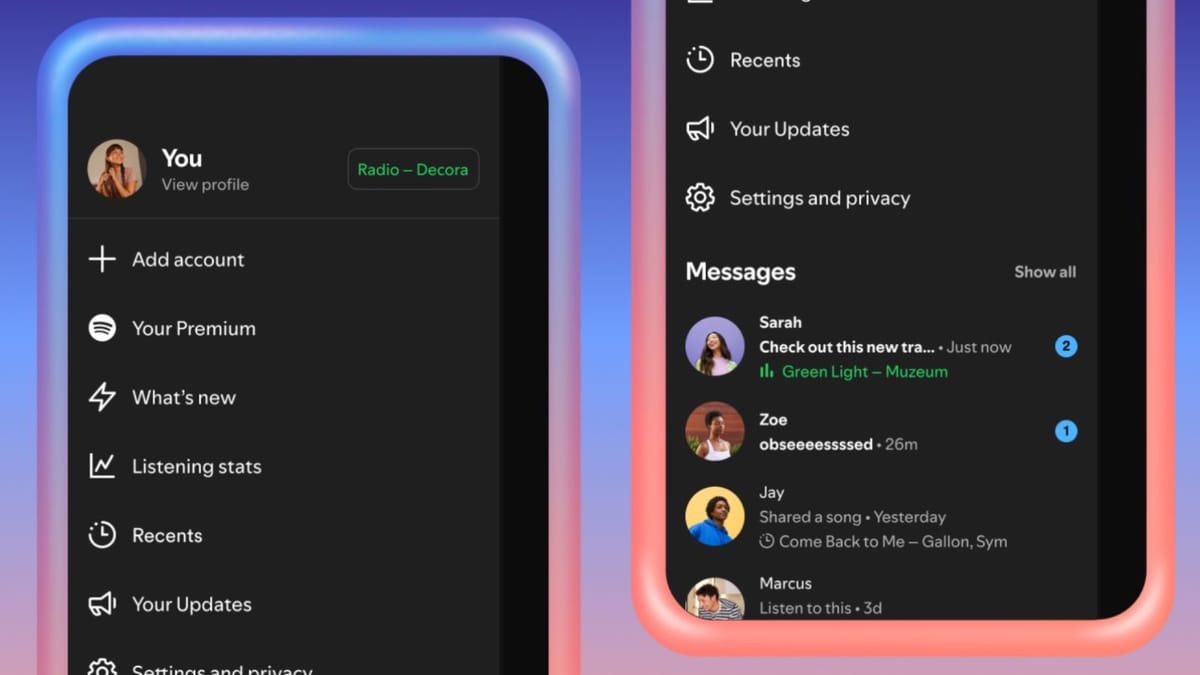
Spotify announced two messaging features on January 7, 2026, designed to transform how its 696 million monthly users share music through the platform's Messages system. Listening activity provides real-time visibility into friends' and family members' current listening sessions, while Request to Jam enables users to initiate collaborative listening experiences based on those musical moments.
The features build upon Messages, which launched approximately one year ago and has accumulated nearly 40 million users who have sent nearly 340 million messages. According to the announcement, these metrics demonstrate that "listeners are excited to share what they're streaming" within Spotify's native communication infrastructure.
Subscribe PPC Land newsletter ✉️ for similar stories like this one
Listening activity operates as an opt-in feature displaying what music users are currently playing within Messages in real time. When a user is not actively listening, their most recently played song appears instead. The functionality remains visible only to friends and family already connected through Messages, creating a controlled sharing environment rather than public broadcasting.
Users activate listening activity through Privacy and social settings, accessible via the side drawer next to the "View profile" button. Once enabled, activity appears in the chat row of the side drawer and at the top of Messages chats. Tapping on a friend's listening activity reveals options to add tracks to libraries, start playback, open the track's context menu, or react with one of six standard emojis.
The feature maintains privacy through connection-based visibility. Only contacts with whom users have already established Messages conversations can see listening activity. Users retain control over which contacts access their activity and can disable the feature at any time.
This approach differs from earlier social features Spotify implemented. The platform previously offered Friend Activity, which displayed listening behavior to all connected users regardless of messaging relationships. Messages integration creates more intimate sharing circles based on existing communication patterns rather than broad social networks.
Request to Jam complements listening activity by enabling users to convert musical moments into shared experiences. The feature addresses coordination challenges that previously prevented friends from initiating remote listening sessions despite knowing someone might be available.
Jam, Spotify's existing collaborative listening feature, has experienced substantial growth with daily active users more than doubling year over year. The original Jam functionality allowed users to listen from anywhere but lacked mechanisms to identify when friends were already listening and available for collaboration.
Request to Jam integrates this capability directly into Messages. Premium users can tap the Jam button in the top right corner of a Messages chat to send a remote Jam request. Recipients can accept or decline the invitation. Accepting makes the recipient the host of the Jam session, after which both participants can add tracks to a shared queue and listen together.
During Jam sessions, participants see each other's display names and receive suggested songs based on their combined taste profiles. Users can exit Jam sessions whenever they choose. Pending Jam invitations automatically time out if not accepted within a few minutes, preventing notification accumulation.
The technical implementation enables messaging while listening. Participants can discuss what's playing and what's up next through Messages during the Jam session, creating simultaneous communication and listening experiences that address social coordination challenges inherent in remote music sharing.
Buy ads on PPC Land. PPC Land has standard and native ad formats via major DSPs and ad platforms like Google Ads. Via an auction CPM, you can reach industry professionals.
These features represent continued investment in Messages as a content-sharing platform. Spotify positions Messages as addressing user desires to "share the songs, podcasts, and audiobooks they love with their friends and family" directly within the streaming application rather than through external social platforms.
The 340 million messages sent by 40 million users since Messages launched suggests average engagement of 8.5 messages per user. This metric indicates relatively light usage compared to dedicated messaging platforms but demonstrates consistent sharing behavior within Spotify's user base.
Messages remains available only to users aged 16 and older, addressing youth safety considerations across markets where the feature operates. Free users can join Jam sessions hosted by Premium users when in person, but Request to Jam's remote invitation capability requires Premium subscription status for the initiating user.
The rollout began January 7, 2026, targeting users in Messages-enabled markets on iOS and Android devices. Spotify indicated broad availability across these markets by early February 2026. Desktop and television platforms were not mentioned in the initial rollout announcement, suggesting mobile-first deployment strategy.
The announcement arrives as streaming platforms compete through social functionality development. Music streaming services increasingly position themselves as social networks rather than pure content delivery systems, recognizing that shared experiences drive engagement and retention.
Spotify has invested heavily in collaborative features throughout 2025 and early 2026. The platform launched Instagram audio preview integration in August 2025, automatically including sound clips when users share tracks to Instagram Stories. That feature enabled friends to tap music stickers to access tracks directly in Spotify, reducing friction in content sharing across platforms.
Amazon Music introduced Fan Groups in November 2025, enabling users to join genre-based or artist-specific communities directly within its streaming application. That feature allows members to make posts, create groups, share recommendations, and save suggestions from other users without leaving the platform.
Competitive pressure extends beyond dedicated streaming services. Meta enhanced marketing messages on Messenger for business customer retention in September 2025, demonstrating how messaging infrastructure supports both consumer and commercial relationships across platforms.
The social functionality development reflects broader trends in platform strategy. Content platforms increasingly emphasize internal sharing mechanisms over external link distribution, aiming to retain user attention within platform boundaries. This approach creates self-contained ecosystems where content discovery, sharing, and discussion occur without requiring users to switch applications.
Social features create new data collection opportunities that inform advertising targeting and content recommendations. Listening activity and Request to Jam generate behavioral signals about music preferences, social connections, and collaboration patterns that extend beyond individual listening histories.
These signals complement Spotify's existing advertising infrastructure. The platform launched its programmatic ad exchange in April 2025, enabling real-time bidding for advertising inventory. Social features provide additional user behavior data that can enhance targeting precision within programmatic systems.
Spotify's advertising business faced challenges in 2025, with ad-supported revenue falling 1% year-over-year to €453 million in Q2 despite 10% growth in ad-supported monthly active users. The company attributed performance issues to execution challenges rather than strategy problems, expressing confidence in long-term advertising prospects.
Social features may address some advertising challenges by increasing engagement rates and session duration. Users participating in Jam sessions or monitoring friends' listening activity spend more time within the application, creating additional advertising inventory opportunities for ad-supported users.
The Premium-only requirement for initiating Request to Jam creates subscription value differentiation. This approach positions social features as premium benefits rather than universal capabilities, potentially encouraging free users to upgrade subscriptions to access collaborative functionality.

Implementing real-time listening activity requires substantial backend infrastructure modifications. The system must continuously track listening sessions, maintain updated status information, and deliver that data to connected contacts with minimal latency. This technical demand differs from traditional streaming infrastructure focused on content delivery rather than social coordination.
Jam sessions require synchronized playback across multiple devices in different locations. The technical implementation must handle network latency variations, different connection qualities, and device compatibility issues while maintaining audio synchronization. The shared queue functionality adds complexity by enabling multiple participants to influence playback sequences collaboratively.
Privacy architecture becomes critical when implementing social features. The system must enforce connection-based visibility rules, respect opt-in requirements, and prevent unauthorized access to listening activity data. These technical requirements increase infrastructure complexity while addressing regulatory compliance needs across different markets.
Message synchronization during Jam sessions requires real-time communication infrastructure separate from audio streaming systems. This parallel technical stack enables users to discuss music selections while maintaining audio quality and synchronization, creating multiple simultaneous data streams between devices.
Social features serve user retention objectives by increasing platform stickiness through social connections. Users with active social relationships within Spotify face higher switching costs when considering competing services, as migration would disrupt established sharing patterns and collaborative experiences.
The features position Spotify as a social platform rather than commodity content delivery service. This positioning matters as music catalogs across major streaming services have achieved substantial parity. Platform differentiation increasingly depends on user experience, interface design, and social functionality rather than content availability.
User engagement metrics influence content licensing negotiations with music rights holders. Higher engagement rates and longer session durations demonstrate platform value to artists and labels, potentially strengthening Spotify's negotiating position for licensing renewals. Social features that increase these metrics therefore serve multiple strategic purposes simultaneously.
The age restriction to users 16 and older reflects youth safety considerations but also limits adoption among younger demographics who might drive social feature usage most actively. This trade-off between safety compliance and market penetration illustrates regulatory constraints affecting platform feature development.
Listening activity creates ambient awareness of friends' musical preferences without requiring active sharing. This passive discovery mechanism introduces users to music through social proof rather than algorithmic recommendations, potentially increasing discovery effectiveness through trusted connections.
The combined taste profiles in Jam sessions demonstrate cross-user recommendation systems that blend multiple preference sets. This technical approach differs from individual recommendations by optimizing for group satisfaction rather than personal preference, requiring different algorithmic approaches and success metrics.
Social discovery complements algorithmic recommendations rather than replacing them. Users receive music suggestions through multiple channels simultaneously: individual taste profiles, group taste combinations, friend listening activity, and traditional genre or mood-based discovery. This multi-channel approach increases overall discovery surface area while addressing different use cases and contexts.
The emphasis on discovery aligns with Spotify's strategic priorities. The platform has consistently invested in recommendation systems as competitive advantages, recognizing that effective discovery increases engagement and reduces churn. Social features extend discovery capabilities by incorporating human curation and social validation into recommendation processes.
The staged rollout to Messages-enabled markets reflects localization requirements and market testing strategies. Different markets have varying privacy regulations, content licensing agreements, and user behavior patterns that influence feature performance and adoption rates.
Messages-enabled markets currently include major English-speaking countries and select European nations where Spotify has established strong market positions. The gradual expansion allows the company to address technical issues and gather user feedback before broader geographic deployment.
Language localization becomes critical for messaging features. The platform must support conversation capabilities in multiple languages while maintaining feature consistency across markets. This technical requirement exceeds complexity of content streaming, which primarily involves audio delivery rather than text-based communication.
Regulatory compliance varies significantly across international markets. Data privacy laws, age verification requirements, and communication monitoring obligations differ between jurisdictions, requiring market-specific implementations that address local regulations while maintaining core functionality.
Subscribe PPC Land newsletter ✉️ for similar stories like this one
Subscribe PPC Land newsletter ✉️ for similar stories like this one
Who: Spotify announced listening activity and Request to Jam features for its nearly 40 million Messages users across its platform of 696 million monthly active users.
What: Two new messaging features enabling real-time visibility into friends' listening activity and the ability to initiate collaborative Jam sessions through Messages, with listening activity showing current or recent music playback and Request to Jam allowing Premium users to invite contacts into shared listening experiences.
When: Announced January 7, 2026, with rollout beginning immediately to Messages-enabled markets on iOS and Android devices, targeting broad availability by early February 2026.
Where: Deployment occurs across Messages-enabled markets on iOS and Android devices, with listening activity available to all Messages users and Request to Jam accessible to Premium subscribers (with Free users able to join Premium-hosted sessions in person).
Why: The features address user requests for enhanced music sharing capabilities within Messages, leverage Jam's growing popularity (daily active users more than doubling year over year), and position Spotify as a social platform rather than commodity streaming service, while creating engagement opportunities that support advertising business development and user retention objectives.