


Spotify today redefined what a podcast play means and shipped five new analytics tools inside Spotify for Creators, pushing the platform deeper into the measurement infrastructure that advertisers and creators have long said is missing from the audio space.
A new definition of a podcast play
The most structurally significant part of the announcement is not a new interface. It is a number: 30. Starting today, a play on Spotify counts only when a listener watches or listens to an episode for at least 30 seconds. Anything shorter - an accidental tap, an autoplay that nobody wanted, a preview that was skipped - no longer registers as a play.
According to Spotify, its audience behavior data shows that 30 seconds is a reliable indicator of intentional consumption. The company spent the past year discussing its findings with the industry, including with the Alliance for Measurement in Podcasting (AMP). That process resulted in AMP announcing a matching Podcast Plays definition that Spotify's data helped inform.
The practical effect is immediate: many creators will see their play counts drop. A show that previously logged 100,000 plays under a less restrictive definition may now show 75,000 or fewer. That adjustment is not a decline in audience. It is a more precise picture of who actually engaged with an episode.
For the advertising community, this distinction matters considerably. Podcast measurement has been a persistent fragmentation problem, with different platforms applying different counting rules to the same type of content. The IAB Media Center addressed the chronic underinvestment in digital audio advertising through improved measurement guidance published in June 2025, noting that digital audio commands 20% of all 18+ time spent with digital media, yet audio investment stood at just 2.9% of total digital advertising revenue as of April 2025. When play numbers cannot be compared across platforms, media buyers struggle to defend audio budget allocations inside Media Mix Models and cross-channel planning tools.
AMP's newly announced Podcast Plays definition, informed by Spotify's data, is an attempt to anchor the industry around a single standard. The 30-second threshold places podcasts closer to how video platforms count a view - YouTube counts a view after approximately 30 seconds for longer content - making comparisons between audio and video formats marginally more coherent.
Five new tools inside Spotify for Creators
Alongside the play count change, Spotify today launched a suite of analytics features within Spotify for Creators. The tools are designed to surface different dimensions of audience behavior that were either unavailable before or scattered across the interface.
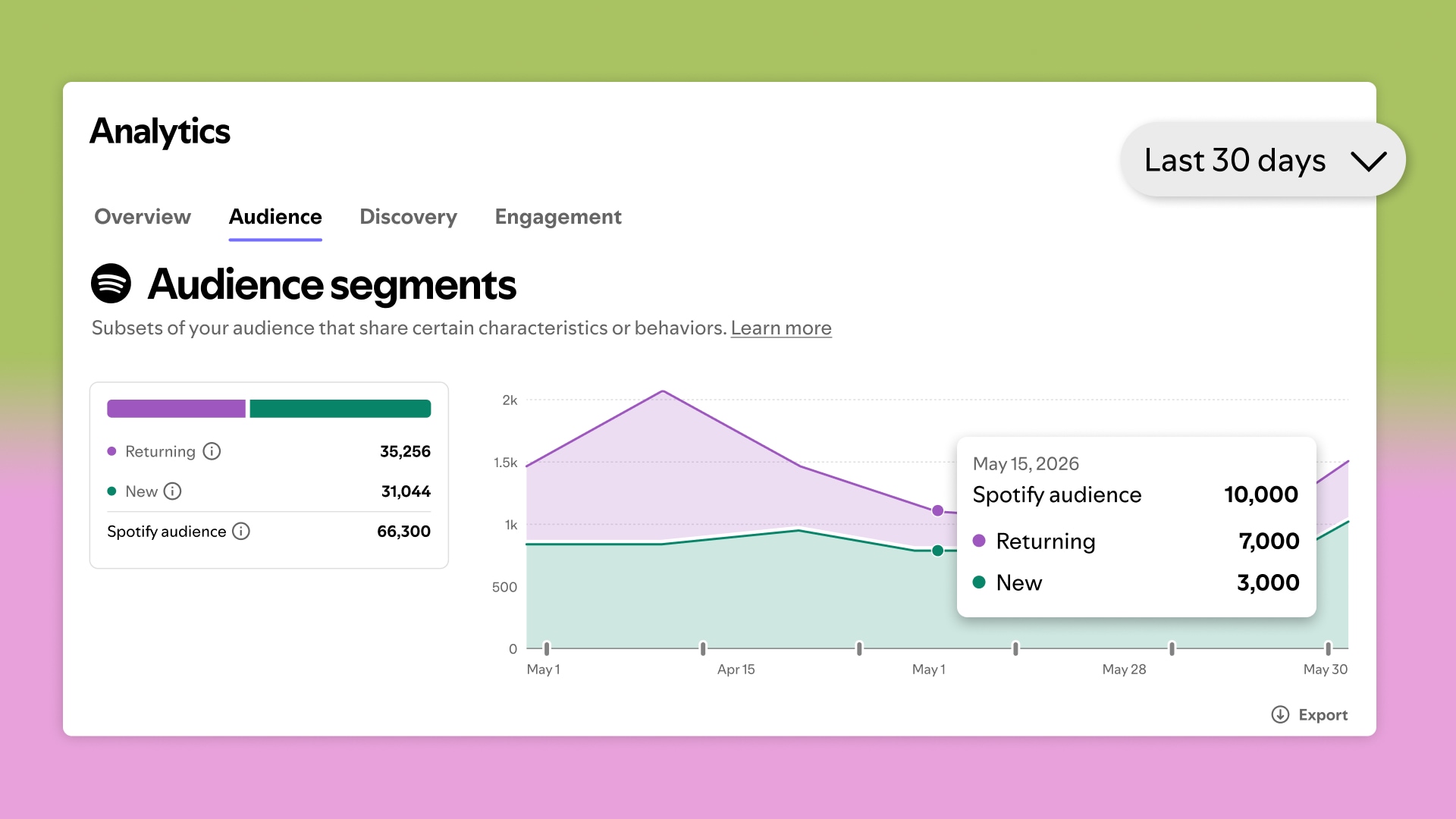
Audience Segments breaks down the listener base between new and returning audiences over time. The distinction matters because the two groups behave differently. A high share of new listeners signals discovery - the show is reaching people who have never heard it before. A high share of returning listeners signals loyalty - existing fans are coming back episode after episode. Knowing which dynamic is driving numbers on any given episode gives creators concrete information for decisions about distribution, promotion, and content strategy.
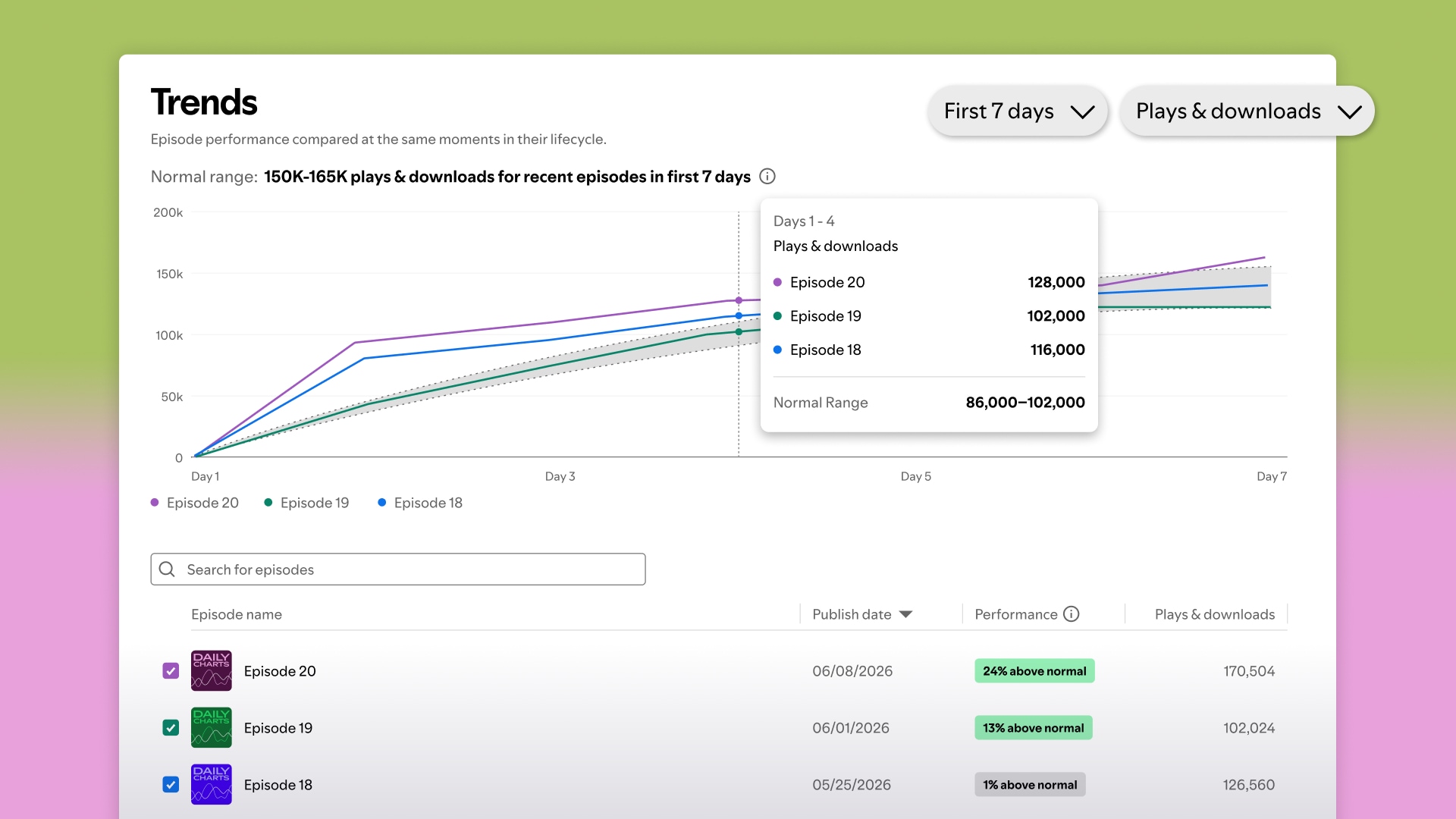
Episode Trends is a benchmarking tool. Rather than showing raw performance numbers for each episode, it compares individual episode results against a creator's typical performance across their catalog. A new episode with 10,000 plays in its first week reads differently if the creator normally gets 5,000 plays in that window versus 20,000. Benchmarking against personal history gives a clearer signal of whether an episode is overperforming, underperforming, or landing roughly as expected.
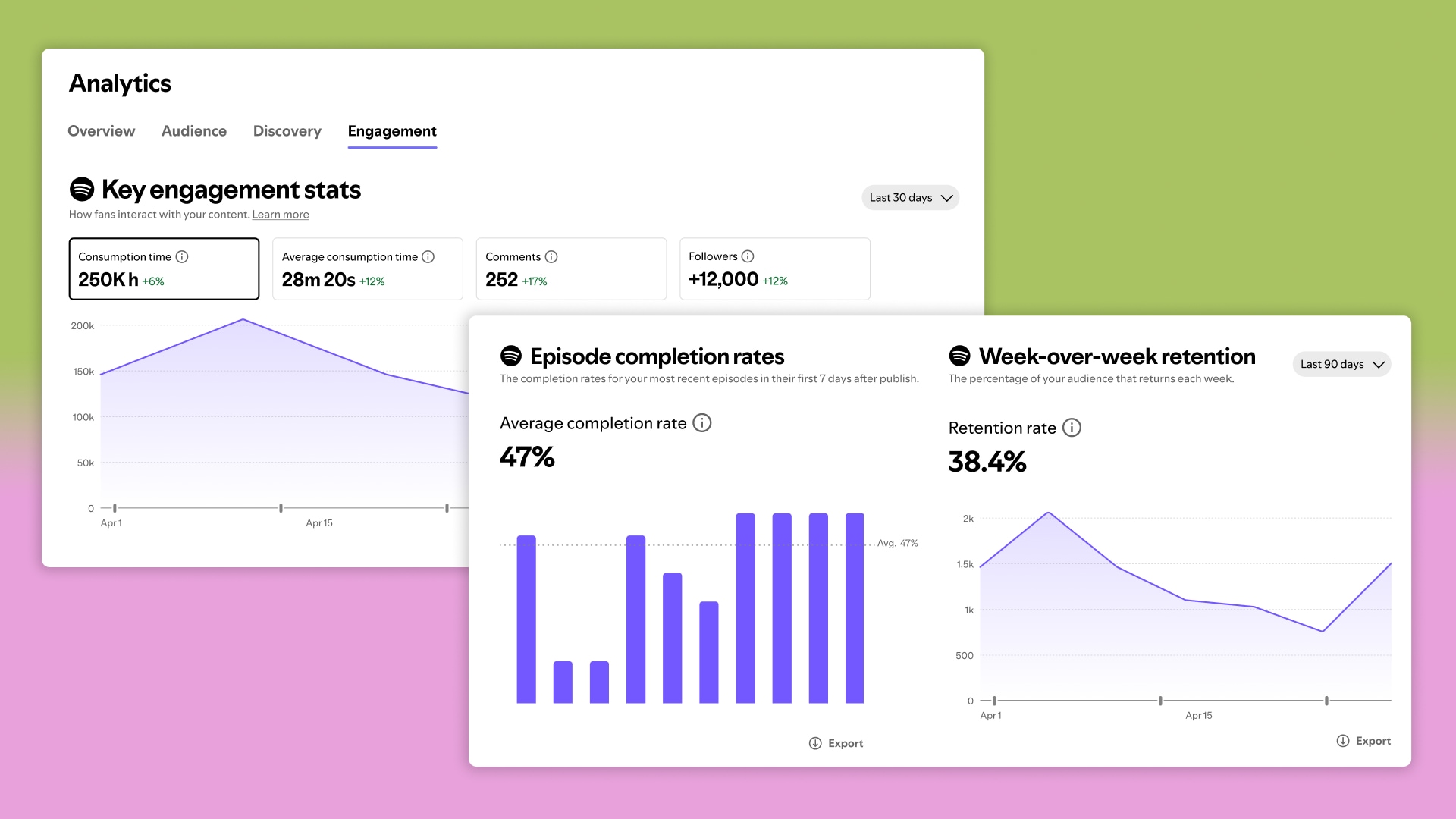
Long-Term Engagement reporting covers audience retention over time. Listeners who found a show months ago and are still returning are a different asset than listeners who subscribed and then drifted. Long-term retention data helps creators identify the content formats and topics that hold audiences through periods when attention is contested, and that signal is valuable to sponsors who want to know whether a show's audience is stable.
The Discovery Journey has been redesigned. The updated version maps the full path from impressions to plays to completion. According to Spotify, the interface traces how audiences find, engage with, and return to content. That funnel view - impression to play to completion - reflects how the programmatic advertising world has long evaluated digital campaigns. Impression rates, click-through rates, and completion rates are the standard metrics for display and video. Bringing equivalent funnel logic to podcast analytics moves the format into a measurement register that media buyers already understand.
Finally, Spotify is giving creators access to their full historical performance data, going all the way back to their first listener on the platform. That scope is notable. Many analytics tools in the creator economy are constrained by rolling windows - 90 days, 12 months - that make it difficult to study long-term trends or understand how a show's audience has evolved over years. Access to the complete dataset, from day one, allows creators and their teams to draw longitudinal conclusions.
Context: where this sits in Spotify's creator infrastructure
This analytics update does not arrive in isolation. Spotify has spent roughly 18 months building a more substantial creator infrastructure, and today's announcement adds a measurement layer to tooling that already covers monetization, distribution, and identity.
The Partner Program launched on January 2, 2025 in the United States, United Kingdom, Canada, and Australia, introducing dual revenue streams that combine Premium subscriber engagement payouts with advertising income from free-tier users. The program distributed more than 100 million dollars to podcast publishers globally in the first quarter of 2025 alone, with payouts growing over 300% in January 2025 compared to the previous year. Hundreds of creators now earn more than 10,000 dollars monthly through it.
Spotify cut the Partner Program's entry barriers on January 7, 2026, reducing eligibility thresholds by 80% and simultaneously announcing a Distribution API that lets creators on external hosting platforms publish and monetize video content on Spotify without changing their existing workflows. Acast, Audioboom, Libsyn, Omny, and Podigee were named as initial Distribution API partners at that point.
By May 2026, the video Distribution API was live on five platforms - Libsyn, Podigee, Audioboom, Audiomeans, and Podspace - while Apple HTTP Live Streaming support was announced for later in the year. Video podcast shows on Spotify surpassed 530,000 by early 2026, up from approximately 500,000 in November 2025.
In May 2026, Spotify announced podcast Memberships, Personal Podcasts, and real-time interactivity at its 2026 Investor Day, along with Creator Sponsorships going live for Partner Program creators. That set of features expanded the monetization surface; today's analytics update expands the measurement surface that underlies it.
Spotify introduced a verified badge for podcasters in May 2026, tying audience authenticity to badge eligibility - a direct response to the problem of artificially inflated listener counts that has complicated programmatic podcast buying.
Why the 30-second standard matters beyond Spotify
The AMP connection is the part of today's announcement most likely to reverberate beyond Spotify's own creator base. AMP is an industry initiative aimed at establishing more consistent cross-platform measurement standards. When a platform with Spotify's scale - 170 million monthly podcast listeners across nearly 7 million titles, according to figures cited by the company in July 2025 - spends a year working with an industry group and shares behavioral data that helps define a common metric, the resulting standard carries more weight than one published without that input.
The fragmentation of podcast measurement has been documented repeatedly in industry research. Bumper, a podcast analytics company, estimated that implementing better data and verification across the industry could unlock an additional 1 billion dollars in podcast advertising spend. The Research from Oxford Road, cited alongside Bumper's April 2026 product launch, framed improved measurement as a commercial argument rather than a purely technical one.
Bauer's Sound Check Europe 2026 research covered by PPC Land found that only 13% of advertisers confidently use audio attribution tools, while 73% say that stronger effectiveness evidence would increase their investment. That gap between willingness to spend and confidence in measurement tools is precisely the problem a shared Podcast Plays definition is designed to address.
Podstock research published recently demonstrated that Spotify drives 1.5 times more podcast listening time than YouTube, despite YouTube having a larger share of platform usage in some markets. The distinction between platform share and time-spent data becomes more meaningful when both sides of the comparison are using compatible play definitions. Without that compatibility, cross-platform comparisons remain estimates.
What advertisers should understand
For media buyers and brands running podcast campaigns on Spotify, the play count change requires a recalibration of how performance benchmarks are read. Historical data and future data will now reflect different counting methodologies. A campaign that ran before today and one that runs starting today will not produce directly comparable play figures without adjusting for the change in definition.
That adjustment is not complicated in principle - it requires understanding the delta between the old and new counts for a given creator's catalog - but it does require active attention from agencies and buying teams. Reporting dashboards that pull Spotify data automatically will reflect the new numbers immediately, while historical comparisons will need context to be interpreted accurately.
The Discovery Journey tool is particularly relevant for advertisers managing programmatic podcast buys. The funnel view - impressions, plays, completions - mirrors the way digital campaign reporting has been structured for years in display and video. Advertisers who are used to evaluating campaigns in terms of reach, engagement, and completion rates now have a parallel framework for evaluating podcast content performance, directly within the same platform where they access inventory through Spotify Ad Exchange and Spotify Ads Manager.
The Audience Segments tool adds a dimension that was largely absent from podcast analytics: the new-versus-returning split. Brands that prioritize audience reach want to see high new listener rates. Brands focused on deep engagement with committed audiences want to see returning listener strength. That segmentation, surfaced at the episode level over time, gives campaign planning a sharper data point.
The Long-Term Engagement reporting and full historical data access serve a different purpose. They allow creators - and the agencies representing them in direct sponsorship negotiations - to present longitudinal evidence of audience stability and growth. A show with three years of consistent audience data has a demonstrably different risk profile for a sponsor than one with six months. Making that data available and searchable changes the nature of the conversation between creators and buyers.
Calibration, not just new features
What Spotify is doing today is not simply adding dashboards. It is making a claim about what constitutes a real listener interaction - and backing that claim with a year of behavioral data and an industry alignment process. Whether the 30-second threshold is the right number will be debated. Some in the industry may argue for a higher bar; others may find the standard workable. But the act of publishing a definition, aligning it with AMP, and embedding it in play counts is a different kind of announcement than a UI refresh.
The measurement and monetization questions have been inseparable in podcast advertising for years. More reliable play counts make podcast inventory easier to price, defend in media plans, and compare against other channels. When combined with the Discovery Journey funnel, Audience Segments, and full historical access, the tools released today give creators a more complete operational picture than most have previously had access to on any single platform.
Timeline
- February 2019 - Spotify acquires Anchor, a free podcast creation and distribution platform
- January 2, 2025 - Spotify launches the Partner Program in the US, UK, Canada, and Australia, introducing dual revenue streams for creators; payouts grow over 300% in January 2025 year-over-year
- July 11, 2025 - Spotify expands automated podcast buying to 170 million listeners across 12 markets via Ads Manager and Ad Exchange
- November 13, 2025 - Spotify brings the Partner Program to Nordic markets including Sweden, Denmark, Finland, and Iceland; video podcast catalog reaches nearly 500,000 shows; Sweden reports nearly 60% year-over-year growth in video podcast listeners
- January 7, 2026 - Spotify cuts Partner Program entry barriers by 80% and announces the Distribution API with Acast, Audioboom, Libsyn, Omny, and Podigee as initial partners
- March 12, 2026 - Spotify sends deletion warnings to inactive Anchor and Spotify for Podcasters accounts with a firm April 17 deadline
- April 21, 2026 - Bumper launches its Bumper Score verified audience metric, with Oxford Road research estimating better verification could unlock 1 billion dollars in additional podcast ad spend
- May 14, 2026 - Spotify activates the video Distribution API on five hosting platforms: Libsyn, Podigee, Audioboom, Audiomeans, and Podspace
- May 19, 2026 - Spotify introduces a verified badge for podcasters, tying audience authenticity as a prerequisite for badge eligibility; first badges visible on select shows
- May 21, 2026 - Spotify announces podcast Memberships, Personal Podcasts, and Creator Sponsorships at its 2026 Investor Day
- June 8, 2026 - Bumper opens its podcast dashboard to all creators and adds an MCP server
- June 11, 2026 - Spotify redefines podcast plays as requiring at least 30 seconds of listening or watching and launches five new creator analytics tools: Audience Segments, Episode Trends, Long-Term Engagement reporting, a redesigned Discovery Journey, and full historical data access; AMP announces a matching Podcast Plays definition that Spotify's behavioral data helped inform
Summary
Who: Spotify, the audio streaming platform with 170 million monthly podcast listeners, in coordination with the Alliance for Measurement in Podcasting (AMP).
What: Spotify today redefined its podcast play metric to require at least 30 seconds of listening or watching, replacing a looser prior standard, and simultaneously launched five new analytics tools inside Spotify for Creators: Audience Segments, Episode Trends, Long-Term Engagement reporting, a redesigned Discovery Journey, and access to full historical performance data dating back to a creator's first listener on the platform. Spotify's behavioral data helped inform AMP's newly announced Podcast Plays definition, which aligns with the 30-second threshold.
When: June 11, 2026. Spotify spent the preceding year discussing its audience behavior findings with the industry, including with AMP, before publishing the new standard today.
Where: The changes are live inside Spotify for Creators, the platform accessible at creators.spotify.com. The AMP Podcast Plays definition is a cross-industry standard intended to apply across platforms beyond Spotify.
Why: Play counts in podcasting have historically varied by platform, making it difficult for advertisers to compare performance across channels, defend audio budget allocations in media plans, or evaluate creator performance consistently. The 30-second threshold filters out accidental starts and low-intent interactions, producing numbers that more accurately reflect deliberate listening. The new analytics tools give creators - and the agencies and brands working with them - a more granular and longitudinal picture of how audiences discover, engage with, and return to content.


Discussion