Tailwind CSS lays off 75% of engineering team as AI impacts revenue
Tailwind CSS laid off three-quarters of its engineering team on January 6, 2026, after AI-driven traffic decline slashed revenue by 80% despite framework's growing popularity.


Tailwind CSS laid off three-quarters of its engineering team on January 6, 2026, after AI-driven traffic decline slashed revenue by 80% despite framework's growing popularity.
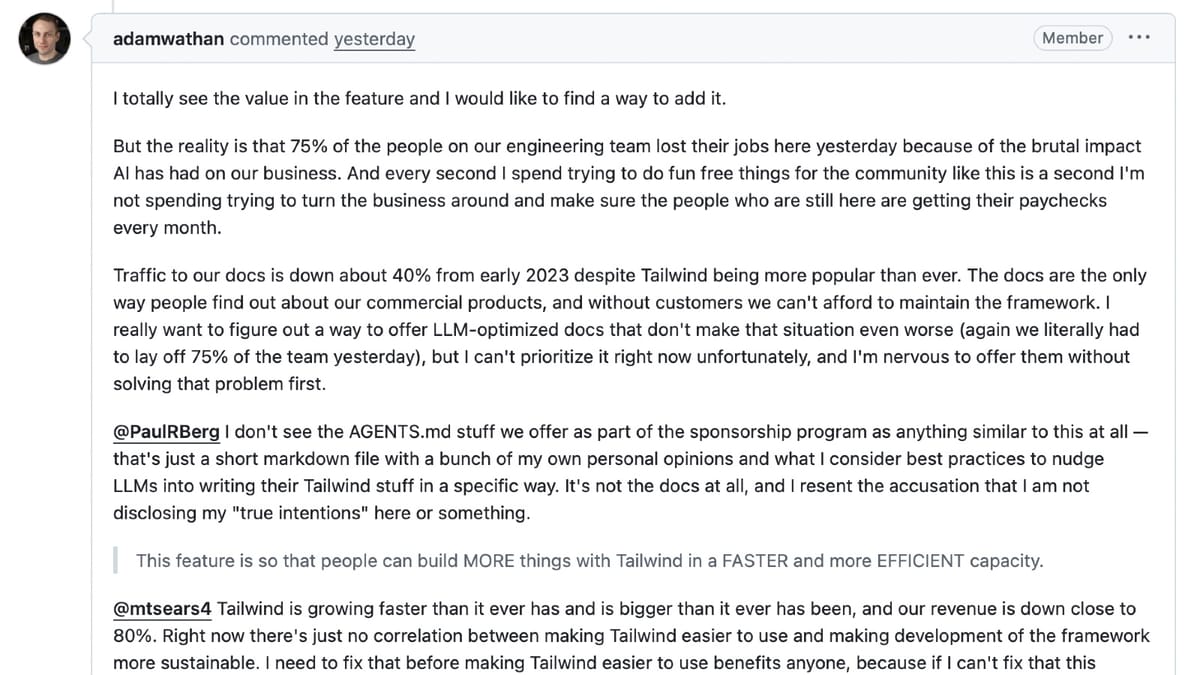
The popular CSS framework Tailwind CSS laid off 75% of its engineering team on January 6, 2026, marking a stark example of how AI tools are reshaping the economics of open-source software businesses. Founder Adam Wathan disclosed the layoffs in a GitHub discussion thread, revealing that three of four engineers lost their jobs as the company's revenue plummeted approximately 80% despite the framework growing more popular than ever.
Wathan made the announcement while declining a community-submitted pull request that would have made Tailwind's documentation more accessible to large language models. The request proposed adding an "llms.txt" endpoint to serve LLM-optimized documentation. "The reality is that 75% of the people on our engineering team lost their jobs here yesterday because of the brutal impact AI has had on our business," Wathan wrote in response to criticism about rejecting the feature. "Every second I spend trying to do fun free things for the community like this is a second I'm not spending trying to turn the business around and make sure the people who are still here are getting their paychecks every month."
Traffic to Tailwind's documentation has dropped roughly 40% since early 2023, according to Wathan. This decline directly undermines the company's business model, which relies on developers visiting the documentation site to discover Tailwind's commercial products. The company generates revenue through Tailwind Plus, a premium offering that includes pre-built UI components, templates, and blocks sold through lifetime licenses rather than subscriptions. Several community members noted that AI coding assistants now generate Tailwind CSS automatically without requiring developers to consult the official documentation.
The company employs a distinctive monetization strategy for an open-source project. Tailwind CSS itself remains free under an MIT license, while the commercial products provide ready-made components that developers can purchase for $299 as a one-time payment. This model worked when developers needed to regularly visit documentation and discover premium offerings organically. Developer Valentin Ignatev observed on X that "AI will scrape your project site, users will never visit it for documentation and will never know about your commercial product."
Making a business on top of open source software already was near impossible. And now OSS maintainers who want to earn money are extra screwed.
— Valentin Ignatev (@valigo) January 7, 2026
AI will scrape your project site, users will never visit it for documentation and will never know about your commercial product.
And… pic.twitter.com/fZdtPOQNPV
Wathan explained the situation creates an impossible dilemma. "Tailwind is growing faster than it ever has and is bigger than it ever has been, and our revenue is down close to 80%," he wrote. "Right now there's just no correlation between making Tailwind easier to use and making development of the framework more sustainable." The disconnect between usage growth and revenue collapse stems from AI models training on public documentation and generating code without directing users to the source.
The financial trajectory tells a sobering story. According to Wathan's previous disclosures, Tailwind had achieved over $2 million in annual revenue by 2020 from Tailwind UI sales alone. By 2024, the company had expanded to eight employees with engineering positions advertised at $250,000 to $300,000 in total compensation. The current sponsor page shows the company pulling in approximately $1 million annually from corporate sponsorships. Despite this seemingly substantial revenue, the combination of high labor costs and the 80% revenue decline created an unsustainable situation that necessitated immediate action.
Companies building AI-powered development tools benefit significantly from Tailwind's popularity. Platforms like Lovable, Bolt, and v0 by Vercel routinely generate websites using Tailwind CSS. Cursor, which sponsors Tailwind according to the framework's sponsor page, integrates the CSS library extensively into its AI coding features. These tools create a paradox where increased adoption of Tailwind through AI-generated code simultaneously destroys the company's ability to monetize that popularity.
One developer in the Hacker News discussion thread calculated that Lovable, an AI-powered website builder claiming $250 million in annual recurring revenue, uses Tailwind extensively but provides no apparent financial support to the framework. This dynamic represents what many see as an extraction of value from open-source maintainers by venture-backed AI companies. The larger AI platforms train their models on freely available documentation, then monetize that knowledge through subscription services ranging from $20 per month for ChatGPT Plus to $200 monthly for Claude Pro, with none of that revenue flowing back to the original creators.
The layoffs leave Tailwind Labs with only its three co-founders and one engineer. Before the cuts, the company maintained a team of eight people according to LinkedIn data. Wathan discussed the situation in his podcast "Adam's Morning Walk" on January 7, describing the decision as necessary for survival but deeply painful. "I wanted to state it like that because I thought just saying '3 people' undersold the impact," he explained, defending his choice to frame the announcement as a percentage rather than absolute numbers.
Programmer ThePrimeagen commented on the situation: "I'll say it again, I think this AI cycle we are in is a net negative on society." His observation reflected broader concerns about how AI training on open-source projects creates value for AI companies while undermining the sustainability of the original creators. The Hacker News discussion about Tailwind's layoffs accumulated over 1,100 points and 635 comments, with many developers expressing sympathy while noting similar challenges across the industry.
The emotional toll on Wathan became evident in his responses throughout the GitHub thread. When community member mtsears4 criticized the decision to close the pull request, writing that it sent the message "that getting money from them is more important than providing a service to help them," Wathan responded with unusual vulnerability for a technical discussion. His subsequent explanation revealed the psychological weight of balancing open-source ideals with business realities while personally responsible for the livelihoods of employees who had just lost their jobs.
Buy ads on PPC Land. PPC Land has standard and native ad formats via major DSPs and ad platforms like Google Ads. Via an auction CPM, you can reach industry professionals.
The decline in documentation traffic mirrors problems faced by other content creators and publishers. Google's AI Overviews feature and competing chatbots answer queries directly without sending users to source websites. For businesses like Tailwind that depend on documentation sites as their primary marketing channel, this shift proves catastrophic. "The docs are the only way people find out about our commercial products, and without customers we can't afford to maintain the framework," Wathan stated.
The Tailwind situation exemplifies a broader crisis facing open-source software maintainers. Traditional funding models relied on converting usage into revenue through various channels: consulting services, hosted solutions, premium features, or complementary products. AI disrupts each of these pathways. Consulting becomes unnecessary when AI can answer implementation questions. Documentation-driven discovery fails when users never visit documentation. Premium template sales decline when AI generates comparable designs instantly.
Several developers suggested alternative revenue strategies. Some proposed that AI companies should sponsor open-source projects their models depend on. GitHub founder Tom Preston-Werner weighed in, suggesting that major AI companies could easily solve this problem by allocating a portion of their revenue to open-source projects their training data depends on. However, no AI company has announced such a program, despite collectively raising tens of billions in funding.
Other community members recommended Tailwind adopt subscription pricing or seek acquisition by a larger company like Vercel. Wathan previously sold components as lifetime purchases, offering continuous updates without recurring fees. This pricing model generated strong initial sales but failed to create ongoing revenue streams as the customer base saturated. One developer who purchased Tailwind UI in 2022 noted they had received years of free updates but would gladly pay 20% of the original purchase price annually for continued development.
Competition from free alternatives also pressures Tailwind's commercial products. Shadcn/ui provides similar component libraries at no cost, using Tailwind CSS as its foundation while offering components through a registry system that developers find easier to use. Material UI and other established libraries maintain their own ecosystems. The proliferation of free UI component options reduces the value proposition for Tailwind's paid offerings even without AI's impact.

The GitHub discussion revealed tensions around intellectual property and fair use in the AI era. Pull request author quantizor defended the llms.txt proposal as complementary rather than replacement functionality. Community member PaulRBerg questioned whether Tailwind monetizes LLM-friendly documentation through its sponsorship program, which includes an "AGENTS.md" file with best practices for AI code generation using Tailwind.
Wathan clarified that the AGENTS.md file contains personal opinions and recommendations rather than documentation, and resented implications of hidden commercial motives. "I don't see the AGENTS.md stuff we offer as part of the sponsorship program as anything similar to this at all—that's just a short markdown file with a bunch of my own personal opinions and what I consider best practices to nudge LLMs into writing their Tailwind stuff in a specific way," he wrote.
The legal framework around AI training on open-source code remains unsettled. Tailwind's MIT license explicitly permits copying, modification, and distribution, but whether training AI models constitutes fair use continues to generate litigation. The New York Times sued OpenAI and Microsoft for copyright infringement in December 2023, but smaller creators lack resources for similar legal challenges. Unlike billion-dollar media companies that can negotiate licensing deals with AI providers, individual open-source maintainers and small companies like Tailwind find themselves with few options.
Some developers suggested more restrictive licensing for future versions. The AGPL license requires companies using code in network services to open-source their entire application, which could theoretically pressure AI companies to negotiate commercial licenses. However, Tailwind's existing codebase cannot have its license retroactively changed, and adopting restrictive licensing would likely fracture the community and reduce adoption.
Tailwind CSS revolutionized frontend development when it launched, popularizing utility-first CSS that applies styling directly in HTML markup rather than separate stylesheets. This approach initially faced skepticism but gained widespread adoption for its speed and maintainability. The framework has become nearly ubiquitous in modern web development, with major companies including Shopify, GitHub, and NASA using it in production applications.
The release of Tailwind v4 in 2024 represented a significant technical achievement, reimplementing the core framework in Rust for dramatic performance improvements and introducing CSS-only configuration. This shift toward native web standards makes the framework more closely aligned with evolving CSS specifications while maintaining the developer experience that drove adoption. One developer noted the irony that learning CSS through Tailwind's utility classes proved more effective than traditional methodologies.
However, technical excellence alone cannot sustain a business when the distribution model collapses. Several commenters observed that Tailwind CSS as software remains feature-complete and could continue indefinitely with minimal maintenance. CSS specifications evolve slowly, and Tailwind's abstraction layer doesn't require constant updates to remain useful. This stability paradoxically undermines the business case for a large team, even as the framework's importance to the ecosystem grows.
The commercial products face different challenges. Tailwind Catalyst, a React component library launched as part of the premium offering, competes with numerous alternatives including shadcn/ui, Radix UI, and Headless UI. These competing libraries often build on Tailwind CSS itself, creating an ecosystem that depends on the free framework while undermining the paid products. One developer criticized Tailwind Plus as lacking coherent direction, attempting to serve multiple markets with snippets, components, and templates without integrating them into a unified design system.
Wathan emphasized his desire to find sustainable solutions: "I totally see the value in the feature and I would like to find a way to add it. But the reality is that 75% of the people on our engineering team lost their jobs here yesterday because of the brutal impact AI has had on our business." He expressed concern that making documentation more LLM-friendly could accelerate traffic losses without solving the revenue problem. The company now faces the challenge of maintaining an increasingly popular open-source framework with drastically reduced resources while discovering new monetization approaches that work in an AI-dominated development landscape.
Several potential paths forward emerged from community discussions. Building an AI-powered design tool specifically optimized for Tailwind could position the company to capture value in the AI workflow rather than being disrupted by it. Tailwind Labs possesses deep expertise in component design and user interface patterns that could differentiate an AI tool from generic alternatives. The recently popular v0 by Vercel demonstrates demand for AI-assisted design tools, and Tailwind's brand recognition could support a competitive offering.
Another strategy involves deepening relationships with corporate sponsors and the AI companies themselves. If Tailwind became essential infrastructure for AI code generation—similar to how jQuery once underpinned the web—major AI providers might view sponsorship as necessary maintenance of their training data quality. Several community members suggested that companies like Anthropic, OpenAI, and Cursor should contribute financially to projects their products depend on, though no mechanism exists to enforce such contributions.
Some developers advocated for paid tiers of documentation or gated access for AI systems. Cloudflare announced a "pay-per-crawl" system in 2024 that allows websites to charge AI companies for access. Whether Tailwind could implement similar restrictions without fragmenting its community remains uncertain. The open-source nature of the project means any restrictions would only apply to official documentation, not the code itself.
The situation raises questions about the future of open-source software business models. Projects that achieved sustainability through documentation-driven discovery of commercial products find that model breaking down as AI intermediates the relationship between users and maintainers. Tailwind's struggle suggests other open-source businesses may face similar pressures as AI tools become standard development practices.
In the immediate term, Tailwind Labs must operate as a significantly leaner organization while maintaining a framework used by millions of developers worldwide. Wathan indicated the remaining team would focus on business sustainability rather than community features, a pragmatic but painful decision that drew criticism from some quarters. The GitHub thread itself became a case study in the tensions between open-source ideals and commercial realities, with passionate arguments on both sides ultimately locked by administrators after discussion became unproductive.
Whether Tailwind can successfully navigate this transition remains to be seen. The company's survival matters beyond its immediate stakeholders—it serves as a test case for whether open-source infrastructure can sustain itself in an AI-dominated economy, or whether such projects will increasingly become unsupported public goods maintained by volunteers while AI companies capture the economic value they enable.
Subscribe PPC Land newsletter ✉️ for similar stories like this one
Subscribe PPC Land newsletter ✉️ for similar stories like this one
Who: Tailwind CSS, founded by Adam Wathan, laid off three engineers from a four-person engineering team. The company now operates with only its three co-founders and one remaining engineer. The framework serves millions of developers worldwide and is used by major companies including Shopify, GitHub, and NASA.
What: The company reduced its engineering staff by 75% after revenue declined approximately 80% despite growing framework popularity. Traffic to documentation dropped 40% since early 2023 as AI coding tools generate Tailwind CSS without requiring developers to visit the official site. The layoffs occurred alongside declining a community feature request to make documentation more LLM-accessible.
When: The layoffs occurred on January 6, 2026, with Wathan disclosing them publicly on January 7 through a GitHub comment thread. The revenue decline accelerated throughout 2023-2024 as AI coding assistants became mainstream development tools. Documentation traffic began declining in early 2023, establishing a pattern that worsened over subsequent months.
Where: The announcement appeared in a GitHub pull request discussion for the tailwindcss.com repository. The company sells Tailwind Plus, its commercial product offering UI components and templates, through its website. Tailwind CSS powers websites globally across industries, from startups to Fortune 500 companies, making it one of the most widely deployed CSS frameworks.
Why: AI-powered development tools train on Tailwind's public documentation and generate code automatically, eliminating the need for developers to visit the documentation site where they would discover commercial products. This breaks Tailwind's business model, which relied on documentation traffic to drive awareness of paid offerings. AI companies monetize this knowledge through subscription services without compensating the original creators, creating an unsustainable economic situation for open-source maintainers.