
The CMO is losing control - Empathy Lab's blueprint to fight back
Empathy Lab's Growth OS whitepaper, published March 10, 2026, argues CMOs must orchestrate AI across pricing, media, and commerce or lose control of demand.

Empathy Lab's Growth OS whitepaper, published March 10, 2026, argues CMOs must orchestrate AI across pricing, media, and commerce or lose control of demand.
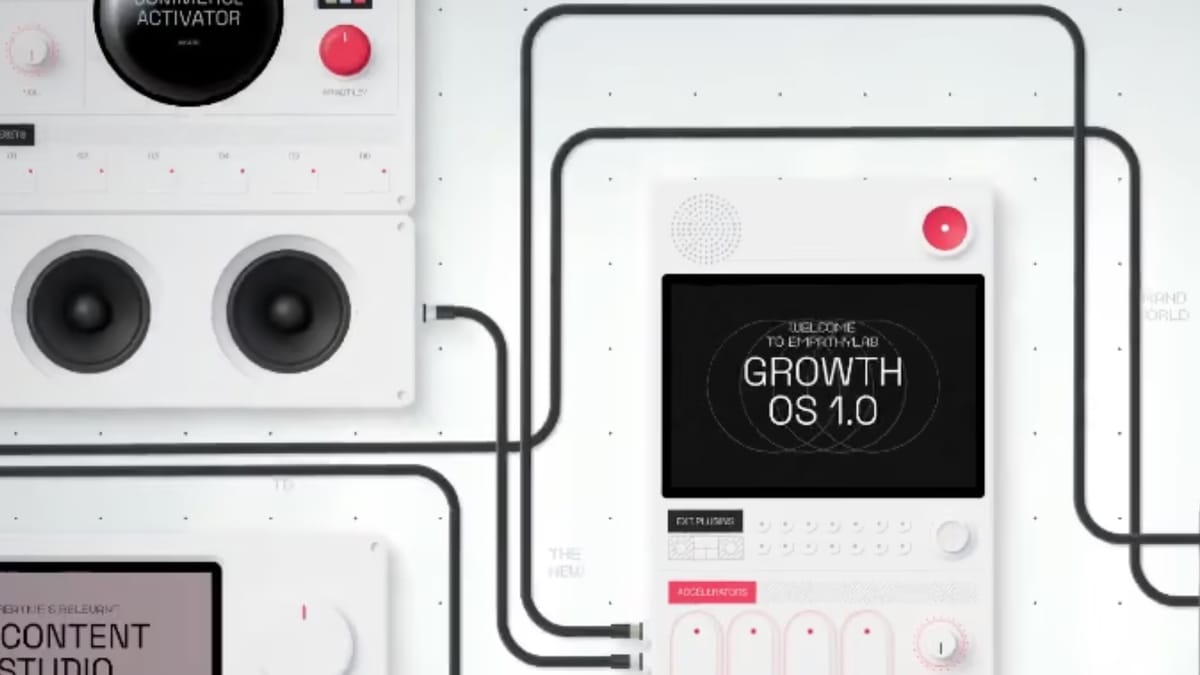
Empathy Lab, a digital consultancy operating as part of EPAM, published a whitepaper on March 10, 2026, laying out a detailed technical and organizational blueprint for what it calls the Growth Operating System - a framework intended to reposition chief marketing officers as the architects of enterprise growth rather than managers of campaign output. The document arrives at a moment when the infrastructure of consumer discovery is shifting underneath marketing teams at a pace that most organizational structures were not built to handle.
The whitepaper, authored by David Billings (Chief Strategy Officer), Alice Lee (Senior Director, Marketing Consulting), Yury Bialykh (CTO), and Ben Hall (VP, GTM North America), makes a direct argument: marketing leaders who respond to the rise of AI-powered search, conversational assistants, and agent-driven shopping journeys with incremental automation will find themselves managing a factory, not a growth engine. Those who instead treat AI as connective tissue across pricing, media, creative, and commerce will, according to the document, own the next decade.
The whitepaper opens with a structural observation that frames everything that follows. "The funnel has collapsed," it states. "Discovery to purchase now happens in one agent-mediated moment, inside systems you don't own." That is not a rhetorical flourish - it is a description of infrastructure changes that have already shipped.
According to the whitepaper, in the first few weeks of 2026 alone, three companies shaping the web's underlying architecture independently announced structural product shifts. Cloudflare, which sits at the front of roughly one fifth of global web traffic, introduced controls that simplify how AI agents access and consume web content at scale. Cloudflare's ongoing work in this area has been substantial, including partnerships with Visa and Mastercard on agent authentication protocols. Coinbase expanded capabilities enabling agents to transact through secure, authenticated wallets. Shopify began re-architecting its commerce platform for agent-driven discovery, configuration, and fulfillment, exposing products and policies in machine-readable form rather than purely human-oriented interfaces.
These moves are not isolated experiments. A global study by Riskified cited in the whitepaper found that 73% of shoppers are already using AI in their shopping journey, 37% use AI to summarize reviews, and 70% are at least somewhat comfortable with an AI agent making purchases on their behalf. A further 45% are embracing AI assistants like ChatGPT for product recommendations, 32% compare prices with AI, and 13% have already completed a purchase after being referred by an AI assistant.
Walmart now integrates with ChatGPT so shoppers can browse and buy without visiting its site, while simultaneously deploying Sparky, its own proprietary shopping assistant, to keep control over the experience and data. That dual approach reflects what the whitepaper calls the new tension: meeting demand wherever it starts, while protecting traffic and brand equity. The dynamics of this tension have been playing out across retail platforms throughout late 2025 and into 2026.
The whitepaper draws on a Gartner survey to establish the gap between awareness and action at the leadership level. According to that research, 65% of CMOs say advances in AI will dramatically change the role of the CMO in the next two years. Yet only 32% say significant changes are needed to the CMO profile and skill set. That gap - between recognizing disruption and preparing for it - is what the document describes as the CMO's "AI Blind Spot."
The NielsenIQ figures cited in the whitepaper add economic weight. According to 2025 NielsenIQ research, only 69% of marketing leaders believe their CEOs and CFOs support long-term brand investment - an 11% drop from the previous year. Meanwhile, 84% of CMOs view return on investment as their primary metric when it comes to budget allocation. Confidence in brand purpose has also slipped, falling from 83% to 71%.
David Billings, Chief Strategy Officer at Empathy Lab, is quoted directly in the whitepaper: "In an AI-mediated market, brand is a critical strategic moat, and effective coordination is what keeps it intact. CMOs who focus only on efficiency will see that moat erode, while those who orchestrate decisions across the system will preserve both growth and relevance."
The document draws a sharp distinction between automation and orchestration - a distinction that carries operational consequences. Automation, according to the whitepaper, speeds up individual tasks but operates inside existing structures. The ceiling appears quickly. Efficiency improves, but the system that governs growth remains unchanged. Gains stay local, returns diminish, and opportunities that sit between functions remain out of reach.
Five warning signs of what the document calls the "efficiency path" are listed: success measured in output volume rather than value; tools selected for productivity rather than interoperability; KPIs tied to channel metrics rather than enterprise outcomes; tasks automated but not integrated into adjacent decisions; and marketing disconnected from product, pricing, and supply.
Orchestration, by contrast, is described as a fundamental change in how decisions are connected, made, and executed. It shifts marketing from optimizing individual functions to aligning the organization around shared growth objectives. The whitepaper is precise about what orchestration is not - it is not replacing people with AI, not optimizing channels in isolation, not generating more content faster, not marketing as an algorithm factory, and not disconnected copilots.
Alice Lee, Senior Director of Marketing Consulting at Empathy Lab, puts it this way in the document: "The real value of orchestration isn't speed, it's coherence. When data, creativity, media and commercial decisions are connected, you stop optimizing in fragments and start shaping outcomes. That's when AI moves from a productivity tool to a growth multiplier across the enterprise."
A concrete case from the whitepaper illustrates this. Empathy Lab partnered with Nectar360 to build Pollen, an agentic retail media platform that applies AI across planning, insight, and activation workflows. Alice Anson, Director of Digital Media at Nectar360, is quoted: "With Pollen we've used AI to stitch together the previously separate layers of retail media, from audience insight through to activation. It means teams can get to intelligent, actionable recommendations quickly, without having to navigate all the underlying complexity."
The whitepaper's most detailed section concerns the architecture of what Empathy Lab calls the Growth Operating System (Growth OS). This is not positioned as a product to purchase but as an architectural pattern to implement - using whatever existing infrastructure an organization already has.
The document introduces six foundational layers. The Unified Data Layer consolidates customer identity across touchpoints and provides real-time access to product data, inventory, and pricing. The Shared Intelligence Services layer maintains a centralized model registry and enables cross-application learning loops - so that, for example, when a pricing model learns something about customer sensitivity, that insight is available to media planning and creative optimization rather than locked inside a single tool. The Policy and Governance Engine enforces brand guidelines, compliance rules including GDPR and CCPA, margin thresholds, and ethical guardrails for AI-generated content across all applications simultaneously.
The Event and Integration Fabric provides event streaming and routing across applications via an API gateway, plus connectors to existing enterprise systems including ERP and CRM. The Human-Agent Governance Layer defines what agents can do autonomously, what requires human approval, and how decisions are logged for accountability. The Operational Foundation provides container orchestration, monitoring, A/B testing infrastructure, and performance management.
The document includes a precise seven-step sequence showing how these layers interact in practice. A pricing team updates margins on a product category. Step one: the Unified Data Layer receives the update from the ERP. Step two: the Event Fabric broadcasts a "pricing-changed" event to subscribed applications. Step three: the AI Media Planner receives the event and recalculates optimal budget allocation. Step four: before executing, it queries the Policy Engine to validate the reallocation against brand and financial constraints. Step five: the Governance Layer checks whether the change exceeds thresholds requiring human approval. Step six: if approved, the Media Planner updates bids and budgets via the Integration Fabric. Step seven: all decisions are logged for audit and fed back to the Intelligence Services for future optimization. The entire sequence, according to the document, can complete in seconds for routine changes.
Implementation is described as flexible. The data layer can run on Databricks or Snowflake. Integration can use MuleSoft or an API gateway. Event-driven services can operate on AWS or Azure. Adobe, Salesforce, SAP, and Shopify become nodes in the orchestration layer rather than systems to work around.
Sitting above the Growth OS are what the whitepaper calls Growth Applications - modular engines each designed to optimize one part of the growth system. These are distinguished from standalone AI tools, which the document describes as tactical add-ons in isolated areas that do not change how the business thinks. Growth Applications, by contrast, influence critical decisions around revenue, cost, or experience through shared data and embedded intelligence.
Four examples from the Empathy Lab portfolio are described. Synthetic Audiences tests product ideas and content on virtual focus groups before market launch. The whitepaper includes a case study from Mars: Empathy Lab used AI-driven audiences to cut research costs, speed up innovation, and democratize testing across global teams. Yasmeen Cohen, Global Product Strategy Lead at Mars, is quoted: "We have 75% accuracy in terms of the response rate from the humans vs the synthetics, which gives us enough certainty to start expanding this capability and use it as an augmentation of our traditional research."
The AI Media Planner allocates budgets dynamically using real-time signals and predictive models. The AI Content Studio generates and localizes creative at scale within brand guardrails. The Agentic Commerce Activator prepares product data, creative, and pricing logic for AI-driven shopping journeys - directly addressing the structural challenge documented by Retail Economics and Amazon Web Services in a March 2026 report showing that AI bot traffic grew 5.4 times during 2025, with OpenAI generating 198 crawls for every single visit delivered to a retail site.
Architecture without governance is, according to the whitepaper, "a concept rather than an operational reality." The document describes a Growth Governance Council chaired by the CMO and including the CFO, CIO, CDO, commercial leadership, legal and compliance, and customer experience or product leads. This body sets enterprise objectives and outcome KPIs, brand laws and safety parameters, and liquidity rules including hurdle rates and risk thresholds. It also maps decision rights - what agents can do automatically, where human approval applies, and who owns exceptions. The operational cadence runs to monthly parameter calibration and quarterly outcome reviews.
At the operational level, cross-functional Growth Squads operate one or more Growth Applications within the guardrails of the Growth OS. Each squad owns an outcome - acquisition, activation, retention, trade, commerce, or brand experience. Squad roles described in the whitepaper include a Growth Architect who sets outcome goals and owns the applications backlog; a Model Supervisor who audits agent decisions and anomaly feeds; a Prompt Strategist and Creative Architect who creates master templates and curates output; a Signal Engineer who connects real-time signals to the OS; a Privacy and Ethics Lead who encodes brand law and compliance checks; and an Agent Steward who documents behaviors and failure modes for agents.
Reckitt's Bastien Parizot, Senior Vice President IT & Digital, is cited at length in the whitepaper on the practical value of this approach. Reckitt has deployed 10 AI marketing tools within a single enterprise-grade AI solution running on its data and analytics backbone. The platform empowers more than 1,000 marketers across 15 markets. Sameer Amin, SVP Media at Reckitt, is also quoted: "In 2026, brands have to do two things at once. They need to use AI to orchestrate richer, more consistent brand experiences everywhere people engage. And they need to ensure that same brand meaning is encoded clearly enough to surface favorably when AI assistants assemble recommendations. Miss either, and preference is shaped elsewhere."
The whitepaper's argument lands at an intersection that PPC Land has been tracking closely throughout the past year. The rise of agentic commerce has already reshaped the product data requirements for retail advertisers. AI-powered search has changed how brands need to think about visibility, with research from Gartner projecting that by 2026, approximately 30% of brand perception will be shaped by generative AI content. Even the accuracy of AI tools for campaign guidance has emerged as a concern, with one study finding 20% of AI responses to PPC-related questions contained inaccurate information.
The Empathy Lab document does not address advertising platforms directly. Its focus is organizational architecture. But the implications for performance marketers are concrete. When pricing updates trigger automatic media shifts, when brand guardrails are embedded in every automated workflow, and when AI agents weigh structured data in seconds to determine which products surface in recommendations, the margin for error in how brands represent themselves to machines narrows considerably.
Jeroen Manten, Director IT Digital at PostNL, captures this in a quote within the whitepaper: "Today, we talk a lot about AI and new technology, but the real shift is in what customers will expect from us. They will increasingly expect organizations to do the work for them. When you think about that, you realise we don't have a channel problem anymore - we have an orchestration challenge."
The question of whether CFO pressure or CMO leadership drives AI adoption at scale is one that the industry has begun actively debating. Sir Martin Sorrell, founder of Monks, argued in March 2026 that enterprise AI adoption at scale will be compelled by chief financial officers rather than led by marketing chiefs. The Empathy Lab whitepaper makes the opposite case: that CMOs who cede this ground to cost pressure alone will end up optimizing themselves into irrelevance.
The document's final section offers a six-step operational sequence for marketing leaders to begin building toward orchestration. These include naming three enterprise outcomes to own in the current quarter, standing up a small application portfolio tied to those outcomes, activating decision rights with the CFO, running a weekly rhythm where squads review anomaly logs and agent win-rates, publishing outcome dashboards that show compounding impact across pricing, media, creative, and commerce, and updating brand strategy to encode brand essence in a form that machines can carry and humans can feel.
Who: Empathy Lab, a digital consultancy operating under EPAM, authored by David Billings, Alice Lee, Yury Bialykh, and Ben Hall. External voices include executives from Reckitt, Mars, Nectar360, PostNL, and Walmart.
What: A 34-page whitepaper titled "The Growth Operating System: Why orchestration is the new source of competitive advantage for CMOs," introducing a six-layer technical architecture and a governance model designed to unify AI-powered marketing applications into a single connected system.
When: Published March 10, 2026, drawing on data from Gartner, NielsenIQ, and Riskified research published in 2025 and early 2026.
Where: Published by Empathy Lab, an EPAM company. The whitepaper is available for download via Empathy Lab's website. The case studies cover Reckitt (15 markets, 1,000+ marketers), Mars (global product testing), Nectar360 (retail media), and PostNL (customer experience orchestration).
Why: According to a Gartner survey cited in the document, 65% of CMOs expect AI to dramatically change their role within two years, yet only 32% say significant changes to the CMO skill set are needed. The whitepaper argues this gap - between recognizing disruption and preparing for it - will separate organizations that control their own demand from those whose visibility is shaped by external algorithmic systems they do not own.