X terminates European Commission's ad account after €120 million fine
X head of product Nikita Bier terminated the European Commission's advertising account on December 7, 2025, two days after the EC imposed a €120 million DSA fine.

X terminated the European Commission's advertising account on December 7, 2025, two days after the regulatory body imposed a €120 million fine against the platform for Digital Services Act violations, marking an unprecedented escalation in the conflict between the social media company and European regulators.
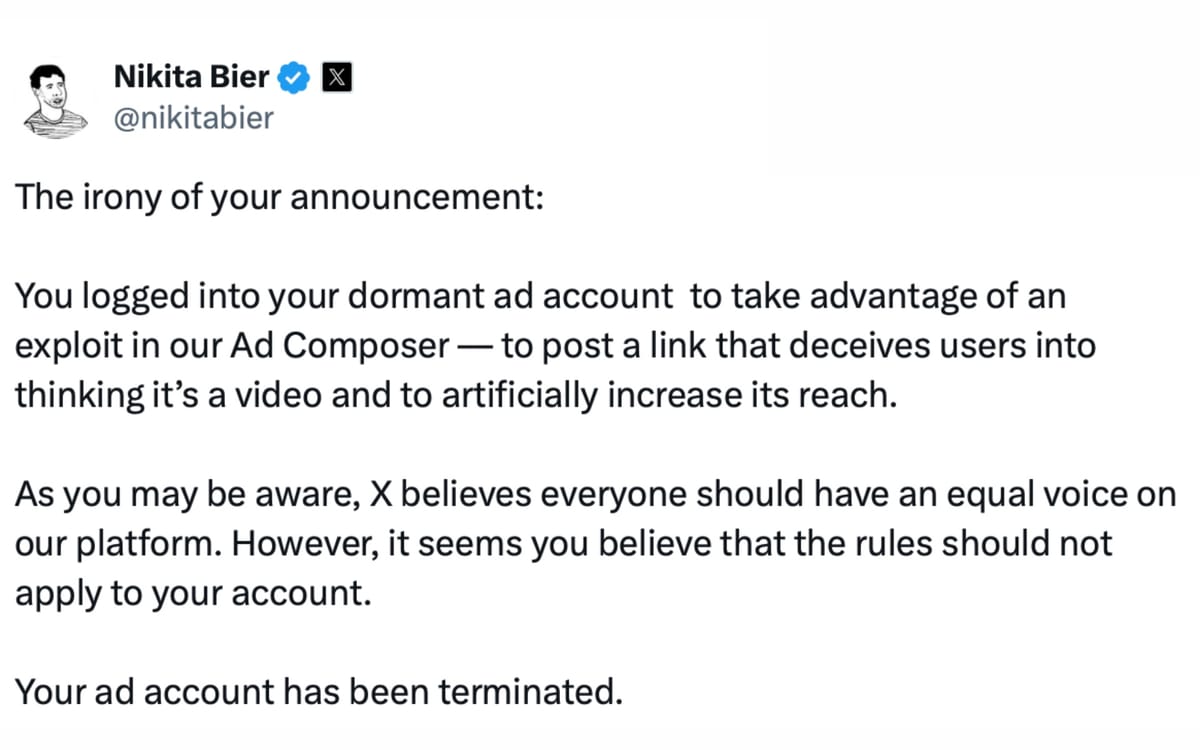
Nikita Bier, X's head of product, announced the termination in a response to the Commission's announcement of the fine, according to a post on X. "The irony of your announcement: You logged into your dormant ad account to take advantage of an exploit in our Ad Composer — to post a link that deceives users into thinking it's a video and to artificially increase its reach," Bier wrote.
"As you may be aware, X believes everyone should have an equal voice on our platform," Bier continued. "However, it seems you believe that the rules should not apply to your account. Your ad account has been terminated."
Subscribe PPC Land newsletter ✉️ for similar stories like this one
The accusation creates a notable contradiction: X's head of product acknowledged the platform offers advertising formats capable of deceiving users about content type, the same category of deceptive design practices cited in the European Commission's €120 million fine. Bier's statement characterizes this ad format as an "exploit" rather than an intentional product feature, suggesting the platform recognizes the deceptive potential of certain advertising presentation methods.
The account suspension prevents the European Commission from running paid advertisements on X, severing a channel the regulatory body previously used for public campaigns on climate action, digital rights, and anti-disinformation efforts, according to reports from TASS and other international news sources.
The European Commission issued the €120 million fine on December 5, 2025, marking the first non-compliance decision under the Digital Services Act. The penalty addressed three distinct violations: deceptive design of the platform's blue checkmark verification system, inadequate transparency in its advertising repository, and failure to provide researchers with access to public data.
The termination decision represents a dramatic reversal of the typical platform-regulator relationship, where technology companies typically face enforcement actions from government bodies rather than taking punitive action against them. X's move demonstrates the platform's willingness to prioritize what it characterizes as equal enforcement of platform rules over maintaining relationships with regulatory authorities.
Bier's accusation centers on the Commission's use of X's advertising system to promote the fine announcement itself. According to his statement, the Commission accessed a dormant advertising account and used features of the Ad Composer tool to create a post designed to appear as video content, a format that typically receives higher engagement and reach on the platform.
The acknowledgment that X's Ad Composer contains functionality allowing advertisers to create misleading content presentations raises questions about platform design accountability. The Commission's fine specifically targeted deceptive design practices, with Executive Vice-President Henna Virkkunen stating that "deceiving users with blue checkmarks" violated DSA transparency requirements. X's own admission that its advertising tools enable deceptive formatting appears to validate concerns about platform design choices that mislead users.
The timing of the account termination, occurring just 48 hours after the fine announcement, suggests a deliberate response to the regulatory action. X has not issued formal statements explaining the specific technical violation the Commission allegedly committed, nor has the company clarified whether it plans to modify the Ad Composer tool to prevent future exploitation of the deceptive format capability.
The Digital Services Act fine itself addressed multiple transparency shortcomings. According to the Commission's December 5 press release, X's blue checkmark system deceives users by allowing anyone to purchase verified status without meaningful identity confirmation. "On X, anyone can pay to obtain the 'verified' status without the company meaningfully verifying who is behind the account, making it difficult for users to judge the authenticity of accounts and content they engage with," the Commission stated.
The regulatory body also cited inadequate advertising repository transparency, noting that X's database lacks sufficient details about advertiser identities and targeting criteria. Additionally, the Commission found that X's terms of service impose unnecessary barriers preventing eligible researchers from accessing publicly available platform data through scraping methods.
The €120 million penalty breaks down into three components: €45 million for the blue checkmark violation, €40 million for researcher data access restrictions, and €35 million for advertising repository deficiencies, according to Commission officials cited by Euronews. The fine represents the first of potentially multiple Digital Services Act enforcement actions against X, with two additional investigations ongoing regarding illegal content moderation and algorithmic recommendation systems.
U.S. diplomatic officials reacted sharply to both the fine and the subsequent account termination. U.S. Ambassador to the European Union Andrew Puzder characterized the fine as "excessive" and "the result of EU regulatory overreach targeting American innovation" on December 6, according to the Commission decision documentation.
Secretary of State Marco Rubio escalated the rhetoric further, posting on X that "The European Commission's $140 million fine isn't just an attack on @X, it's an attack on all American tech platforms and the American people by foreign governments," according to Fortune. Elon Musk subsequently agreed with Rubio's characterization.
The conflict occurs amid broader tensions between major technology platforms and European regulators. Google faces a €2.95 billion fine for advertising technology violations imposed by the Commission in September 2025. Meta challenged a Commission decision on Digital Markets Act compliance in July 2025, while multiple platforms including Google and Meta withdrew entirely from European Union political advertising markets in 2025 citing regulatory complexity.
Buy ads on PPC Land. PPC Land has standard and native ad formats via major DSPs and ad platforms like Google Ads. Via an auction CPM, you can reach industry professionals.
For the digital advertising industry, the account termination raises questions about platform accountability mechanisms and the limits of regulatory enforcement. Advertising platforms typically maintain terms of service that prohibit specific content or practices, with account suspension serving as the primary enforcement mechanism for violations.
X's admission that its Ad Composer tool contains exploitable features enabling deceptive content presentation highlights tensions between product design and platform policy enforcement. The company's characterization of the format as an "exploit" suggests unintended functionality, yet the feature apparently remained available to advertisers despite its potential to mislead users about content type.
Digital advertising standards generally require clear labeling of content types to prevent user confusion. Video content typically commands higher engagement rates and premium advertising pricing compared to static or text-based formats, creating financial incentives for advertisers to misrepresent content presentation. X's acknowledgment that its tools enable such misrepresentation without proper safeguards raises questions about platform design priorities.
The European Commission has not publicly responded to the account termination as of December 7, 2025. The regulatory body faces a decision about whether to escalate the conflict further, potentially through additional Digital Services Act enforcement actions, or to seek alternative channels for communicating with European users on X.
X maintains that the Ad Composer exploit violated platform policies, though the company has not specified which particular policy the Commission breached or whether the deceptive ad format capability has been disabled for other advertisers. The platform's advertising policies prohibit deceptive content, manipulated media, and attempts to artificially inflate engagement metrics, among other restrictions.
The apparent availability of ad formats that can deceive users contradicts X's stated policy prohibitions against deceptive content. Platforms typically bear responsibility for designing advertising tools that comply with their own stated policies, rather than offering functionality that enables policy violations and then penalizing advertisers who utilize available features.
The Commission's advertising account had remained dormant since 2021, according to Bier's statement, suggesting the regulatory body had not actively used X's paid promotion features for several years before accessing the account to promote the fine announcement.
U.S. political figures have framed the dispute as part of broader trade tensions between the United States and European Union. President Donald Trump's administration has criticized European digital regulations as protectionist measures targeting American technology companies, with Commerce Secretary Howard Lutnick characterizing the Digital Services Act as "overseas extortion," according to reports cited by multiple news sources.
The account termination follows a pattern of X taking increasingly confrontational positions toward regulatory authorities. The platform withdrew from the EU's voluntary Code of Conduct on Disinformation in May 2023, citing disagreements with mandatory third-party fact-checking requirements. The Commission opened Digital Services Act investigations into X less than two months after the platform's DSA obligations became legally binding.
Executive Vice-President Henna Virkkunen stated in the December 5 announcement: "Deceiving users with blue checkmarks, obscuring information on ads and shutting out researchers have no place online in the EU. The DSA protects users," according to the Commission's press release.
The platform has 60 working days to inform the Commission of measures addressing the deceptive blue checkmark usage, and 90 working days to submit action plans for remedying advertising repository and researcher access violations. Failure to comply with the non-compliance decision may trigger periodic penalty payments, according to the Commission's enforcement framework.
For advertising technology professionals, the dispute highlights growing friction between platform governance mechanisms and regulatory oversight. Platforms increasingly face demands for content moderation, transparency, and data access from multiple jurisdictions with divergent requirements, creating operational challenges for companies operating globally.
The acknowledgment that X's advertising tools enable deceptive content presentation may strengthen the Commission's position in ongoing DSA enforcement proceedings. Platform design choices that facilitate user deception directly contradict transparency requirements under European digital regulations, potentially supporting arguments for more stringent oversight or design modifications.
The Digital Services Act applies to Very Large Online Platforms with more than 45 million monthly users in the European Union, representing 10 percent of the bloc's population. X qualifies under this threshold, subjecting the platform to enhanced transparency obligations and potential fines reaching 6 percent of global annual turnover for serious violations.
The Commission's fine represents less than 1 percent of the maximum penalty X could face under DSA provisions, suggesting potential for significantly larger enforcement actions if the platform fails to address the identified violations or commits additional infractions. The existence of advertising formats capable of deceiving users about content type may factor into future compliance assessments.
Subscribe PPC Land newsletter ✉️ for similar stories like this one
Subscribe PPC Land newsletter ✉️ for similar stories like this one
Who: X head of product Nikita Bier terminated the European Commission's advertising account, affecting the regulatory body's ability to run paid promotions on the platform. The European Commission had imposed the €120 million fine under Executive Vice-President Henna Virkkunen's authority. U.S. diplomatic officials including Ambassador Andrew Puzder and Secretary of State Marco Rubio criticized the enforcement action.
What: X permanently suspended the European Commission's advertising account, preventing the regulatory body from running paid advertisements on the platform. The termination came after X accused the Commission of exploiting the Ad Composer tool to create deceptive video-like content that artificially increased reach. Bier's statement acknowledged X offers advertising formats capable of deceiving users about content type, characterizing these features as "exploits" available through the Ad Composer tool. The action followed the Commission's €120 million Digital Services Act fine for three violations: deceptive blue checkmark design, inadequate advertising repository transparency, and blocking researcher data access.
When: X announced the account termination on December 7, 2025, two days after the European Commission issued the €120 million fine on December 5, 2025. The fine followed a two-year investigation that began with formal proceedings opened December 18, 2023, and preliminary findings adopted July 12, 2024.
Where: The enforcement actions affect X's operations across the 27 European Union member states, where the platform has more than 45 million monthly users qualifying it as a Very Large Online Platform under Digital Services Act regulations. The account termination prevents the European Commission from running advertisements visible to users in any geographic location through X's platform.
Why: X justified the account termination by claiming the European Commission violated platform policies by accessing a dormant advertising account to exploit features in the Ad Composer tool that enable deceptive content presentation. The company's acknowledgment that its advertising tools contain functionality allowing users to deceive others about content format creates a contradiction with the platform's stated policies against deceptive content, while also validating regulatory concerns about deceptive design practices cited in the €120 million fine. The action represents X's stated commitment to equal enforcement of platform rules regardless of account holder status, while also serving as apparent retaliation for the regulatory penalty.