YouTube sneaks into Android Auto - but only as audio controls
YouTube now appears in Android Auto's media controls, letting drivers play, pause, and skip content. Video playback remains blocked. Premium subscription required.


YouTube now appears in Android Auto's media controls, letting drivers play, pause, and skip content. Video playback remains blocked. Premium subscription required.
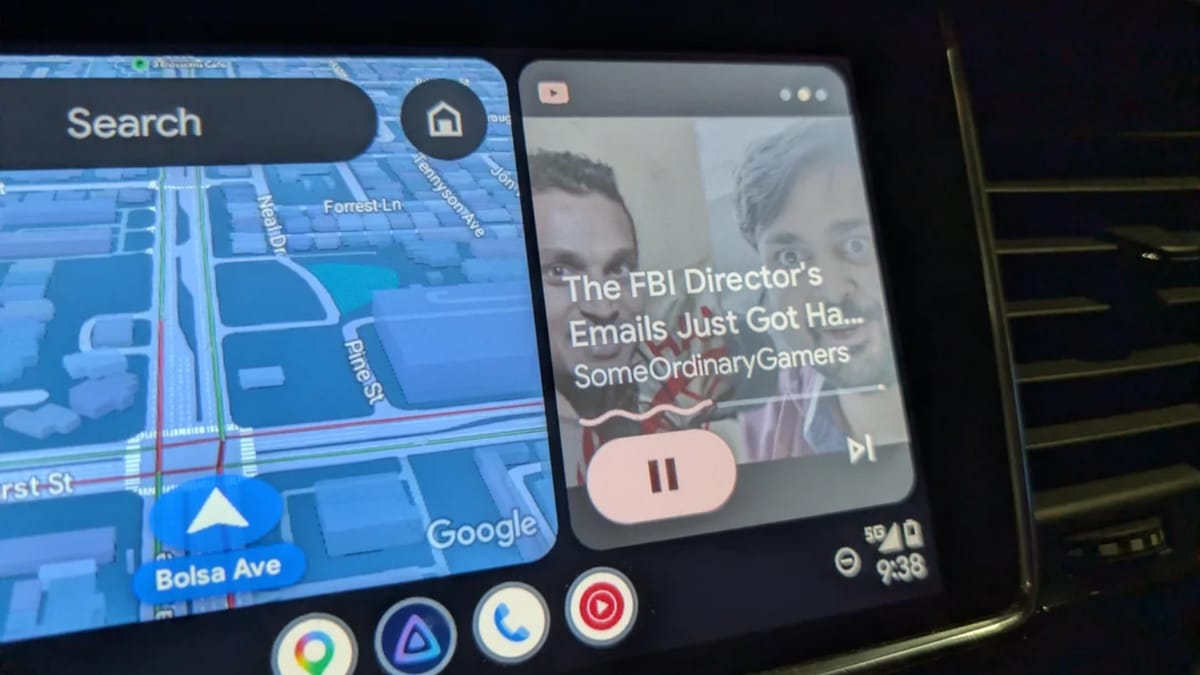
YouTube today quietly extended its reach to Android Auto dashboards, showing up in the platform's media controls - the same strip of buttons that drivers typically use to manage music and podcasts. The change, spotted by users on the r/AndroidAuto subreddit over the past 48 hours, does not bring full video playback to in-car screens. What it does bring is basic transport control: play, pause, and skip. For millions of people who use YouTube as a podcast substitute, that is a meaningful, if modest, shift.
The feature appears to be a server-side rollout, not tied to a specific app version update. According to a Reddit user posting in the r/AndroidAuto community, the player "happened in the middle of my car ride, which was weird" - indicating Google is deploying this incrementally rather than through a conventional app release. No APK sideload or manual update appears to be required.
The new integration places YouTube inside Android Auto's media panel. Drivers can see what is currently playing on YouTube and use the standard transport controls available on their car's head unit display. There is no video feed, no content browser, and no full-screen player. According to Android Authority, which first reported the feature, "there's still no video playback, no browsing, and not even a full-screen player."
In practical terms, this means a driver who was listening to a YouTube video before getting in the car can now resume, pause, or skip that content without picking up their phone. The audio continues playing while the phone's screen remains off, which is the core use case here - one that until now required either a workaround or the use of a separate app like YouTube Music.
There is a meaningful prerequisite. According to Android Authority, "you'll need a YouTube Premium subscription for this to work, since background playback is required." The report notes that the cheaper Premium Lite plan, priced at $7.99 per month since its US launch in March 2025, qualifies for the feature. That plan added background play and offline downloads as recently as March 3, 2026, closing a long-standing gap between Lite and the full $13.99 monthly tier.
This subscription requirement narrows the audience considerably. According to YouTube's own earnings disclosures, the platform crossed 300 million paid subscriptions across Google One, YouTube Premium, and YouTube Music during the third quarter of 2025. However, the overlap between Premium or Premium Lite subscribers and Android Auto users in cars equipped with compatible head units is a subset of that figure.
The obvious follow-up question is whether full video playback will follow. Community responses on Reddit suggest this is unlikely while a vehicle is in motion, and for reasons that go beyond technical complexity.
According to one r/AndroidAuto user who drives a 2024 Nissan Frontier: "AA/Google does everything in its power to NOT LET you do video while driving because of the legal repercussions. That's why most AA apps want your phone rooted to use it." Another user confirmed that in their 2026 Chevrolet Equinox, YouTube video "only plays in park and needs an Onstar plan."
That last detail is significant. A user identified as Br33d confirmed: "I've got the YouTube app in my 2026 Equinox, it only plays in park and needs an Onstar plan. Also plays a bunch of other streaming services like PeacockTV, Prime Video, HBO, etc. Only while parked though."
This aligns with what Google announced at I/O 2025. According to Android Authority, "Google announced plans at I/O 2025 to add video app support for Android Auto while parked." The parked-only limitation reflects a deliberate legal and safety position: video content running while a vehicle is in motion creates liability that no major platform has been willing to accept in a certified app. Workarounds exist - third-party tools like Carstream, available via the unofficial AAAD repository, allow some users to cast video to their screens - but these fall outside Google's officially sanctioned ecosystem.
The distinction matters. Android Auto's official framework, which Google controls and enforces through its app approval process, has consistently restricted video to audio-only contexts while driving. A user on the thread noted that Android Auto "does everything in its power to remove the 'video' side of AA apps," and that Google is likely to keep official YouTube video restricted to parked scenarios indefinitely - or until legislation in key markets explicitly addresses in-vehicle entertainment.
The actual utility of today's change is most visible in a specific usage pattern: long-form audio content consumed via YouTube rather than a dedicated podcast app. YouTube hosts enormous quantities of podcast-style content - interviews, commentary, educational series - that many users prefer because the content is free with ads or accessible via Premium without switching apps.
A user in the thread summarised the situation succinctly: "I mostly care about YouTube control. I listen to podcasts on YouTube quite a bit and I can't control it at all without touching my phone." Another added: "I listen to kind of a videocast - 90% sounds but sometimes they show kind of images."
For this group, the Android Auto integration removes a specific friction point. Previously, managing YouTube audio in the car meant either glancing at a phone screen - legally and practically problematic - or missing track controls entirely. The new media panel controls address exactly that gap, even without any video element.
According to a comment from user zacharydunn60, who asked whether the feature supports background play: "The integration looks native and polished! Does it support background play (audio only when screen off)?" The original poster, who identified as driving a 2019 Buick Encore, confirmed it does.
There is a gap between the feature that has arrived and what Android Auto users have been requesting for years. Apple CarPlay, one of Android Auto's primary competitors, does support video playback in certain vehicle configurations. A user noted the irony directly: "The ultimate irony is that Apple CarPlay has this feature and on Android Auto it's not available... for now anyway."
The comparison is complicated. CarPlay's video support has historically depended on vehicle manufacturer implementation and often also restricts playback to parked or passenger-use scenarios. But the perception that CarPlay has moved faster on this front contributes to frustration among Android Auto users who see competitors advancing while their platform delivers audio controls as a notable update.
Third-party alternatives have filled part of this gap. The AA Browser, referenced by multiple users in the thread, allows YouTube and other streaming services to load in a web-based interface. According to user stephengnb: "I now use AA Browser to watch YouTube, and while I like that it turns off when in Drive for safety reasons, I understand some people don't want that." Carstream, distributed via the AAAD repository on GitHub, provides a more direct casting experience but operates outside Google's official framework and has faced periodic Play Store removals.
Not all Android Auto users are seeing the new YouTube media controls yet. The rollout appears to be server-side, meaning Google is enabling it gradually across accounts rather than through a uniform software update. According to the original Reddit post by IGameShit, the change "happened in the middle of my car ride, which was weird" - an unusual characteristic for app-level updates but consistent with how Google deploys many Android Auto features.
Some users questioned whether the feature was simply YouTube Music rather than regular YouTube. The original poster addressed this: "The symbol in the top left of the player indicates to me that it's taking it straight from YouTube, as I was watching this video from YouTube directly." This distinction matters because YouTube Music has displayed video player controls in Android Auto for some time - the novelty here is the appearance of the main YouTube app in that same interface.
User dennyfischer confirmed independently: "It's YouTube, but audio-only. Got this also on my Pixel 10 Pro." Multiple device configurations appeared in the thread, including the Pixel 8 Pro and the Samsung Galaxy range running Android 16.
For marketing professionals, the Android Auto integration touches a segment of YouTube consumption that has historically been difficult to monetize or measure. In-car audio listening differs from the living-room and mobile YouTube experiences that most advertising campaigns are optimised for.
YouTube's advertising revenues grew 15% year-over-year to $10.3 billion in Q3 2025, driven primarily by direct response advertising. That growth has been concentrated on mobile and connected TV screens. The in-car screen represents a nascent and legally constrained surface - one where, at least for now, video ads cannot play while the vehicle is moving. Audio-only consumption through Android Auto falls into a grey zone: YouTube's standard ad insertion logic applies, but the user interface removes visual ad elements.
YouTube Premium Lite's expansion to include background play, announced on March 3, 2026, is directly relevant here. More users on the entry-level subscription tier now have access to the background playback that makes the Android Auto integration functional. Simultaneously, those users are consuming YouTube content in an ad-light environment - Premium Lite removes most ads while retaining some music and Shorts advertising. The net effect for advertisers is a growing segment of YouTube consumption that occurs outside their standard targeting reach.
The broader context of YouTube's subscription growth - which saw the platform test a two-person Premium plan in India, France, Taiwan, and Hong Kong beginning May 5, 2025 - reflects a deliberate strategy to capture more paying users across diverse economic profiles. Each incremental Premium or Premium Lite subscriber is a viewer who transitions partially out of the ad-supported inventory pool. The Android Auto integration extends Premium's utility into one more context: the commute.
Who: Google, as the developer of both YouTube and Android Auto, is rolling out the change. It affects Android Auto users with a YouTube Premium or Premium Lite subscription, across multiple vehicle types and head unit configurations.
What: YouTube now appears in Android Auto's media controls, allowing play, pause, and skip functionality for content playing on YouTube via a connected Android phone. There is no video playback, no content browser, and no full-screen player. The feature requires a YouTube Premium or Premium Lite subscription because it relies on background playback capability.
When: The rollout began appearing for users approximately two days before the date of this article, on or around March 28, 2026. It is a server-side update with no specific app version tied to its appearance.
Where: The feature operates within Android Auto's existing media panel interface, which appears on compatible car head units when a phone running Android Auto is connected. It has been confirmed across multiple vehicles and phone models running Android 15 and Android 16.
Why: Google has been working toward broader video app support for Android Auto, as announced at I/O 2025. The media controls represent an incremental step - extending YouTube's audio control functionality into the car, with full video expected to follow in parked scenarios as that feature set matures. The legal constraints around in-motion video on car screens remain the primary limiting factor for any expansion beyond audio.