
33Across and Valpak bet on new movers to fix programmatic's signal problem
33Across and Valpak today launched an exclusive supply-side partnership activating new mover audiences across CTV, display, and mobile through AI-driven curation.

33Across and Valpak today launched an exclusive supply-side partnership activating new mover audiences across CTV, display, and mobile through AI-driven curation.
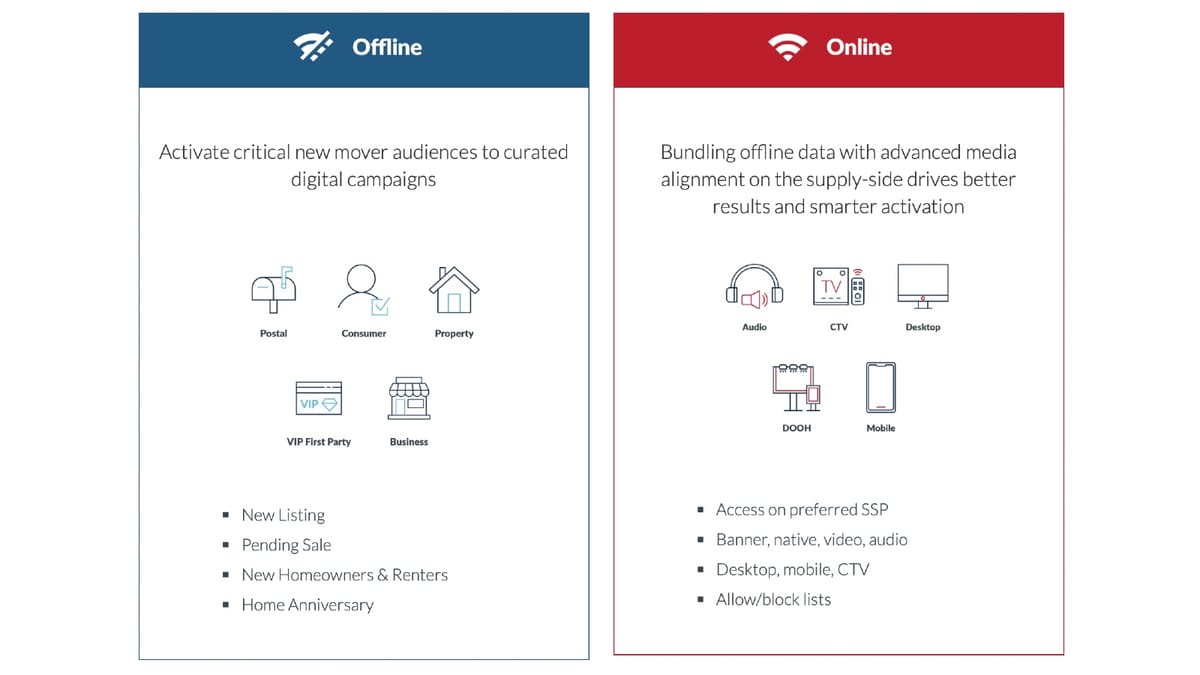
33Across today announced an exclusive supply-side partnership with Valpak, combining offline mover data with programmatic inventory curation to give advertisers access to new mover audiences across connected television, display, and mobile channels. The deal, disclosed on March 3, 2026, connects Valpak's deterministic lifestage datasets directly into curated private marketplaces, positioning the partnership as a response to the ongoing degradation of third-party identity signals across the open web.
The mechanism sits at the supply side. Rather than applying Valpak data at the demand-side platform level - where data match rates deteriorate through cookie syncing - 33Across integrates the audience intelligence before inventory reaches any DSP. According to the announcement, this is handled through Glossary, 33Across' supply-side curation product, which filters non-performant supply and surfaces what the company describes as premium, performance-ready media. The approach reflects a broader structural shift already documented across the industry: supply-side platforms are moving from passive inventory pipes to active curation layers that pre-package audiences and media quality together before a bid request ever leaves the exchange.
The commercial logic behind the deal rests on a specific consumer behaviour thesis. Moving home, according to the companies, represents one of the most commercially potent moments in a household's lifecycle. Purchases cluster densely around relocation - financial products, insurance policies, telecom services, home improvement, retail, and more. The argument is that a consumer who has just signed a new lease or mortgage is not merely addressable, but actively shopping across multiple high-value categories at once.
"New movers present a rare window when consumers are actively making high-value, multi-category purchases," said Paul Bell, President of 33Across. "By activating deterministic lifestage data through curated supply, marketers can connect these audiences with premium content and optimized media paths that drive measurable performance, moving beyond broad demographics to outcome-based activation."
Valpak's historical strength has been exactly this kind of lifecycle targeting, but through direct mail. The company's iconic Blue Envelope mails to more than 41 million demographically targeted households each month, according to company materials. Its data business - Valpak Data - draws from billions of aggregated records across public, survey, behavioral, transactional, and proprietary sources. The partnership transfers that offline intelligence into digital inventory environments for the first time at the supply level, rather than layering it on top of DSP campaigns after the fact.
"Valpak has long helped brands reach movers through our iconic Blue Envelope," said Benjy Uhl, Head of Product and Data at Valpak. "Extending our mover audiences into digital environments through 33Across allows marketers to engage high-intent consumers consistently across CTV, display, and mobile."
The technical architecture of the deal matters for understanding what differentiates it from conventional data-layering approaches. In a standard programmatic workflow, audience data is typically applied at the DSP after an impression has been requested - a method that introduces matching inefficiencies. Research published in 2024 documented that match rate losses between platforms typically range from 40% to 70%, with further data deterioration at each third-party cookie sync. Applying Valpak data on the supply side before the bid request is issued sidesteps a significant portion of that degradation.
Through the Glossary product, Valpak's mover journey data is integrated directly into curated private marketplaces (PMPs). The data is applied at the supply level before inventory reaches the DSP, filtering non-performant supply and surfacing premium, performance-ready media. According to the announcement, activating audiences at the media consumption point also yields what the companies call "true publisher overlap" - meaning greater segment scale than would be achievable by stacking data on top of post-bid inventory selection.
The three headline capabilities outlined in the partnership are:
The efficiency argument is not trivial. The Association of National Advertisers has found that on average, 42% of each programmatic dollar is directed toward "nonworking media" - fees, technology costs, and supply chain intermediaries rather than actual media placement. Supply-side data activation, by shifting targeting logic upstream, is designed to reduce the proportion of spend absorbed by these layers. The IAB Tech Lab formally standardised curation frameworks in late 2024, establishing protocols for how supply-side audience packaging should function, which created clearer infrastructure for deals like this one to operate within.
The partnership arrives as the programmatic industry continues to absorb the consequences of third-party signal erosion. The challenges facing advertisers unprepared for a cookieless environment have been well-documented. Third-party cookies remain deprecated in Firefox and Safari, and identity resolution products have proliferated - but match rates and audience accuracy vary considerably across vendors. IP address matching, examined in late 2025, was found to produce accuracy rates as low as 13% for postal matches, undermining one of the alternative identity approaches many advertisers had adopted.
Against that backdrop, deterministic data sources - records tied to known, verified events like household moves - carry a different quality profile than probabilistically inferred identity. Valpak's mover datasets are derived from billions of aggregated records across public, survey, behavioral, transactional, and proprietary sources, according to the company. That specificity, combined with the supply-side integration architecture, is the proposition 33Across is building the partnership around.
The industry has been moving in this direction across multiple channels. Programmatic curation was identified in December 2025 as the anticipated cornerstone of programmatic audio buying in 2026, with analysts at Triton Digital predicting that quality and alignment would matter more than raw scale. The same structural logic applies here: an advertiser reaching 41 million mover households through a curated deal ID may derive more campaign value than reaching a nominally larger audience through open auction inventory of uncertain quality.
33Across was founded in 2008 by Eric Wheeler, according to Wikipedia. The company is based in Sunnyvale, California, and has operated in the programmatic supply-side space for over 15 years. Its technology history spans data segmentation from 2009, a supply platform launched in 2014, the 33Across Exchange and curated deals from 2016, and the LEXICON identity product launched in 2021. According to company materials, LEXICON's identity resolution technology now powers 150 billion bid requests daily as of 2024.
The company describes itself as shortening the path between inventory and advertising demand using machine learning, AI, and predictive modeling. Its positioning emphasises privacy-first principles and cross-device bidding capabilities. The Glossary curation product, at the centre of this Valpak deal, represents 33Across' more recent focus on pre-DSP audience packaging - a capability set that has grown in strategic importance as the value of supply-side data integration has become clearer across the market.
The Valpak deal follows a September 2025 announcement in which 33Across launched a product aimed specifically at financial services marketers, offering unique audiences and digital inventory targeting. That earlier move signalled the company's intention to build vertical-specific audience propositions through supply-side infrastructure, of which the Valpak partnership is a further development.
Valpak operates as what the company calls the nation's premier direct marketing company, trusted by tens of thousands of local and national businesses. The direct mail product - the Blue Envelope - mails to more than 41 million demographically targeted households each month. However, the partnership announced today draws on a different part of the business: Valpak Data, which helps marketers identify and build target audiences using a multi-sourced audience data stack that combines thousands of data points across billions of records, to support audience development and campaign optimisation.
The mover journey data specifically is derived from aggregated records across public sources, survey data, behavioral signals, transactional records, and proprietary sources. This breadth of sourcing is what allows the data to cover different types of relocation - out-of-state moves, upsizing, downsizing, and business launches - each of which carries its own downstream purchasing behaviour profile.
For marketers, the practical implication of this deal is that Valpak's new mover audiences become accessible through curated private marketplace deals across CTV, display, and mobile - without requiring a separate data licensing agreement or custom integration. The supply-side packaging means the audience is already embedded in the inventory deal ID, reducing the operational complexity of activation.
The CTV component is particularly notable. Connected TV advertising spending has approached $33.35 billion in 2025, with CTV budget allocation having doubled from 14% in 2023 to 28% in 2025. Reaching verified mover households on CTV - a high-attention, living-room environment - represents a different proposition to the same audience targeted through open programmatic display inventory. Industry experts have repeatedly cautioned advertisers against running CTV campaigns without curation, noting that open-market CTV buying often surfaces inventory of uncertain quality.
The deal also intersects with ongoing shifts in how the industry thinks about lifestage and intent data. IAB Australia's retail media blueprint from December 2025 identified trigger-based and lifecycle-based segmentation as among the most effective audience frameworks - precisely the model Valpak's mover data represents. Real-time triggers, the blueprint noted, enable highly personalised response methodologies inside buying windows. A household that has recently moved is, by definition, inside one of the most commercially active buying windows in its lifecycle.
The privacy architecture of the deal - supply-side integration of consented, aggregated data rather than individual-level cross-site tracking - is also aligned with the direction regulators and browsers have pushed the industry. The exclusive nature of the partnership means the combination of Valpak mover data with 33Across curation will not be available through other supply-side platforms, at least within the terms of the current agreement.
Who: 33Across, a programmatic supply-side technology company founded in 2008 and based in Sunnyvale, California, and Valpak, a direct marketing company known for its Blue Envelope direct mail product reaching more than 41 million households monthly.
What: An exclusive supply-side partnership integrating Valpak's new mover audience data directly into 33Across' Glossary curation product, enabling advertisers to activate deterministic lifestage data through curated private marketplaces across CTV, display, and mobile inventory - with data applied before inventory reaches the DSP, rather than layered on top of post-bid inventory selection.
When: Announced March 3, 2026.
Where: The partnership operates across the open programmatic web in the United States, with inventory accessible through curated private marketplace deal IDs activatable via any demand-side platform.
Why: Ongoing signal loss across the programmatic ecosystem has eroded the reliability of third-party targeting data, with IP address matching showing accuracy rates as low as 13% for postal matches. Deterministic lifestage data tied to verifiable events like household relocation offers a more durable targeting signal. By integrating that data at the supply level before bid requests are issued, 33Across and Valpak aim to shift more advertiser spend toward working media, reduce the data degradation that occurs through multiple cookie syncs, and deliver mover audiences - consumers in an actively high-purchase lifecycle moment - across premium digital inventory.