77% of UK marketers predict growth while AI stays out of creative roles
77% of UK marketers forecast revenue expansion in 2026 despite rising competition and integration challenges, according to new survey data released December 10.


77% of UK marketers forecast revenue expansion in 2026 despite rising competition and integration challenges, according to new survey data released December 10.
More than three-quarters of UK marketing professionals expect business revenues to grow in 2026, while artificial intelligence continues reshaping operations without replacing creative teams, according to research from performance marketing agency Impression released December 10, 2025. The survey of 1,000 marketing professionals spanning middle management through C-level executives reveals persistent optimism tempered by significant operational challenges around competition, costs, and cross-channel integration.
The research covered professionals across 19 industry sectors at companies generating revenues from under £1 million to exceeding £500 million, conducted during October 2025. The findings illuminate how UK marketers navigate economic uncertainty while maintaining budget commitments and embracing artificial intelligence without fundamental workforce restructuring.
Subscribe PPC Land newsletter ✉️ for similar stories like this one
Increased competition emerged as the primary business challenge facing marketers during 2025, particularly acute among larger organizations. Businesses generating over £500 million in annual revenue reported competition as their most significant concern, with 24% identifying it as their biggest challenge. Rising costs ranked second across multiple dimensions: advertising costs, cost of living, inflation pressures, and operational expenses collectively affected marketers, with smaller businesses under £1 million revenue experiencing the most severe impact from these economic pressures.
Online data security surfaced as a specific concern for companies in the £100 million to £500 million revenue bracket, highlighting how data breaches affect brand trust and organizational reputation at scale. These findings align with broader advertising cost pressures documented throughout 2025, where display retargeting costs surged 11% year-over-year during the holiday period.
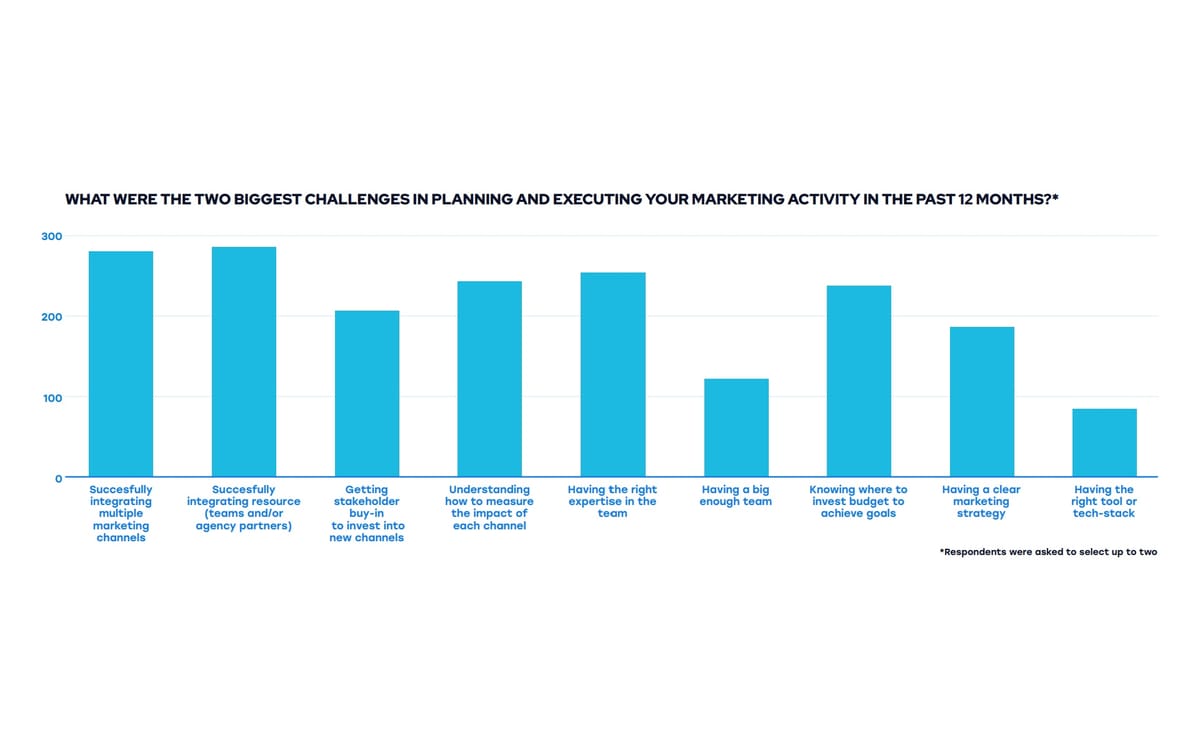
Integration challenges dominated operational execution difficulties. Successfully integrating multiple marketing channels ranked as the top planning and execution challenge, followed closely by integrating resources including teams and agency partners. Smaller businesses specifically struggled with budget allocation decisions and developing clear marketing strategies, while organizations across all sizes grappled with measurement challenges and assembling teams with appropriate expertise.
"Integration problems are usually about ownership," stated Claire Elsworth, Strategy Director at Impression. Elsworth emphasized that building multi-channel plans proves easier than aligning teams, partners, and platforms behind shared vision, objectives, and timelines. This integration deficit reflects measurement challenges where 86% of in-house marketers struggle to determine each channel's impact despite unprecedented analytics access.
Revenue growth forecasts show 77% of marketers anticipating expansion in 2026, representing an 8-percentage-point decrease from 2025 levels when 85% predicted growth. Among those expecting increases, 63% project slight growth between 1% and 25%, while only 13% foresee significant expansion exceeding 26%. This moderate decline in confidence occurs against uncertain economic conditions and shifting consumer behaviors documented across multiple industry forecasts for 2026.
Marketing budgets demonstrate stronger momentum. Sixty-nine percent of respondents expect budget increases in the next 12 months, up 8 percentage points versus 2025. This budget expansion accompanies investment growth in creative assets, with 56% planning to increase creative spending—a 3-percentage-point rise compared to the previous year. Team growth plans similarly show expansion, with 54% anticipating larger marketing teams, up 5 percentage points year-over-year.
Budget allocation between brand-building and performance marketing reveals strategic priorities. Most marketers reported splits between 60:40 and 70:30 favoring brand-building activities, aligning with research popularized by Les Binet and Peter Field regarding balanced long-term brand investment and short-term sales activation. Smaller businesses demonstrated heavier emphasis on performance marketing compared to larger organizations that maintained more balanced approaches.
Investment priorities for 2026 concentrate on email/SMS/app push marketing, content marketing, and generative engine optimization targeting AI-powered search platforms. Twenty-six percent plan to increase email channel investment, 23% will expand content marketing budgets, and an equal 23% intend to invest in AI-powered search optimization—reflecting how AI platforms are emerging as significant advertising destinations.
Buy ads on PPC Land. PPC Land has standard and native ad formats via major DSPs and ad platforms like Google Ads. Via an auction CPM, you can reach industry professionals.
Search engine optimization and content marketing emerged as top revenue drivers during the past 12 months. These organic channels outperformed social media advertising, which experienced substantial decline in effectiveness rankings compared to previous years. Email, SMS, and app push communications ranked closely behind SEO and content, while social media advertising fell significantly despite maintaining relevance for customer engagement purposes.
The shift toward organic channel performance coincides with rising paid advertising costs and expanding opportunities for organic traffic acquisition. Businesses prioritize building sustainable visibility foundations rather than relying exclusively on paid acquisition, particularly as platform costs increase and attribution becomes more complex. This strategic rebalancing reflects how rising acquisition costs drive brands to prioritize organic foundations.
Social media platforms remain dominant for audience engagement despite advertising effectiveness concerns. Instagram and Facebook combined capture 45.5% of platform activity where audiences actively engage with brands. YouTube and TikTok represent the largest non-Meta platforms, with TikTok's video-first approach influencing Meta properties to adopt similar features including Instagram Reels and Facebook video formats.
Twenty-six percent of surveyed marketers identified SEO as their anticipated biggest revenue driver for 2026, while 25% selected AI-powered search platforms, 28% chose email/SMS/app push, 27% picked content marketing, 28% named influencer marketing, and 23% specified social media advertising. This distribution demonstrates fragmentation across multiple channels rather than concentration around single dominant platforms.
Artificial intelligence and automation ranked as the second most important success factor for 2026 behind clear marketing strategy. Thirty-six percent of respondents identified AI and automation as critical to achieving goals, while 44% emphasized having a clear marketing plan. Despite AI's prominence in strategic importance, only 12% of marketers plan to use AI for content creation, indicating preference for human-generated creative work.
Marketing team growth plans contradict predictions of AI-driven workforce reductions. Fifty-four percent plan to expand internal marketing teams during the next 12 months, while just 6.7% anticipate team size decreases. This growth occurs alongside AI adoption, suggesting technology augments rather than replaces marketing professionals—at least during 2026.
AI application focuses on data analysis and insights, the primary use case for 18.9% of respondents. Personalization and customer segmentation ranked second at 13.2%, followed by marketing campaign optimization at 11.5%. Content creation applications, despite media attention, attracted only 12.1% adoption, while customer service chatbots garnered 11.5% implementation.
"The anticipated growth in marketing teams shows that AI job scaremongering could still be a bit premature," stated Mikey Emery, Commercial Director at Impression. Emery characterized AI as elevating roles through execution task automation rather than wholesale replacement, with future success depending on recruiting hybrid talent capable of leveraging AI to reduce delivery costs while preserving human creativity and problem-solving capabilities.
Technology investment priorities reflect this AI integration pattern. Customer data platforms lead planned investments at 29%, followed by AI/machine learning tools at 27%, marketing automation platforms at 26%, and improved CRM systems at 25%. These technologies enable personalization and efficiency rather than eliminating marketing workforce requirements, particularly as 92% of marketers report AI transforms customer engagement while precision-focused practitioners waste 27% less budget.
Customer lifetime value analysis and marketing mix modeling emerged as preferred methods for measuring campaign effectiveness, each utilized by over 40% of respondents. Multi-touch attribution, incrementality testing, and A/B testing followed, while 10% reported no formal measurement practices. This measurement priority reflects ongoing struggles where 54.1% of professionals report unchanged confidence in measurement accuracy year-over-year despite improving tools and expanding data access.
Smaller businesses demonstrated lower measurement sophistication, with companies generating under £1 million revenue more likely to lack formal effectiveness measurement compared to larger organizations implementing comprehensive attribution systems. The measurement gap creates budget allocation challenges, as 60.2% of marketers face stakeholder questions about metric validity at least occasionally.
Personalization strategies concentrate on audience segmentation rather than one-to-one customization. Most marketers employ segmented personalization for key audience groups rather than individual-level personalization, balancing resource constraints against personalization benefits. Larger businesses demonstrate higher rates of one-to-one personalization compared to smaller organizations prioritizing segment-based approaches.
Platform adoption patterns reveal strong preference for in-house marketing execution, with 59.3% of respondents planning to deliver activity internally. Combined approaches using agencies and in-house teams account for 20.6%, while agency-only models represent 16.1% and freelancer-only approaches constitute just 4% of planned execution. This in-house concentration marks shift from previous years when agency reliance dominated, though larger revenue businesses maintain stronger agency relationships compared to smaller organizations.
Clear marketing strategy emerged as the single most important success factor for 2026, identified by 44% of respondents. This planning emphasis outweighed all other factors including AI and automation at 36%, new tools and technology at 32%, accurate measurement at 30%, and larger budgets at 29%. The finding underscores persistent execution gaps where strategic planning remains disconnected from operational delivery.
"This is a useful reminder that clarity still beats complexity," Elsworth noted. She emphasized that AI and automation rank highly but require clear plans to avoid becoming distractions, with strategy defining both what marketers will do and equally important, what they will not pursue. The basics matter: solid foundations, fit-for-purpose tools, and teams understanding how elements connect to maximize investment value.
Outsourcing plans concentrate on email/SMS/app push at 26%, content marketing at 23%, and AI-powered search optimization at 23%. Search engine optimization, organic social media, and public relations follow closely, indicating marketers supplement internal capabilities with external expertise across multiple specialized domains rather than wholesale agency delegation.
Brand investment priorities align with revenue-driving channel performance. Businesses plan largest increases in email marketing, content marketing, and influencer marketing—all areas demonstrating strong organic performance during 2025. Traditional media faces declining investment, with only limited planned spending on out-of-home advertising, linear television, and outbound activity compared to digital channel expansion.
Subscribe PPC Land newsletter ✉️ for similar stories like this one
Subscribe PPC Land newsletter ✉️ for similar stories like this one
Who: Impression, a performance marketing agency with over 120 employees and offices in Nottingham, London, Manchester, and New York, surveyed 1,000 UK marketing professionals from middle management through C-level positions across 19 industry sectors at companies generating revenues ranging from under £1 million to exceeding £500 million annually. Survey was conducted during October 2025.
What: Research revealed 77% of UK marketers forecast revenue growth in 2026 (down 8 percentage points from 2025), 69% expect marketing budget increases (up 8 percentage points), 56% plan increased creative asset investment (up 3 percentage points), and 54% anticipate team growth (up 5 percentage points). Key challenges include increased competition particularly for £500 million-plus businesses, rising costs affecting smaller organizations, and integration difficulties across channels and teams. AI adoption accelerates for data analysis and automation but not creative role replacement, with only 12% planning AI content creation while 54% expand human teams.
When: Survey data collected October 2025, results released December 10, 2025. Findings cover past 12-month performance during 2025 and future 12-month plans for 2026.
Where: Research focused on United Kingdom marketing professionals working across automotive, FMCG, fashion, professional services, and 15 additional industry sectors. Findings reflect UK market conditions including economic uncertainty, competitive pressures, and technology adoption patterns specific to British marketing landscape.
Why: Research addresses how UK marketers navigate competing priorities of economic uncertainty, competitive intensity, rising costs, technology adoption, and operational integration challenges while maintaining growth expectations and investment commitments. The 8-percentage-point decline in revenue growth confidence from 85% to 77% year-over-year reflects cautious optimism amid persistent challenges, while budget and team expansion plans demonstrate continued commitment to marketing investment despite headwinds. Integration challenges dominate execution difficulties because strategic planning remains disconnected from operational delivery across channels, teams, and agency partnerships.