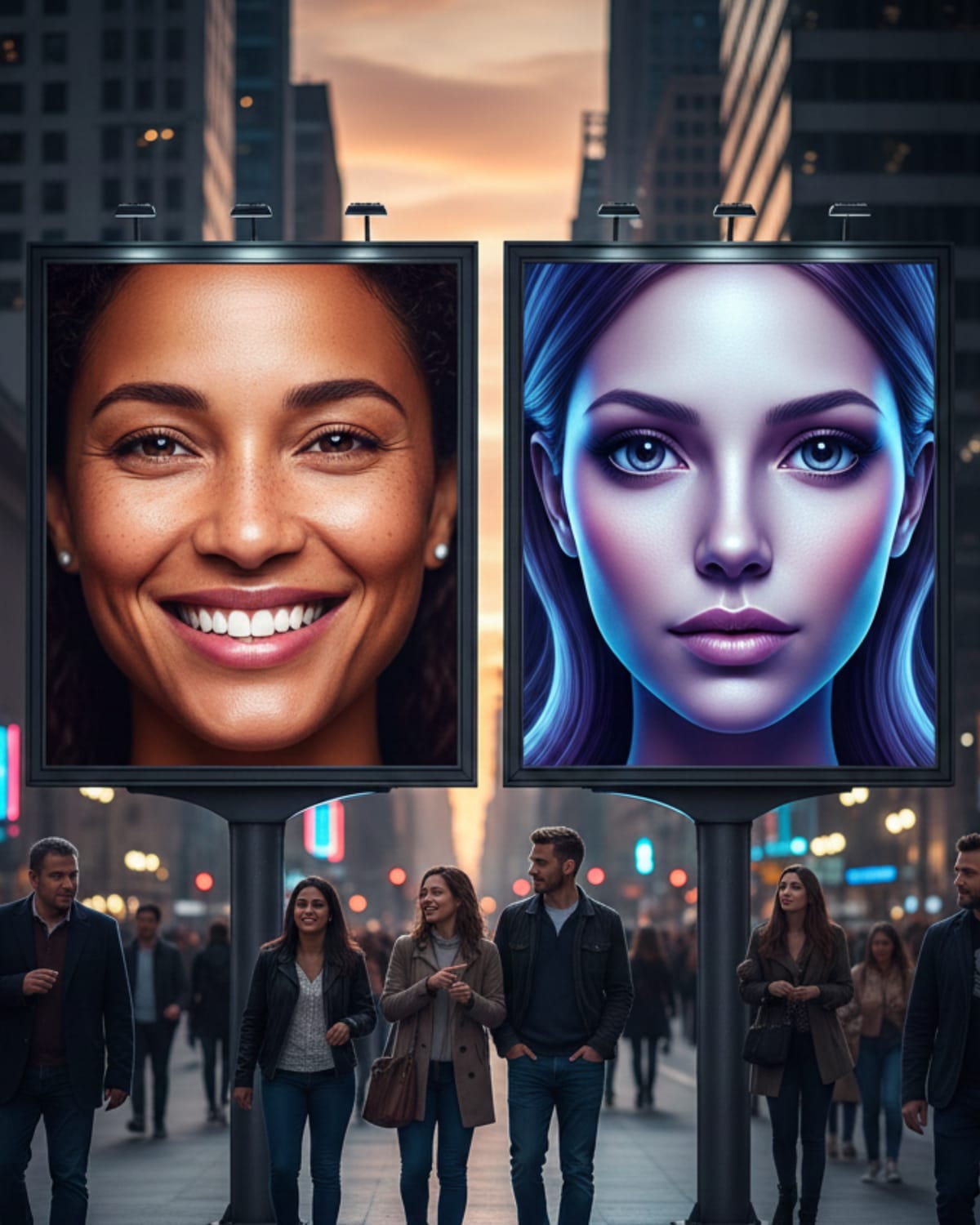
Taboola announced on January 28, 2026, findings from a field study conducted with researchers at Columbia University, Harvard University, Technical University of Munich, and Carnegie Mellon University examining how generative AI-generated advertising performs against human-made creative in real-world campaign environments. The research analyzed hundreds of thousands of live advertisements running on Realize, Taboola's performance advertising platform, spanning more than 500 million impressions and 3 million clicks.
The study, titled AI Ads That Work: How AI Creative Stacks Up Against Humans, provides empirical evidence addressing persistent concerns across the advertising industry about whether artificial intelligence can produce creative content matching human effectiveness without sacrificing campaign performance or downstream conversion quality.
AI-generated advertisements performed comparably to human-made ads across the dataset. In raw performance data, AI ads achieved an average click-through rate of 0.76% compared to 0.65% for human-made advertisements. When researchers applied statistical controls comparing matched pairs of ads within identical campaigns and timeframes, AI-generated and human-made advertisements showed statistically equivalent performance.
The methodology employed a "sibling ads" approach comparing matched pairs of AI-generated and human-made advertisements created by the same advertiser for identical campaigns on the same day. This design isolated the impact of creative generation method while controlling for advertiser identity, timing, audience targeting, and landing pages—variables that typically confound performance comparisons in advertising research.
The research team included Oded Netzer, Vice Dean for Research at Columbia Business School, alongside colleagues from the partner universities. "Taboola's platform provided us with a literal gold mine of real-world data that is simply unavailable in a lab setting," Netzer stated. "By analyzing over 500 million impressions, we were able to move past the hype of GenAI and uncover its real impact in large scale settings."
Performance patterns revealed that AI-generated advertisements achieved the highest engagement rates when consumers did not perceive them as artificial. AI-generated ads that did not "look like AI" significantly outperformed both human-made advertisements and AI-generated advertisements perceived as artificial. This finding emerged from a separate perception study where participants evaluated whether advertisements appeared AI-generated or human-made.
Nearly half of AI-generated advertisements were perceived as human-made, indicating that consumers struggled to accurately identify creative origin. Advertisements perceived as AI-generated underperformed regardless of whether they were actually created by AI or human designers. This suggests perceived artificiality, rather than actual origin, primarily determines engagement outcomes.
Researchers analyzed visual features to identify characteristics associated with AI perception. Common signals included highly stylized or overly polished visuals, heavy color saturation, and strong symmetry. The presence of large, clear human faces represented the strongest indicator of perceived human creation and drove higher engagement across both AI-generated and human-made advertisements.
Advertisements created with GenAI Ad Maker, Taboola's free creative generation tool within the Realize platform, included prominent human faces more frequently than human-made advertisements. This pattern reflects design principles incorporating Taboola's Creative Shop best practices, which emphasize authentic human imagery to build trust and emotional connection.
The study addressed concerns about whether AI-generated advertisements might generate low-quality or curiosity-driven clicks that fail to convert. Data showed no evidence of reduced downstream conversion performance. AI-generated creatives increased or maintained click-through rates without negatively impacting conversion rates, indicating advertisers did not trade quality for production scale.
Specific industry sectors demonstrated particularly strong AI-generated advertisement performance. Food and drink categories alongside personal finance industries showed early adoption patterns and strong results. Other categories including education demonstrated more muted outcomes, suggesting industry context influences AI creative effectiveness.
The research methodology tracked live advertisement performance across Taboola's publisher network, which includes approximately 600 million daily active users. Publishers utilizing Taboola's technology include NBC News, Yahoo, and original equipment manufacturers such as Samsung and Xiaomi. The platform works with thousands of businesses advertising through Realize.
Taboola expanded its Realize platform partnerships with TIME, Weather Channel Digital, Gannett, Nexstar, and Slate in October 2025, providing performance advertisers access to display inventory across these publisher networks. The company expected to pay over $1.5 billion to publishers and original equipment manufacturers in 2025.
The announcement arrives as advertising platforms accelerate AI integration across creative production and campaign management systems. Smartly added AI creative predictive tools across advertising channels in November 2025, introducing Creative Predictive Potential and Creative Insights to help brands reduce wasted spend while maximizing return on advertising investment.
Meta unveiled Creative breakdown for Flexible formats and AI-generated image ads in July 2025, enabling performance analysis by individual creative elements. The company reported 30% more advertisers using AI creative tools in first quarter 2025, while Advantage+ sales campaigns showed an average 22% boost in return on ad spend.
The Columbia study distinguishes itself through real-world performance measurement rather than controlled laboratory experiments. Traditional research approaches examine consumer reactions to creative concepts in artificial settings, providing limited insight into actual campaign performance under market conditions where budget, competition, and consumer behavior interact dynamically.
Taboola launched Predictive Audiences in June 2025, achieving conversion improvements up to 270% for early adopters including The Motley Fool, QuinStreet, and NerdWallet. That targeting capability combines advertisers' first-party conversion data with Taboola's network intelligence to identify high-converting customers.
The platform introduced Abby, a generative AI assistant for campaign creation, in October 2024. Early testing indicated campaigns launched using Abby could go live up to 75% faster than manually configured campaigns, addressing advertiser demands for efficient creative production at scale.
Industry adoption of AI creative tools has accelerated despite ongoing concerns about quality degradation and brand safety. Research analyzing AI advertising hype versus working systems revealed systematic patterns where quality issues emerge alongside legitimate performance improvements, complicating advertiser decision-making.
Queensland Symphony Orchestra's February 2024 AI advertisement faced criticism across industry publications as representing poor AI-generated creative quality. Victoria's Secret created AI campaign content internally but never released it due to concerns about external backlash, demonstrating that positive internal assessment cannot always overcome perception risks.
The Columbia study provides evidence that AI creative tools can deliver comparable performance to human-made advertisements when executed following established creative principles. The research team emphasized that success depends on using AI thoughtfully and aligning creative output with proven human-centered best practices, particularly prioritizing authentic imagery and human faces.
Performance measurement frameworks require adaptation as AI-generated creative becomes standard practice. Traditional metrics comparing impressions, clicks, and conversions remain relevant, but understanding which creative approaches generate engagement requires granular analysis distinguishing between different AI execution strategies.
AdClarity added click-through rate benchmarking to its ad intelligence platform in December 2025, enabling advertisers to benchmark engagement across display, video, social, and in-app advertisements at individual ad, campaign, brand portfolio, and geographic levels.
The study's findings arrive as marketing professionals navigate competing claims about AI capabilities. Research analyzing four million Claude AI conversations revealed that just 5% of occupational tasks account for 59% of all AI interactions, demonstrating that tasks demanding high creativity, cognitive complexity, and idea generation attract the heaviest AI engagement.
For the marketing community, the research provides empirical foundation for AI creative deployment strategies. Advertisers can leverage generative AI to achieve production speed and cost efficiency without necessarily compromising campaign effectiveness. However, success requires understanding which creative execution strategies maximize performance rather than assuming AI automatically delivers optimal results.
The perception research component reveals that consumer ability to identify AI-generated content remains limited, but perceived artificiality significantly impacts engagement regardless of actual origin. This finding suggests that creative quality and adherence to established best practices matter more than production method.
Publishers utilizing AI-powered content discovery tools face related challenges. Taboola launched DeeperDive AI answer engine in June 2025, providing publishers with AI-powered search functionality directly within their websites. Major media organizations Gannett and The Independent joined as launch partners for technology drawing from proprietary, real-time content created by journalists and editors across the open web.
Connected television performance measurement represents another area where Taboola has deployed AI capabilities. The company partnered with LG Ad Solutions in December 2025 for CTV performance tracking, combining LG's first-party Automatic Content Recognition data with Realize to extend campaigns beyond Smart TVs into publisher sites.
Taboola partnered with Paramount Advertising in October 2025, introducing Performance Multiplier designed to help small and medium-sized businesses measure and extend connected TV advertising campaign reach across the open web. That integration marked the first time a major streaming provider adopted Taboola's Realize AI technology.
The academic research contributes to broader understanding of how artificial intelligence affects advertising effectiveness. Previous Columbia University research examined TikTok ban impacts, finding that a temporary TikTok outage in January 2025 caused Meta advertising prices to increase 10%, demonstrating how platform availability affects competitive dynamics and pricing across digital advertising markets.
The study's dataset encompassed more than 300,000 advertisements across multiple industries including personal finance, food and drink, and education. Advertisements spanned Taboola's publisher network reaching approximately 600 million daily active users. Data collection occurred over an extended period providing sufficient volume for statistical analysis accounting for seasonal variations, competitive dynamics, and changing consumer behavior.
Netzer emphasized that findings demonstrate AI can enhance human cues rather than replace them. "Our findings prove that when AI is used to enhance human cues—like the trust found in a human face—it doesn't just match human performance; it often sets a new ceiling for engagement," he stated.
The research methodology's "sibling ads" approach represents a significant methodological contribution to advertising effectiveness research. By comparing advertisements created by identical advertisers for identical campaigns on identical days, researchers isolated creative generation method as the variable of interest while controlling for confounding factors that typically complicate advertising performance analysis.
This approach contrasts with traditional advertising research methodologies that compare performance across different advertisers, different time periods, or different campaign objectives—introducing multiple variables that make causal inference difficult. The matched pairs design provides stronger evidence about AI creative effectiveness than would be possible with less rigorous comparison approaches.
For advertising technology platforms competing in the AI creative space, the research provides validation that AI-generated content can achieve performance parity with human-made creative. However, the perception findings suggest that execution quality matters significantly. Platforms must ensure their AI tools produce creative that aligns with established best practices rather than generating obviously artificial content that consumers penalize.
The food and drink sector's strong early adoption and performance suggests certain industries may be particularly well-suited for AI creative deployment. These categories often require high-volume creative production for promotional campaigns, testing multiple offers, and seasonal activations—use cases where AI's speed and cost advantages provide clear operational benefits.
Personal finance demonstrated similarly strong results, another category requiring significant creative volume for different product offers, customer segments, and regulatory compliance requirements across multiple jurisdictions. AI tools enable personal finance advertisers to generate compliant creative variations more efficiently than manual production workflows.
Education's more muted results suggest that categories involving complex purchase decisions, extended consideration periods, or emotionally resonant messaging may require more sophisticated AI approaches or continued reliance on human creative development for primary campaign concepts.
The research provides evidence addressing advertiser concerns that AI creative might generate superficial engagement rather than meaningful customer actions. The finding that AI-generated advertisements maintained conversion performance while improving click-through rates indicates that increased engagement translates into downstream business outcomes rather than representing curiosity clicks that fail to convert.
This finding matters for advertisers evaluating whether to adopt AI creative tools at scale. The business case for AI creative adoption strengthens when tools deliver both operational efficiency through faster production and lower costs alongside maintained or improved campaign effectiveness measured through conversions and return on advertising spend.
Industry consolidation around AI creative tools continues accelerating. Google launched Asset Studio for advertising creative production in September 2025, integrating Imagen 4 and enabling advertisers to generate creatives using AI alongside traditional, human-made content within Google Ads interface.
Amazon enhanced Performance+ and Brand+ with AI improvements in November 2025, introducing dynamic creative optimization integrated directly into campaign workflows. Amazon's internal testing showed dynamic creative optimization drove 8.4% lift in paid units among U.S. advertisers using the feature.
The academic research provides independent validation of AI creative effectiveness separate from platform-provided performance metrics. While advertising platforms regularly report strong AI tool performance, academic research conducted by university researchers analyzing real-world data offers credibility that internal platform studies cannot provide.
For marketing professionals evaluating AI creative adoption, the research suggests that success depends on understanding execution quality rather than assuming all AI-generated creative performs equivalently. The perception findings indicate that creative appearing overly artificial underperforms regardless of actual production method, while creative perceived as authentic achieves strong engagement.
The presence of large, clear human faces represented the most influential factor in making advertisements feel human-made and driving higher engagement. This finding aligns with decades of advertising research demonstrating that human faces capture attention, build emotional connection, and increase message recall. AI tools that incorporate this established best practice into generated creative achieve better performance than tools producing abstract or non-human imagery.
Technical implementation details remain important for advertisers deploying AI creative at scale. GenAI Ad Maker operates as a free tool within the Realize platform, enabling advertisers to generate creatives alongside traditional human-made content without requiring separate software or workflow changes. This integration reduces adoption friction compared to standalone AI creative tools requiring separate processes.
The study's January 28, 2026 announcement timing positions findings during planning cycles for second quarter 2026 campaigns when advertisers finalize creative production strategies and budget allocations. Evidence that AI creative achieves performance parity with human-made content while offering significant cost and speed advantages may accelerate adoption during this planning period.
Timeline
- October 15, 2024: Taboola unveils Abby AI assistant for campaign creation, enabling 75% faster campaign launches
- June 4, 2025: Taboola launches Predictive Audiences achieving conversion improvements up to 270% for early adopters
- June 11, 2025: Taboola announces DeeperDive AI answer engine for publishers with Gannett and The Independent as launch partners
- July 11, 2025: Meta unveils Creative breakdown for Flexible formats and AI-generated image ads
- September 10, 2025: Google launches Asset Studio for advertising creative production with Imagen 4 integration
- October 15, 2025: Taboola expands Realize platform with TIME, Weather Channel Digital, Gannett partnerships
- October 22, 2025: Taboola and Paramount launch Performance Multiplier for small business CTV measurement
- November 10, 2025: Amazon enhances Performance+ and Brand+ with dynamic creative optimization capabilities
- November 18, 2025: Smartly adds AI creative predictive tools across advertising channels
- December 5, 2025: AdClarity adds CTR benchmarking to ad intelligence platform
- December 7, 2025: LG Ad Solutions and Taboola partner for CTV performance tracking
- January 28, 2026: Taboola announces Columbia University research findings on AI advertising creative performance
Summary
Who: Taboola announced research conducted with Columbia University, Harvard University, Technical University of Munich, and Carnegie Mellon University researchers analyzing AI-generated advertisement performance.
What: The study titled "AI Ads That Work: How AI Creative Stacks Up Against Humans" analyzed hundreds of thousands of live advertisements across more than 500 million impressions and 3 million clicks, finding AI-generated ads performed comparably to human-made ads with 0.76% average click-through rate versus 0.65% for human ads, achieved highest engagement when not perceived as artificial, and maintained conversion quality without degradation.
When: Taboola announced findings on January 28, 2026, based on research analyzing live advertisement performance data collected across Taboola's Realize platform during 2025.
Where: The research analyzed advertisements running on Realize, Taboola's performance advertising platform reaching approximately 600 million daily active users across publisher networks including NBC News, Yahoo, Samsung, and Xiaomi.
Why: The research addresses advertising industry concerns about whether AI-generated creative can match human effectiveness while providing empirical evidence that AI creative tools deliver comparable performance when executed following established best practices emphasizing authentic human imagery, particularly large clear human faces that drive trust and engagement.
Share this article
The link has been copied!