YouTube creators challenge platform's claims of manual appeal reviews
Creators report AI-automated responses to channel termination appeals within minutes, contradicting platform's statements about human review processes.


Creators report AI-automated responses to channel termination appeals within minutes, contradicting platform's statements about human review processes.
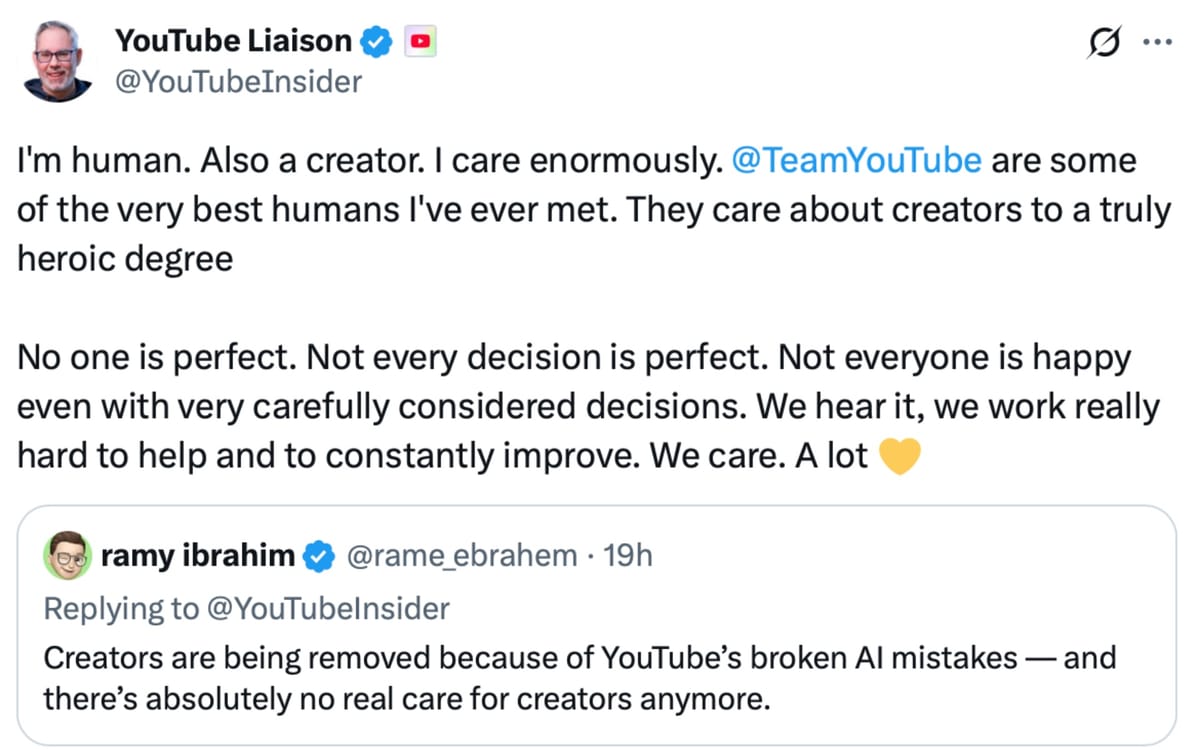
YouTube creators are questioning the platform's transparency regarding channel termination appeal processes, following widespread reports that appeals receive rejection notices within minutes of submission. According to X (formerly Twitter) posts from multiple creators in early November 2025, the video platform's automated systems appear to handle appeals that TeamYouTube publicly characterizes as manually reviewed by human staff.
The controversy emerged prominently on November 8, 2025, when TeamYouTube responded to creator JAm imran, whose channel appeal had remained under review since October 1. "Appeals are manually reviewed so it can take time to get a response," TeamYouTube stated in the public reply. The response prompted immediate pushback from the creator community, with numerous accounts sharing experiences of appeals rejected in timeframes inconsistent with human review processes.
Subscribe PPC Land newsletter ✉️ for similar stories like this one
Multiple creators documented appeals submitted and rejected within 2-5 minutes, according to screenshots and timestamped posts shared across social media. Creator GBYT posted on November 9 that "YouTube is openly lying about manual review of appeals" and that "appeals are being rejected instantly, showing that YouTube uses AI to manage appeals and that there is no manual review." The post accumulated 73,000 views and received community notes from X users pointing to patterns of rapid rejections.
The technical impossibility of reviewing lengthy content libraries within such brief timeframes forms the core of creator complaints. Creators with channels containing hours of video content report receiving definitive rejection notices within minutes, insufficient time for human reviewers to examine material comprehensively. One creator noted on November 9 that "no human can verify 45 minute video in 3 minutes."
TeamYouTube's official communications maintain consistent messaging about manual review procedures. The support account repeatedly tells creators that "appeals are manually reviewed so it can take time to get a response" and urges patience. However, the documented response times contradict these statements, with creators receiving rejection emails in timeframes suggesting algorithmic processing rather than human evaluation.
The pattern of rapid rejections cuts across multiple creator categories. Creators terminated for alleged spam, deceptive practices, and policy violations all report similar experiences. One creator with 24,000 subscribers stated on November 9 that YouTube "wrongly terminated my 24K sub channel for 'spam and deceptive practices' on November 5th. I'm tired of typing to every YouTube AI bot."
Some creators received provisional reinstatement notices from TeamYouTube support staff, only to face subsequent terminations after what the platform characterized as secondary human reviews. Screenshots show a TeamYouTube representative telling one creator on November 11 that "your channel has been reinstated" and advising that content restoration could take 24-48 hours. Hours later, the same creator received notification that the channel would "remain terminated" after the team "checked this again."
The inconsistency in messaging extends to YouTube's liaison representatives. Rene Ritchie, identified as YouTube's head of editorial and creator liaison, posted on November 11 that "I'm human. Also a creator. I care enormously. @TeamYouTube are some of the very best humans I've ever met. They care about creators to a truly heroic degree." The statement emphasized that "no one is perfect. Not every decision is perfect" while asserting that decisions undergo careful consideration.
Buy ads on PPC Land. PPC Land has standard and native ad formats via major DSPs and ad platforms like Google Ads. Via an auction CPM, you can reach industry professionals.
Community notes attached to Ritchie's post contested these characterizations. "The 'careful decisions' made by YouTube take an average of 5 minutes, and the response is usually negative for creators," according to the community-added context. "The use of AI in decision-making has been demonstrated on multiple occasions, and the author of the tweet avoids discussing it."
Creator Nate Hake drew parallels between YouTube's current situation and Google's handling of website publisher complaints about search algorithm changes. "This is exactly what @searchliaison said to bloggers in 2023 after Google's AI censored thousands of us to make way for AI Overviews," Hake posted on November 12. "2 years later – Google did away with Search Liaison entire & stopped even pretending to care."
The reference points to Google's discontinuation of its Search Liaison role, which ended on August 1, 2025, after serving as the primary communication channel between Google and web publishers. Danny Sullivan, who held the position from 2017 to 2025, frequently addressed publisher concerns about algorithm updates and ranking changes. His role concluded as Google expanded AI-powered features across search results.
YouTube's appeal system exists within broader platform infrastructure that processes millions of videos daily. The platform's content moderation systems employ automated detection for policy violations, with human review theoretically serving as a secondary layer for disputed decisions. Creators terminated under these systems can submit appeals through YouTube Studio, initiating what the platform describes as manual review processes.
The volume of content uploaded to YouTube creates inherent scaling challenges for human review systems. The platform reports that users upload hundreds of hours of video per minute, generating massive content libraries requiring policy enforcement. This operational reality places pressure on automated systems to handle initial violation detection and potentially appeal processing.
YouTube's use of AI extends beyond moderation into content creation and enhancement. In August 2025, the platform acknowledged using machine learning to modify videos during processing, applying sharpening and noise reduction without creator consent or notification. The revelation followed creator complaints about unexpected visual changes to uploaded content.
The platform's AI implementation strategy includes both enforcement and creative tools. YouTube launched Edit with AI in November 2025, enabling creators to generate Shorts automatically from existing footage. The feature operates in 15 markets including the United States, India, and Brazil, though remains excluded from European Union and United Kingdom territories.
YouTube introduced a pilot program for terminated creators on October 8, 2025, allowing some previously banned channels to request reinstatement after one-year waiting periods. The program excludes creators terminated for copyright infringement and severe policy violations, requiring applicants to demonstrate changed behavior patterns. Approved creators start fresh with zero subscribers and must rebuild audiences from scratch.
The current controversy involving appeal processing adds complexity to YouTube's reinstatement initiatives. Creators questioning whether human reviewers actually examine appeals may hesitate to participate in programs requiring demonstrated compliance with platform policies, particularly when initial termination decisions potentially originated from automated systems.
Platform monetization programs create economic pressures around content moderation. YouTube Partner Program, TikTok Creator Fund, Meta's Creator Bonus Program, and X's revenue sharing incentivize content production at scale, sometimes encouraging material that tests platform policy boundaries. This dynamic increases both the volume of content requiring review and the financial stakes of enforcement decisions for creators.
Google, YouTube's parent company, maintains extensive documentation about search algorithm updates and ranking systems. In a June 2, 2021 blog post titled "How we update Search to improve your results," Google's Danny Sullivan explained that the company implements "thousands of" updates annually to improve search quality. "Google Search receives billions of queries every day from countries around the world in 150 languages," Sullivan wrote. "Our automated systems identify the most relevant and reliable information from hundreds of billions of pages in our index to help people find what they're looking for."
Sullivan's explanation emphasized periodic "core updates" involving "broad improvements to our overall ranking processes" that can "produce some noticeable changes." The documentation stated these updates aim to improve how systems "assess content overall" rather than targeting specific sites or pages. "There's nothing wrong with pages that may perform less well in a core update," Sullivan wrote. "They haven't violated our webmaster guidelines nor been subjected to manual or algorithmic action."
The philosophical framework Google applies to search algorithm improvements differs substantially from YouTube's content moderation challenges. Search ranking aims to identify the most relevant results for queries, while content policy enforcement requires binary determinations about whether material violates specific rules. These distinct operational contexts create different requirements for automation and human oversight.
Creator advocacy organizations have not yet issued formal statements about the appeal processing controversy. Individual creators continue sharing experiences on social media platforms, with some documenting multi-month appeal periods while others report instant rejections. The disparity in processing times suggests potential inconsistencies in how YouTube's systems handle different termination categories or creator account types.
Marketing professionals managing YouTube channels for brands face particular concerns about automated enforcement and appeal processes. Channel terminations impact advertising campaigns, influencer partnerships, and content marketing strategies. The inability to quickly resolve erroneous terminations through reliable human review creates business continuity risks for companies operating official YouTube presences.
YouTube's Trust and Safety team employs thousands of staff members globally to review content flagged by automated systems and user reports. The company has not disclosed what percentage of appeal reviews receive human attention versus automated processing. Internal workflows for appeal handling remain proprietary, with limited public documentation about decision-making processes.
The platform's scale presents genuine operational challenges distinct from intentional obfuscation. Processing millions of appeals annually requires substantial human resources, creating economic incentives to automate initial screening even if subsequent review involves human evaluators. The question centers on whether YouTube's public communications accurately represent actual processes rather than aspirational procedures.
Community note systems on X have emerged as informal fact-checking mechanisms for platform communications. The notes attached to YouTube Liaison posts represent crowdsourced challenges to official statements, indicating creator community skepticism about platform transparency. This dynamic creates reputational pressure on YouTube to clarify actual appeal processing methodologies.
The controversy arrives during a period of heightened scrutiny around AI transparency across technology platforms. Regulatory frameworks in the European Union and United Kingdom have established disclosure requirements for automated decision-making systems, particularly in high-stakes contexts affecting livelihoods. YouTube's exclusion of certain AI features from EU and UK markets suggests awareness of compliance complexities.
Creator education around platform policies and appeal processes could benefit from enhanced clarity about automation's role. If YouTube employs AI for initial appeal screening with human review reserved for specific criteria, explicit communication about these workflows would enable creators to set realistic expectations. Current ambiguity fuels speculation and erodes trust between the platform and its creator community.
The financial implications extend beyond individual creators to the broader creator economy. Channel terminations eliminate revenue streams for full-time content producers, affecting employees, contractors, and business partners dependent on YouTube income. Rapid appeal rejections compound these impacts by foreclosing remediation pathways quickly, potentially before creators can arrange alternative income sources.
Subscribe PPC Land newsletter ✉️ for similar stories like this one
Who: YouTube creators across multiple content categories face channel terminations with appeals that receive responses within minutes, contradicting TeamYouTube's statements about manual human review processes. TeamYouTube support staff and YouTube Liaison Rene Ritchie maintain that appeals undergo careful human consideration while creators document experiences suggesting automated rejection systems.
What: Creators report submitting channel termination appeals through YouTube Studio and receiving rejection notices in 2-5 minute timeframes, technically insufficient for human reviewers to examine hours of video content comprehensively. The discrepancy between official platform communications emphasizing manual review and documented rapid response times suggests potential use of AI-powered automated systems for appeal processing.
When: The controversy intensified during early November 2025, particularly November 8-12, following TeamYouTube's public statement on November 8 that "appeals are manually reviewed so it can take time to get a response." Creator JAm imran's 37-day appeal wait beginning October 1 contrasts sharply with other creators' reports of instant rejections.
Where: The appeal processing concerns affect YouTube's global creator community, with documented cases from creators in multiple countries. The platform's AI features face varied deployment across regions, with Edit with AI operating in 15 markets while excluding European Union and United Kingdom territories due to regulatory considerations.
Why: The volume of content uploaded to YouTube creates scaling challenges for human review systems, generating economic pressure to automate moderation and potentially appeal processing. Platform transparency concerns extend beyond individual creator cases to broader questions about how major technology platforms deploy AI systems in high-stakes decisions affecting livelihoods, particularly when public communications may not accurately represent actual processes. The controversy reflects mounting creator skepticism about platform accountability following patterns observed in Google's handling of publisher complaints about algorithm changes before discontinuing its Search Liaison communication channel.