AI takes first steps onto television home screens for nonprofit advertising
Magnite deploys first AI-generated home screen ads on LG and TCL, lowering creative barriers for nonprofits entering streaming TV advertising markets.


Magnite deploys first AI-generated home screen ads on LG and TCL, lowering creative barriers for nonprofits entering streaming TV advertising markets.
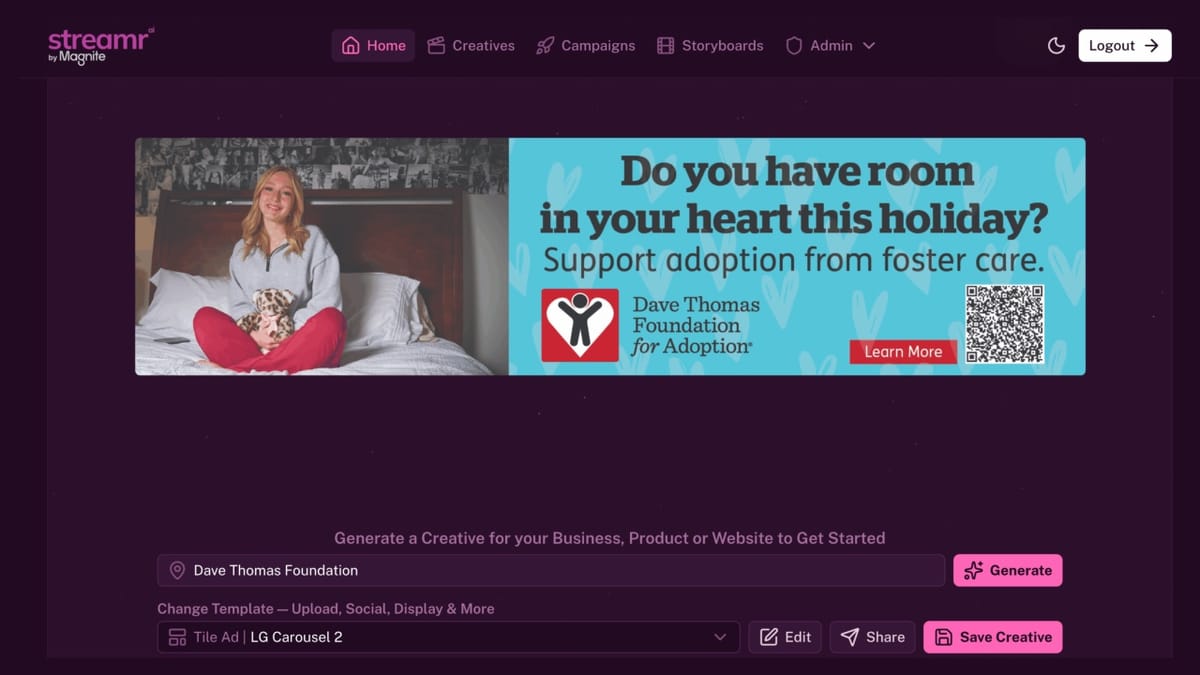
Magnite announced on December 17, 2025, the first deployment of AI-generated home screen advertisements across LG Ad Solutions and TCL, marking a technical milestone in connected television advertising. The Dave Thomas Foundation for Adoption became the inaugural organization to utilize Magnite's streamr.ai platform for generating creative assets specifically designed for television home screen placements.
The implementation represents the first instance of generative AI technology producing commercial advertisements that appear on smart television home screens before viewers select content to watch. Magnite's streamr.ai solution generated multiple creative variations for the Dave Thomas Foundation, enabling the nonprofit to access premium streaming inventory traditionally reserved for organizations with substantial production budgets.
Magnite deployed the AI-generated creative across both LG Ad Solutions and TCL platforms, two major television manufacturers serving millions of households globally. LG Ad Solutions operates 200 million LG Smart TVs worldwide, with 40 million units in the United States market. TCL represents a significant manufacturer presence in the streaming television ecosystem.
The streamr.ai platform's core functionality centers on AI-driven creative generation. The technology simplifies the production of high-quality advertising assets appropriate for television environments. This capability addresses what Magnite describes as "a key obstacle to running ads in premium video and streaming environments" by eliminating traditional creative production requirements.
When combined with Magnite's ClearLine platform, the approach provides streamlined access to premium inventory from partners including LG Ad Solutions and TCL. This integration drives operational efficiency for both advertisers and publishers by reducing friction across the entire advertising workflow from creative development through campaign execution.
The Dave Thomas Foundation for Adoption, a national nonprofit public charity dedicated to finding permanent families for children in foster care across the United States and Canada, utilized streamr.ai to develop multiple creative advertisements for streaming platforms. The organization's mission focuses on foster care adoption, addressing the needs of children waiting for permanent placement.
Andrea Thorn at Avalon Consulting, strategic consultant for The Dave Thomas Foundation for Adoption, explained the significance of accessible creative tools. "As a media buyer for nonprofits, we are always looking for responsible ways to extend our clients' reach," Thorn stated. "Having access to tools like streamr.ai allows us to create thoughtful, streaming-ready messages more efficiently."
The holiday season timing provided strategic value for nonprofit messaging, according to Thorn. "During the holiday season, when giving is top of mind, streaming helps nonprofits tell their stories with clarity and emotional resonance to engage viewers," she stated. The capability to lower creative barriers and simplify activation enables mission-driven organizations to extend reach, drive awareness, and inspire action within premium, brand-safe environments.
Thorn emphasized accessibility challenges nonprofits face entering streaming television advertising. "Streaming provides a powerful opportunity to help people understand the need for foster care adoption, but accessing that space has traditionally been difficult for some of the organizations we work with," she stated. "With tools like streamr.ai, we're able to participate in these environments in a more accessible way."
Buy ads on PPC Land. PPC Land has standard and native ad formats via major DSPs and ad platforms like Google Ads. Via an auction CPM, you can reach industry professionals.
Television home screens have emerged as critical advertising surfaces within streaming environments. Recent research from LG Ad Solutions revealed viewers spend an average of 10 minutes browsing home screens before selecting content. This heightened attention generates willingness to learn more about advertised brands, while human-centered creative content boosts brand consideration and clear calls-to-action lift purchase intent.
Jeremy Straight, Global VP at TCL Ads, characterized home screen advertising as a defining element of modern television interfaces. "By supporting AI-enhanced creative through Magnite, TCL is able to differentiate our platform with experiences that feel more dynamic and it opens up premium advertising opportunities to millions of brands looking to engage with diverse audiences in the comfort of their living room," Straight stated.
Kelly McMahon, EVP of Global Operations at LG Ad Solutions, highlighted the programmatic accessibility of home screen placements. "The home screen is already recognized as one of the most valuable moments in streaming," McMahon stated. "By combining the capabilities offered by streamr.ai and accessing home screen inventory through programmatic endpoints, these premium placements are available to a wider spectrum of advertisers."
Advertisers can now seamlessly build, customize, and activate home screen placements as part of broader connected television strategies without requiring separate workflows or additional operational complexity. "This represents a turning point in how brands think about premium inventory and how easily they can show up where viewers begin their streaming journey," McMahon stated.
Nearly all LG Smart TV users—97 percent—always enter the home screen, visiting an average of three times per day, according to research released in November 2025. The home screen serves as the initial touchpoint for content discovery, making it a strategic location for brand exposure at the beginning of viewing sessions.
Consumer behavior research indicates home screen advertisements drive measurable action beyond traditional brand awareness metrics. A recent Magnite-commissioned MRI-Simmons survey revealed one in three adults reported taking action after viewing home screen advertisements.
Among LG channel viewers specifically, 26 percent searched for a product online after seeing a home screen advertisement for that product—2.5 times more likely than the average United States adult. These behavioral patterns signal significant opportunities for ecommerce and small-to-medium business advertisers seeking measurable return on advertising spend.
Home screen advertisements show 105% year-over-year growth in consumer utility, with over 25 percent of connected television viewers finding these placements helpful. The format's effectiveness stems from timing—appearing when viewers actively engage with their televisions to select content creates natural moments for brand consideration without interrupting viewing experiences.
The performance data suggests connected television increasingly functions as a performance channel rather than purely awareness-focused medium. Home screen advertisements help transform television screens into shoppable environments where intent and action occur within the same session, making connected television a high-value addition to performance-focused media strategies.
Magnite's streamr.ai platform represents one component of broader industry movement toward AI-powered creative automation. The platform utilizes generative AI technology to generate and resize advertisements across various formats, executing programmatic purchases via the ClearLine platform.
The technology addresses creative production challenges that historically limited access to premium streaming inventory. Traditional creative development for television environments required substantial budgets, production teams, and technical expertise. These barriers prevented many organizations—particularly nonprofits and small businesses—from accessing streaming television advertising opportunities.
Magnite acquired streamr.ai on September 9, 2025, specifically to simplify connected television advertising for small and medium-sized businesses through AI-powered creative generation tools. The acquisition followed the company's April 23, 2025 merger of its SpringServe ad server with supply-side platform capabilities, creating a unified infrastructure for streaming advertising transactions.
As streamr.ai continues development, Magnite anticipates opportunities to streamline creative production across broader ranges of streaming experiences. This includes immersive layouts, companion-driven formats, and other dynamic home screen surfaces supporting diverse advertiser and publisher needs within the expanding streaming landscape.
The introduction of AI-generated home screen advertisements occurs within a rapidly developing connected television advertising ecosystem. Multiple platforms have launched AI-powered creative tools throughout 2025, addressing similar barriers to television advertising access.
Google launched Asset Studio on September 10, 2025, enabling advertisers to generate and edit advertising assets using artificial intelligence. The platform utilizes Imagen 4 for image generation and Veo technology for video creation, automatically creating assets optimized for different advertising formats across Google's network properties.
Amazon introduced AI Creative Studio on October 15, 2024, combining multiple generative AI tools into a single application. The company reported brands using its Image Generator achieved an average 5 percent increase in sales performance between October 2023 and June 2024, demonstrating measurable business impact from AI-powered creative tools.
Research from the Interactive Advertising Bureau released July 15, 2025, revealed 86 percent of buyers currently use or plan to implement generative AI for video advertisement creation. The study projected generative AI creative will account for 40 percent of all advertisements by 2026.
Connected television advertising spending is projected to reach $46.9 billion by 2028, surpassing traditional television advertising at $45.1 billion for the first time. Connected television's share of media budgets doubled from 14 percent in 2023 to 28 percent in 2025, with 72 percent of marketers planning increased programmatic advertising investment.
The deployment of AI-generated home screen advertisements intersects with ongoing industry efforts to standardize connected television advertising formats. IAB Tech Lab published standardized guidelines for six connected television ad formats on December 11, 2025, including specifications for menu ads that appear within smart television user interfaces.
Menu ads integrate into television navigational menus, appearing as headline banners or tiles within home screens. The technical specifications define creative types, aspect ratios, file submission requirements, audio guidelines, placement parameters, interactive capabilities, and duration standards for these placements.
The standardization effort addresses fragmentation across streaming platforms, where advertising formats have proliferated without consistent implementation standards. IAB Tech Lab released the specifications for public comment through January 31, 2026, enabling industry stakeholders to provide input before final adoption.
Home screen advertising's prominence reflects changing television consumption patterns. Nielsen's July 2025 report indicated streaming officially eclipsed the combined share of broadcast and cable television for the first time, representing 44.8 percent of television viewership in May 2025 while broadcast and cable combined totaled 44.2 percent of viewing.
The effectiveness of home screen advertisements gains support from attention-based measurement research examining viewer engagement quality rather than simple impression delivery. Teads research published September 25, 2025, demonstrated connected television home screen advertisements achieved 48 percent attention rates, surpassing YouTube skippable pre-roll advertisements by 16 percentage points.
The study, conducted in partnership with MediaMento Institute, utilized in-lab eye-tracking technology and brand recall surveys with 100 Smart TV viewers. Research revealed 3D home screen advertisements captured viewer attention 29 percent faster than traditional formats while sustaining engagement for significantly longer periods.
Brand recall performance proved exceptional across multiple measurement categories. Unaided recall reached 50 percent among viewers exposed to home screen advertisements, while aided recall peaked at 84 percent. Visual recognition averaged 55 percent, with top-performing executions achieving 86 percent recognition rates—substantially above typical short-form video advertising benchmarks.
Kargo connected television campaigns achieved 78 percent higher attention than industry standards in August 2025 analysis by TVision. Fifteen-second advertisements delivered 50 percent higher eye-on-screen effectiveness than standard connected television benchmarks, while 30-second formats achieved 74 percent superior performance compared to industry standards.
The deployment of AI-generated home screen advertisements supports broader trends toward performance-oriented connected television advertising. Multiple platforms introduced measurement solutions throughout 2025 addressing historical limitations in streaming advertising accountability.
Teads launched deterministic connected television measurement on October 23, 2025, tracking site visits, leads, and sales directly tied to connected television exposure. The solution moves beyond traditional metrics like impressions and completion rates, offering attribution capabilities connecting premium streaming exposure to qualified visits and conversions.
LG Ad Solutions partnered with Taboola in December 2025 to enable performance measurement frameworks appropriate for television environments. The solution enables advertisers to extend LG Ad Solutions campaigns beyond Smart TVs into trusted publisher environments, quantifying return on investment by attributing site visits and down-funnel conversions back to television exposure.
Research from the Interactive Advertising Bureau released in October 2025 revealed 73 percent of advertisers view measurement and attribution as top challenges in connected television advertising. The same research showed two-thirds of advertisers improved return on advertising spend after implementing Conversion APIs for measurement.
The performance marketing expansion reflects fundamental shifts in how businesses approach video advertising. Wunderkind launched programmatic connected television pause advertisements in July 2025, reducing store visit costs by 79 percent through QR code integration. The campaign demonstrated scalability of first-party data on connected television combined with impactful creative execution driving above-benchmark results.
The introduction of AI-generated creative tools addresses persistent obstacles in connected television advertising campaigns. Research published in July 2025 revealed 72 percent of marketers reuse or slightly modify assets across platforms, while just 25 percent tailor creative for both social and connected television campaigns.
This disconnect between video advertising strategy and creative execution presents significant challenges as video consumption patterns reshape the advertising landscape. Traditional creative production for television environments requires specialized expertise and substantial resource allocation beyond what many small businesses and nonprofits can provide.
Creative adaptation challenges extend beyond resource constraints to technical requirements. IAB Tech Lab guidelines establish 1920×1080 resolution as standard creative size for fullscreen connected television executions, with 16:9 aspect ratio preferred across formats. Meeting these technical specifications while maintaining brand consistency and message effectiveness requires sophisticated production capabilities.
AI-powered creative generation reduces these obstacles by enabling video asset creation from text descriptions or reference images. Brands can produce multiple creative variations rapidly without proportional increases in production costs, eliminating traditional barriers to creative testing and allowing simultaneous experimentation with different messaging approaches.
The Dave Thomas Foundation implementation demonstrates how AI-generated creative tools expand nonprofit access to premium advertising environments. Nonprofits typically operate with limited marketing budgets and minimal creative production resources, making television advertising largely inaccessible despite its effectiveness for awareness campaigns.
The foundation's strategic consultant emphasized the importance of efficient creative production for mission-driven organizations. "That support helps us share our clients' important missions – such as the urgent need for foster care adoption – with audiences we might not otherwise reach," Thorn stated. "That means more people learning about the Foundation's mission and more chances to inspire someone to take the next step toward adoption and explore other ways to get involved to help."
Streaming platforms provide powerful storytelling capabilities particularly suited to nonprofit messaging. The visual medium enables organizations to communicate complex issues with emotional resonance, engaging viewers during moments when they actively choose to consume content in comfortable home environments.
Traditional barriers preventing nonprofit television advertising included creative production costs, media planning complexity, and minimum spending requirements typically available only to larger organizations. AI-powered creative generation combined with programmatic access to premium inventory eliminates these structural obstacles.
While the initial implementation featured nonprofit creative, the technology's commercial applications extend across organizations of all sizes seeking streaming television access. Small and medium-sized businesses historically faced barriers accessing connected television advertising due to complexity and cost requirements.
Traditional minimum spending requirements, complex campaign setup processes, and creative production costs prevented most small businesses from accessing connected television advertising markets. These barriers required relationships with multiple technology vendors, substantial creative investments, and sophisticated campaign management expertise.
Connected television's share of media budgets doubled from 14 percent in 2023 to 28 percent in 2025, reflecting advertiser recognition of streaming platform performance capabilities. An estimated $100 billion in United States television advertising spending seeks measurable outcomes rather than traditional awareness metrics.
The technology enables fully customized advertisements tailored to specific audience segments at any scale. Whether launching single advertisements or thousands of dynamic variations, the platform maintains studio-quality output designed for modern advertising complexity without requiring proportional increases in creative team capacity or production budgets.
The AI-generated home screen advertisement deployment builds upon Magnite's broader infrastructure developments throughout 2025. The company merged its SpringServe ad server with supply-side platform capabilities on April 23, 2025, creating a unified platform that streamlines buyers' connection to 99 percent of United States streaming supply according to Jounce Media's March 2025 Supply Path Benchmarking Report.
The merger eliminated traditional inefficiencies where ad servers and supply-side platforms operated as separate layers in advertising technology stacks. By combining these functions, Magnite provides more direct access to premium inventory while maintaining sophisticated targeting and yield optimization capabilities.
Magnite announced ClearLine evolution on October 1, 2025, unifying curation and activation capabilities into a single platform. The update enables buyers and curators to discover, package, and activate inventory across the company's premium omnichannel footprint, with plans to integrate AI assistance and agentic workflows leveraging streamr.ai technology.
The unified platform currently operates in closed beta with major industry participants including Disney Advertising, LG Ad Solutions, Paramount, Roku, Samsung, and Warner Bros. Discovery. This infrastructure provides the foundation for deploying AI-generated creative across premium home screen inventory at scale.
Magnite indicates streamr.ai will continue evolving beyond initial home screen advertisement capabilities. The platform's development roadmap includes opportunities to streamline creative production across broader ranges of streaming experiences, supporting diverse advertiser and publisher needs within the expanding streaming landscape.
Potential expansion areas include immersive layouts that integrate brand messaging within content discovery interfaces, companion-driven formats that synchronize with content consumption patterns, and additional dynamic home screen surfaces. These developments would further reduce barriers between advertisers and premium streaming inventory.
The home screen represents only one component of the connected television advertising surface. IAB Tech Lab specifications encompass pause ads, squeezeback formats, overlay ads, in-scene insertions, and screensaver ads—formats existing outside traditional commercial breaks that have proliferated across streaming platforms.
As generative AI capabilities mature, the technology may extend to these additional formats, enabling comprehensive creative production across the full spectrum of connected television advertising placements. This would provide advertisers with unified creative development workflows spanning all streaming advertising opportunities from home screens through content viewing and pause moments.
Subscribe PPC Land newsletter ✉️ for similar stories like this one
Subscribe PPC Land newsletter ✉️ for similar stories like this one
Who: Magnite, the largest independent sell-side advertising platform, partnered with LG Ad Solutions and TCL to deploy AI-generated home screen advertisements. The Dave Thomas Foundation for Adoption served as the inaugural organization utilizing streamr.ai technology for creative generation. Andrea Thorn at Avalon Consulting served as strategic consultant for the foundation's campaign.
What: Magnite launched the first AI-generated home screen advertisements across LG and TCL platforms using its streamr.ai technology. The deployment enables advertisers to generate television-quality creative assets through artificial intelligence, eliminating traditional production barriers. The technology combines AI-driven creative generation with programmatic access to premium home screen inventory through Magnite's ClearLine platform.
When: Magnite announced the implementation on December 17, 2025, following its September 9, 2025 acquisition of streamr.ai. The deployment occurred during the holiday season when nonprofit giving campaigns reach peak importance. LG Ad Solutions research released in November 2025 documented viewers spending an average of 10 minutes browsing home screens before content selection.
Where: The AI-generated advertisements appear on home screens across LG Ad Solutions' network of 200 million LG Smart TVs worldwide and TCL television platforms. LG operates 40 million Smart TV units in the United States market. The placements display before viewers select streaming content, appearing during the content discovery phase when 97 percent of LG Smart TV users enter home screens an average of three times daily.
Why: Traditional creative production requirements prevented many organizations—particularly nonprofits and small businesses—from accessing premium streaming television advertising. Magnite's streamr.ai technology eliminates these barriers by automating creative generation while maintaining broadcast quality standards. The deployment addresses creative bottlenecks limiting connected television advertising accessibility as streaming's share of media budgets doubled from 14 percent in 2023 to 28 percent in 2025.