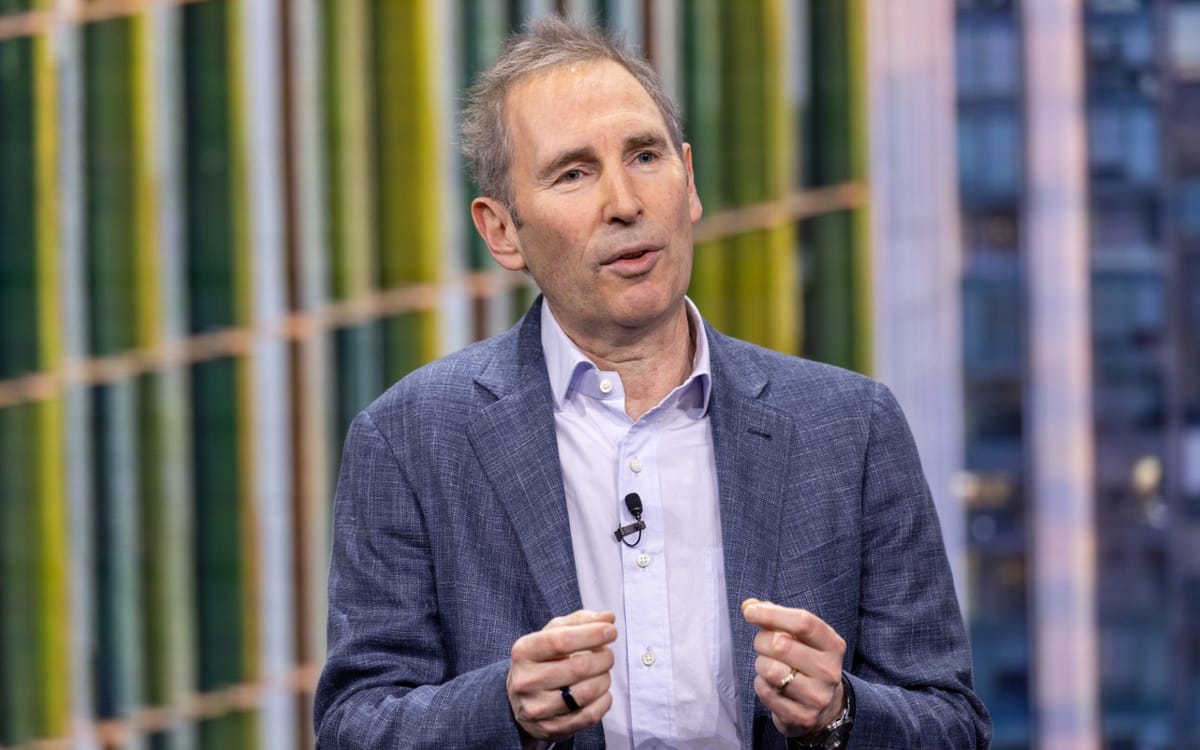
Amazon CEO Andy Jassy on persistence: seeing projects through makes the difference
Amazon CEO Andy Jassy discusses the importance of resilience and controlling controllable factors during AWS's uncertain early development period in December 2025.

Amazon CEO Andy Jassy shared insights about career decisions and business persistence during a December 2, 2025 employee discussion, revealing that his greatest professional regrets stem from abandoning projects before completion rather than from failed initiatives. The remarks provided a detailed examination of the mindset that guided Amazon Web Services through its uncertain early development phase.
"I haven't regretted a lot of the decisions I've made in my life," Jassy said. "I feel like you make the best decisions you can with the information you have at the time, and you don't have perfect information." The qualification that followed addressed a specific pattern. "But the ones I've looked back on and felt a little bit of remorse about have been the decisions where I left something where I felt like I really didn't see it through."
Subscribe PPC Land newsletter ✉️ for similar stories like this one
The distinction matters because it separates strategic pivots from premature abandonment. Jassy emphasized that staying with difficult projects does not mean remaining in every situation indefinitely. His framework centers on identifying initiatives worth sustaining through uncertainty rather than maintaining commitments that no longer align with strategic goals.
AWS represented precisely the type of uncertain venture that tested this philosophy. "While we were excited about what we were building, I would not say that we were filled with unbridled confidence," Jassy explained about the cloud computing service's early period. "There was a lot of uncertainty as we were building. People inside the company thought it was nutty."
Internal skepticism about AWS emerged during an era when on-premises data centers dominated enterprise computing. The concept of renting computing capacity from a retail company struck many observers as impractical. Amazon's core business revolved around selling physical products through an online marketplace, not providing infrastructure services to developers and enterprises.
Jassy described the decision point that shaped his approach. "And so, I made the decision that I was going to see it through," he said of AWS. The commitment extended beyond simple persistence to encompass a fundamental shift in analytical framework.
"When the team and I got to a point where we started thinking about how do we control what we can control, we can't control whether people will use this new form of computing, we can't control how fast it'll grow, we can't control if it's a successful business, but we can control what we define, and we can control what we build, and we can control who we hire, and we can control the speed at which we operate, and we can control who we target as customers, and we can control pricing it, so that we build something long term," Jassy explained.
This framework separated external market validation from internal execution capabilities. Teams could not predict customer adoption rates or competitive responses, but they controlled product specifications, hiring standards, development velocity, customer segmentation, and pricing architecture.
"Once we started focusing on controlling what we could control, we got to a much better spot," Jassy said. The strategic refocusing produced measurable results. AWS evolved from an internal skepticism target into Amazon's primary profit engine, generating $30.9 billion in revenue and $10.2 billion in operating income in the most recent reported quarter, accounting for approximately 70% of Amazon's total operating profit.
The business outcomes validated Jassy's persistence philosophy, but he addressed the broader pattern behind successful initiatives. "I think the business has worked out reasonably well. We have a ton of work to do, obviously moving forward," he said about AWS before shifting to general principles.
"It's very rare that you catch lightning in a bottle, where you have an idea, you launch it a few days and it's a home run," Jassy stated. The observation contradicted popular narratives about instant startup success and breakthrough innovation. Most ventures require sustained effort through ambiguous periods rather than immediate validation.
"Almost always it takes a lot of hard work. It takes time that we are uncertain, it takes decisions that you made that didn't quite work out, that you had to adjust, it takes resilience and persistence, and everything that's worth doing, I think, virtually everything that's worth doing, takes that type of persistence and resilience, and so that was a great lesson for me," Jassy said.
The framework Jassy described aligns with patterns visible across Amazon's business development. Amazon's advertising business expanded from a secondary revenue stream into a major growth driver, reaching $15.7 billion in quarterly revenue with 22% year-over-year growth by the second quarter of 2025. That transformation occurred over multiple years as Amazon refined targeting capabilities, expanded inventory across Prime Video and other properties, and built measurement infrastructure.
Similar persistence appears in AWS's expansion beyond basic computing services. The platform launched AWS RTB Fabric on October 23, 2025, providing specialized infrastructure for real-time bidding advertising workloads with single-digit millisecond latency. The service represents Amazon's progression from general cloud computing into highly specialized vertical applications that leverage accumulated infrastructure expertise.
AWS's infrastructure advantages created opportunities for Amazon's advertising business to develop technical capabilities unavailable to competitors. Amazon Marketing Cloud enables measurement and analytics across pseudonymized data sets, while partnerships with Roku, Disney, Netflix, Spotify, and SiriusXM assembled Connected TV advertising reach exceeding 80 million U.S. households through Amazon DSP.
The AWS foundation enabled Amazon to introduce AI-powered advertising features, including conversational prompts for sponsored ad campaigns that automatically engage shoppers at decision moments. These capabilities built on years of infrastructure investment and data accumulation rather than emerging from immediate inspiration.
Jassy's perspective on controllable factors reflects broader strategic themes in Amazon's business approach. In his April 2025 shareholder letter, Jassy defended multibillion-dollar AI investments by emphasizing Amazon's mission to improve customer experiences through technological advancement. The letter outlined a "Why Culture" that questions assumptions and explores possibilities others consider foreclosed.
The leadership principles Jassy discussed parallel decision-making frameworks Amazon applies across business units. His emphasis on controlling execution variables while accepting market uncertainty appears in Amazon's approach to retail media network development, logistics infrastructure expansion, and healthcare ventures.
AWS's trajectory from internal skepticism target to profit cornerstone validates Jassy's thesis about persistence through uncertainty. The business generated just $4.6 billion in annual revenue a decade ago when Amazon's total revenue stood at $89 billion, according to Jassy's shareholder letter. By 2024, AWS revenue exceeded $100 billion annually while Amazon's overall revenue reached $638 billion.
The growth patterns demonstrate compound effects from sustained investment in capabilities others viewed skeptically. AWS customers include advertising technology platforms that rely on Amazon's infrastructure to process millions of bid requests per second. AWS became central infrastructure for digital advertising beyond Amazon's own business, controlling the systems that power how digital ads are bought, sold, and measured across the industry.
Jassy's comments addressed employees rather than external stakeholders, focusing on career decision-making rather than business strategy. Yet the principles he outlined—seeing commitments through uncertain periods, focusing on controllable execution factors, accepting that worthwhile initiatives require sustained effort—shaped outcomes visible across Amazon's portfolio.
The AWS example provided Jassy's primary case study, but the broader framework applies to any venture navigating extended periods without clear validation. Market uncertainty remains constant during development phases. Teams cannot predict competitor responses, customer adoption patterns, or technological shifts that alter competitive dynamics.
What teams control, according to Jassy's framework, centers on execution quality. Product definitions, hiring standards, development speed, customer targeting, pricing models, and operational excellence remain within direct influence even when market reception stays uncertain.
"And that doesn't mean you should always stay in everything you're doing," Jassy clarified. The distinction between strategic persistence and inflexible commitment matters because not every uncertain situation merits sustained investment. The framework requires judgment about which uncertainties stem from insufficient execution versus fundamental market realities.
Jassy joined Amazon at age 29 after exploring other professions, according to the Amazon announcement. His career path included roles where he left projects before completion, experiences that informed his later approach to AWS and subsequent responsibilities.
The December 2 remarks continued themes Jassy emphasized throughout 2025 about organizational decision-making and sustained investment. Amazon's advertising infrastructure expansion accelerated during the year through partnerships, technical integrations, and platform consolidation that reflected multi-year strategic development rather than rapid pivots.
Amazon's position in advertising technology markets derived from AWS infrastructure built over decades, retail marketplace data accumulated through billions of transactions, and content properties assembled through sustained investment in Prime Video and other services. These assets combined to create competitive advantages unavailable to platforms lacking equivalent scale.
Jassy's emphasis on persistence aligns with patterns visible in how Amazon develops capabilities. The company entered advertising gradually, building measurement infrastructure before expanding inventory. It developed AWS incrementally, adding services based on customer needs rather than comprehensive initial launches. Healthcare ventures, physical retail experiments, and logistics network expansion followed similar patterns of sustained iteration.
The contrast between Jassy's framework and startup culture narratives about rapid iteration and pivoting highlights different approaches to uncertainty management. While many technology companies emphasize quick validation cycles and willingness to abandon unproven concepts, Jassy described commitment to seeing uncertain initiatives through extended development periods.
AWS's success provided validation for this approach, but the framework contains inherent risks. Sustained investment in initiatives that ultimately fail consumes resources that could address other opportunities. The challenge involves distinguishing projects worth seeing through from those requiring strategic abandonment.
Jassy's December 2 discussion did not address how teams identify which uncertain ventures merit persistence versus which require pivots. The framework focused on execution within committed initiatives rather than selection criteria for those commitments.
Marketing professionals tracking Amazon's business development can observe how Jassy's persistence philosophy manifests in platform capabilities that evolved over years. Amazon Marketing Cloud required infrastructure investment in AWS, data accumulation across retail and streaming properties, and privacy framework development before enabling advanced measurement capabilities advertisers now access.
Amazon's Model Context Protocol Server launched in closed beta on November 13, 2025, enabling AI agents to interact with advertising APIs through natural language. The capability built on AWS infrastructure, advertising platform development, and API architecture refined through years of iteration.
The pattern Jassy described—focusing on controllable factors while accepting market uncertainty, maintaining commitment through ambiguous periods, investing in capabilities that produce compound advantages—shapes Amazon's competitive position across businesses. AWS transformed from internal skepticism target into infrastructure supporting competitors' operations. Amazon's advertising business evolved from ancillary revenue stream into growth driver exceeding $15 billion quarterly.
Jassy's framework emphasizes that worthwhile initiatives require sustained effort through uncertain periods rather than immediate validation. The perspective differs from management philosophies emphasizing rapid experimentation and quick abandonment of unproven concepts, reflecting Amazon's approach to building durable competitive advantages through patient capital deployment.
Subscribe PPC Land newsletter ✉️ for similar stories like this one
Subscribe PPC Land newsletter ✉️ for similar stories like this one
Who: Amazon CEO Andy Jassy addressed employees in a discussion about career decisions and business persistence, drawing from his experience leading Amazon Web Services through its uncertain early development phase.
What: Jassy explained that his professional regrets center on abandoning projects before completion rather than failed initiatives, emphasizing the importance of seeing commitments through uncertain periods by focusing on controllable execution factors instead of unpredictable market outcomes. He described AWS's evolution from internal skepticism target to Amazon's primary profit engine as validation of persistent commitment to worthwhile ventures.
When: The employee discussion occurred on December 2, 2025, more than a decade after AWS established itself as dominant cloud computing infrastructure and eight months after Jassy's April 2025 shareholder letter outlined similar themes about sustained investment and organizational decision-making frameworks.
Where: The remarks appeared in Amazon's news center and addressed employees working across Amazon's business units, though Jassy's framework focused specifically on AWS development that transformed computing infrastructure markets and enabled Amazon's subsequent advertising technology expansion.
Why: Jassy's perspective matters because it reveals decision-making principles that shaped Amazon's competitive advantages in cloud computing, advertising technology, and other markets where the company invested years building capabilities others viewed skeptically, demonstrating how persistence through uncertainty combined with focus on controllable execution factors produces compound advantages unavailable through rapid iteration alone.