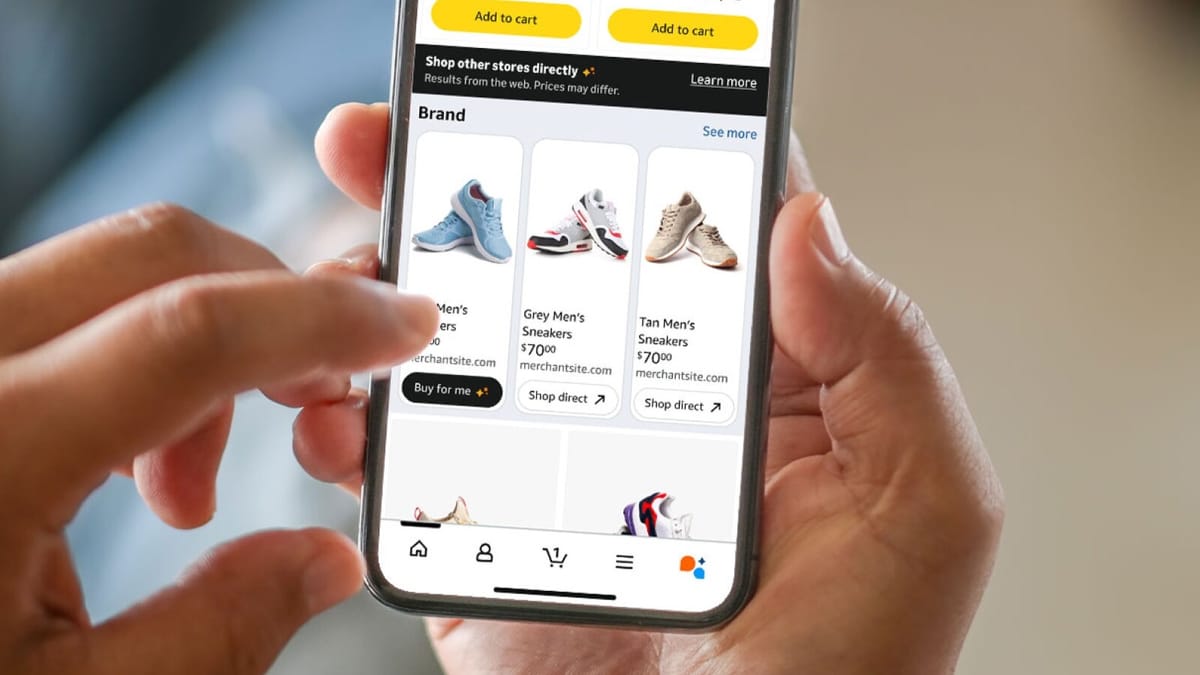
Amazon on March 11, 2026, announced that merchants can now connect to its Shop Direct AI-powered shopping experience through third-party product feeds, a structural change that lowers the technical barrier for brands seeking visibility across Amazon's customer base without selling directly through its marketplace.
The move extends a program that Amazon launched the previous year. Shop Direct currently includes over 100 million products from more than 400,000 merchants, with tens of millions of those products available through the Buy for Me feature - an agentic AI mechanism that completes a purchase on a customer's behalf, using their stored Amazon payment and shipping details, from a merchant's own website. The feed integration adds a new entry point: rather than requiring merchants to build a custom connection to Amazon's infrastructure, the company has opened participation through established feed syndicators, specifically Feedonomics, Salsify, and CEDCommerce.
"Product feeds give merchants a streamlined way to reach Amazon customers who are searching for their products," said Amanda Doerr, vice president of Core Shopping at Amazon. "With feeds, merchants can easily sync their catalog, pricing, and inventory in real time and maintain their customer relationships, while the program drives meaningful traffic and sales and gives customers access to even more selection."
The significance of that last phrase - maintaining customer relationships - is not incidental. It marks a notable distinction between Shop Direct's opt-in model and the controversy Amazon faced in early 2026 over Project Starfish, a program in which Amazon's AI agents scraped independent brand websites to create listings without merchant consent. That episode drew sharp criticism from small businesses, and the feed-based model announced on March 11 represents a formalization of merchant consent at the foundation of the program.
How the feed mechanism works
Merchants participating through Feedonomics, Salsify, or CEDCommerce use the same product catalog files they already supply to other retail and marketing partners. According to Amazon's announcement, those feeds sync catalog data, pricing, and inventory in real time with the Shop Direct selection. The result is that product availability displayed to Amazon customers reflects live stock levels and current prices from the merchant's own systems - a direct technical response to one of the primary complaints raised about the earlier scraping approach, which generated inaccurate and outdated product data.
Once a product appears in Shop Direct results, customers see two options depending on eligibility. The first is a "Shop Direct" button, which redirects the customer to the merchant's website after a notification confirming they are leaving Amazon. The second, for Buy for Me-eligible products, is an automated purchase pathway. Amazon's agentic AI handles the complete transaction: the customer confirms order details on Amazon's familiar checkout screen - including delivery address, applicable taxes, shipping fees, and payment method - and Amazon then transmits the purchase to the merchant's website using encrypted payment and shipping data. The merchant receives the customer's name and address, manages delivery, and handles any returns, exchanges, or service queries.
Order tracking is available through a dedicated tab in Amazon's "Your Orders" section called Buy for Me Orders. Merchant store names appear clearly throughout the process, whether customers are being redirected or having Amazon execute the purchase on their behalf. According to Amazon's announcement, this naming transparency applies at every touchpoint.
Rufus - Amazon's AI shopping assistant, which drove an estimated $12 billion in incremental sales during 2025 and reached more than 300 million users - also receives product information from the feeds. Merchants whose catalogs sync through the program can appear in both traditional search results and within Rufus responses when customers query for products in the Amazon Shopping app.
The scale and context
The program's current scale matters for marketing professionals assessing reach. Shop Direct's 100 million products from over 400,000 merchants places it among the larger cross-retailer product surfaces in U.S. e-commerce. Amazon has referred customers millions of times to merchant stores through Shop Direct, according to the company's announcement - a metric that frames the program as a traffic channel rather than simply a product listing mechanism.
The evolution of Buy for Me illustrates the program's trajectory. Products available through the agentic purchase feature grew from 65,000 at launch to over half a million by November 2025 - a roughly eight-fold increase in the initial months. The March 11 feed integration is the mechanism Amazon has chosen to accelerate that growth further. By removing the need for brands to build custom API connections, Amazon opens the program to merchants whose technical resources might not support bespoke integrations.
Amazon's announcement confirmed that additional feed syndicators will be added in the future, alongside a merchant-direct feed portal that would allow brands to participate without going through any third-party intermediary. That portal was not yet available as of the announcement date.
What the consent and data architecture means for merchants
The data flow under this model carries practical implications. When a customer uses the "Shop Direct" button, the merchant receives organic traffic to their own website and manages the full customer relationship. When a customer uses Buy for Me, Amazon completes the transaction on the merchant's website on the customer's behalf. The merchant receives the customer's name and shipping address. Amazon retains payment information and processes the transaction through its own infrastructure.
This creates an asymmetry in customer data ownership. The merchant gains a sale and a delivery address but does not gain the full first-party customer data that would ordinarily accompany a direct website transaction - including email address, browsing behavior on Amazon, or the customer's broader Amazon purchase history. For brands that have invested heavily in direct-to-consumer strategies to build first-party data assets, this trade-off deserves attention. Participation in Shop Direct increases visibility and drives incremental sales but routes some transactions through Amazon's data environment.
The agentic AI tensions in the broader industry are relevant here. Amazon has spent the past year blocking third-party AI agents from accessing its platform while simultaneously expanding its own agentic tools. A federal court granted Amazon a preliminary injunction against Perplexity's Comet browser on March 9, 2026 - just two days before this announcement - blocking the AI startup's agents from accessing Amazon accounts. The Shop Direct feed announcement, coming within 48 hours of that ruling, illustrates the dual track Amazon is pursuing: restricting external AI mediation of its marketplace while expanding its own AI-mediated reach into external merchants' inventories.
Availability and how to join
Shop Direct is available to all U.S. customers on Amazon.com, the Amazon Shopping app, mobile web browsers, and within Rufus. The geographic scope is currently limited to the United States. Merchants seeking to join the program through the three named syndicators can contact their account representatives at Feedonomics, Salsify, or CEDCommerce directly. For merchants whose feed syndicator is not currently part of the program, Amazon has provided a contact address - [email protected] - for inquiries about other participation options. A dedicated Shop Direct Merchant page covers setup procedures, feed configuration, brand presence optimization, and the process for opting out of the program.
The opt-out mechanism is notable. Unlike the earlier scraping controversy, where independent sellers found their products listed without consent and had no clear path to removal, the feed-based program is structured as an explicit opt-in through the syndicator relationship. Amazon's merchant page addresses the opt-out process directly, which suggests the company has designed the program with at least some attention to the consent failures that characterized Project Starfish.
For performance marketers and e-commerce advertisers, Shop Direct represents a distribution channel with characteristics distinct from both Amazon's standard marketplace and traditional paid search. There are no per-click costs or sponsored listing fees associated with appearing in Shop Direct through the feed, according to Amazon's announcement. The program drives visibility at the discovery stage - Amazon has referred customers millions of times to merchant items - while the conversion occurs either on the merchant's own site or through Amazon's checkout infrastructure.
The Rufus AI assistant's integration with Shop Direct inventory means product catalog quality is now a signal that influences AI-generated shopping recommendations. Feed data - including titles, descriptions, inventory levels, and pricing - feeds directly into the AI systems that surface products to hundreds of millions of Amazon customers. This is a meaningful shift for brands that have historically optimized product data only for their own website's search and for standard marketplace listings.
The program also intersects with ongoing conversations about agentic commerce and how brands position themselves when AI intermediaries mediate purchase decisions. Research from September 2025 showed that most major UK and U.S. retailers welcome AI agents and treat them as a new customer segment rather than a threat. Amazon's Shop Direct feed program operationalizes a version of that logic - merchants provide product data to Amazon's AI systems voluntarily, in exchange for discovery and traffic across one of the largest consumer shopping surfaces in the world.
The question of what constitutes meaningful incremental reach will vary by brand. Merchants already selling on Amazon's marketplace will need to assess whether Shop Direct generates traffic to products they do not list on the platform, or whether the program creates any competitive dynamics with their existing Amazon store presence. Merchants not currently on Amazon - whether by choice or category constraints - gain a new pathway to Amazon's customer base that stops short of the full seller agreement and associated fee structure.
Timeline
- February 2024 - Amazon launches Rufus in beta, training the assistant on product catalog, customer reviews, and web data: PPC Land coverage
- July 12, 2024 - Rufus expands to all U.S. customers ahead of Prime Day
- August 21, 2025 - Amazon blocks AI bots from major tech companies including OpenAI, Anthropic, Meta, Google, and Huawei
- September 2, 2025 - Amazon launches Lens Live with real-time scanning and Rufus integration
- September 27, 2025 - Research shows major merchants welcome AI agents while Amazon maintains restrictions
- November 4, 2025 - Amazon files federal lawsuit against Perplexity AI over Comet browser AI shopping access
- November 11, 2025 - Amazon unveils unified Campaign Manager and AI agents at unBoxed 2025
- November 18, 2025 - Rufus passes 250 million users, Buy for Me grows to over 500,000 products
- January 3, 2026 - Project Starfish controversy surfaces, independent brands report unauthorized AI-generated listings
- February 7, 2026 - Amazon reports Rufus drove $12 billion in incremental annualized sales in 2025
- March 4, 2026 - Amazon's updated Business Solutions Agreement takes effect, introducing formal Agent Policy
- March 9, 2026 - Federal court grants Amazon injunction against Perplexity's Comet browser
- March 11, 2026 - Amazon announces third-party product feed support for Shop Direct through Feedonomics, Salsify, and CEDCommerce
Summary
Who: Amazon, in partnership with feed syndicators Feedonomics, Salsify, and CEDCommerce, alongside the more than 400,000 merchants currently participating in Shop Direct and U.S. customers shopping on Amazon.com and the Amazon Shopping app.
What: Amazon announced on March 11, 2026, that merchants can now connect their product catalogs to its Shop Direct AI-powered shopping experience through third-party product feeds, enabling real-time synchronization of catalog data, pricing, and inventory. Qualifying products become eligible for the Buy for Me agentic purchase feature, through which Amazon's AI completes transactions on a customer's behalf from the merchant's own website.
When: The announcement was made on March 11, 2026. Additional syndicators and a merchant-direct feed portal are expected in the coming months, though no specific dates were provided.
Where: Shop Direct is available exclusively in the United States, accessible through Amazon.com, the Amazon Shopping app on iOS and Android, mobile web browsers, and within Rufus, Amazon's AI shopping assistant.
Why: Amazon states the change responds to requests from merchants - both large and small - who wanted a simpler path to participate in Shop Direct. The broader context is Amazon's ongoing effort to expand its AI-powered product discovery surfaces beyond its own marketplace inventory, while maintaining control over the customer experience and transaction infrastructure. The timing also reflects the company's effort to distance the program from the consent problems associated with Project Starfish, by formalizing feed-based, opt-in participation as the primary merchant entry point.
Share this article
The link has been copied!