Amazon tightens its grip as programmatic identity enters a new era
Amazon billing, pricing, and fee changes collide with The Trade Desk identity overhaul and dentsu's leadership reset in the week's most consequential ad industry moves.


Amazon billing, pricing, and fee changes collide with The Trade Desk identity overhaul and dentsu's leadership reset in the week's most consequential ad industry moves.
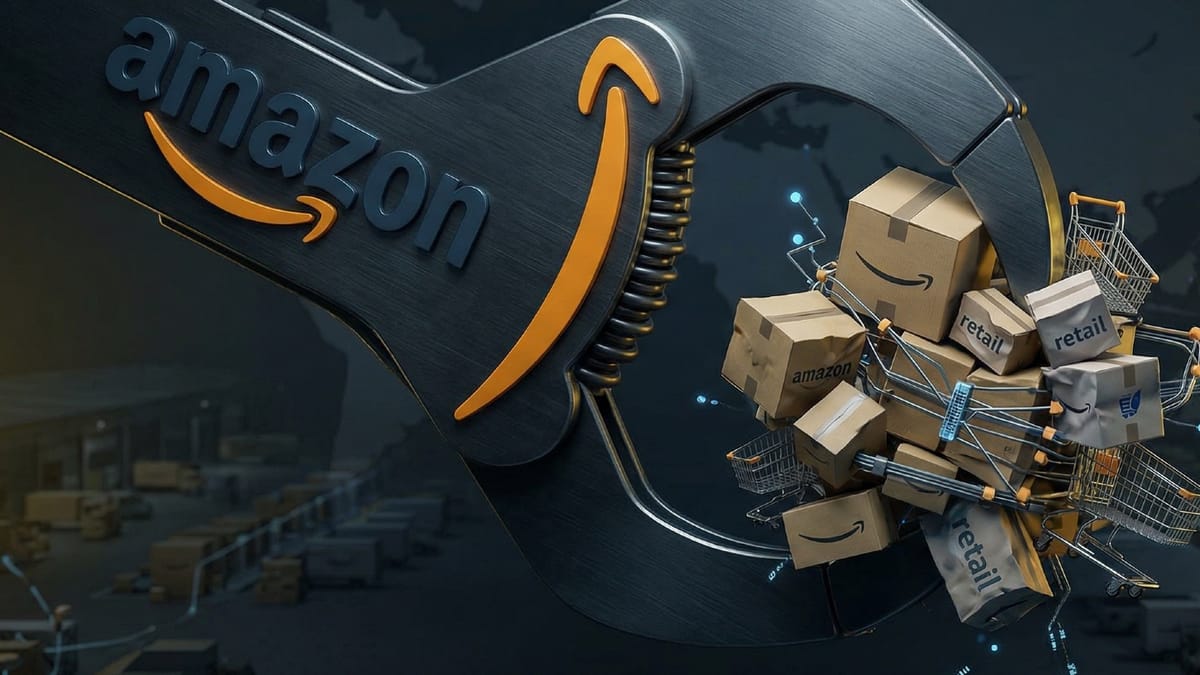
The first week of April 2026 arrived with a dense cluster of deadlines, acquisitions, and policy changes that, taken together, sketch a clear picture of where the balance of power in digital advertising currently sits. Amazon tightened its financial grip on sellers. The Trade Desk restructured how it compensates identity data partners. Dentsu formally began a new chapter under Takeshi Sano. Publicis made a major sports marketing bet. And across search, Google continued pushing through a succession of updates that have yet to fully resolve. None of these developments is isolated; they are threads in the same fabric.
The most operationally urgent story for sellers this week originated inside Amazon's Seller Central. On April 4, Amazon announced a 3.5% fuel and logistics surcharge on Fulfillment by Amazon (FBA), Multi-Channel Fulfillment (MCF), Buy with Prime, and Remote Fulfillment with FBA fees across the United States and Canada. The surcharge takes effect April 17 for FBA and Remote Fulfillment, and May 2 for Buy with Prime and MCF. Amazon framed the change as a temporary measure to recover a portion of actual cost increases. Translated into unit economics, the surcharge adds approximately $0.17 per item on average — a figure that sounds modest but compounds across high-volume sellers moving tens of thousands of units monthly.
This announcement did not come in isolation. It followed a separate billing change disclosed via an internal Seller Central letter, first analysed publicly by Steven Pope of My Amazon Guy on April 2 and then circulated more widely by advisor Jon Elder on LinkedIn on April 4. Under a new system taking effect April 15, Amazon will automatically deduct advertising costs from seller retail proceeds rather than billing them separately to credit cards. The financial logic is transparent: Amazon's advertising business generated $68.6 billion in full-year 2025 revenue, according to Q4 results reported on February 6. At that scale, credit card interchange fees — typically 1.5% to 2.5% per transaction in the United States — represent a meaningful drag. Eliminating the card layer consolidates revenue flows and reduces costs. Amazon is offering $2,500 in promotional credits to affected accounts as part of the transition.
Earlier, on March 31, Amazon ended FBA commingling, requiring resellers to apply FNSKU barcodes on all newly inbound units — a structural change that separates inventory by seller and increases per-unit accountability. Then, on April 23, Amazon's updated List Price validation rules come into force. Under the new requirements, a seller-submitted List Price — the figure displayed with a strike-through on product pages — must be substantiated by either recent third-party retailer pricing evidence or actual Amazon Featured Offer purchase history at that price. A second deadline, May 18, changes the Typical Price calculation to incorporate promotional sales when a product's price remains below its non-promotional median for more than half of any 90-day period.
The advertising implications are direct. Sponsored Products campaigns driving traffic to listings that no longer display a valid reference price will convert at lower rates, raising effective cost per acquisition without any change to bid strategy. Sellers who have relied on inflated list prices to display large savings percentages face a fundamental rethink. Amazon's pattern through early 2026 — per-unit FBA removal billing in February, commingling elimination in March, billing automation and fuel surcharges in April — forms a consistent arc toward greater specificity, tighter accountability, and reduced operational flexibility for third-party sellers.
Across the programmatic ecosystem, The Trade Desk quietly communicated changes to how it compensates partners inside its Identity Alliance — a development first reported by Digiday and picked up by AdExchanger on April 1. Identity Alliance, which The Trade Desk describes as a "graph of graphs," unifies identity providers including Experian, ID5, and LiveRamp into a single cross-device targeting and measurement infrastructure. Partners have historically been compensated based largely on the volume of data applied to campaigns. Under the new framework, payments shift to incremental value — meaning a data partner only earns compensation for signals that are unique and not already captured elsewhere in the DSP's system.
The change matters for several reasons. Separate sources quoted by Digiday independently estimated the offering generates "tens of millions of dollars" each year in partner payments — sums that will now be redistributed away from volume contributors toward those proving genuine additionality. ID5 CEO Mathieu Roche acknowledged the logic of the shift, noting that quality over quantity was directionally sensible. Experian and LiveRamp declined to comment on record.
The backdrop is significant. The Trade Desk posted nearly $3 billion in revenue in 2025, but its Q1 guidance of $678 million disappointed investors and prompted a further stock price decline. Its take rate, while at the top of its historical range at above 21%, has drawn scrutiny. Meanwhile, Publicis recommended some clients move spend away from The Trade Desk in March, and as Digiday reported in a separate piece, advertisers are increasingly shopping around despite the DSP's continued dominance. Publishers using OpenPath have reported double-digit revenue gains — one publisher cited a 10% year-over-year gain in January 2026 alone — but volatility remains, and the tool's transparency limitations continue to generate frustration.
The identity payment overhaul is consistent with The Trade Desk's Kokai platform strategy, which aims to route spend through signals that demonstrably improve outcomes rather than rewarding partners for sheer data volume. Whether that reassures its agency relationships — fraying in some cases after mid-contract rate increase attempts and rapid account team turnover, as described by sources in Digiday's March reporting — is a separate question.
On April 1, Takeshi Sano confirmed on LinkedIn that he had formally assumed the role of President and Global CEO at dentsu, following the 177th Ordinary General Meeting of Shareholders on March 27. PPC Land covered the transition in full. Sano joined dentsu in April 1992 — more than three decades inside a single organisation. He became CEO of dentsu Japan in January 2024 and deputy global COO in January 2025.
The context behind his appointment is unambiguous. Earlier in February 2026, dentsu reported a ¥327.6 billion ($2.18 billion) net loss for fiscal 2025, driven by a ¥310.1 billion ($2.03 billion) goodwill impairment on its international operations — a formal write-down of value attributed to overseas acquisitions that has not materialised. Adweek had previously reported that dentsu had been exploring a sale of its international business, including Merkle, before the review collapsed without a deal. In August 2025, the company cut 3,400 positions across international operations, 8% of its overseas workforce, following a ¥79.9 billion quarterly loss for the three months ended June 2025.
Sano's restructuring programme is explicit in its scale. Dentsu plans to invest ¥26 billion ($173 million) in additional restructuring during fiscal 2026, targeting ¥42 billion ($280 million) in total annual savings and ¥50 billion ($333 million) in recurring savings by fiscal 2027. A further 1,300 positions are being eliminated, following 2,100 cuts during fiscal 2025. Structural change accompanies the headcount reductions: the global COO and global president roles have been eliminated entirely, concentrating authority in Sano. Regional CEOs and practice leaders now report directly to him. Japan, which accounts for roughly 40% of group net revenue, posted net revenue of ¥504.6 billion ($3.36 billion) for fiscal 2025 with 0.5% organic growth, significantly outperforming international regions where the Americas declined 3.4% and EMEA fell 2.4%.
While dentsu consolidates, Publicis moved in the opposite direction. Adweek reported on April 2 that Publicis Groupe has acquired 160over90, a sports and culture agency with more than 670 employees across the US, UK, EMEA, and APAC, from WME Group for an undisclosed sum. The agency, which has worked on campaigns for the Super Bowl, Olympics, and World Cup, becomes part of Publicis Sports, a division led by CEO Suzy Deering. Publicis CEO Arthur Sadoun described the acquisition as the company's "next big bet," linking it to a broader thesis that live sport represents one of the last mass-audience moments resistant to AI-driven personalisation. Publicis reported $17.18 billion in net revenue in 2025, up 5.6% from 2024. The WME partnership, maintained alongside the acquisition, gives Publicis first-look access to talent and IP. MediaPost also noted that the acquisition makes Publicis a more formidable competitor in sports marketing at precisely the moment dentsu is pulling back internationally.
March's search activity has carried directly into April, with the Google March 2026 core update — the first core update of the year — still in progress. The rollout began on March 28 at 5:14 ET and is expected to take up to two weeks. It follows the March 2026 spam update, which launched March 24 and completed within 19.5 hours, making it the fastest-rolling spam update on record. Barry Schwartz at Search Engine Roundtable noted that the core update "is a regular update designed to better surface relevant, satisfying content for searchers from all types of sites." Google's John Mueller explained separately why these updates take weeks to complete: the different components operate step-by-step rather than simultaneously, with each system and algorithm pushed individually as teams finish their work.
Parallel to the core update, Google announced several policy and product changes affecting advertisers. Google Shopping Ads will require election advertiser verification for political content in several countries including the United States starting April 16, 2026, per a Search Engine Roundtable report. The update adds restrictions specifically to Shopping campaigns. Additionally, as part of its broader Customer Match migration, Google formally blocked Customer Match data uploads via the Google Ads API from April 1, requiring all developers using OfflineUserDataJobService or UserDataService to migrate to the Data Manager API. The Data Manager API — launched in December 2025 with eleven launch partners including Hightouch, Tealium, and Treasure Data — limits each Google Cloud project to 100,000 requests per day and 300 per minute. Individual requests can contain up to 10,000 audience members, each with up to 10 user identifiers.
On the events front, Google announced on April 2 that Search Central Live Shanghai 2026 is scheduled for May 15 at the Crowne Plaza Shanghai Noah Square, 1699 Jinshajiang Road, Putuo District. It marks the series' first event on mainland China — a market where Google's search engine has not operated freely since 2010. Speakers include Ian Hung (Search Ecosystem Consultant), Vince Yue (Associate Principal, Trust & Safety Search), Cherry Prommawin, and Gary Illyes. Fluency in Mandarin is a hard requirement for attendance. Registration closes April 27, with accepted applicants notified by May 4. The event follows the Search Central Live Toronto announcement on March 11, with that event scheduled for April 21.
Among the week's more consequential moves beyond the major platform operators was OpenAI's acquisition of TBPN, a live-streaming business with a small but influential audience in the technology industry. MediaPost's analysis on April 3 framed the deal as OpenAI positioning itself as the "Voice of AI" — acquiring not just a media property but a narrative platform that shapes industry perception ahead of what is expected to be an IPO process. TBPN will continue to operate with editorial independence, choosing its own guests and programming. The acquisition echoes earlier patterns — Westinghouse Electric owning CBS, Microsoft partnering with NBC to launch MSNBC — where technology companies sought to control adjacent media infrastructure to shape conversations about their own sector.
Separately, Microsoft Advertising is testing a two-tier sponsored product carousel on Bing, a format pairing a large double-row sponsored carousel with organic cards from individual websites beneath it. The format was spotted by freelance search expert Sachin Patel in a limited test. As of February 2026, Bing holds a 5.11% share of the worldwide search engine market. Navah Hopkins, Microsoft Advertising liaison, also announced that advertisers can now update Merchant Center store names and domains directly from Merchant Center — changes requiring editorial review before going live. These ecommerce moves sit within a broader Microsoft strategy that has been pulling back from traditional ad technology (Microsoft Invest DSP was discontinued by February 28, 2026) while pushing into AI-native and commerce-adjacent formats.
The Microsoft Prebid Cache shutdown, reported by PPC Land in December and confirmed for April 30, 2026, adds another constraint on publishers who have relied on the free infrastructure for video header bidding delivery. Publishers who have not implemented local caching or found an alternative hosted solution face a hard deadline on April 30. The gap between the discontinuation of Microsoft Invest DSP and the Prebid Cache shutdown has left video publishers in a particularly difficult operational position.
Returning to Amazon's seller ecosystem with more precision: the April 15 billing shift, where advertising costs auto-deduct from retail proceeds, eliminates a separate invoicing step that previously allowed sellers to track ad spend and retail revenue on distinct ledgers. CFO Brian Olsavsky noted during the Q4 2025 earnings call that advertising contributed more than $12 billion of incremental revenue to Amazon in 2025. If a conservative 30% of that revenue was billed through credit cards, that represents roughly $20.6 billion in card-processed transactions — and interchange fees on that volume are not immaterial. The practical impact for sellers is that cash flow management changes: previously, retail proceeds and ad spend were on different cycles. Now they are netted in a single flow.
The Prime Video Ultra rebrand, announced March 13 and effective April 10, raises the monthly cost of an ad-free Prime Video tier from $2.99 to $4.99 — a 67% increase. Amazon reframes this as a feature expansion: Prime Video Ultra adds 4K/UHD, Dolby Atmos, five concurrent streams, and 100 offline downloads. A Prime subscriber who paid $14.99 per month before Amazon introduced ads in January 2024 and who now pays for the Ultra tier will pay $19.98 per month — $239.76 annually, compared to $139 before ads were introduced. The effective cost of ad-free viewing has risen nearly $100 per year over two years. Crucially for advertisers, every dollar increase in the ad-free tier's price modestly expands the ad-supported audience by making the paid upgrade less attractive relative to accepting ads.
The wider agency holding company picture remained contested this week, with principal media practices again under scrutiny. AdExchanger's analysis from the period noted that a former WPP agency leader, Richard Foster, filed a $100 million wrongful termination lawsuit alleging he was dismissed after raising concerns about rebate practices. WPP's counter-filing revealed a 2024 memo showing GroupM's principal media revenue exceeded $1 billion globally. The disclosure has accelerated scrutiny of practices across holding companies at a moment when WPP — now operating its media buying arm as WPP Media, renamed from GroupM — is itself executing a major structural overhaul under CEO Cindy Rose's Elevate28 plan. The plan reorganises WPP into four units (WPP Media, WPP Creative, WPP Production, and WPP Enterprise Solutions), unified under the WPP Open agentic marketing platform. WPP projects the programme will cost £400 million ($540 million) to implement, yielding £500 million ($676 million) in gross savings.
Publicis's dispute with The Trade Desk — which Digiday characterised as being less about transparency than about who captures the margin in programmatic transactions — ran alongside WPP's internal turbulence. TTD CEO Jeff Green responded to the public fracture with a LinkedIn post calling out agencies that "wave the flag of transparency publicly, but run from it in practice as they arbitrage" — a pointed exchange that made visible tensions that have been building since Publicis began steering some clients away from TTD in March.
Not all of the week's significant marketing stories were rooted in platform economics. On April 2, PPC Land reported on Nestlé's handling of the March 26 theft of 413,793 KitKat bars — precisely 12 tonnes — from a truck in transit from a factory in central Italy to distributors in Poland. No injuries were reported. The cargo remained unlocated at the time of Nestlé's public disclosure, which came on April 1. Working with creative agency VML, Nestlé launched the Stolen KitKat Tracker on April 1 — a purpose-built digital tool hosted on a Nestlé corporate website that allows any consumer to enter the eight-digit batch code on the back of a KitKat wrapper to check whether it belongs to the stolen shipment. The tool works because each bar carries a unique batch code tied to Nestlé's product traceability infrastructure, which law enforcement uses to trace stolen goods.
The brand response that followed on April 1 and 2 was wide: Domino's UK, Durex Singapore, Pizza Hut South Africa, McAfee, Rode, and Barilla all posted responses joining the conversation on social media. On April 2, KitKat US released a faux movie poster called "The KitKat Job" in collaboration with Tubi. The episode demonstrates what happens when a supply chain crisis is transformed into a consumer-facing traceability product — and raises a separate, less comfortable question about the normalisation of European cargo theft and freight fraud as a backdrop for brand engagement.
Monday, March 30
Tuesday, March 31
Wednesday, April 1
Thursday, April 2
Friday, April 3
Earlier in the week