Amazon's product collections bet: 3-10 ASINs and AI will replace headlines
Amazon replaces existing product collections with AI-powered format starting January 28, 2026, requiring 3 ASIN minimum and eliminating custom creative.


Amazon replaces existing product collections with AI-powered format starting January 28, 2026, requiring 3 ASIN minimum and eliminating custom creative.
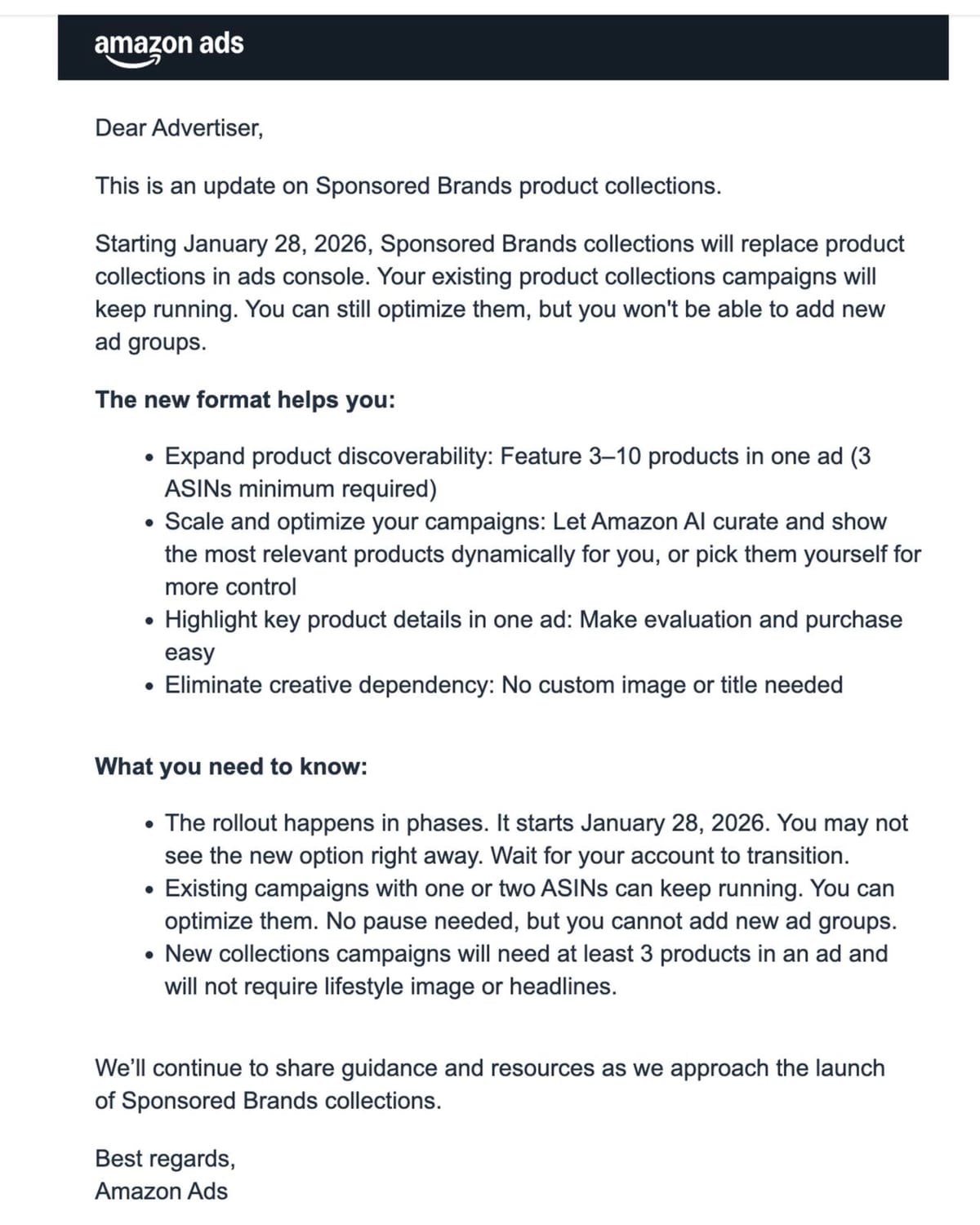
Amazon this month announced the rollout of Sponsored Brands product collections, a format replacing existing product collections campaigns starting January 28, 2026. The update enables advertisers to feature between 3 and 10 products in a single ad unit, according to the announcement shared with advertisers. The phased implementation affects all US advertisers running product collections campaigns, with existing campaigns limited to optimization-only access.
The new format introduces significant structural changes. According to the announcement, Amazon "will replace product collections in ads console" with Sponsored Brands collections that require a minimum of 3 ASINs. Existing campaigns with one or two ASINs can continue running and accept optimization changes, but advertisers cannot add new ad groups to these campaigns. The technical specifications mark a departure from previous requirements. Product collections historically supported campaigns with as few as one ASIN.
API documentation for the existing product collection format reveals extensive technical requirements that the new format eliminates. According to Amazon's Advanced Tools Center documentation, current product collection ads require brand logos with minimum dimensions of 400 x 400 pixels, custom images sized at 1200 x 628 pixels or larger, and file sizes not exceeding 5MB for images and 1MB for logos. These specifications disappear under the new format where Amazon eliminates custom creative requirements entirely.
Amazon positions the format as expanding product discoverability. The announcement states advertisers can "feature 3-10 products in one ad" with a 3 ASIN minimum requirement. This expansion from the previous maximum of 3 products creates opportunities for broader catalog exposure within individual ad units. The discoverability enhancement matters for brands operating extensive product portfolios where single-product advertising limits visibility for related items.
Current product collection specifications allow simple landing pages supporting up to 100 ASINs, according to API documentation, though only three ASINs appear in the actual ad creative. The landing page ASIN list includes the three advertised products plus up to 97 additional items. This extensive landing page capacity enables brands to showcase comprehensive product catalogs beyond the limited ad unit display. The new format's 3-10 ASIN range suggests Amazon may restrict landing page capacity alongside visible product expansion, though the announcement provides no explicit landing page specifications.
The format introduces two product selection approaches. Advertisers can allow Amazon's AI to "curate and show the most relevant products dynamically" or manually select specific products for greater control. The dynamic curation leverages Amazon's first-party shopping signals to optimize which products appear based on individual shopper behavior and search context. Manual selection maintains traditional advertiser control over product presentation within campaign parameters.
Amazon frames the AI curation as a scaling mechanism. According to the announcement, the system helps advertisers "scale and optimize your campaigns" by automating product selection through machine learning. This mirrors patterns across Amazon's advertising infrastructure throughout late 2025, where the company systematically reduced manual campaign management requirements through AI automation.
The format eliminates custom creative requirements. The announcement states the new collections "will not require lifestyle image or headlines." This contrasts sharply with traditional Sponsored Brands campaigns where advertisers provide custom headlines and images. The creative elimination reduces production barriers for brands lacking design resources while standardizing ad appearance across Amazon's marketplace.
The removal of custom images represents a significant strategic shift. According to Amazon's API documentation, "historical data shows that, on average, Sponsored Brands ads with a branded creative generates a 50% increase in CTR and a 60% increase in branded search compared to ads with only product images." Despite this documented performance advantage, Amazon eliminates the custom image requirement entirely in the new format. The documentation defines product collection with custom images as "branded creative" while product collection without custom images does not qualify as branded creative.
Product details receive enhanced prominence in the new format. According to Amazon, the system will "highlight key product details in one ad" to make "evaluation and purchase easy." This structural change shifts emphasis from branded messaging toward product-specific information. The approach aligns with Amazon's AI-powered prompts launched in November 2025, which automatically engage shoppers with product expertise at decision moments.
The rollout follows a phased timeline. According to the announcement, implementation "starts January 28, 2026" but advertisers "may not see the new option right away." Amazon instructs advertisers to "wait for your account to transition" as the platform applies changes gradually across advertiser accounts. This staged deployment enables Amazon to monitor performance and address technical issues before universal availability.
Existing campaigns face specific limitations during the transition. The announcement clarifies that "existing campaigns with one or two ASINs can keep running" and advertisers "can optimize them" without pause requirements. However, the system prevents adding new ad groups to these legacy campaigns. This creates operational constraints for advertisers who historically scaled campaigns by adding ad groups rather than creating entirely new campaigns.
New collections campaigns require structural changes. According to Amazon, campaigns "will need at least 3 products in an ad" and operate without lifestyle images or headlines. This three-product minimum represents a fundamental requirement rather than an optimization recommendation. Advertisers operating in narrow product categories with fewer than three relevant ASINs will face challenges meeting the format requirements.
Technical documentation specifies that current product collection ads with zero or one product do not display on Amazon at all. According to the API documentation, "a product collection custom image ad may contain zero or one products, but an ASIN-only ad with zero or one product does not display." This technical constraint explains why Amazon sets the three-product minimum - the format requires sufficient products to populate the ad unit. Single-ASIN and two-ASIN campaigns failing to meet the minimum simply won't render in search results or other placements.
The timing positions the feature for Q1 2026 implementation. January 28 sits between holiday shopping periods and spring seasonal promotions, providing a relatively stable testing environment. Amazon historically uses lower-volume periods to introduce platform changes, enabling system stabilization before high-traffic events where technical issues create more significant advertiser impact.
The update builds on Amazon's systematic campaign simplification throughout 2025. The company unified its DSP and sponsored ads console in November 2025, eliminating fragmented workflows across advertising products. That consolidation preceded AI agents for campaign management and Creative Agent expansion to television formats, all announced at the November 2025 unBoxed conference.
The Sponsored Brands collections announcement follows Amazon's pattern of reducing creative dependencies across advertising formats. The company introduced Sponsored Products video in November 2025 with interactive thumbnails that required no separate creative production. That format enabled advertisers to upload product feature videos directly within existing campaigns rather than requiring dedicated video creative development.
Amazon's AI-powered dynamic selection differs from manual product collection management. The system processes shopping signals including browsing behavior, search queries, purchase history, and category engagement patterns. This first-party data integration enables contextual product selection that adapts to individual shopper profiles rather than displaying identical product sets to all customers viewing the same campaign.
The three-product minimum creates strategic implications for advertisers. Brands operating focused product lines with limited SKU counts must identify sufficient products for collections campaigns or abandon the format entirely. This requirement potentially disadvantages smaller brands or those operating in specialized categories where product variety remains constrained by market dynamics.
The elimination of custom headlines and lifestyle images removes brand differentiation opportunities. Traditional Sponsored Brands campaigns enabled advertisers to communicate brand positioning through visual creative and messaging. The new format shifts entirely toward product-centric display, potentially reducing brand recognition value in favor of immediate purchase conversion.
Landing page options remain unclear in the new format. Current product collection ads support three landing page types according to API documentation: PRODUCT_LIST for simple landing pages with up to 100 ASINs, STORE for Amazon Brand Store pages, and CUSTOM_URL exclusively for vendors with custom landing pages. The documentation specifies "only vendors can use the CUSTOM_URL enum. This pageType is not available for sellers." The announcement provides no clarity on whether these landing page options persist in the new Sponsored Brands collections format or whether Amazon restricts advertisers to specific landing page types.
Performance measurement will determine format adoption patterns. Amazon's internal testing data for previous format changes consistently showed performance improvements justifying mandatory transitions. The company reported 9% click-through rate increases for Sponsored Products video and 26% workflow time reductions for smart search during 2025 platform enhancements.
Advertiser control diminishes through AI-powered product selection. While Amazon provides manual product selection options, the system's emphasis on AI curation suggests optimization toward automated approaches. This mirrors Google's Performance Max campaigns, where advertiser control traded against supposed performance improvements through machine learning optimization.
The feature arrives as Amazon expands AI across advertising operations. The company introduced reserve share of voice for branded search in October 2025, enabling fixed-price keyword reservations. That feature addressed visibility variability while Brand Store page views metrics launched November 2025 tracked traffic specifically from Sponsored Brands advertisements.
Amazon positions collections as simplifying campaign management. According to the announcement, the format helps advertisers "eliminate creative dependency" by requiring "no custom image or title needed." This creative elimination reduces production bottlenecks for brands lacking design resources while accelerating campaign launch timelines.
The phased category rollout suggests Amazon recognizes category-specific challenges. Some product categories naturally support collections better than others. Electronics accessories naturally group into complementary product sets, while specialized industrial equipment often exists as standalone items without obvious collection partners. Category-specific implementation enables Amazon to address these variations systematically.
Industry reaction to the announcement highlighted concerns about AI control. Mansour Norouzi, Partner and Director of Advertising at Incrementum Digital, noted on LinkedIn that "this is clearly Amazon leaning harder into AI and personalization based on what the customer is actually searching for." His commentary emphasized hoping Amazon doesn't eliminate manual product selection capabilities, which "sounds like we can still choose products manually, which is good."
The update affects thousands of advertisers managing Sponsored Brands campaigns. Amazon's advertising business generated $15.7 billion in Q2 2025, representing 22% year-over-year growth according to financial results. Sponsored Brands represents a significant component of that revenue, with product collections serving specific catalog promotion use cases.
Strategic implications extend beyond immediate operational changes. The format shift signals Amazon's long-term direction toward AI-mediated advertising where manual configuration diminishes in favor of automated optimization. This trajectory matches patterns across major advertising platforms where automation replaces human decision-making in bid management, targeting, and now creative presentation.
The three-product requirement creates inventory management considerations. Advertisers must maintain sufficient ASIN counts to populate collections campaigns while ensuring product availability across featured items. Stock-outs affecting collection components create incomplete ad experiences potentially reducing performance compared to fully stocked collections.
Budget allocation decisions require recalibration under the new format. Advertisers historically running single-product or two-product collections campaigns must determine whether expanding to three-product minimums justifies continued investment or whether budget reallocation to alternative formats provides superior returns. This evaluation involves comparing performance between previous collection campaigns and anticipated results from expanded product counts.
The announcement documentation provides limited guidance on optimization best practices. Amazon stated it "will continue to share guidance and resources as we approach the launch" but offered minimal technical specifications beyond basic requirements. This documentation gap forces advertisers to experiment with format features through trial and error rather than following established best practice frameworks.
API integration implications remain unaddressed in the announcement. Current product collection management requires multiple API endpoints including sb/v4/ads/productCollectionExtended for ad creation and sb/ads/creatives/productCollectionExtended for creative updates. According to documentation, advertisers must obtain assetIds from the asset library API for brand logos and custom images before creating ads. The new format eliminating custom creative requirements potentially simplifies API workflows by removing asset library dependencies, though Amazon provides no technical specifications for how API calls will change. Third-party tools and platforms integrated with Amazon's advertising API will require updates accommodating the new format structure and modified field requirements.
Campaign migration strategies vary based on existing campaign structures. Advertisers running numerous single-ASIN or two-ASIN collections campaigns face decisions about which campaigns merit expansion to meet three-product minimums versus which campaigns should transition to alternative Sponsored Brands formats or Sponsored Products campaigns entirely.
The format change intersects with Amazon's broader unified reporting system launched November 2025. That infrastructure consolidation enables consistent performance measurement across advertising products, allowing advertisers to compare collections campaign results against alternative sponsored formats through standardized metrics.
Amazon's competitive positioning drives format development. The company faces intensifying competition from Google Shopping, Meta's commerce initiatives, and emerging AI shopping agents. Simplified campaign creation with AI optimization reduces barriers enabling more advertisers to execute sophisticated campaigns without requiring specialized expertise.
The collections update reflects Amazon's dual strategy balancing scale and control. Large brands with extensive catalogs benefit from AI-powered dynamic selection handling hundreds of product variations. Smaller brands requiring precise product presentation retain manual selection capabilities maintaining strategic control over product positioning.
Technical implementation details remain sparse in available documentation. The announcement provides no information about how AI curation algorithms prioritize products within collections, what signals determine dynamic product selection, or how performance data from collections campaigns feeds back into optimization systems. These technical specifications matter for advertisers seeking to understand how the format operates beneath surface-level features.
The January 28 rollout date provides limited preparation time. Advertisers received the announcement approximately 20 days before implementation begins, creating compressed timelines for strategic assessment, campaign restructuring, and internal stakeholder alignment around format changes. This acceleration matches Amazon's typical pattern of announcing platform changes shortly before implementation.
Performance benchmarks will emerge gradually through advertiser experimentation. Initial format adoption will generate performance data comparing legacy collection campaigns against new three-product-minimum structures. These results will inform industry best practices around when collections campaigns justify investment versus alternative advertising approaches.
The format evolution continues Amazon's systematic reduction of manual campaign management. The trajectory points toward increasingly automated advertising where advertisers provide business objectives and inventory parameters while AI systems handle tactical execution including product selection, bid optimization, and creative presentation.
Amazon's existing product collection format supports vertical video specifications according to API documentation. The format accepts 9:16 aspect ratio videos with dimensions of 720x1280, 1080x1920, or 2160x3840 pixels, duration between 6-45 seconds, and specific technical requirements for codecs and bitrates. The announcement makes no mention of video capabilities in the new Sponsored Brands collections format. This omission raises questions about whether vertical video support continues, particularly given Amazon's November 2025 push toward video advertising across multiple formats including the interactive video launch for Sponsored Products.
Who: Amazon Ads announced changes affecting all US advertisers running Sponsored Brands product collections campaigns through the ads console. The update impacts sellers, vendors, and agencies managing Amazon marketplace advertising.
What: Amazon replaces existing product collections campaigns with Sponsored Brands collections requiring 3-10 products per ad unit (3 ASIN minimum). The new format eliminates custom headlines and lifestyle images while introducing AI-powered dynamic product curation alongside manual selection options. Existing campaigns with fewer than 3 ASINs can continue running and accept optimization changes but cannot add new ad groups.
When: The phased rollout starts January 28, 2026, with gradual implementation across advertiser accounts. Amazon states advertisers may not see the new option immediately and should wait for account transitions. The company will share additional guidance and resources as the launch approaches.
Where: The update applies to Sponsored Brands product collections in Amazon's ads console across the US marketplace. The feature operates within Amazon's advertising ecosystem including search results, product detail pages, and other sponsored placement locations.
Why: Amazon positions the change as expanding product discoverability by enabling 3-10 products per ad compared to previous limits. The format eliminates creative dependency requiring no custom images or headlines, reducing production barriers for advertisers. AI-powered dynamic curation aims to scale campaigns by showing relevant products based on shopper context while manual selection preserves advertiser control. The update follows Amazon's pattern throughout 2025 of reducing manual campaign management through AI automation across its advertising infrastructure.