Anthropic opens Claude Code's automation power to everyone with Cowork
Anthropic launched Cowork on January 12, bringing Claude Code's file automation to non-developers through natural language on macOS.


Anthropic launched Cowork on January 12, bringing Claude Code's file automation to non-developers through natural language on macOS.
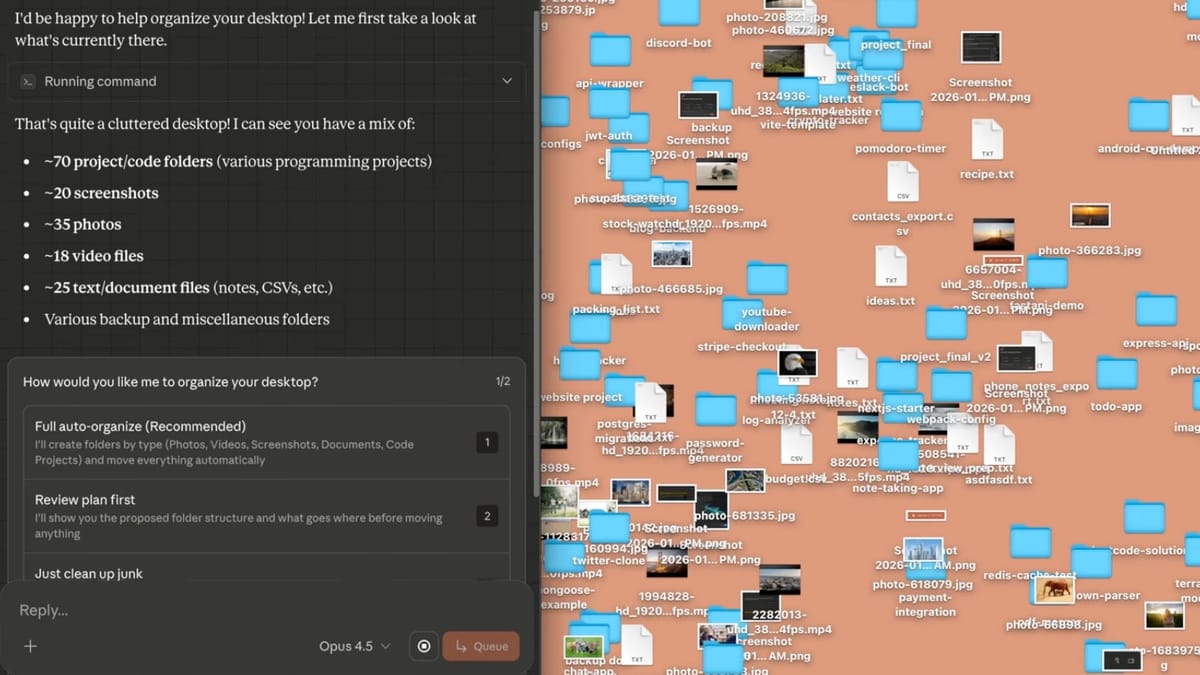
Anthropic today released Cowork, extending the automation capabilities previously limited to developers using Claude Code to all Claude Max subscribers. The research preview makes file manipulation, document generation, and data processing accessible through natural language instructions rather than programming expertise.
Cowork operates through Anthropic's macOS application, providing Claude with controlled access to selected folders on users' computers. According to the announcement, the system can reorganize downloads by sorting and renaming files, create spreadsheets from expense screenshots, or produce report drafts from scattered notes. The release positions Claude as capable of handling tasks with "much more agency than you'd see in a regular conversation."
"When we released Claude Code, we expected developers to use it for coding," Anthropic stated in the announcement. "They did—and then quickly began using it for almost everything else. This prompted us to build Cowork: a simpler way for anyone—not just developers—to work with Claude in the very same way."
The product shares technical foundations with Claude Code, enabling similar task complexity while targeting non-technical workflows. Users assign tasks through conversation, after which Claude creates implementation plans and provides progress updates throughout execution. The system queues multiple tasks, allowing parallel processing rather than requiring sequential user interaction.
Subscribe PPC Land newsletter ✉️ for similar stories like this one
Cowork integrates with two existing infrastructure components: connectors and skills. Connectors link Claude to external information sources previously established for other Claude interfaces, while skills represent sets of best practices for document creation tasks. According to Anthropic, skills improve Claude's capability to generate documents, presentations, and other files beyond conversational output.
The system pairs with Claude in Chrome, Anthropic's browser extension released in research preview in October 2025. When combined, Claude can execute tasks requiring web browser access alongside file system operations. This dual capability enables workflows spanning local file manipulation and online research or data gathering.
Users maintain granular control over Claude's system access. The interface requires explicit folder permissions, preventing Claude from reading or modifying files outside designated directories. Significant actions trigger confirmation prompts, providing opportunities for user intervention before execution.
Despite these safeguards, Anthropic acknowledged persistent security considerations. Claude can execute potentially destructive operations such as file deletion when instructed, creating risk if the system misinterprets instructions. The company emphasized clear guidance as essential for preventing unintended outcomes.
Prompt injections constitute the primary security concern for Cowork operations. These attacks attempt to alter Claude's behavior through content encountered during internet access, potentially causing the system to deviate from user intentions. According to the announcement, "agent safety—that is, the task of securing Claude's real-world actions—is still an active area of development in the industry."
Anthropic implemented what it described as "sophisticated defenses" against prompt injection attacks. The company acknowledged, however, that complete mitigation remains an unsolved challenge across the AI agent sector. Users face particular risk during early learning phases when they may not recognize malicious instruction patterns or unexpected behavior.
The company provided detailed security documentation through its Help Center, recommending precautionary measures particularly for new users. These guidelines address both intentional security attacks and accidental instruction misinterpretations that could result in data loss or system modifications.
Buy ads on PPC Land. PPC Land has standard and native ad formats via major DSPs and ad platforms like Google Ads. Via an auction CPM, you can reach industry professionals.
Cowork's release follows similar moves by competing AI providers toward agentic systems capable of autonomous task execution. OpenAI released Operator in January 2025, enabling task automation through web browser control. Amazon introduced Nova Act in March 2025, competing directly with anthropic and OpenAI's offerings.
The timing aligns with predictions from consulting firms including McKinsey, which identified AI agents as "the next frontier of generative AI" in July 2024 research. The firm's analysis suggested agents would progress from answering questions to completing multi-step processes independently.
Safety concerns emerged alongside technical capabilities. Geoffrey Hinton, often described as an AI pioneer, warned that agents present unique risks because "they can do things in the world" beyond answering questions. Hinton specifically identified Anthropic as "the most concerned with safety" among major AI companies, noting that safety researchers who departed OpenAI subsequently joined Anthropic.
Cowork currently exists as macOS-exclusive software with Windows support planned according to the announcement. Cross-device synchronization remains absent in the research preview, limiting users to single-machine workflows. Anthropic committed to "lots of improvements" based on preview feedback, suggesting substantial modifications before broader release.
The company positioned the early release as intentional: "We're releasing Cowork early because we want to learn what people use it for, and how they think it could be better." This approach mirrors Anthropic's October 2025 strategy with Claude in Chrome, which also launched as research preview to gather usage data before general availability.
Access to Cowork requires Claude Max subscription status and the Anthropic macOS application. Users navigate to the "Cowork" option in the application sidebar to begin sessions. Non-Max plan subscribers can join a waitlist for future access according to the announcement.
The product designates selected folders as Claude's operating environment. Users must explicitly grant permission for each directory, establishing boundaries for file system access. Claude cannot read, edit, or create files outside these approved locations, even within the same conversation thread.
Task execution begins when users describe desired outcomes through natural language. Claude generates implementation plans visible to users before beginning work. Progress updates appear throughout execution, maintaining transparency about ongoing operations rather than presenting only final results.
Multiple tasks can enter the queue simultaneously, departing from traditional conversational AI patterns requiring sequential turn-taking. According to Anthropic, this design "feels much less like a back-and-forth and much more like leaving messages for a coworker."
Connectors and skills extend Cowork's baseline capabilities. Connectors established for other Claude interfaces function within Cowork sessions, providing continuity across different product surfaces. Skills represent curated instruction sets for specific document types, though Anthropic provided limited detail about available skills in the announcement.
Anthropic labeled Cowork as research preview, signaling incomplete development and expected modifications based on user feedback. The company encouraged experimentation "with what Cowork can do for you, and to try things you don't expect to work: you might be surprised!"
This phrasing suggests uncertainty about use cases and capabilities, contrasting with finished products where manufacturers typically define specific applications. Research previews enable companies to gather real-world usage data influencing subsequent development priorities.
Windows compatibility remains absent at launch despite macOS-only restriction potentially limiting user base. The announcement confirmed Windows support as planned without providing implementation timelines. Cross-device synchronization similarly appears on the development roadmap without specific availability dates.
Safety enhancements represent ongoing work according to the announcement. While Anthropic implemented prompt injection defenses, the company acknowledged continuing vulnerability. The research preview provides opportunities to identify attack patterns and system vulnerabilities before broader distribution.
Usage data from the preview will inform feature prioritization and interface modifications. Anthropic indicated plans for "lots of improvements" without specifying which aspects will receive attention first. The company's approach parallels standard software development methodology where initial releases gather feedback shaping subsequent iterations.
The preview designation carries implications for enterprise or production use. Organizations typically avoid deploying preview software in critical workflows given expected instability and incomplete feature sets. Cowork's current status positions it as experimental rather than production-ready.
Multiple AI providers converged on similar agent architectures throughout 2024 and 2025. OpenAI's January 2025 Operator release enabled web-based task completion including vacation planning and form submission. The company subsequently introduced Deep Research capabilities in February 2025, followed by an Agents SDK in March 2025.
Amazon entered the competition in March 2025 with Nova Act, positioning its offering against established players. The rapid succession of releases indicated market recognition of agents as strategic product category beyond conversational interfaces.
Google adopted Anthropic's Model Context Protocol in April 2025, establishing interoperability standards between AI models and data sources. This standardization effort suggested industry acknowledgment that proprietary integration approaches would fragment the emerging agent ecosystem.
The progression from question-answering systems to autonomous task execution represents a fundamental capability shift. Earlier AI assistants required users to interpret suggestions and manually implement recommendations. Agents instead execute multi-step processes independently, reducing user involvement from continuous guidance to initial instruction and final approval.
This architectural change introduces new risk categories. Conversational AI that provides incorrect information causes bounded harm—users may receive bad advice but must take action to implement it. Autonomous agents that misinterpret instructions can directly modify systems, delete data, or execute financial transactions before users recognize problems.
Industry observers including Hinton emphasized these distinctions. His comment that agents are "more dangerous than AI that just answers questions" reflected concern about delegating execution authority to systems prone to misinterpretation and lacking human judgment.
The availability of accessible automation tools like Cowork presents opportunities and challenges for marketing operations. Campaign management, content generation, and data analysis workflows increasingly incorporate AI assistance, reducing manual effort while introducing new quality control requirements.
Marketing teams traditionally relied on specialized tools for specific tasks: content management systems, email platforms, analytics dashboards. AI agents promise consolidation through natural language interfaces capable of operating multiple systems simultaneously. This could reduce tool sprawl while increasing dependence on AI intermediaries.
Data privacy regulations including GDPR complicate AI agent deployment in marketing contexts. Agencies and brands must ensure agents handling customer data comply with data processing agreements and security requirements. The file system access Cowork requires raises questions about where customer information resides and whether AI processing meets contractual obligations.
Campaign optimization represents an obvious application for autonomous agents. Rather than marketers manually adjusting bids, budgets, and targeting parameters based on performance data, agents could execute modifications based on performance thresholds. This automation already exists in platform-specific contexts like Google's Performance Max, but agent-based approaches could span multiple platforms simultaneously.
Content creation workflows appear positioned for agent integration. Marketing teams frequently produce similar document types—briefs, reports, presentations—from source materials including research, campaign data, and stakeholder input. Cowork's ability to generate "a first draft of a report from your scattered notes" directly addresses this use case.
However, brand voice consistency and factual accuracy remain human responsibilities regardless of agent capabilities. AI systems including Claude produce plausible-sounding content that may contain errors or fail to match established communication standards. Marketing teams must establish review processes preventing agent-generated content from reaching audiences without verification.
The research preview status limits immediate enterprise adoption. Marketing organizations typically avoid deploying incomplete software in production workflows given brand risk and client obligations. Teams may experiment with Cowork for internal operations while awaiting general availability for client-facing applications.
Subscribe PPC Land newsletter ✉️ for similar stories like this one
Subscribe PPC Land newsletter ✉️ for similar stories like this one
Who: Anthropic released Cowork for Claude Max subscribers, extending capabilities previously available only to developers using Claude Code. The company positioned itself as the most safety-conscious among major AI providers according to AI researcher Geoffrey Hinton.
What: Cowork provides natural language access to Claude's file manipulation, document generation, and data processing capabilities without requiring programming knowledge. The system operates through the macOS application, granting Claude controlled access to selected folders for tasks including file organization, spreadsheet creation, and report drafting. Users can integrate existing connectors and skills while combining Cowork with Claude in Chrome for browser-based tasks.
When: Anthropic announced Cowork on January 12, 2026, as a research preview. The release followed Claude Code's success with developers who expanded usage beyond coding to general automation tasks. Windows support and cross-device synchronization remain planned without specific availability dates.
Where: Cowork currently operates exclusively through Anthropic's macOS application, requiring Claude Max subscription access. The system works within user-designated folders on local computers, with optional browser integration through Claude in Chrome. Windows users can join a waitlist for future access.
Why: Anthropic observed developers using Claude Code for non-coding tasks, identifying demand for accessible automation beyond programming contexts. The research preview enables the company to gather usage data before broader release while competing with similar offerings from OpenAI and Amazon in the emerging AI agent market. Safety considerations including prompt injection vulnerabilities remain active development areas, with Cowork providing real-world testing for protective measures before general availability.