
Carrefour bets on AI, ChatGPT, and smart shelves to win European retail
Carrefour's 2030 plan targets 3.5% operating margin, 5 billion euros in free cash flow, and AI-powered shopping via ChatGPT, Vusion, and Google partnerships.

Carrefour's 2030 plan targets 3.5% operating margin, 5 billion euros in free cash flow, and AI-powered shopping via ChatGPT, Vusion, and Google partnerships.
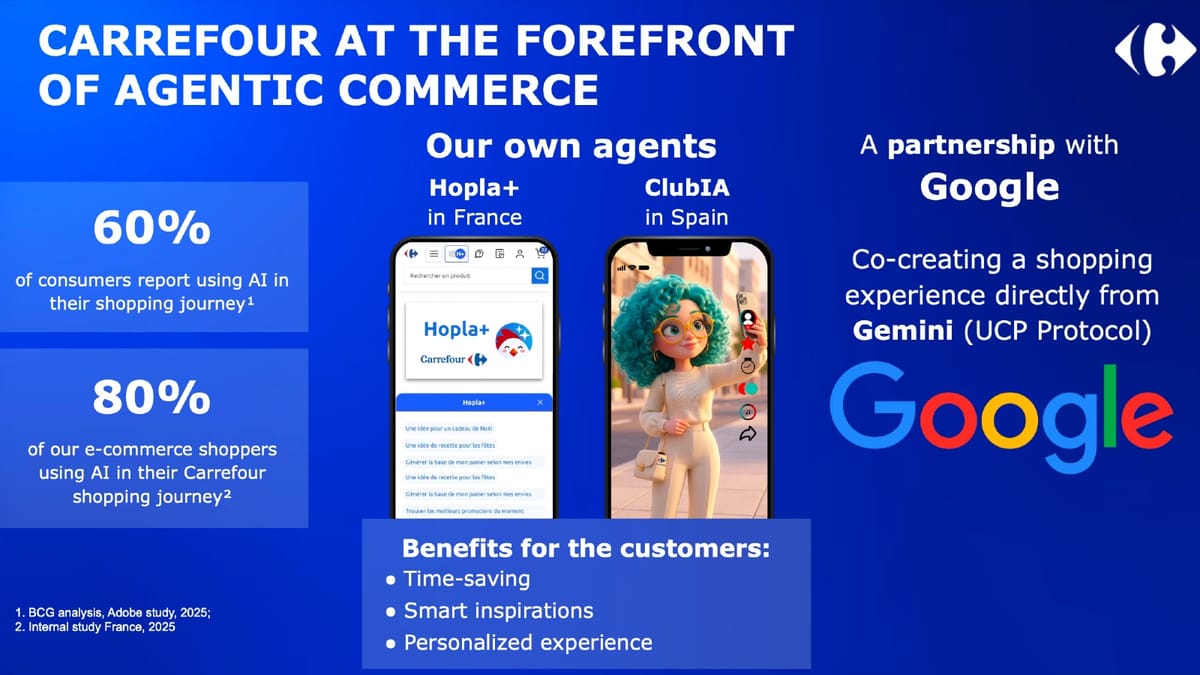
Carrefour unveiled its Carrefour 2030 strategic plan on February 18, 2026, staking out a growth agenda built on three pillars: price competitiveness, store expansion, and a heavy commitment to artificial intelligence and data. The French retail giant, which generated 91.5 billion euros in revenue in 2025 across more than 15,500 stores in over 40 countries, simultaneously announced a partnership with shelf technology company Vusion and confirmed it had become the first food retailer in Europe to join Google's Universal Commerce Protocol. Then, on March 27, 2026, Carrefour took another step: it launched a full grocery shopping service inside ChatGPT, targeting France's estimated 26 million ChatGPT users.
Together, these moves represent a concentrated attempt to reshape how European grocery retail intersects with advertising technology, agentic commerce, and retail media - topics that sit at the core of what marketing professionals now watch closely.
Carrefour is a French multinational retail corporation founded in 1959 in Annecy, France. The company opened its first hypermarket - a format it effectively invented - in Sainte-Genevieve-des-Bois, near Paris, in 1963, combining a supermarket, a discount store, and a car park under one roof. That format became the template for large-format food retail across Europe and, eventually, the world. Today the group is one of the largest food retailers on the planet by revenue, trailing only Walmart and Amazon in global terms.
As of 2025, Carrefour operates a multi-format network of more than 15,500 stores across more than 40 countries. The formats range from hypermarkets - typically above 2,500 square metres of sales floor - to supermarkets under the Carrefour Market, Match, and various local banners, to proximity convenience stores, and to the cash-and-carry wholesale format Atacadao in Brazil. The group generated 91.5 billion euros in total revenue in 2025. Its integrated store network employs approximately 300,000 people directly, with more than 500,000 people working under the Carrefour banner worldwide when franchise and partner stores are included.
The group's geographic footprint is concentrated but wide. France remains its single largest market by both sales and operating profit. In France, Carrefour holds the number two position by market share in food retail, with the top four players in that market together controlling approximately 76% of the sector, according to management commentary during the investor session. Spain is Carrefour's second-largest market in Europe, where the company holds clear leadership in the hypermarket format. Brazil is the group's primary growth market, built around the Atacadao cash-and-carry chain, which operates with a price-leadership model targeting both individual shoppers and small business customers. Bancosol, Carrefour's financial services arm in Brazil, provides credit and insurance products embedded in the retail relationship.
Beyond these three core markets, Carrefour operates in Belgium, Poland, Argentina, and through franchise partnerships in approximately 40 to 42 countries as of the announcement date. The international franchise model - Carrefour Partenariat International - licenses the brand and retail know-how to local entrepreneurs, particularly in regions such as the Middle East, North Africa, and sub-Saharan Africa, where Carrefour has a retail presence without owning or operating stores directly. The plan targets reaching 60 countries through this franchise model by 2030, which would make Carrefour the retailer with the broadest geographical footprint in the world.
Carrefour is listed on Euronext Paris and holds a BBB credit rating with a stable outlook from Standard & Poor's. Its market capitalization stood at approximately 11 billion euros at the time the 2030 plan was presented, a figure management referenced when describing the significance of the 5 billion euro cumulative free cash flow target - representing roughly 15% of market capitalization per year across the 2026 to 2028 period.
The group's real estate portfolio in France, Spain, and Brazil was independently appraised at 14.2 billion euros at year-end 2025 by CBRE, JLL, Colliers, and EY - more than the company's stock market value. That portfolio grew 25%, or 2.8 billion euros, between year-end 2021 and year-end 2025, driven by inflation, acquisitions, and new construction, particularly in Brazil where Carrefour builds and then often sells Atacadao sites through sale-and-leaseback transactions once real estate value has been created.
In terms of digital infrastructure, Carrefour describes itself as sitting on one of Europe's largest retail data lakes, fed by approximately 10 billion annual transactions across its store and e-commerce estate. That data asset underpins both its personalization capabilities and its retail media business through Unlimitail, the joint venture with Publicis Groupe that sells advertising to brands wanting to reach Carrefour shoppers across on-site digital properties and, increasingly, off-site programmatic channels.
The Carrefour 2030 plan focuses on three core markets: France, Spain, and Brazil. According to the plan's press release, these three countries account for approximately 85% of consolidated net sales and nearly 99% of the group's Recurring Operating Income in 2025. France alone produced 41.7 billion euros in net sales and 983 million euros in recurring operating income in 2025. Spain contributed 10.9 billion euros in net sales and 463 million euros in operating income. Brazil added 17.7 billion euros in net sales and 709 million euros in operating income.
Romania, previously part of the portfolio, was announced for sale ahead of the plan's launch. Italy was disposed of in December 2025. The remaining geographies - Belgium, Poland, and Argentina - are grouped into an "Other countries" segment, where management says it will keep strategic options open, from continued investment to partial or full monetization. The plan's guiding principle for those markets is described simply in the documents as "maximizing value creation."
The financial targets are specific. Carrefour targets a recurring operating margin of more than 25 basis points above 2025 levels in 2026, reaching 3.2% in 2028 and 3.5% by 2030. That represents a 90 basis point improvement over the plan's five-year duration. The group aims to generate 5 billion euros in cumulative net free cash flow between 2026 and 2028, with the 2026 figure set above the 2025 result of 1.565 billion euros despite an increase in capital expenditure. Annual capital spending will start at approximately 1.8 billion euros, rising toward 2 billion euros by 2030.
During a dedicated investor session on February 19, 2026, CFO Matthieu Malige addressed analysts on the mechanics behind those targets. France, Spain, and Brazil are each expected to contribute to operating margin expansion annually. He noted that the 2025 starting point in France was weighed down by the integration costs of the Cora and Match store acquisitions - the combined recurring operating income for France came in at 2.4% of net sales in 2025 - and that as those one-off costs disappear and those banners normalize their profitability, the aggregate will improve. Brazil's starting point of roughly 4% margin was described as well below historic levels, weighed down by macro headwinds including high interest rates and sharp commodity deflation that hurt volumes in the cash and carry segment during the second half of 2025.
A central commitment of the plan is price competitiveness in France, measured against the "Distriprix Net" index compiled by NielsenIQ's a3distrib methodology. This index incorporates promotions and loyalty discounts and is published quarterly. According to the plan documents, Carrefour was tied for second place in France's cheapest chains ranking on that index at the time of the announcement, with a gap versus the market leader of approximately 3.5 to 3.6 percentage points. Management has committed to improving that gap each year.
Funding for price investment will partly come from the Concordis buying alliance, which Carrefour and Coopérative U announced in July 2025. That alliance, headquartered in Brussels, pools purchasing volumes across European markets and becomes effective for 2026 supplier negotiations. It runs initially for six years. Its formation also carries consequences for the retail media landscape: Coopérative U is eventually expected to join Unlimitail, Carrefour's retail media joint venture with Publicis, which had previously been exclusively partnered with Criteo for on-site retail media development.
On loyalty, the plan targets reaching 60 million members in Le Club Carrefour by 2030, up from the current base of approximately 50 million. In France, 200 private label products will be offered at cost price for members starting immediately following the announcement. In Brazil, a cross-banner loyalty program named "Nosso Clube" is being developed for the Atacadao format.
Private labels are also central. According to the plan, private labels will represent approximately 40% of food sales by 2026, and Carrefour aims to grow them 1.5 times faster than national brands in France, Spain, and Belgium. A new entry-price private label called "Bulnez" will launch in Brazil's Atacadao stores with 500 SKUs by 2028.
On February 18, 2026, Carrefour and Vusion - the Paris-listed company serving over 350 major retail groups worldwide - signed a strategic partnership covering the digitalization of all of Carrefour's hypermarkets and supermarkets in France by 2030. The investment is described in the press release as more than 150 million euros over the plan's duration, initially limited to France.
The technical scope is substantial. Three distinct technology layers will be deployed:
The Vusion IoT infrastructure covers electronic shelf labels connected in real time to cloud systems, enabling instant price changes and what the company calls "pick-to-light" guidance for employees picking e-commerce orders. Rather than paper labels requiring manual replacement, shelf labels update automatically when prices change anywhere across the store estate.
EdgeSense is a Bluetooth-connected rail system. Products placed on smart rails are geolocated automatically within the store, allowing the system to know at any moment where each item is on the shelf. This makes e-commerce order picking faster and restocking more systematic, reducing the time employees spend searching for misplaced items.
Captana Artificial Intelligence adds micro-cameras that analyze shelves continuously. The system detects out-of-stocks automatically - without human inspection - flags price discrepancies between the physical shelf label and the system, and identifies planogram errors. The stated objective is a 20% reduction in out-of-stock rates via automated detection.
Thierry Gadou, Chairman and CEO of Vusion, said in the press release: "With Carrefour, we share the same vision of a modern store at the heart of tomorrow's omnichannel commerce. We are going to make this vision a reality in the coming years. Following Walmart's decision to deploy EdgeSense across all its stores in the US, Carrefour is the first major European retailer to deploy the latest-generation Vusion platform at scale. The objective is threefold: to improve the banner's performance and the satisfaction of both customers and employees."
Pilots for this technology had already been running since June 2025, according to the press release. For Carrefour, the partnership also creates a new digital communication channel directly on shelves - a physical retail media surface - that can be monetized through supplier data and shelf-level advertising.
During the February 19 investor session, CEO Alexandre Bompard cited Walmart's implementation of Vusion's technology as an explicit data point supporting the investment case: Walmart's return on investment from the same system was described as a reference for confidence in the decision.
The Carrefour 2030 plan described an "unprecedented partnership with Google on agentic commerce" as one of its AI priorities. Carrefour is identified as the first food retailer in Europe to join Google's Universal Commerce Protocol, which Google launched on January 11, 2026, alongside Shopify, Etsy, Walmart, Target, and more than 20 additional companies.
The Universal Commerce Protocol establishes open-source technical standards that allow AI agents to discover products, negotiate checkout parameters, link customer identities, and manage post-purchase workflows across different retail systems - without requiring custom integrations for each merchant. The protocol operates through REST and JSON-RPC transport layers and connects with three complementary standards: the Agent Payments Protocol, the Agent2Agent Protocol, and the Model Context Protocol, which was originally developed by Anthropic and donated to the Linux Foundation.
The practical implication for Carrefour is that its product catalog and checkout processes can be accessed directly by AI agents, including Google's Gemini, without requiring a user to navigate to Carrefour's website first. Target and Walmart demonstrated this on January 11, 2026, enabling checkout directly from within Google's Gemini interface.
Then, on March 27, 2026, Carrefour launched its ChatGPT integration, described by Retail Insight Network as making Carrefour the first major European retailer to integrate its full product offering directly into the chatbot interface. French users can now ask ChatGPT for recipe ideas, check product availability, build a shopping basket, and select delivery or click-and-collect options, all without leaving the ChatGPT interface. Payment is then completed on Carrefour's website.
According to Emmanuel Grenier, a member of Carrefour's digital leadership cited in the Retail Insight Network report, the initiative is intended to provide a more streamlined and personalized shopping experience through the ChatGPT interface. The design choice to keep checkout on Carrefour's own platform - rather than transacting inside ChatGPT directly - means the retailer retains transaction data and the direct customer relationship. OpenAI had previously attempted in-app transactions but stepped back from that model.
This is not Carrefour's first chatbot experiment. In 2023, the company launched Hopla, a ChatGPT-powered chatbot on its e-commerce platform designed to generate shopping baskets based on budget or dietary constraints. That evolved into Hopla+, which uses customer purchase history to refine recommendations and, according to the LinkedIn post by retail media commentator Roger Dunn shared following the announcement, had reached 100,000 monthly users. Carrefour's approach is therefore a progression: moving from an internal tool to embedding the experience inside platforms where consumers already spend time.
The 26 million ChatGPT users in France represent the stated addressable audience. Whether those users change grocery shopping behavior as a result of the integration remains an open question. Research published in June 2025 found that AI search visitors convert at rates 23 times higher than organic traffic, suggesting that audiences already using AI tools for product discovery carry higher purchase intent. A separate study by Semrush found that AI search visitors are worth 4.4 times more than traditional organic traffic.
Carrefour's retail media joint venture with Publicis, Unlimitail, sits inside the plan as one of the revenue levers expected to grow. The target is to double Unlimitail's revenue by 2028. During the investor session, management described the current size of the retail media business as "fairly limited," acknowledging that the market has developed more slowly than expected since Unlimitail launched roughly two and a half years ago.
MediaMarktSaturn, Europe's largest consumer electronics chain, launched its first offsite retail media program through Unlimitail in September 2025, deploying across Germany, Spain, Italy, the Netherlands, and Belgium initially. That partnership is part of a broader pattern in which Unlimitail is expanding its third-party retailer client base beyond Carrefour itself.
European retail media spending reached 13.7 billion euros in 2024, growing 21.1%, according to IAB Europe data released in October 2025. Projections from that report show the European sector reaching 28.8 billion euros by 2028. Against that backdrop, Carrefour's ambition to double Unlimitail's revenue appears calibrated to market growth rather than aggressive outperformance - which is consistent with the description of the target as a "modest ambition" offered by management in the investor session.
The Vusion partnership adds a physical dimension to this retail media picture. Electronic shelf labels can carry digital supplier content directly at the point of shelf, creating an inventory of in-store retail media placements that previously did not exist at scale.
Carrefour 2030 targets 7,500 convenience stores across France and Spain by 2030, adding roughly 1,000 in France and 750 in Spain. In Brazil, the plan calls for 70 additional Atacadao cash-and-carry stores, reaching 455 total. In France, 50 additional Market supermarkets will open or be converted by 2030.
The operating model is shifting toward franchise. In France, 40 Market supermarkets per year will be transferred to franchise operators. Hypermarkets are moving toward lease-management contracts at a rate of 15 per year. The plan describes this as an asset-light approach that improves profitability while reducing capital intensity. Historical data from the investor session shows that the profitability improvement in France between 2018 and 2025 - from approximately 1.5% to 3% recurring operating margin - was achieved across a period that included COVID-19 and hyperinflation, and was fueled partly by this franchise transition, along with private label growth, e-commerce improvement, and purchasing alliance development.
The real estate portfolio was independently valued at 14.2 billion euros at year-end 2025, covering France, Spain, and Brazil. That is up 25%, or 2.8 billion euros, since year-end 2021, according to appraisals conducted by CBRE, JLL, Colliers, and EY. Carrefour has rotated roughly 500 million euros of real estate annually, generating 200 to 300 million euros net free cash flow contribution from real estate each year, a level it intends to maintain.
The dividend policy is being formalized at a payout ratio of 50% to 60% of adjusted earnings per share, with dividends expected to grow each year. The group holds a BBB credit rating from Standard & Poor's with a stable outlook and aims to maintain that throughout the plan. The board retains discretion over additional returns through special dividends or share buybacks.
The group is also changing its financial reporting structure. From fiscal year 2026, results will be reported in five segments: France, Spain, Brazil, Other countries, and Global Functions. This replaces a structure that combined markets into broader geographic groupings. Separately, net free cash flow will be split between a "Retail cash flow" component and a "Real Estate cash flow" component, in response to investor requests for clearer visibility on the origins of cash generation.
Three investor workshops are planned for the year ahead: a CSR strategy session on June 16, 2026; a hypermarket strategy session in November 2026; and a tech and AI session in January 2027.
The convergence of events embedded in Carrefour's announcements - the ChatGPT integration, the Google Universal Commerce Protocol membership, the Vusion partnership, the Unlimitail expansion - maps directly onto questions that advertisers, agencies, and ad tech professionals are working through in 2026.
The Google Universal Commerce Protocol is restructuring how product discovery occurs in AI-mediated interfaces. Brands that sell through Carrefour now face a situation where their products can be recommended or dismissed by an AI agent based on catalog structure, availability data, and algorithmic ranking - not a human browsing a shelf or a search results page. ChatGPT shopping features have been expanding across European markets since mid-2025, and Carrefour's integration accelerates the need for FMCG brands to think about product discoverability inside conversational interfaces.
The shelf-level technology from Vusion creates a new layer of in-store retail media inventory. Advertisers accustomed to buying banner placements on retailer websites will increasingly encounter physical digital surfaces - smart shelf labels capable of carrying promotional content - that require different thinking about formats, pricing, and measurement.
And retail media itself continues to grow faster than the broader advertising market. European on-site retail media spend grew 22.2% to exceed 10 billion euros in 2024, with projections placing the sector at nearly 29 billion euros by 2028. Carrefour, through Unlimitail, is positioned as one of the operators of that infrastructure in Europe. Its stated ambition to double revenue from that business by 2028 means FMCG brands and agencies managing retail media budgets in France and beyond will be working with a platform that is actively scaling.
Who: Carrefour Group, the French multinational retailer with 91.5 billion euros in 2025 revenue, alongside technology partners Vusion (shelf digitalization), Google (Universal Commerce Protocol), and OpenAI (ChatGPT integration); with Unlimitail, the retail media joint venture with Publicis, as a commercial beneficiary of the plan.
What: A multi-year strategic plan through 2030 that targets a 3.5% operating margin, 5 billion euros in cumulative net free cash flow between 2026 and 2028, the digitalization of all French hypermarkets and supermarkets through Vusion's IoT and AI technology, integration of Carrefour's grocery catalogue into both Google's Universal Commerce Protocol and ChatGPT, and the doubling of Unlimitail's retail media revenue by 2028.
When: The strategic plan was announced on February 18, 2026; the Vusion partnership was signed on the same date; the ChatGPT integration launched on March 27, 2026. Financial targets span from 2026 through 2030.
Where: The plan's core geographic scope is France, Spain, and Brazil. The Vusion deployment and the ChatGPT integration are initially limited to France. The Google Universal Commerce Protocol and Unlimitail's retail media expansion operate at a broader European and global level.
Why: Carrefour is responding to the accelerating adoption of AI-mediated shopping, seeking to position its catalog inside conversational interfaces before competitors do, while simultaneously using store digitalization technology to reduce operational costs, improve stock availability, and create new in-store retail media inventory. The broader financial logic is that cost savings from AI and technology, combined with market share gains and high-margin services like financial products and retail media, can fund a sustained improvement in operating margins while still growing free cash flow.