ChatGPT's massive scale meets challengers in race for AI dominance
Similarweb data reveals year-over-year growth from January 2025 to 2026 across ChatGPT, Gemini, Perplexity, and Claude as mobile app adoption surges past website visits.


Similarweb data reveals year-over-year growth from January 2025 to 2026 across ChatGPT, Gemini, Perplexity, and Claude as mobile app adoption surges past website visits.
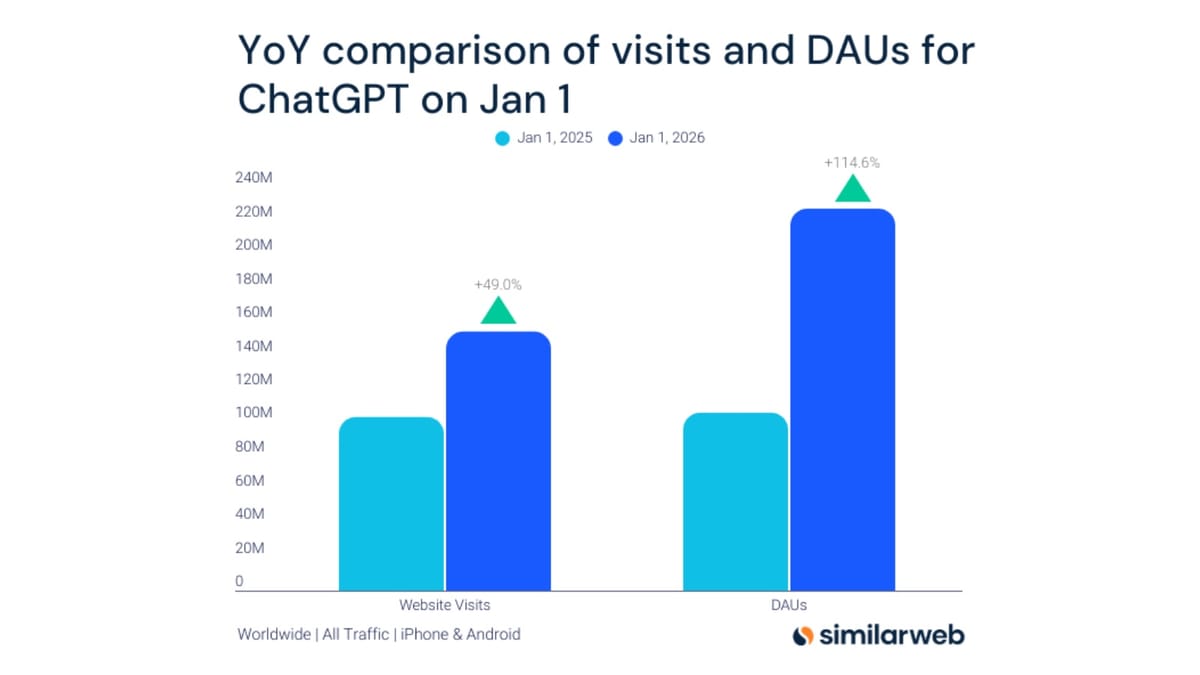
The AI chatbot landscape shifted dramatically from January 2025 to January 2026, transforming from what industry observers characterized as "one giant" into a genuine competitive race. Data shared by Similarweb on January 5, 2026, documented substantial growth across multiple platforms, revealing patterns that challenge previous assumptions about market consolidation around a single dominant player.
ChatGPT entered 2025 already operating at massive scale, according to the analysis shared through Similarweb's social media channels. While its growth spike appeared significant compared to standard websites, percentage-based growth calculations revealed smaller expansion rates than emerging challengers faced. The baseline had already reached such enormous proportions that comparable percentage gains would require user acquisition on scales rarely achieved in consumer technology.
Gemini achieved the largest year-over-year growth when comparing January 1, 2025, performance against January 1, 2026, metrics. The question confronting industry analysts centers on sustainability. Gemini still faces ground to cover in app usage relative to competitors, but the momentum documented through Similarweb's measurements demonstrates undeniable traction. ChatGPT maintained commanding lead in U.S. AI chatbot traffic with 66% share according to November 2025 data, though Gemini demonstrated growth patterns that contrasted sharply with ChatGPT's decline during that measurement period.
Subscribe PPC Land newsletter ✉️ for similar stories like this one
For Perplexity, 2025 represented what observers termed "the year of the app." The platform started January 2025 with similar app usage and daily website visits. Twelve months later, the data showed a massive leap in app engagement, fundamentally altering the platform's user interaction patterns. Mobile adoption accelerated throughout the year, reshaping how users accessed the AI search capabilities Perplexity offers. The platform achieved substantial scale while launching Max subscription tier at $200 monthly on July 2, 2025, providing unlimited access to advanced AI models including OpenAI's o3-pro and Claude Opus 4.
Claude maintained solid, consistent growth throughout 2025. By year's end, it finished head-to-head with Perplexity in website visits, marking a massive achievement for the Anthropic-developed assistant. The steady climber demonstrated different growth mechanics compared to platforms experiencing more volatile expansion patterns. Claude's development continued throughout the year, with Anthropic launching Claude for Chrome extension as a research preview on August 26, 2025, targeting 1,000 Max subscribers who pay between $100 and $200 monthly.
The measurements revealed a critical shift in usage patterns across the AI chatbot ecosystem. Significant gains in app usage occurred across the board during 2025. Users moved from "testing on the web" to "daily habits on mobile," fundamentally changing how they accessed AI assistance. This migration from desktop-based experimentation to mobile integration represents a maturation phase for the technology category. When tools become mobile-first, they typically achieve deeper integration into users' daily workflows and information-seeking behaviors.
ChatGPT processed approximately 2.5 billion messages daily by July 2025, representing roughly 29,000 interactions per second, according to comprehensive analysis conducted by OpenAI, Duke University, and Harvard University researchers released September 15, 2025. Weekly message volume increased more than 500% between July 2024 and July 2025, driven by both new user acquisition and increased engagement among existing users across all demographic segments. The research documented that ChatGPT reached 700 million weekly users by July 2025, representing approximately 10% of the world's adult population.
Gemini's user base expanded substantially throughout 2025, growing from 450 million monthly active users in July to 650 million in October 2025, a 44% increase over three months. Google systematically integrated Gemini capabilities across its product ecosystem, launching Gemini 3 with generative UI capabilities on November 18, 2025, and introducing Ads Advisor and Analytics Advisors powered by Gemini models in December. The platform demonstrated state-of-the-art performance across major AI benchmarks, topping the LMArena Leaderboard with a breakthrough score of 1501 Elo.
The competitive dynamics extended beyond pure user metrics into technical capabilities and specialized features. Perplexity distinguished itself through AI-powered search focused on real-time information retrieval and citation. The company processed over 20 million daily queries by mid-2025, demonstrating substantial adoption of conversational search technology. However, the platform faced multiple security vulnerabilities in its Comet browser between August and October 2025, revealing fundamental architectural weaknesses that could enable attackers to steal user credentials and access sensitive data.
Claude emphasized different technical approaches centered on safety and accuracy, positioning itself as an alternative for users prioritizing reliability in AI-generated responses. The platform appeared in multiple country rankings across Similarweb's geographic data, competing directly with ChatGPT and Gemini while maintaining distinct positioning around responsible AI development. Anthropic faced legal challenges, with Reddit filing a $1 billion lawsuit on June 4, 2025, alleging the AI company violated contractual agreements by using Reddit content without authorization to train its Claude chatbot.
Traffic patterns for AI chatbot platforms fluctuated significantly throughout 2025. ChatGPT referral traffic experienced a dramatic 52% decrease starting July 21 as OpenAI adjusted citation weighting in its retrieval-augmented generation system to prioritize high-utility sources like Reddit and Wikipedia over branded content. Research published by Profound in August analyzing over one billion ChatGPT citations found Reddit citations increased 87% while Wikipedia citations rose 62% during the same period.
The implications for marketing professionals extend beyond simple user counts into fundamental questions about content discovery and brand visibility. Traditional search engine optimization strategies designed for Google's algorithm faced challenges adapting to multiple AI platforms with different citation practices and content selection criteria. ChatGPT demonstrated substantial traffic-driving capabilities that contrasted with broader concerns about AI search impact, driving over 1.6 billion visits to external websites between September and November 2025 according to data from SEO platform Conductor.
Google's Gemini numbers compared less favorably in referral traffic metrics, driving 287 million site visits between September and November 2025, though the platform increased its outgoing traffic by 388% compared to the previous year. While referrals trended in a positive direction, AI platforms drove just 1% of overall traffic to sites, with ChatGPT accounting for 87% of all AI referrals. Meanwhile, Google's AI products continued as what publishers characterized as "a massive drain on publisher traffic," with just 1% of users clicking links included in Google's AI Overviews according to Pew Research.
The geographic data revealed patterns specific to regional preferences and platform availability. Russia's top 10 included Yandex-related AI tools, reflecting the country's dominant local search engine ecosystem. India and Brazil showed strong adoption of mainstream platforms including ChatGPT and Gemini. European markets including the UK, France, and Italy demonstrated similar hierarchies with ChatGPT leading followed by Gemini and various specialized AI tools.
Buy ads on PPC Land. PPC Land has standard and native ad formats via major DSPs and ad platforms like Google Ads. Via an auction CPM, you can reach industry professionals.
Analytics infrastructure evolved to accommodate AI chatbot traffic measurement. Google Analytics introduced official documentation in July 2025 advising users to create custom channel groups specifically for tracking traffic from AI chatbots including ChatGPT, Gemini, Microsoft Copilot, Claude, and Perplexity. Research published by NP Digital revealed that 24.3% of marketers receive consistent referral traffic from AI tools while 39.3% report occasional traffic, demonstrating widespread integration between AI platforms and traditional web properties.
The development trajectories suggest continuing fragmentation rather than convergence around a single dominant platform. Each major player pursues distinct strategies: ChatGPT focuses on conversational versatility and broad consumer adoption, Gemini leverages Google's infrastructure and enterprise relationships, Perplexity targets real-time search and information retrieval, while Claude emphasizes safety and accuracy in AI-generated responses. These differentiated approaches create multiple viable paths to market share rather than winner-take-all dynamics.
Mobile adoption emerged as the decisive factor separating growth leaders from laggards. Platforms that successfully transitioned users from web-based testing to mobile app habits achieved substantially higher engagement rates and daily active user counts. This pattern mirrors broader technology adoption cycles where mobile-first strategies typically correlate with mainstream acceptance. When users install dedicated apps rather than accessing services through web browsers, they signal deeper commitment and integration into daily workflows.
User behavior patterns revealed through the data indicated fundamental changes in how people seek information and complete tasks. Personal and domestic applications drove platform growth more than workplace productivity, according to comprehensive analysis of ChatGPT usage patterns. Non-work usage expanded from 53% to over 70% of all consumer messages between June 2024 and June 2025, challenging prevailing assumptions about AI adoption being primarily enterprise-driven phenomena.
Gender gaps in usage largely disappeared across major platforms. Users with typically feminine first names comprised slightly more than half of active ChatGPT users by June 2025, compared to just 20% in the months following the platform's November 2022 launch. This evolution suggested AI tools achieved mainstream acceptance across gender lines rather than remaining concentrated among traditional technology early adopters, broadening addressable markets and use case diversity.
Global adoption showed particularly strong momentum in middle-income countries with GDP per capita between $10,000-40,000, indicating the technology penetrated beyond wealthy markets into developing economies. This geographic expansion created new competitive dynamics as platforms competed for users across diverse regulatory environments, language requirements, and infrastructure conditions. Localization capabilities and regional partnerships became increasingly important differentiation factors.
The competitive landscape intensified throughout 2025 with multiple platforms launching premium subscription tiers, specialized features, and infrastructure improvements. Microsoft's Copilot secured third position in U.S. rankings according to Similarweb data, leveraging integration with Windows and Microsoft 365 products. Character.AI claimed fourth position, focusing on conversational interactions with fictional and celebrity-inspired characters rather than general-purpose assistance.
Other platforms appearing across various geographic rankings included Hugging Face, an open-source AI model repository and community platform, and specialized tools focused on specific use cases including image generation and coding assistance. This proliferation of specialized offerings suggested market segmentation where different platforms served distinct user needs rather than attempting to replicate identical feature sets.

Marketing professionals confronted increasing complexity as AI platforms fragmented discovery patterns previously dominated by Google search. The platforms operated with fundamentally different user interfaces, citation practices, and monetization models compared to traditional search engines. Predictions emerged that ChatGPT could potentially overtake Google's search traffic by 2030, though current traffic share data showed substantial gaps between conversational AI tools and traditional search engines.
Brand monitoring across AI platforms became a recognized need as these systems gained influence over information discovery. Meltwater launched GenAI Lens on July 29, 2025, specifically to track brand representation across ChatGPT, Claude, Gemini, Perplexity, Grok, and Deepseek. The San Francisco-based company positioned this as addressing a critical blind spot in digital marketing, enabling faster detection of reputational risks by identifying early signs of misinformation, negative sentiment, or misleading narratives.
The monetization strategies varied significantly across platforms. Google repeatedly denied plans to introduce advertising within Gemini despite multiple reports suggesting otherwise, while ChatGPT explored advertising formats with internal discussions centering on sponsored content appearing directly within AI responses. These different approaches to revenue generation would likely influence product development priorities and user experience design decisions.
Developer communities demonstrated strong adoption patterns that reinforced platform growth. Stack Overflow monthly question volume collapsed from peaks exceeding 200,000 in 2014 to under 50,000 by late 2025 as developers shifted to AI platforms for coding assistance. OpenAI's GPT models dominated usage statistics with 81.4% of developers indicating they worked with these tools, while Claude Sonnet achieved 42.8% adoption and Gemini Flash reached 35.3% according to Stack Overflow's 2025 Developer Survey.
The infrastructure requirements for supporting AI chatbot growth created substantial economic pressures. Data center electricity consumption increased dramatically as platforms scaled to accommodate billions of daily interactions. Companies faced balancing computational needs for real-time AI processing against sustainability commitments and energy efficiency requirements, with implications for operational costs and environmental impact.
Security and privacy concerns emerged as critical considerations for users and enterprises evaluating AI platform adoption. Platforms implemented various approaches to data handling, with some offering temporary chat features and others defaulting to data retention for model training purposes. Google's Gemini automatically enabled a "Personal Context" feature on August 13, 2025, that allowed the platform to analyze and learn from user conversations, marking a substantial shift in data handling through opt-out rather than opt-in mechanisms.
The trajectory documented through Similarweb's measurements indicated sustained growth across multiple platforms rather than consolidation around a single dominant player. This competitive diversity suggested the AI chatbot category would continue fragmenting into specialized use cases and regional preferences rather than following the winner-take-all dynamics that characterized previous technology platform competitions. Marketing professionals, content creators, and businesses would need to develop strategies accommodating multiple AI platforms with different citation practices, user demographics, and technical capabilities rather than optimizing for a single dominant channel.
Subscribe PPC Land newsletter ✉️ for similar stories like this one
Subscribe PPC Land newsletter ✉️ for similar stories like this one
Who: Similarweb, the web analytics platform, shared data analyzing ChatGPT (OpenAI), Gemini (Google), Perplexity, and Claude (Anthropic) across year-over-year measurements from January 2025 to January 2026, documenting usage patterns affecting marketing professionals, content creators, and businesses monitoring AI platform adoption.
What: Year-over-year growth data revealed ChatGPT's massive incumbent scale with smaller percentage growth compared to challengers, Gemini's largest growth rate among major platforms, Perplexity's transformation into mobile-app-focused platform, and Claude's steady climb to match Perplexity in website visits, with overall pattern showing migration from web-based testing to daily mobile app habits across all platforms.
When: Similarweb shared the analysis on January 5, 2026, comparing January 1, 2025, metrics against January 1, 2026, performance after a year that saw ChatGPT reach 700 million weekly users by July 2025, Gemini expand from 450 million to 650 million monthly active users between July and October 2025, and substantial app adoption increases across all platforms.
Where: The data covered global AI chatbot markets with geographic variations showing ChatGPT leading across all surveyed countries, Gemini claiming second position in most markets including the United States, Russia showing preference for Yandex-related AI tools, and European markets, India, and Brazil demonstrating mainstream platform adoption patterns.
Why: The data matters for marketing community because it documents fundamental shift from single dominant platform to genuine competitive race, revealing mobile app adoption as decisive growth factor, demonstrating fragmented discovery patterns requiring multi-platform strategies rather than single-channel optimization, and indicating continuing market segmentation where different platforms serve distinct user needs rather than winner-take-all consolidation.