
Firefox hands you the AI kill switch you've been asking for
Mozilla introduces centralized AI controls in Firefox 148, letting users block all generative AI features or pick individual tools with persistent settings.

Mozilla introduces centralized AI controls in Firefox 148, letting users block all generative AI features or pick individual tools with persistent settings.
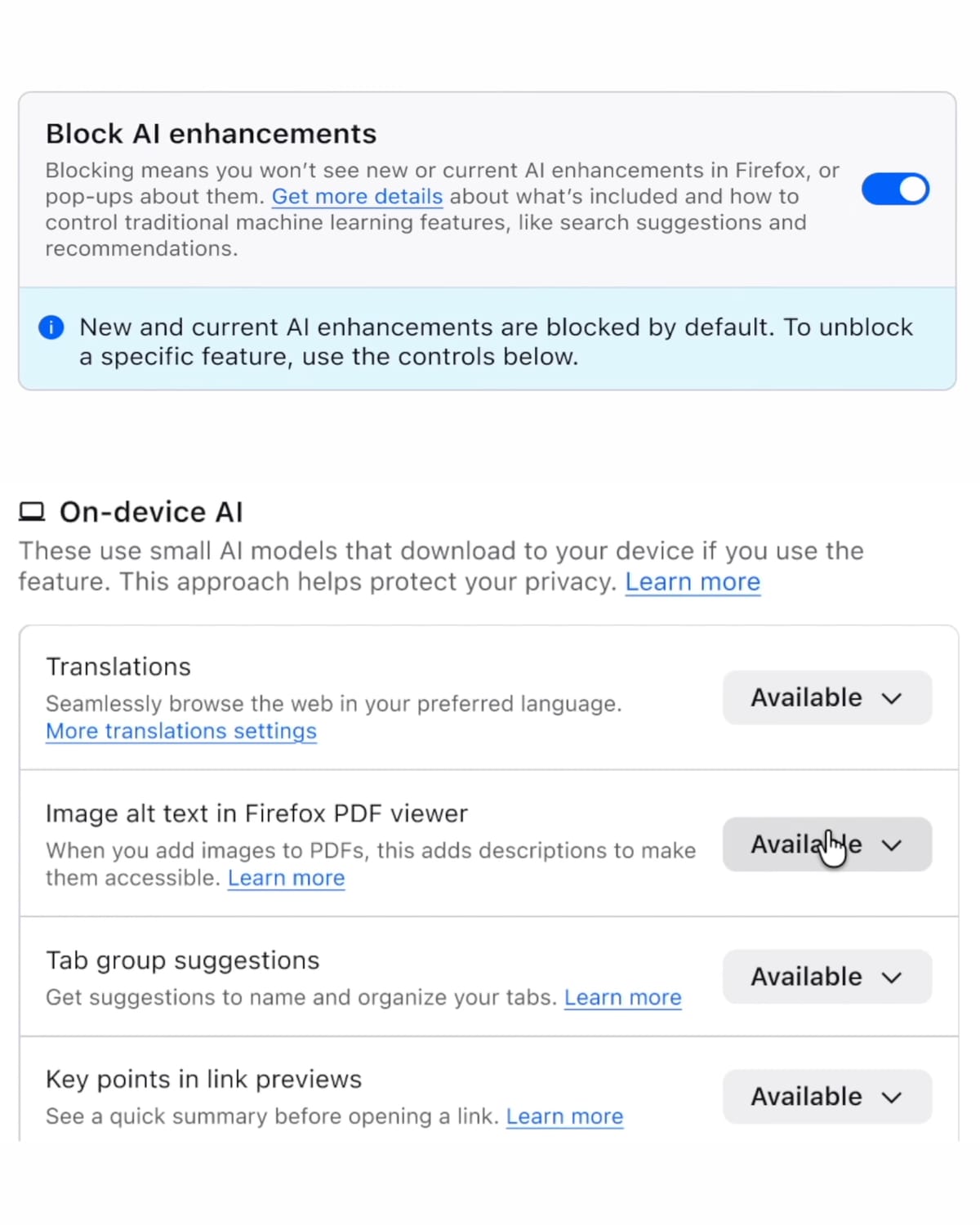
Mozilla last week integrated centralized AI controls into Firefox 148, scheduled for release February 24, addressing mounting user demands for granular control over artificial intelligence features. According to Mozilla's February 2 announcement by Ajit Varma, the new controls provide a single location within desktop browser settings to block current and future generative AI capabilities while maintaining options for users who want specific features enabled.
The timing reflects broader industry tensions over mandatory AI integration. Where platforms like YouTube have faced backlash for automatic translation features without clear opt-out mechanisms, and DuckDuckGo browser redesigned its interface with optional AI functionality users can disable through settings, Firefox positions its approach around user choice rather than default deployment.
Firefox's initial control panel governs five distinct capabilities. The Translations feature helps users browse web content in preferred languages through on-device processing. Alt text in PDFs adds accessibility descriptions to images within PDF documents, addressing content that typically lacks proper metadata. AI-enhanced tab grouping suggests related tabs and generates group names based on browsing patterns.
Link previews display key points from destinations before users click through, condensing information from target pages. The AI chatbot in the sidebar provides access to multiple platforms including Anthropic Claude, ChatGPT, Microsoft Copilot, Google Gemini and Le Chat Mistral without leaving the browsing context.
Each feature operates independently. Users selecting the Block AI enhancements toggle eliminate all AI functionality, preventing pop-ups or reminders about existing or upcoming capabilities. For those wanting selective adoption, individual toggles control each feature separately. Settings persist across browser updates, requiring no reconfiguration after version upgrades.
The control structure differs fundamentally from reactive approaches seen elsewhere in the browser market. Chrome has faced user demands for AI Overview control, leading to third-party extension development when native options proved insufficient. Firefox establishes proactive controls before features proliferate across the interface.
Firefox's measured deployment contrasts with aggressive integration strategies competitors pursue. Mozilla appointed Anthony Enzor-DeMeo as CEO in December 2025, outlining plans to transform Firefox into what he termed "a modern AI browser" while maintaining trust-centered approaches. The AI controls announcement demonstrates how Mozilla balances this pivot against its privacy-focused reputation.
Browser market dynamics shape these strategic choices. Firefox held 3.981% of global market share in December 2024 according to Cloudflare data analyzing browser usage patterns, placing fourth behind Chrome's dominant 64.7%, Safari's 16.715%, and Microsoft Edge's 7.357%. The competitive position limits Mozilla's ability to impose features users actively reject.
Mozilla's financial dependence on search partnerships creates additional constraints. The company's CFO testified in May 2025 that without search revenue, "Mozilla and other small, independent browsers may be forced to scale back operations and cut support for critical projects." This financial reality makes alienating existing users through forced AI adoption particularly risky.
The competitive landscape has grown more challenging as artificial intelligence reshapes search and browsing behaviors. Google deployed AI Mode features across international markets, while OpenAI expanded ChatGPT search to all free users in December 2024. These developments threaten traditional search-based business models that have sustained Firefox operations, creating pressure to integrate AI capabilities while avoiding user backlash.
DuckDuckGo demonstrated an alternative approach in July 2025, incorporating Duck.ai service across multiple access points while explicitly allowing users to disable functionality through browser settings. That implementation emphasized optional feature adoption rather than mandatory integration, maintaining the privacy-focused positioning that attracted DuckDuckGo's core user base.
The AI controls operate through distinct technical architectures. On-device features including translations, alt text generation, and tab grouping process information locally without transmitting data to external servers. This approach aligns with Firefox's November 2024 fingerprinting protections that reduced user identifiability through browser characteristics by nearly half.
Sidebar chatbot integration presents different privacy considerations. Users selecting this feature access external AI platforms through Firefox's interface, with each platform maintaining its own data handling policies. The control panel provides transparency about which services process information externally versus locally.
Mozilla's historical commitment to privacy protection influences these architectural decisions. The company has maintained Total Cookie Protection by default since introducing Enhanced Tracking Protection, confining cookies to their creation sites rather than enabling cross-site tracking. The AI controls framework extends this principle to generative features, giving users explicit control over data processing methods.
Settings persistence addresses practical implementation challenges that plague feature adoption. Users configuring preferences once avoid repeated configuration after updates, eliminating the friction that often leads to default acceptance. This contrasts with platforms where updates reset preferences or introduce new features without clear indication of their data processing implications.
Mozilla enables early testing through Firefox Nightly, the development channel where experimental features appear before stable releases. Users seeking immediate access can install Nightly builds to explore AI controls ahead of the February 24 general availability date. The company solicits feedback through Mozilla Connect, its community platform for feature discussion and product direction input.
The beta approach mirrors Mozilla's historical feature development process. The company updated Pocket integration throughout 2024, maintaining optional activation while building content discovery capabilities into the browser. That precedent suggests Mozilla will iterate on AI controls based on user feedback before broader deployment.
Early access enables Mozilla to identify implementation issues before they affect the general user base. Technical problems with individual features, user interface clarity concerns, or unexpected interactions between AI capabilities and existing Firefox functionality can be addressed during the Nightly phase rather than after stable release.
The feedback mechanism through Mozilla Connect provides direct communication channels between developers and users experiencing the features. This contrasts with platforms where user preferences emerge through social media complaints or third-party analytics rather than structured input mechanisms during development phases.
The AI controls announcement signals broader shifts in how browsers balance innovation against user autonomy. Marketing professionals managing campaigns across multiple platforms face increasingly fragmented environments where users exercise granular control over AI-mediated features affecting content presentation and interaction patterns.
Browser-level AI adoption affects content distribution strategies. Users blocking link previews may engage differently with headlines and calls to action compared to those enabling the feature. Tab grouping algorithms might surface related content in ways that change browsing patterns and session lengths. These variations complicate attribution modeling and performance measurement across user segments.
The sidebar chatbot integration introduces additional complexity. Users accessing Claude, ChatGPT, Gemini, Copilot, or Le Chat Mistral through Firefox's interface may substitute browser-based research for direct site visits, affecting referral traffic patterns and conversion paths. Research published by Profound in August analyzing over one billion ChatGPT citations found Reddit citations increased 87% while Wikipedia citations rose 62% after OpenAI adjusted retrieval weighting, demonstrating how AI platforms reshape traffic distribution.
Translation features operating within browsers rather than at destination sites could mask true geographic audience composition. Marketers targeting specific language communities might reach users whose browser translates content automatically, complicating campaign optimization based on language targeting parameters.
The control granularity Mozilla provides may establish expectations across the browser market. Users experiencing Firefox's unified AI management interface may expect similar control mechanisms in Chrome, Safari, and Edge. Platforms failing to provide comparable transparency could face competitive disadvantage among privacy-conscious user segments.
Mozilla's AI controls framework anticipates regulatory developments affecting automated processing of user data. South Korea established AI privacy guidelines in August 2025 addressing personal data usage in generative AI development and services. The commission explicitly focused on internationally interoperable standards recognizing global trends toward balancing AI innovation with safety considerations.
European regulations including GDPR create baseline requirements for data processing transparency and user control. Browser-level AI features that process user information without explicit consent face potential regulatory challenges, particularly when processing occurs across multiple sites or generates persistent identifiers. Mozilla's opt-in approach for specific features addresses these regulatory frameworks preemptively.
The distinction between on-device and cloud-based processing carries legal implications. Features executing locally without transmitting user data face fewer regulatory barriers than those sending information to external servers for processing. Firefox's architecture separating these categories enables users to adopt local AI capabilities while blocking external processing.
Privacy frameworks increasingly focus on automated decision-making that affects users. Tab grouping algorithms, link preview generation, and translation services all constitute automated processing that could fall under enhanced transparency requirements. Providing explicit controls over these features demonstrates compliance approaches that may become mandatory across jurisdictions.
The AI controls announcement acknowledges limitations inherent in current generative technologies. Mozilla's February 2 statement notes that "automatic dubbing helps make info more accessible globally, even though not all videos can be successfully or accurately dubbed," reflecting broader industry challenges with AI-generated content quality.
Translation accuracy varies based on language pairs, domain-specific terminology, and contextual complexity. Marketing content relying on wordplay, cultural references, or brand-specific language may translate poorly through automated systems. Users enabling translation features experience different content from authors' intended presentation, potentially affecting brand perception and message comprehension.
Alt text generation for PDF images operates within technical constraints. The feature requires sufficient context from surrounding document content to generate meaningful descriptions. Complex diagrams, specialized technical illustrations, or images without adequate textual proximity may receive generic or inaccurate descriptions that fail accessibility objectives.
Tab grouping algorithms make inferences based on browsing patterns and page content. Users working across unrelated topics may find suggested groupings unhelpful or confusing. The feature's utility depends on browsing behaviors aligning with algorithmic assumptions about topical relationships, creating variable user experiences.
Link preview generation introduces latency and bandwidth considerations. Fetching destination content before users click increases data usage and may delay page loads depending on network conditions. The feature provides value only when users would otherwise visit pages that don't meet their needs, creating efficiency gains contingent on accurate preview generation.
Browser vendors pursue distinct approaches to AI integration reflecting different business models and user bases. Chrome's dominant market position enables aggressive feature deployment, as demonstrated by integration of Gemini capabilities in September 2025 with agentic browsing capabilities and multi-tab analysis. Google's advertising revenue model incentivizes AI features that increase engagement and data collection opportunities.
Safari maintains Apple's hardware-focused strategy, emphasizing on-device processing that protects user privacy while integrating with ecosystem services. Safari 26.2 implementation of Core Web Vitals measurement APIs in December 2025 completed cross-browser support for performance assessment, demonstrating Apple's measured approach to capability expansion.
Edge leverages Microsoft's enterprise positioning, integrating Copilot features targeting productivity use cases. The browser's 7.357% market share primarily derives from enterprise deployments where IT administrators configure features centrally, reducing individual user control as a competitive differentiator.
Firefox's minority position necessitates differentiation through privacy protections and user autonomy. The AI controls framework addresses users who selected Firefox specifically for independence from surveillance-driven business models. Maintaining this positioning while adding AI capabilities requires more granular control mechanisms than competitors provide.
Alt text generation for PDFs addresses critical accessibility gaps in document distribution. Many PDFs lack proper tagging and alternative text for images, creating barriers for screen reader users. Automated generation provides baseline accessibility that document creators often omit, particularly in legacy content or user-generated materials.
The feature operates within limitations inherent to retroactive accessibility improvements. Automatically generated descriptions may lack the nuance and specificity that human-created alt text provides. Technical diagrams, charts, and complex visual information require detailed descriptions that AI systems struggle to generate accurately without domain expertise.
Translation features similarly expand content accessibility across language barriers. Users previously excluded from English-dominant web content gain access through browser-level translation that operates regardless of publisher-provided options. This capability proves particularly valuable for technical documentation and specialized content where professional translation would be cost-prohibitive.
However, automatic translation introduces accuracy concerns affecting user experience quality. Marketing content relying on specific language choices, cultural contexts, or brand voice consistency may degrade through machine translation. Users consuming translated content experience different messaging from authors' intentions, potentially affecting brand perception and purchase decisions.
Tab grouping addresses cognitive accessibility by reducing information overload from numerous open tabs. Users managing complex research tasks or multitasking across projects benefit from automated organization that reduces manual categorization effort. The feature proves most valuable for users whose cognitive styles align with algorithmic grouping logic.
Firefox Nightly builds provide immediate access to AI controls ahead of the February 24 stable release. Users installing Nightly experience cutting-edge features with the understanding that experimental implementations may contain bugs or undergo significant changes before general availability.
Mozilla Connect serves as the official feedback channel for AI controls testing. The platform enables structured discussion of feature implementation, user experience concerns, and technical issues discovered during early access phases. Mozilla's development team monitors these discussions to identify patterns requiring attention before stable release.
The three-week window between announcement and stable release provides time for meaningful iteration based on Nightly user feedback. Critical bugs, user interface clarity problems, or unexpected feature interactions can be addressed while the broader Firefox user base remains unaffected. This approach balances innovation speed against stability requirements.
Community engagement through Mozilla Connect reflects the company's governance model emphasizing user participation in product direction decisions. Unlike proprietary browsers where feature decisions occur behind closed doors, Mozilla solicits input from users who will ultimately determine feature adoption through their configuration choices.
Firefox's AI controls framework may establish precedents affecting industry-wide feature deployment. Competitors observing user adoption patterns and feedback on Mozilla's approach could incorporate similar control mechanisms, particularly if Firefox users demonstrate strong preferences for granular management over default acceptance.
The centralized control interface addresses a practical challenge as AI features proliferate. Users facing dozens of scattered settings across browser preference menus struggle to understand what capabilities process their data and how. Unified control panels improve transparency while reducing configuration complexity.
Settings persistence across updates prevents the erosion of user preferences through forced re-acceptance of features. Platforms introducing new AI capabilities with opt-out defaults often benefit from user inertia and confusion, leading to adoption through passive acceptance rather than active choice. Firefox's approach prevents this pattern by maintaining user-configured states.
The Block AI enhancements toggle provides a nuclear option for users who want complete separation from generative features. This accommodation recognizes legitimate concerns about AI reliability, privacy implications, and philosophical objections to automated content generation. Platforms forcing AI adoption alienate users holding these positions.
The AI controls implementation separates capabilities by processing location and data requirements. On-device features including translations, alt text generation, and tab grouping require no external communication, operating entirely within browser memory. This architecture minimizes privacy risks while enabling offline functionality.
Cloud-based features including sidebar chatbot access require explicit user selection acknowledging external data processing. The interface presents clear distinctions between local and remote processing, enabling informed decisions about which features align with individual privacy preferences and use cases.
The control granularity extends to individual feature components. Users who value translations but object to automated tab organization can enable the former while blocking the latter. This flexibility acknowledges that AI utility varies across use cases and individual preferences rather than treating all features as a unified package.
Technical implementation through browser settings rather than per-site controls enables consistent experiences across all browsing contexts. Users configure preferences once rather than managing feature state on each visited site, reducing friction while maintaining desired privacy protections universally.
Who: Mozilla introduced AI controls affecting Firefox desktop browser users globally, with early access through Firefox Nightly and general availability starting February 24 in version 148.
What: Centralized AI controls provide a single location to block all current and future generative AI features or manage five individual capabilities including translations, PDF alt text, tab grouping, link previews, and sidebar chatbot access to Claude, ChatGPT, Copilot, Gemini and Le Chat Mistral, with settings persisting across updates.
When: Mozilla announced the feature February 2, 2026, with Firefox Nightly access available immediately and stable release scheduled for February 24, 2026.
Where: The controls appear within Firefox desktop browser settings globally, affecting users across all markets where Firefox operates while maintaining separate configurations for individual browser installations.
Why: Mozilla addressed mounting user demands for AI feature control while balancing its strategic pivot toward modern AI browser capabilities against privacy-focused positioning, responding to competitive pressures from Chrome's aggressive AI integration and financial constraints from search partnership dependencies, with the announcement demonstrating how minority browser vendors must differentiate through user autonomy rather than forced feature adoption that larger competitors can impose through dominant market positions.