Frustrated users rename Microsoft to "Microslop" after cuts and AI overreach
Microsoft cancels employee subscriptions to news services and closes its employee library while adding more AI features to Windows, sparking user backlash and a viral Chrome extension.
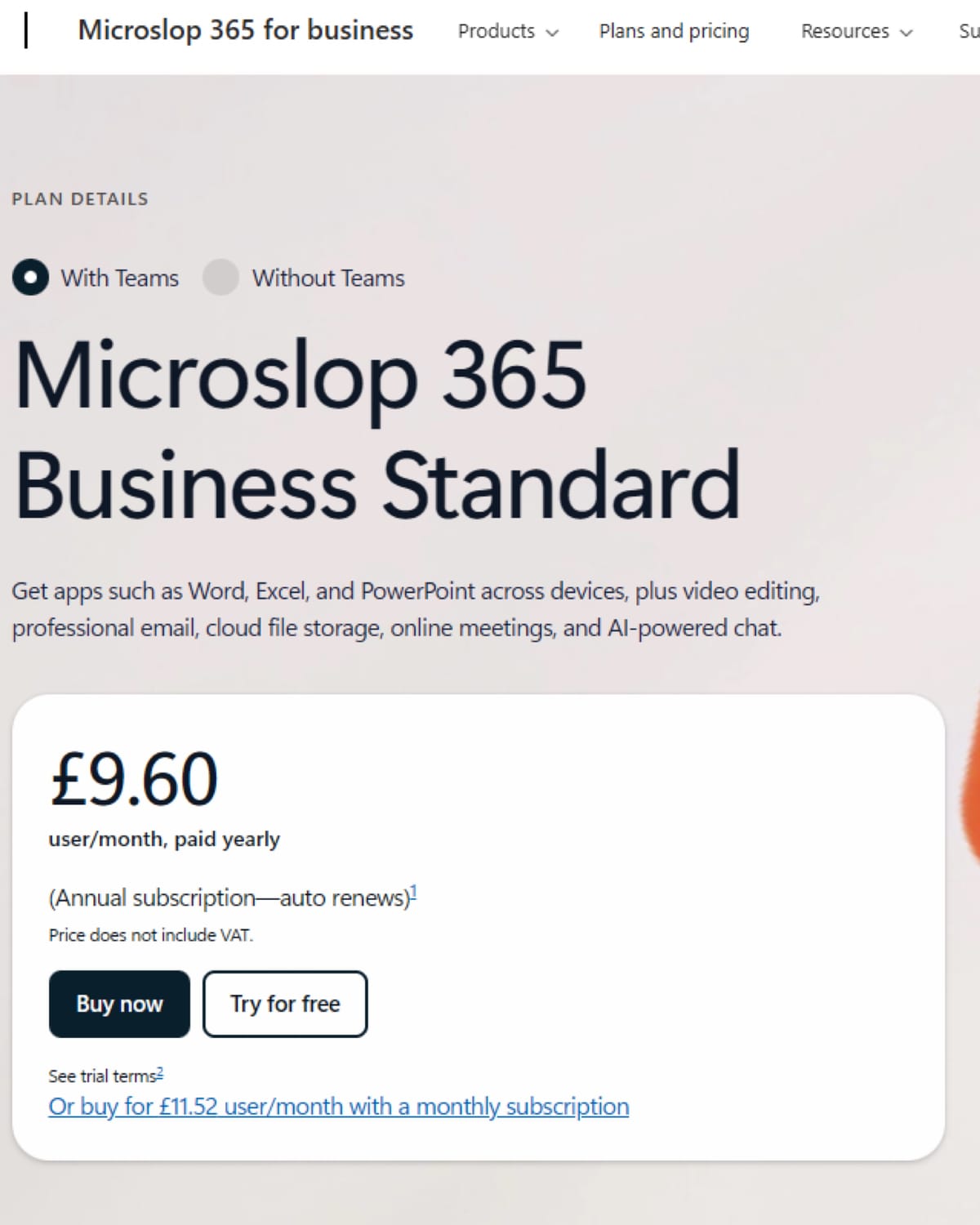
Microsoft 365 pricing page showing "Microslop 365 Business Standard" after browser extension replacement
Microsoft 365 pricing page showing "Microslop 365 Business Standard" after browser extension replacement
Microsoft today faces mounting criticism from Windows 11 users who have coined the derisive nickname "Microslop" in response to the company's aggressive push to embed artificial intelligence features across its operating system while simultaneously cutting back on employee benefits and resources. The backlash has spawned a Chrome browser extension that automatically replaces every instance of "Microsoft" with "Microslop" across the internet, reflecting growing frustration with the company's strategic direction.
The criticism intensified after Microsoft began canceling employee subscriptions to news and business publications in November 2025, with some publishers receiving automated termination notices. "This correspondence serves as official notification that Microsoft will not renew any existing contracts upon their respective expiration dates," reads an email from Microsoft's vendor management team sent to affected publishers. "We would like to take this opportunity to express our sincere appreciation for your partnership, collaboration, and continued support throughout our engagement."
Strategic News Service, which provided global reports to Microsoft's approximately 220,000 employees and executives for more than 20 years, lost its contract under the new policy. In an email to Microsoft employees who relied on SNS reports, the publisher noted that "Microsoft has just released an automated announcement that all library contracts, of which the SNS Global Report is perhaps the most strategic for your own use, are to be turned off."
scoop: Microsoft is closing its employee library and cutting back on subscriptions. The physical and digital Microsoft Library is transitioning to an AI-powered "learning experience." All of this in my Notepad newsletter, live now for subscribers 👇 https://t.co/UWc2iZSgov
The cutbacks extend beyond subscriptions. Employees have lost access to digital publications like The Information and can no longer perform digital checkouts of business books from the Microsoft Library. While Microsoft historically rotated publishers in its Library service, the current changes represent a much broader transformation that appears to combine cost reduction with the company's AI strategy.
In an internal FAQ about the subscription cancellations, Microsoft stated that subscriptions are not being renewed as "part of Microsoft's shift to a more modern, AI-powered learning experience through the Skilling Hub." The explanation positions AI tools as replacements for traditional information resources, a framing that has drawn skepticism from employees and industry observers who question whether AI assistants can adequately substitute for professional journalism and expert analysis.
The internal cost-cutting coincides with Microsoft's substantial external investments. The company announced plans to spend $80 billion during 2025 on AI datacenter construction worldwide, with more than half allocated to United States facilities. Microsoft completed the Fairwater datacenter in Wisconsin on September 20, 2025, featuring hundreds of thousands of NVIDIA GB200 graphics processing units connected by enough fiber optic cable to circle Earth 4.5 times.
The contrast between infrastructure spending and employee resource reductions has not gone unnoticed. Windows 11 users expressed frustration through social media, with one tweet from Windows Latest garnering significant attention. "Frustrated Windows 11 users are calling Microsoft 'Microslop,' as the company continues to add Copilot and AI features to the OS," the post stated. "One user has also created a Chrome extension that replaces 'Microsoft' with 'Microslop' across the internet."
The Chrome extension in question, titled "Microsoft to Microslop," has attracted 2,000 users and holds a 4.8-star rating based on 81 reviews. Updated on January 16, 2026, the extension's listing in the Chrome Web Store shows it automatically replaces every mention of Microsoft on the internet with Microslop, transforming even Microsoft's own marketing materials. Screenshots demonstrate the extension changing official Microsoft 365 Business Standard pricing pages to read "Microslop 365 Business Standard."
Windows 11 users cite multiple grievances beyond the subscription cuts. Copilot has expanded from its original sidebar implementation into Paint, Notepad, Microsoft Office, and numerous other areas of Windows. Users report feeling overwhelmed by AI features they neither requested nor find useful. "Microsoft's incompetence is what's hurting it, we all fucking HATE windows 11, and I mean HATE," wrote one user in a widely shared response. "It is fucking TRASH. All we wanted was a fucking OS what we got is the greatest data harvesting AI bloated piece of shit in history and it has hardware limits."
When Windows Latest asked Microsoft Copilot for its opinion on the "Microsoft to Microslop" browser extension, the AI assistant responded: "It's definitely... a vibe." The response, shared in a follow-up tweet, captured the awkwardness of Microsoft's AI providing commentary on user criticism of Microsoft itself.
The timing of the backlash is particularly challenging for Microsoft given Copilot's technical difficulties. CEO Satya Nadella sharply criticized the company's AI assistant in internal communications on December 28, 2025, stating that integrations connecting Copilot with Gmail and Outlook "don't really work" for the most part and are "not smart," according to The Information. The frank assessment revealed growing concerns within Microsoft about Copilot's technical execution and market performance, despite public positioning of AI as central to the company's growth strategy.
Nadella has assumed an unusually hands-on role in fixing the struggling product, essentially becoming what sources describe as the company's top product manager. In September 2025, he announced he would delegate some responsibilities to focus on AI product development, handing off many business functions to Head of Sales Judson Althoff, who received the new title "Commercial CEO." The CEO maintains active participation in an internal Teams channel with about 100 top engineers, posting detailed critiques when AI products fall short.
The organizational changes reflect internal urgency around Copilot's performance challenges. Nadella reportedly sent bug reports directly to product groups working on the consumer chatbot. Over the summer, he vented frustration in a Teams channel that Microsoft hadn't shipped new features for complex Excel functions like financial models fast enough. The pressure to deliver functional AI products intensifies as competitors make progress in similar spaces.
Yet the commercial success of Copilot as an advertising platform contrasts sharply with its reception among Windows 11 users who feel the AI assistant has been forced upon them. Copilot currently holds 14% AI market share, with Google's Gemini less than 1% behind, according to recent industry analysis. The market share data suggests Microsoft's aggressive integration strategy has achieved some adoption, though user sentiment indicates the approach may carry reputational costs.
The Windows 11 operating system has experienced additional technical challenges beyond AI feature complaints. Core components began malfunctioning in July 2025, affecting the Start Menu, Taskbar, File Explorer, and System Settings. Microsoft officially acknowledged these issues in late November 2025, though problems persisted through each monthly update from July through October. The company announced on November 25, 2025, an ambitious plan to eliminate all C and C++ code from its products by 2030 through AI-assisted rewrites.
Questions arose about whether the rewrite strategy addressed Microsoft's actual problems. Multiple commenters pointed out that the most broken parts of Windows 11 do not consist of C or C++ code, but rather newer components built with modern technologies. "The problem here isn't Rust. It's that the core parts of the windows kernel are mostly fine. All of the most broken parts are not in C/C++ at all," noted one respondent to Galen Hunt's LinkedIn announcement about the rewrite initiative.
The convergence of subscription cancellations, aggressive AI integration, and technical reliability issues has created what some users characterize as a crisis of confidence in Microsoft's product direction. "Make as much noise as possible," wrote one user in response to the "Microslop" trend. "That CEO has got to go, and everyone at Microsoft needs to know it in order to make it happen."
Microsoft's strategy reflects a fundamental bet that AI-powered tools can replace or enhance traditional information resources and workflows. The company's internal FAQ describing the shift to "AI-powered learning experience through the Skilling Hub" suggests Microsoft believes its own AI products should substitute for subscriptions to publications like The Information and Strategic News Service.
This approach raises questions about information quality and independence. Professional journalism from specialized publications provides context, analysis, and independent perspectives that may differ from AI-generated summaries trained on existing content. The decision to replace paid subscriptions with AI tools potentially limits Microsoft employees' access to critical analysis of industry trends, competitive dynamics, and emerging threats.
The marketing community watches these developments with particular interest given Microsoft's role as a major advertising platform operator. Microsoft introduced Copilot Checkout on January 8, 2026, enabling shoppers to complete purchases entirely within the Copilot interface without redirecting to merchant websites. The implementation arrived alongside Brand Agents, AI-powered shopping assistants merchants can deploy on their own websites.
According to Microsoft's internal data cited in the January 8 announcement, journeys including Copilot led to 53% more purchases within 30 minutes of interaction compared to journeys without the AI assistant. When shopping intent is present, conversions reach 194% more likely than sessions lacking Copilot engagement. These performance metrics raise questions about attribution methodology and baseline comparisons, particularly given the technical issues Nadella identified in internal communications.
The "Microslop" nickname has gained traction partly because it captures user frustration with what they perceive as Microsoft's declining software quality. Windows 11 has received consistent criticism since its release for interface changes, hardware requirements, and feature implementations that users find intrusive rather than helpful. The aggressive Copilot integration represents the latest in a series of decisions that prioritize Microsoft's strategic initiatives over user preferences.
User complaints about "data harvesting" and "AI bloated" software reflect broader concerns about privacy and software complexity. Windows 11's integration of cloud services, telemetry collection, and AI features creates dependencies on Microsoft's infrastructure while generating data flows users cannot easily inspect or control. The hardware requirements for Windows 11, including specific TPM chips and processor generations, limit the operating system's compatibility with older equipment.
Microsoft's advertising expansion depends heavily on Copilot adoption and data collection. The company has positioned AI as transforming search and advertising through several initiatives centered around Copilot: Copilot Search in Bing reimagines search results with AI-curated overview pages and embedded conversational capabilities; Copilot Vision in Edge allows the assistant to see what users see and provide real-time responses while browsing; Copilot Discover personalizes the MSN experience based on user interactions and preferences.
The October 23, 2025 announcement from Mustafa Suleyman, CEO of Microsoft AI, represented a shift toward AI systems that prioritize human connection over engagement metrics. "Technology should work in service of people. Not the other way around. Ever," Suleyman stated. The sentiment contrasts with user perceptions that Microsoft is deploying AI features to serve business objectives rather than user needs.
Microsoft has introduced numerous advertising formats specifically designed for the Copilot experience. Microsoft Advertising Showroom ads provide "a rich and immersive experience where users can explore what they are searching for in the digital space." Dynamic Filters leverage the interactive nature of Copilot, "removing the friction of typing additional questions and quickly narrowing options more likely to drive conversions based on an individual's preferences."
These advertising innovations depend on Copilot adoption and user engagement. The "Microslop" backlash threatens this strategy by undermining user trust and potentially driving users toward competing platforms. Windows remains dominant in desktop computing, but alternatives including macOS, Linux distributions, and Chrome OS have gained market share in specific segments.
The Chrome extension that replaces "Microsoft" with "Microslop" functions as both protest and satire. By transforming Microsoft's own marketing materials, the extension makes visible the gap between corporate messaging and user experience. Screenshots show Microsoft 365 Business Standard pricing pages reading "Microslop 365 Business Standard," with the familiar four-color logo appearing above the altered name.
User responses to the extension varied from supportive to cautionary. "I don't know who needs to read this, but please don't download 'funny' extensions that request access to view every site you visit," warned one user, highlighting legitimate security concerns about browser extensions with broad permissions. The warning reflects a tension between political expression through technical tools and the practical risks of granting extensions extensive access to browsing activity.
The subscription cancellations affect Microsoft employees specifically working in areas where industry intelligence and analysis inform strategic decisions. Strategic News Service provided reports on technology trends, competitive dynamics, and market developments. The Information offers investigative reporting on technology companies and their business strategies. Access to these publications helps employees understand the competitive landscape and identify emerging opportunities or threats.
Microsoft's decision to replace these subscriptions with AI-powered learning tools through the Skilling Hub represents a bet that internally developed resources can substitute for external analysis. The approach assumes Microsoft's AI tools can synthesize information as effectively as specialized journalists and analysts who maintain independent perspectives and industry relationships.
The timing of the subscription cancellations - starting in November 2025 - coincides with the period when Nadella was privately criticizing Copilot's technical performance. The juxtaposition suggests potential disconnects between Microsoft's external communications about AI capabilities and internal assessments of those systems' actual performance.
Microsoft's market position allows it to pursue strategies that would be risky for smaller competitors. Windows maintains dominant market share in desktop operating systems despite user complaints. Microsoft 365 holds strong enterprise adoption. Azure continues growing as a cloud infrastructure provider. The company's financial strength enables substantial AI investments while reducing costs in other areas.
Yet the "Microslop" nickname and Chrome extension represent reputational damage that could accumulate over time. Brand perception matters particularly in consumer-facing products where alternatives exist. The Chrome extension has modest adoption with 50 users, but its existence and social media attention indicate a level of user dissatisfaction significant enough to inspire coordinated criticism.
The contrast between Microsoft's $80 billion AI infrastructure spending and its cancellation of employee subscriptions worth perhaps a few million dollars annually highlights resource allocation priorities. The company is betting that AI capabilities will drive future growth while traditional information services represent legacy costs to be minimized.
This calculation may prove correct from a financial perspective. AI-powered tools could eventually provide information synthesis and analysis competitive with specialized publications. Yet the transition period creates risks as employees lose access to established resources before replacement tools reach comparable quality.
The Windows 11 reliability issues that persisted from July through November 2025 compound user frustration with AI feature additions. When core operating system functions malfunction for months while the company simultaneously adds new AI features, users perceive misaligned priorities. The problems affecting Start Menu, Taskbar, File Explorer, and System Settings represented fundamental breakdowns in basic computing functionality.
Microsoft's announcement of plans to rewrite legacy code using AI represents another instance of betting on AI solutions to fix problems the company's current development processes created. The proposed elimination of C and C++ code by 2030 through AI-assisted rewrites raises questions about code quality, maintainability, and security when artificial intelligence generates system-level software.
The marketing implications of the "Microslop" backlash extend beyond Microsoft's immediate brand reputation. The company operates as a major advertising platform through Bing, Microsoft Advertising Network, LinkedIn, and now Copilot commerce features. Advertiser confidence depends partly on platform stability and user trust. If Windows users increasingly view Microsoft with skepticism or frustration, it could affect their engagement with Microsoft properties and, consequently, advertising effectiveness.
Microsoft's Epsilon data integration announced on January 7, 2026, enables advertisers to activate Epsilon's consumer insights directly within Microsoft's advertising ecosystem. Early testing demonstrated substantial performance improvements, with a pilot campaign in the travel vertical achieving two times higher return on ad spend compared to traditional in-market audiences. These technical capabilities matter less if users abandon Microsoft platforms or actively install tools to mock the brand.
The timing of the January 15, 2026 reporting on the "Microslop" phenomenon - just one week after Microsoft announced Copilot Checkout and the Epsilon integration - creates a narrative tension. Microsoft is simultaneously advancing sophisticated advertising technologies while facing grassroots user criticism that manifests through browser extensions and social media mockery.
User sentiment on social media reflects frustration across multiple dimensions. Some users object to privacy implications of AI features and data collection. Others dislike interface changes and feature additions they perceive as unnecessary. Still others criticize performance and reliability issues. The "Microslop" nickname encompasses all these concerns into a single term expressing generalized dissatisfaction.
"Is Microsoft's Copilot strategy hurting its AI race more than helping it?" asked Windows Latest in their original tweet about the backlash. The question captures a fundamental tension in Microsoft's approach. Aggressive feature integration and deep operating system incorporation could theoretically accelerate AI adoption and create competitive advantages. Yet if the strategy alienates users and damages brand perception, it might undermine those benefits.
The Chrome extension developer remains anonymous, though the extension's presence in the official Chrome Web Store indicates it passed Google's review process for browser extensions. The extension grew from 50 users on January 15 to 2,000 users by January 16, demonstrating rapid adoption following media coverage. The developer's description states: "Honestly just getting a very good chuckle out of it and am managing my levels of spite through this." The closing line reads: "Screw you Satya Nadella. Learn about Barbara Streisand," referencing the Streisand effect where attempts to suppress information amplify its spread.
The extension operates purely on the client side, visually manipulating text without changing underlying webpage data. "This extension only visually manipulates the text - the real data on the webpages is not manipulated," according to the Chrome Web Store listing. "If you inspect the element, it will still contain the correct 'Microsoft' expression, so no links or download-links will break." The 10.77KB extension does not collect, transmit, or store any data whatsoever, functioning only to modify the visual display of text locally in the browser.
Microsoft's internal response to the criticism remains unclear. The company has not issued public statements addressing the "Microslop" nickname or the Chrome extension. Nadella's private communications criticizing Copilot's technical execution suggest awareness of performance issues, but Microsoft's public posture continues emphasizing AI as central to its strategy.
The subscription cancellations will take effect as contracts expire, meaning some publishers may retain access into 2026 while others have already been terminated. Strategic News Service's email to Microsoft employees indicated the change had already occurred for that publication. The timing varies based on when individual contracts were set to renew.
The employee subscription cuts represent one element of a broader pattern of Microsoft consolidating operations around AI priorities. GitHub lost its operational independence in August 2025 when Microsoft absorbed the developer platform into its CoreAI division. Thomas Dohmke, who served as GitHub's CEO since November 2021, resigned as part of the restructuring, with his transition period concluding at the end of 2025.
The integration marked a fundamental shift in Microsoft's approach to the platform it acquired for $7.5 billion in 2018. When the acquisition closed, Microsoft executives promised GitHub would remain an independent company, operating separately from Redmond's corporate structure. That pledge lasted seven years. Jay Parikh, executive vice president of Microsoft CoreAI, now oversees GitHub alongside the company's broader artificial intelligence infrastructure. The reorganization positions GitHub as a component of Microsoft's AI development pipeline rather than an autonomous business unit serving the global developer community.
Microsoft's original acquisition pitch emphasized autonomy. Nadella personally assured developers that GitHub would "retain its developer-first ethos, operate independently and remain an open platform." The broken promise resonates with developers who viewed GitHub's independence as protection against corporate interference. Gergely Orosz, a prominent technology commentator, tweeted: "I keep being amused that Microsoft decided to leave GitHub without a CEO and independence - playing reorg games instead of reinventing themselves - right when GitHub would desperately need to. AI makes existing workflows useless. All set for a startup to take on GitHub."
Microsoft's shift toward "AI-powered learning experience through the Skilling Hub" implies the company views AI tools as adequate substitutes for professional journalism and specialized analysis. This perspective reflects confidence in AI capabilities that Nadella's internal criticisms suggest may be premature. The gap between external messaging about AI transformation and internal concerns about technical execution creates a credibility challenge.
The December 2025 patch for Windows 11 component failures will provide indication of whether Microsoft successfully resolved issues that persisted since July. The promised fix addresses immediate symptoms but does not resolve questions about how similar problems might emerge as AI-generated code becomes more prevalent in Microsoft's codebase.
Industry observers will track whether the "Microslop" criticism represents a passing moment of frustration or signals more sustained brand damage. Microsoft's market position provides cushion against user complaints, but accumulating reputational issues could affect product adoption, platform choice, and competitive dynamics over time.
The employee subscription cancellations affect Microsoft's internal culture and information access. Employees working on competitive strategy, market analysis, and product development benefit from exposure to independent journalism and expert analysis. Replacing these resources with internal AI tools potentially creates an echo chamber where Microsoft's own perspectives and data dominate, limiting exposure to external viewpoints and critical analysis.
The $80 billion AI infrastructure investment contrasts with the relatively modest costs of employee subscriptions, raising questions about resource allocation priorities. Microsoft's financial position easily accommodates both infrastructure spending and information subscriptions. The decision to cancel subscriptions while spending heavily on datacenters suggests a strategic choice rather than financial necessity.
Marketing professionals monitoring Microsoft's trajectory face questions about platform commitment and long-term stability. The company's aggressive AI integration, technical reliability issues, and user backlash create an environment of uncertainty. Microsoft's search advertising revenue growth of 21% in the fourth quarter of fiscal 2025 demonstrates commercial success, yet user sentiment tells a more complicated story.
The "Microslop" phenomenon represents user agency in the face of corporate strategic decisions. When users feel their preferences are ignored or their experiences degraded, some respond through mockery and resistance. The Chrome extension transforms passive frustration into active commentary, making visible the disconnect between Microsoft's vision and user experience.
Timeline
July 2025: Windows 11 core components begin malfunctioning across Start Menu, Taskbar, File Explorer, and System Settings
January 15, 2026: Windows Latest reports on "Microslop" nickname and Chrome extension replacing Microsoft name across internet
Summary
Who: Microsoft Corporation and its approximately 220,000 employees, CEO Satya Nadella, Windows 11 users worldwide, anonymous Chrome extension developer, Strategic News Service publisher, Windows Latest technology news outlet, and Microsoft's vendor management team.
What: Microsoft canceled employee subscriptions to news services including Strategic News Service and The Information while closing digital library access, citing a shift toward "AI-powered learning experience through the Skilling Hub." Simultaneously, frustrated Windows 11 users coined the nickname "Microslop" and created a Chrome browser extension that replaces every mention of "Microsoft" with "Microslop" across the internet. The backlash reflects user frustration with aggressive Copilot AI integration across Windows while the operating system experienced months of technical malfunctions affecting core components.
When: Microsoft began canceling subscriptions in November 2025, with termination notices sent to publishers whose contracts were expiring. The "Microslop" Chrome extension and social media backlash emerged publicly on January 15, 2026. Windows 11 technical problems persisted from July through November 2025, while CEO Satya Nadella's internal criticism of Copilot occurred on December 28, 2025.
Where: The subscription cancellations affect Microsoft's global workforce of approximately 220,000 employees across all locations. The Windows 11 user backlash manifests across social media platforms including X (formerly Twitter), the Chrome Web Store where the extension is available, and technology news coverage. Microsoft's internal FAQ about the changes circulated within the company's communication systems.
Why: Microsoft positions the subscription cancellations as part of its strategic shift toward AI-powered tools, betting that its Copilot and Skilling Hub platforms can replace traditional information resources. The move follows a broader pattern of consolidation, including Microsoft's August 2025 absorption of GitHub into CoreAI after seven years of promised independence. The user backlash stems from frustration with aggressive AI feature integration that users perceive as unwanted, combined with technical reliability issues affecting basic operating system functions and concerns about privacy and data collection. The timing creates tension as Microsoft invests $80 billion in AI infrastructure while cutting employee information resources and breaking previous commitments to operational independence, leading users to question the company's priorities and brand the company with the derisive "Microslop" nickname.
Share this article
The link has been copied!
Your link has expired. Please request a new one.
Your link has expired. Please request a new one.
Your link has expired. Please request a new one.
Great! You've successfully signed up.
Great! You've successfully signed up.
Welcome back! You've successfully signed in.
Success! You now have access to additional content.