Gemini now serves local results from Google Maps in visual format
Google's Gemini AI assistant integrates Maps data with photos and ratings directly in conversational interfaces starting December 13, 2025.


Google's Gemini AI assistant integrates Maps data with photos and ratings directly in conversational interfaces starting December 13, 2025.
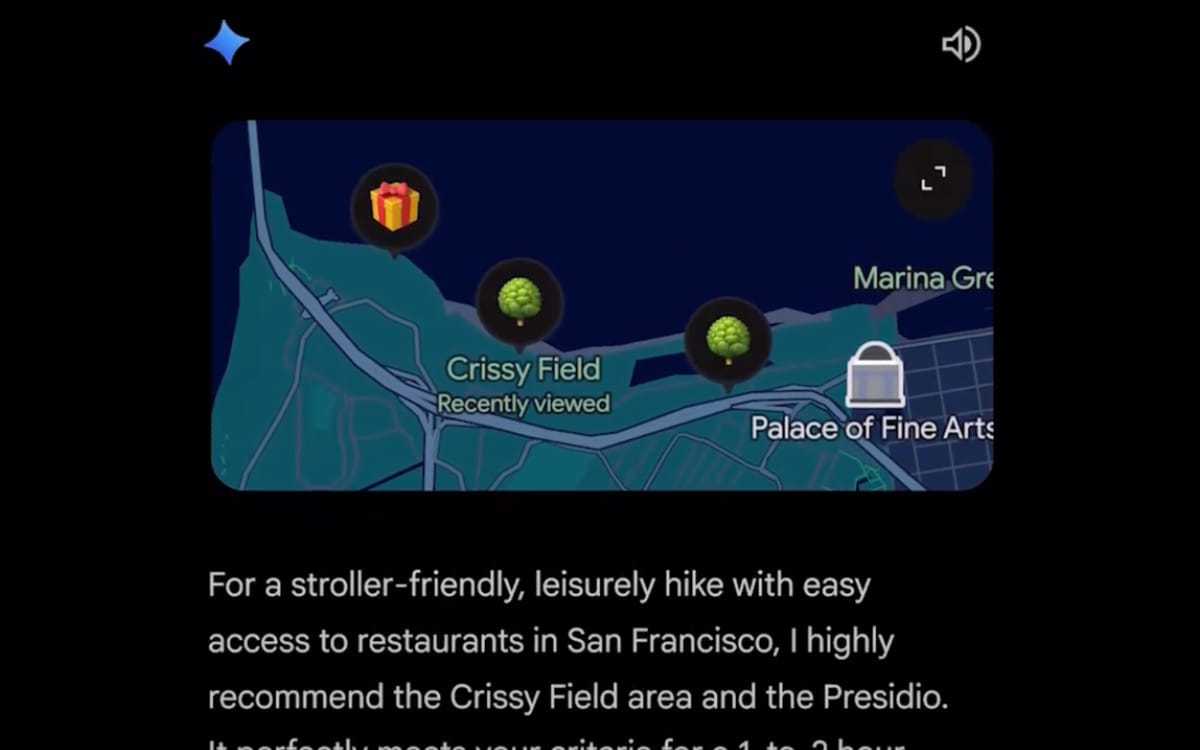
Google announced on December 13, 2025, that its Gemini AI assistant can display local search results in a rich visual format by pulling data directly from Google Maps. The integration provides users with photos, ratings, and location information without requiring separate navigation to Maps applications.
"Starting today, Gemini can serve up local results in a rich, visual format. See photos, ratings, and real-world info from @GoogleMaps, right where you need them," stated the official Gemini account on X at 1:04 AM Eastern Time. The feature rolled out immediately in English for both desktop and mobile Gemini interfaces.
The announcement marks another step in Google's effort to consolidate its service ecosystem within conversational AI experiences. Rather than generating text-only responses to local queries, Gemini now presents structured information cards displaying business photographs, customer ratings, and practical details sourced from Google Maps' database. Users searching for restaurants, stores, or service providers receive visual context alongside traditional AI-generated text descriptions.
Subscribe PPC Land newsletter ✉️ for similar stories like this one
Technical implementation connects Gemini's natural language processing capabilities with Google Maps' extensive local business data infrastructure. When users ask Gemini about nearby locations or specific businesses, the system identifies location-related intent and queries Maps databases for relevant establishments. The response format combines AI-generated explanatory text with embedded visual cards showing business imagery and rating information.
Google Maps contains detailed profiles for millions of businesses worldwide, including photographs uploaded by business owners and customers, numerical ratings based on user reviews, operating hours, contact information, and other practical details. This data becomes accessible through Gemini's conversational interface without requiring users to switch applications or open separate browser tabs.
The feature availability remains limited to English language interactions at launch, though Google typically expands language support for major features over time. Desktop users access the functionality through Gemini web interfaces at google.com, while mobile users can interact through the Gemini mobile application available on Android and iOS platforms.
User responses to the announcement reveal mixed reactions to Google's expanding AI integration. Some users expressed concern about unwanted features appearing in AI responses. One user commented: "Sounds great, but in practice this kind of thing shows up unprompted and unwanted. The barrage of irrelevant YouTube videos has made me want to stop using Gemini." The Gemini team responded by acknowledging the feedback and stating they are "working on improving our responses to be more relevant and reduce unprompted video suggestions."
Other users reported technical issues affecting Gemini's performance separate from the Maps integration. One developer described problems with document reference capabilities: "After approximately 30 turns of conversation, the model stops referencing the document I uploaded in the very first turn, even though the current context is only a few tens of thousands of tokens." The Gemini team acknowledged this feedback and indicated they shared it with their internal development team.
Additional complaints included geographic accuracy problems. A user reported: "I asked for the swimming pools in my municipality and he gave me the ones in the city centre, then when I suggested the right municipality he wrote them down… Why?!" Geographic precision represents a critical challenge for local search features, particularly when users employ conversational queries that may lack specific location identifiers.
The local results integration builds on Google's broader strategy of connecting Gemini with existing Google services. The company previously integrated Gemini with Gmail, Maps, and YouTube when it rebranded its AI assistant from Bard in February 2024. These Extensions allow users to access information from multiple Google applications within single conversational sessions.
Google has systematically expanded Gemini's capabilities throughout 2025. The company launched Gemini Live in over 40 languages in October 2024, enabling natural voice conversations beyond English-speaking markets. In July 2025, the Gemini mobile app automatically gained access to phone, messaging, and system utilities on Android devices, though this expansion raised privacy concerns among European regulators.
The Maps integration coincides with Google's competitive positioning against other AI assistants. Microsoft's Bing Chat, OpenAI's ChatGPT, and Anthropic's Claude all offer conversational interfaces, but Google maintains unique advantages through its ownership of Maps, YouTube, Gmail, and other widely-used consumer services. Connecting these services creates differentiation that competitors without comparable consumer product ecosystems cannot easily replicate.
Local search represents particularly high commercial value for Google. Businesses depend on Google Maps visibility for customer discovery, and local intent searches frequently result in near-term purchases or service appointments. By surfacing this information through Gemini, Google potentially increases engagement with local business data while maintaining users within its AI interface rather than directing them to competitor platforms or direct business websites.
The visual presentation approach differs from text-only AI responses. Traditional conversational AI systems generate descriptive text when users ask about local businesses, potentially including details about location, operating hours, or general reputation. Adding visual elements like photographs and numerical ratings provides faster information processing for users accustomed to visual scanning rather than reading paragraphs of generated text.
Google's announcement did not specify whether the Maps integration affects how local businesses appear in results or whether business owners need to take action to optimize their presence in Gemini responses. Google Maps profiles already support structured data including business categories, attributes, photographs, and review management. These existing profile elements likely feed into Gemini's response generation without requiring separate optimization processes.
The feature connects with Google's development of AI Mode, a dedicated conversational search interface that expanded to over 40 countries and territories in October 2025. AI Mode provides extended conversational capabilities beyond traditional search, and recently Google began testing AI Mode access directly from search results pages on mobile devices worldwide starting December 1, 2025.
Buy ads on PPC Land. PPC Land has standard and native ad formats via major DSPs and ad platforms like Google Ads. Via an auction CPM, you can reach industry professionals.
The technical architecture supports multimodal inputs beyond text. Users can interact with Gemini through voice commands, image uploads, or text entry. When combined with visual Maps results, this multimodal approach enables scenarios like showing Gemini a photograph of a restaurant and asking for similar nearby options, then receiving visual cards showing comparable establishments with ratings and photographs.
Response relevance remains a persistent challenge for AI-generated results. The user complaints about unprompted video suggestions and incorrect geographic targeting indicate ongoing refinements needed in Gemini's response generation systems. Google's response to feedback emphasizes iterative improvement rather than claiming immediate solutions to reported problems.
Marketing implications extend beyond consumer-facing features. Local businesses that maintain complete Google Maps profiles with high-quality photographs, accurate information, and positive reviews may gain visibility advantages as users increasingly access Maps data through conversational AI interfaces. The shift toward visual cards within AI responses potentially reduces click-through rates to business websites while increasing interactions through Google-controlled interfaces like Maps or direct phone calls.
The announcement timing in mid-December positions the feature for adoption during the holiday shopping season when consumers frequently search for local businesses, restaurants, and services. Retail establishments, restaurants, and service providers typically experience elevated search volume during this period, making local search improvements particularly impactful for both consumer utility and business discovery.
Privacy considerations around location data did not feature prominently in the announcement. Google Maps already processes extensive location information including user position, search history, and visited locations. Integrating this data with Gemini's conversational capabilities combines location tracking with AI-generated responses, though Google has not publicly detailed specific privacy protections or data handling procedures for this integration.
Development priorities indicated by user feedback responses suggest Google acknowledges quality issues requiring attention. The Gemini team's repeated requests for users to submit device-level feedback indicate active monitoring and iteration on feature performance. However, some users expressed frustration with perceived inadequacy of current capabilities. One user stated: "I canceled my Pro subscription today, so many problems, its broken, failure to refresh working memory of current files, and order indexing failures."
The Maps integration represents one component of Google's broader AI infrastructure development. The company recently launched Video Overviews for NotebookLM on July 30, 2025, demonstrating continued investment in multimodal AI content generation. Earlier in 2025, Google integrated Gemini into Performance Max campaigns for automated creative asset generation, showing application of AI capabilities across both consumer and advertising products.
Competitive dynamics in AI-powered search continue intensifying. OpenAI, Microsoft, Perplexity, and other companies develop conversational search experiences that challenge Google's traditional search dominance. Google's strategy of leveraging its existing product ecosystem through Gemini integration creates defensive moats that pure-play AI companies cannot easily replicate without building comparable consumer services.
User experience considerations balance between enhanced functionality and interface complexity. Adding visual Maps results provides immediate utility for local queries, but users who prefer concise text responses or have bandwidth limitations may find visual elements unwanted. Google's acknowledgment of unprompted content problems suggests ongoing calibration between comprehensive responses and focused relevance.
The December 13 rollout follows Google's pattern of incremental feature releases rather than comprehensive overhauls. The company typically tests features with limited user groups before broad deployment, and language restrictions at launch indicate staged rollout plans. Previous Gemini features started in English before expanding to dozens of additional languages over subsequent months.
Business implications for local establishments depend partly on how frequently users adopt Gemini for local search queries versus continuing to use traditional Google Maps or Search interfaces. User behavior shifts occur gradually, and many consumers maintain established search patterns rather than immediately adopting new AI interfaces. However, Google's prominent placement of AI features across its product portfolio may accelerate adoption rates.
The feature represents another data point in ongoing debates about AI systems and information access. When users receive local business information through AI-generated responses with embedded visual cards, they may spend less time visiting business websites directly. This pattern potentially affects web traffic distribution and raises questions about fair compensation for businesses whose information feeds AI responses while generating reduced direct engagement.
Technical documentation provided in the announcement remained limited. Google did not specify whether the Maps integration uses existing Gemini models or incorporates specialized systems for local information retrieval. The company also did not detail how it determines which businesses to include in visual results or how ranking algorithms function within Gemini's response generation process.
The announcement generated significant visibility with 1.6 million views on X within hours of publication. This engagement level reflects substantial interest in AI assistant capabilities and Google's product development trajectory. However, view counts do not necessarily indicate adoption rates, and actual usage patterns will emerge over time as users encounter the feature during natural Gemini interactions.
Customer service responses from the Gemini team demonstrated consistent messaging patterns. When users reported problems, representatives requested device-level feedback submission and acknowledged issues without providing specific resolution timelines. This response strategy maintains user engagement while managing expectations about immediate fixes.
The visual format choice aligns with broader industry trends toward rich media in search results. Google has progressively added visual elements to search results pages over the past decade, including image carousels, knowledge panels, and product cards. Extending this visual approach into conversational AI interfaces maintains consistency with established user interface patterns.
Local search optimization strategies for businesses may require adaptation as AI interfaces gain adoption. Traditional search engine optimization focuses on website content and technical implementation, while local search optimization emphasizes Google Maps profile completeness and review management. AI-mediated results potentially increase the importance of visual content quality and structured data accuracy since these elements directly feed into Gemini's response generation.
The feature announcement lacks specific monetization details. Google's primary revenue model depends on advertising, and the company has not publicly disclosed whether local results in Gemini will eventually include promotional placements or sponsored listings. Previous reporting indicated Google representatives told advertisers in December 2025 that ads would come to Gemini in 2026, though VP Dan Taylor publicly disputed these claims.
Integration complexity increases as Google connects more services with Gemini. Each new data source introduces additional points of potential failure, accuracy issues, or user experience problems. The user feedback about geographic inaccuracies demonstrates how quality depends on both AI model performance and underlying data accuracy in source systems like Google Maps.
The December launch timing may support holiday season usage patterns, but it also means the feature debuted during a period of elevated search volume and user expectations. Performance under high load conditions will test system reliability and response quality at scale rather than in controlled testing environments.
Subscribe PPC Land newsletter ✉️ for similar stories like this one
Subscribe PPC Land newsletter ✉️ for similar stories like this one
Who: Google developed and deployed the Maps integration feature for Gemini users worldwide who interact with the AI assistant in English through desktop and mobile interfaces.
What: Gemini now displays local search results in visual format incorporating photographs, ratings, and real-world information pulled directly from Google Maps databases, presenting structured business information within conversational AI responses.
When: Google announced the feature on December 13, 2025, at 1:04 AM Eastern Time with immediate rollout to English language users on both desktop and mobile platforms.
Where: The feature operates within Gemini's conversational interfaces accessible through google.com on desktop computers and through the Gemini mobile application on Android and iOS devices, currently limited to English language markets.
Why: Google seeks to consolidate its service ecosystem within AI experiences, differentiate Gemini from competing AI assistants through unique Maps integration, increase engagement with local business data, and maintain users within Google-controlled interfaces rather than directing them to external websites.