
Gmail username change is live - and it could break your login system
Google on March 31 enabled Gmail username changes for U.S. users, creating authentication risks for platforms using email as the primary user identifier.

Google on March 31 enabled Gmail username changes for U.S. users, creating authentication risks for platforms using email as the primary user identifier.
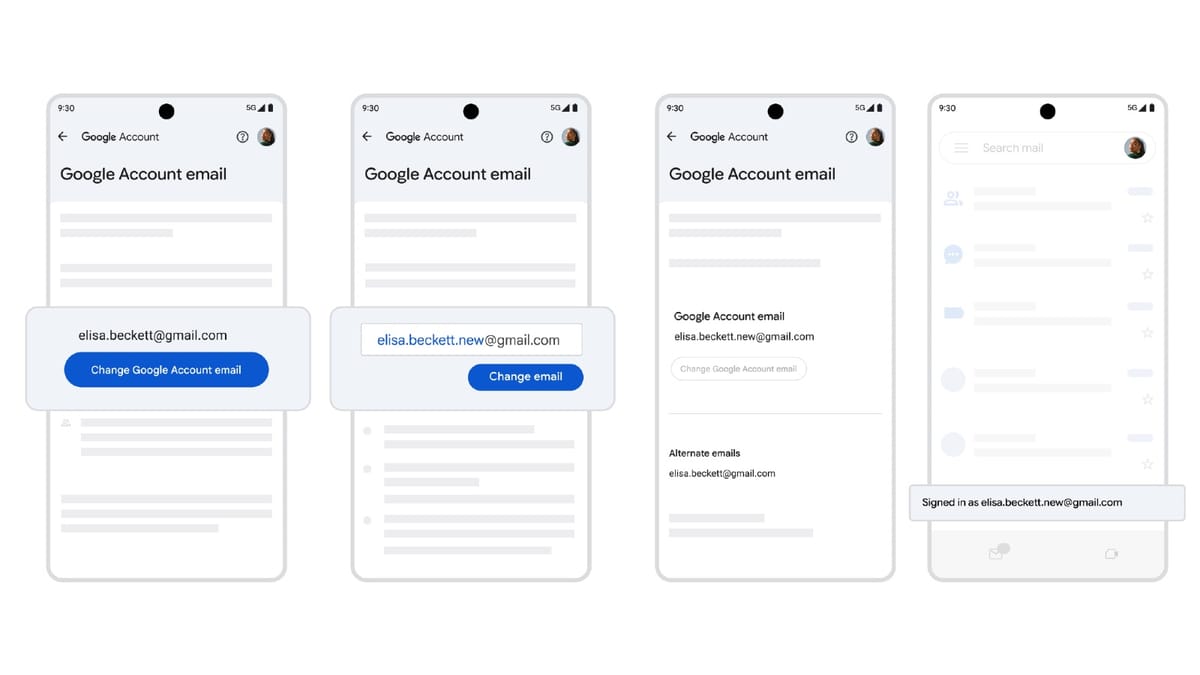
Google on March 31 enabled a long-requested feature for consumer Gmail accounts: the ability to change a Google Account username while keeping all existing data, inbox history, and third-party sign-ins intact. Published on April 2, 2026, by Arne Reimers, a software engineer on the Google Identity and Engagement team, alongside product managers Julia Steier and Cedric Strickland, a technical guidance post on the Google Developers Blog spells out what the change means - and what it could break - for platforms that rely on Sign in with Google or email-based user identification.
The capability has existed for Google Workspace business accounts for some time. Its extension to personal @gmail.com addresses marks a qualitative shift, because consumer Gmail accounts are deeply embedded in third-party authentication flows across the web.
When a U.S. Gmail user changes their username, the old address is not discarded. According to the Google Developers Blog post, "their original email address is retained as an alternative linked to the same account." Both the old and the new address point to the same inbox. Users can sign in, send email, and receive messages using either. The feature is currently available only in the United States.
The surface-level experience is straightforward. A user who signed up for Gmail years ago under a youthful or outdated handle can now adopt a new one without losing a decade of archived messages, Drive files, or YouTube watch history. Google has framed the motivation plainly: many users have addresses that "no longer reflect who they are - whether due to a name change, a shift in professional identity, or simply a username that they have outgrown."
Beneath that simplicity, however, sits a technical architecture that carries real consequences for developers and platform operators.
Google's authentication infrastructure assigns every Google Account a persistent internal identifier called the subject ID, or "sub." This identifier sits beneath the email address layer. It does not change when a username changes. It has never changed. This is the stable anchor that Google's authentication documentation has long recommended as the correct primary key for any account authenticated via Sign in with Google.
The problem is that a significant number of platforms did not follow that guidance. They mapped user accounts to email addresses instead. According to the Google Developers Blog post, platforms using Sign in with Google but mapping accounts based on the email address from the ID token may see disruption after a user changes their username.
The mechanics depend on whether an existing OAuth grant remains active. If an OAuth grant from before the username change is still live, Google will continue to provide the old email address to the platform - preserving continuity for the session. But if that grant was revoked, Google will supply the new email address on the next sign-in attempt. A platform using email as its primary identifier will then fail to recognize the user, potentially creating a duplicate account and severing access to all existing data associated with the original address.
This is not a hypothetical edge case. OAuth grants are revoked regularly - by users managing their account security, by platforms enforcing session timeouts, or by administrative processes. Any revocation between the username change and the next sign-in creates the conditions for this failure.
For users who signed up to a third-party platform with an email address and a password - rather than through Sign in with Google - the immediate sign-in experience is unaffected. The old Gmail address stays active as an alias, so those users can continue authenticating as normal. Platforms in this case hold no subject ID on file; they only know the email address.
The risk here is subtler and deferred. If a user later attempts to use Sign in with Google with their new Gmail address, the platform will see a Google identity it has no record of. It cannot link this new credential to the existing account. The result, again, is a duplicate account - a split identity that leaves the user unable to access their original data through the new sign-in method.
According to the blog post, the recommended mitigation is to allow users to update the email address associated with their account within the platform's own settings. That mechanism provides a path for users to connect their new Gmail identity to their existing platform account before the divergence becomes permanent.
One authentication method is entirely insulated from this change. For users who authenticate via passkeys, the sign-in experience will not be affected by a username change. Passkeys are cryptographic credentials bound to the device and the account's subject ID, not to the email address. They remain valid regardless of what happens at the address layer.
The developer guidance consolidates into three specific recommendations. First, migrate to subject ID as the primary user identifier for any account authenticated via Sign in with Google. The subject ID is described in the post as "the most reliable identifier for a Google user," stable across any changes made to the email address. Technical details are available in Google's implementation best practices documentation at developers.google.com.
Second, for platforms where migrating to subject ID is not immediately feasible, offer email-based account recovery. Because Google retains the old address as an alias, recovery emails sent to that original address will still reach the user. This creates a fallback that can bridge the gap until a more permanent fix is in place.
Third, for traditional email-and-password accounts, enable in-platform email updates. This allows users to proactively align their stored contact information with their current Gmail address, preventing the sign-in mismatch before it occurs.
The three steps are graduated in urgency. Subject ID migration is the structural fix. Email recovery is the operational buffer. In-platform email updates are the defensive measure for accounts outside the Sign in with Google flow entirely.
The authentication change intersects with a broader set of concerns that marketing and ad tech platforms have been managing for several years. Email addresses are not just login credentials in these systems - they are identity anchors used for audience matching, Customer Match uploads, email marketing lists, and cross-channel attribution.
A user who changes their Gmail username does not automatically update their email address in every platform database where it is stored. Historical entries persist unchanged. That slow drift, multiplied across a user base, creates the conditions for degraded match rates on campaigns that rely on email-based hashing - including Google's own Customer Match product.
PPC Land has tracked the broader identity infrastructure changes that set the context for this announcement. The Google Identity Services transition to Federated Credential Management, which began in April 2024, restructured how third-party sites authenticate users through Google accounts. That migration changed the underlying mechanism for Sign in with Google flows. The Gmail username change now introduces a new variable into that same ecosystem: when a user's address changes, sites that stored the previous Gmail address as their user identifier in their own databases will not automatically receive an update.
PPC Land's detailed coverage of the Gmail username change notes that Google's account infrastructure assigns that persistent subject ID beneath the email address layer, and that the feature required "navigating massive technical complexity and collaborating across almost every corner of the Google ecosystem," according to product manager Julia Steier's LinkedIn post. The Gmail address change coverage on PPC Land documents the full scope of platform dependencies involved, from Google Maps and YouTube to Google Play and Drive.
For platforms operating Customer Match campaigns, the implications extend to match rate degradation over time. As users gradually update their Gmail usernames, the email identifiers stored in advertiser databases will increasingly point to addresses that are aliases rather than primary usernames. Whether Google's matching infrastructure resolves both old and new addresses to the same account - and whether that resolution is reflected in match rate reporting - is a technical question that the current documentation does not fully answer.
The Google Data Manager API announcement in December 2025 established a centralized ingestion point for first-party data across Google Ads, Google Analytics, and Display & Video 360. That infrastructure, now operational, is the channel through which advertisers upload hashed email identifiers for audience targeting. The Gmail username change adds a new layer of complexity to the question of which email address to hash and upload.
Google Workspace accounts have had some form of username management available to administrators for years - but the controls sat with domain administrators, not individual users. A Workspace admin could change a user's email address within the organization's domain, with the old address becoming an alias. The behavior was structurally similar to what Google is now offering consumers, but the decision authority was centralized.
The consumer implementation inverts that model. Individual users now hold the authority to change their own address, subject to whatever constraints Google applies - the documentation published on April 2 references an annual change limit and a lifetime cap of three changes, as reported in PPC Land's earlier coverage. Platforms cannot anticipate or pre-emptively respond to individual user decisions. They can only build systems resilient enough to handle the consequences.
The broader authentication ecosystem context matters here. As PPC Land has reported, Google Identity Services transitioned to Federated Credential Management (FedCM) for Sign in with Google flows starting in April 2024. FedCM replaced the third-party cookie-based mechanism that had underpinned One Tap and Automatic Sign-In. That transition was largely invisible to end users but required adjustments from developers with custom integrations - particularly around sign-in layouts and Content Security Policy configurations.
FedCM is one of the few Privacy Sandbox technologies that survived Google's October 2025 retirement of most of the initiative. As PPC Land documented, Chrome retired the majority of Privacy Sandbox APIs in October 2025 following low adoption rates and severe performance problems revealed in testing. FedCM and CHIPS remained because they attracted support from other browser manufacturers and served clear use cases. The Gmail username change operates within the FedCM-era authentication stack, not the older cookie-dependent one.
The April 2, 2026 blog post is framed as a notification and guidance document. It does not set a deadline for platform migration. It does not announce enforcement. The changes to user behavior are already live - as of March 31, U.S. users can change their usernames. Developers who have not already migrated to subject ID as their primary identifier are now operating with a gap between Google's recommended architecture and their actual implementation.
For platforms with large user bases authenticated via Sign in with Google, the practical first step is an audit: identifying where in the data model email addresses from Google ID tokens are used as primary account keys. The scope of that audit determines the migration effort. Platforms that built on subject ID from the start have no action to take. Those that built on email addresses face a data migration that, depending on scale and database architecture, could be straightforward or substantial.
The distinction between active and revoked OAuth grants matters for prioritization. Users whose grants remain active will not experience disruption immediately, even if they change their username, because Google will continue providing the old address. The vulnerability window opens only when a grant is revoked and the user signs in again with a new address. That sequence is not predictable in advance.
For marketing platforms specifically, the question is not just about authentication - it is about data hygiene. Email lists, Customer Match audiences, and cross-channel attribution models built on Gmail addresses will need processes for handling addresses that have been changed, aliased, or otherwise altered. The alias system means old addresses remain technically valid, which may reduce the urgency of the problem - but does not eliminate it.
Who: Google, via its Identity and Engagement team (authors: Arne Reimers, Julia Steier, Cedric Strickland), and third-party platform developers using Sign in with Google or email-based user identification.
What: Google enabled Gmail username changes for U.S. consumer accounts on March 31, 2026. The old address becomes an alias. Both addresses point to the same inbox. The change introduces authentication risks for platforms that identify users by email address rather than by subject ID - including potential duplicate account creation when OAuth grants are revoked.
When: The feature became available to U.S. users on March 31, 2026. Developer guidance was published on April 2, 2026.
Where: Available to U.S. holders of personal @gmail.com accounts. Previously limited to Google Workspace business accounts managed by domain administrators. Developer guidance is published at developers.google.com.
Why: Google states that many users have email addresses that no longer reflect their current identity - due to name changes, professional shifts, or usernames they have outgrown. The technical guidance addresses the downstream risk that email-based authentication systems face when a previously stable identifier becomes mutable.