


Google added a new web banner format to Ad Manager on March 9, 2026, called focused banner ads, a beta feature that pauses a reader's scroll by blurring the article text beneath a standard inline banner until the reader clicks a "Continue reading" button. The release appeared in the 2026 Google Ad Manager release archive alongside several other Q1 updates. Industry reaction was immediate and, in parts, sharply critical.
The format sits within the existing line items and formats section of Ad Manager and targets what Google describes as ad blindness - the well-documented tendency for readers to visually filter out banner placements that they have grown accustomed to seeing. Focused banner ads are a direct attempt to disrupt that pattern. Whether they do so in a manner that publishers and their audiences will accept is, already, contested territory.
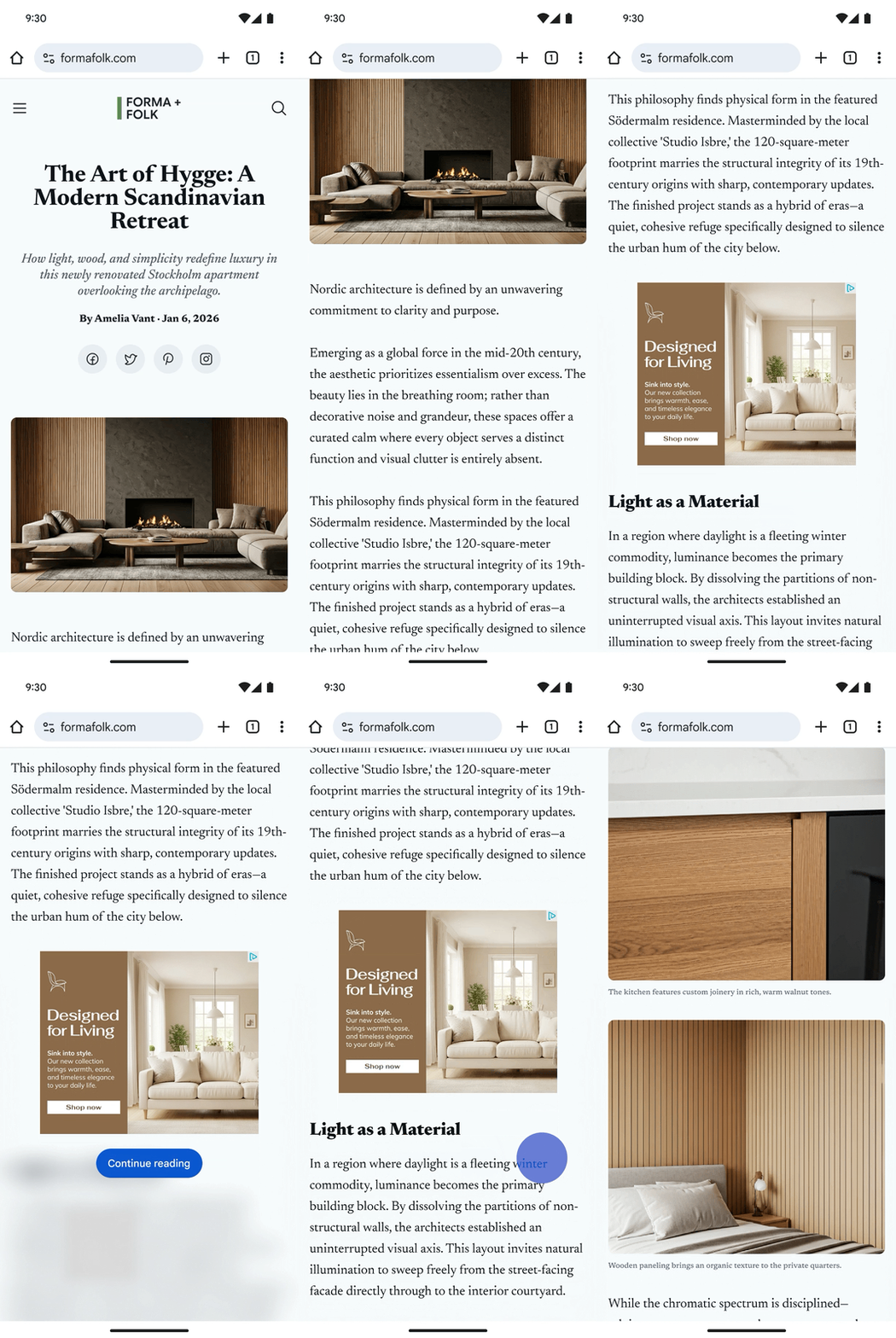
How the format works
According to the Google Ad Manager Help Center documentation, focused banner ads integrate into the web content flow in a four-stage sequence. First, the user is reading an article and the inline banner begins to scroll into view. Second, the banner becomes fully visible, with article text continuing below it. Third - and here the format departs from standard banner behaviour - once the user continues scrolling, the article text beneath the banner blurs and a "Continue reading" button appears. At this point, the reader cannot scroll further. Fourth, clicking "Continue reading" unblurs the text, the button disappears, and the reader continues normally.
The mechanism is enabled at the ad unit level through a single configuration parameter in the Google Publisher Tag (GPT). According to the documentation, the implementation involves calling slot.setConfig({contentPause: true}) on the relevant slot definition. The full tag structure uses googletag.defineSlot with the ad unit path and size array, adds the publisher ads service with addService(googletag.pubads()), then passes the contentPause: true setting before calling googletag.enableServices()and googletag.display(). Publishers specify which ad unit or units they want to test the format on; the focused banner treatment is then applied automatically to those slots.
The documentation notes the format is designed specifically for publishers with text-heavy content - the blur effect works against the article body, and if there is little text beneath the banner, the visual disruption is diminished. Supported environments include both mobile web and desktop. The format supports all deal types and demand sources, meaning it is not restricted to any particular programmatic pipeline or direct deal structure.
Beta status and availability
Google flagged focused banner ads with a prominent beta notice in the Help Center. According to the documentation, "Features in Beta phase might not be available in your network." Publishers who want access before a general release are directed to watch release notes and to contact their account manager. No timeline for general availability was given in the March 9 announcement.
This is consistent with how Google has introduced other disruptive or engagement-oriented formats in recent years. The Google AdSense offerwall, which lets readers watch a short ad to access content, also launched in beta with phased publisher access. Google AdMob's high-engagement settings for interstitial and rewarded formats - introduced in February 2025 - similarly extended the mechanics of user interaction with ads before publishers could dismiss or bypass them.
The focused banner format was one of several items released on March 9. The same batch included a new "All requested sizes" toggle for Ad Exchange line items, updates to the Interactive reports tool, an expansion of Policy Center screenshot support for app-level violations, updates related to the IAB TCF v2.3 transition deadline of March 1, 2026, details on the Bulgarian lev to euro currency changeover taking effect March 10, and the launch of consent syncing for apps in the Google CMP.
The industry response
The format drew swift commentary in the ad tech community, surfaced primarily through a LinkedIn post by Aram Zucker-Scharff, an engineering manager focused on monetisation and advertising. Zucker-Scharff described the format as "a 'Wait, stop, look at this ad' button" and linked to the Google Ad Manager Help Center documentation.
Reaction in the comments varied from scepticism to outright criticism. Josh Peters, an ad tech executive focused on data and audience strategy, wrote: "Your attention score might go up 10%, but your user complaints are going to go up 500%. No one is going to know what is happening." Zucker-Scharff replied to Peters: "It's almost designed to be confusing as possible, right? The button doesn't even give a real reason and it just shows up in the middle of the scroll process. It really is throwing users under the bus, and of course Google won't be the one taking the flak if they're successful in pushing this to buyers."
David Kohl, a growth and transformation leader and CEO, wrote: "This is horrible. Brands have got to realize that at some point, your prospective customers get so annoyed at you for screwing around with their content experiences that the ads are a net negative." Sam Johnson, deputy editor at CreativeScience.io, wrote: "Google prioritizing a monetization strategy over their users...again." Ariane Bernard, a platform tools specialist in CMS, data, and AI, called it "an interstitial by another name" - a label that Zucker-Scharff described as "a good point actually."
Jason Tollestrup, Head of Monetisation and Revenue Operations, offered a more drily ironic take: "I bet those attention scores are super high." Dr. Timothy Libert, founder of webXray, wrote: "The beatings will continue until CTRs improve." Ben Werdmuller, Senior Director of Technology at ProPublica, observed: "It turns out every browser has a 'stop looking at this article' button, too; publishers might find that people start using it ..." Gregory Engel, a staff engineer, connected the format to something already familiar: "So that's why I keep seeing this 'Continue reading' button pop up halfway through articles."
The observation that Engel makes is not trivial. Some publishers appear to have been running focused banner ads already, or a similar proprietary implementation, before the format appeared as an official beta in Ad Manager. Whether those experiences translate into performance data that supports the format's promise remains unclear at this stage.
What Google says it offers publishers
According to the Help Center documentation, focused banner ads "provide an opportunity to increase revenue from banner inventory without disrupting the user experience." The tension between that stated goal and the mechanics of the format - which literally pauses the user's ability to scroll - was a recurring theme in the community discussion.
The format is positioned as an alternative to running more aggressive overlay placements. Google's existing range of attention-oriented formats for web includes web interstitials, which were expanded with new trigger conditions in 2023, and anchor ads, which have seen collapsible mobile web variants added to the Ad Manager format lineup. Focused banner ads represent a different philosophy: instead of a full-page takeover or a persistent sticky unit, the format intercepts the scroll gesture at the point where the ad would otherwise pass out of view.
The claim that this approach is less disruptive than, say, a web interstitial is arguably defensible in a narrow technical sense - the content is still visible on screen, merely blurred, and the user action required is a single click rather than a page load. However, the comparison breaks down if users encounter the format without warning, which the LinkedIn commentary suggests is likely for many readers.
Context in the broader publisher landscape
The timing of this launch is notable. Google's network advertising revenues - covering AdSense, AdMob, and Ad Manager - declined 1% to $7.4 billion in Q2 2025, as AI-powered search features retained more users within Google's own properties rather than directing traffic to publisher websites. Publishers using Ad Manager are therefore operating in an environment where both traffic volumes and per-session revenue are under pressure simultaneously.
Against that backdrop, a format that increases per-impression engagement - even if it does so by blocking the user's scroll path - has a clear commercial rationale for publishers who are already seeing banner ad network revenues erode. The question is whether the uplift in attention metrics translates into durable advertiser demand, or whether it produces short-term metric inflation that buyers eventually discount.
The AdSense banner ads control update announced March 11, 2026 - replacing the ad load slider with granular settings including maximum ad count, minimum distance between ads, and a toggle for additional placements on article pages - shows that Google is reshaping banner format management across multiple products in close succession. Focused banner ads in Ad Manager and the AdSense advanced settings for banner density are two distinct mechanisms, but they point in the same direction: more deliberate, higher-engagement banner placements rather than passive inline units that readers scroll past.
The contentPause mechanism used in focused banner ads has a functional precedent in rewarded formats for web, which Google also supports in Ad Manager. In rewarded web ads, users opt in to watch a video in exchange for access to content. The focused banner differs in that the user has not opted in - the content pause is triggered automatically when scrolling past the ad. That asymmetry is at the core of the criticism: the user is interrupted regardless of their preference, with the only exit being an interaction that registers as engagement.
Technical implementation details
For publishers evaluating the implementation, the GPT tag modification is minimal. The contentPause: true configuration is passed using the setConfig method on the slot object, which Google introduced as a flexible configuration layer for slot-level settings. The method itself is not unique to focused banner ads - it is the same API surface used for other slot-level configurations in Ad Manager.
Publishers are expected to specify only the ad units where they wish to test the format. The documentation does not indicate any automatic opt-in or network-wide rollout. This means the format requires an explicit publisher decision to activate, which is consistent with Google's approach to other high-engagement format betas. There is no indication in the documentation of any reporting dimension specific to focused banner ads - publishers would presumably track performance through standard line item and creative reporting within Ad Manager.
The 300x250 size used in the implementation code example in the documentation is the most common display ad size globally and one of the most widely trafficked banner dimensions in Ad Manager inventories. The format does not appear to be restricted to that size, but no explicit list of supported dimensions appears in the documentation reviewed.
What happens next
As a beta, the format remains subject to change or withdrawal before general availability. Google noted that publishers should watch release notes for the general availability announcement and contact their account manager for access. No publisher testimonials or performance benchmarks appeared in the March 9 announcement or in the Help Center documentation. The absence of any quantified expected uplift - beyond the framing around increased revenue and reduced disruption - means publishers considering adoption have limited data to work with at this stage.
The criticism from the ad tech community, voiced through a LinkedIn thread that drew commentary from engineers, editors, and revenue operations professionals, reflects a genuine uncertainty about how readers will interpret the format at scale. Some commenters had already encountered it in the wild. Others questioned whether the confusion it generates at the point of scroll interruption will produce lasting negative brand associations that outweigh the initial attention gains. Those questions will take real-world deployment data to answer.
Timeline
- March 27, 2024 - Google Ad Manager releases codeless ad units supporting interstitial and anchor formats (PPC Land)
- November 2023 - Google Ad Manager launches web interstitial triggers in beta, expanding when interstitials can fire (PPC Land)
- February 12, 2025 - Google AdMob introduces high-engagement settings for interstitial and rewarded formats, extending skip times and exit steps (PPC Land)
- December 27, 2024 - Google AdSense launches offerwall beta, allowing publishers to gate content behind a short rewarded ad (PPC Land)
- August 7, 2025 - Google network advertising revenues decline 1% to $7.4 billion in Q2 2025, with AI features absorbing publisher traffic (PPC Land)
- November 6, 2025 - Google Ad Manager introduces AI brand safety tools and live CTV monetisation features (PPC Land)
- February 17, 2026 - Google confirms three-stage deactivation schedule for Ad Manager legacy reports tool, with full shutdown May 4, 2026 (PPC Land)
- March 1, 2026 - IAB TCF v2.3 transition deadline; Ad Manager begins dropping or limiting ad requests from publishers not compliant with TCF v2.3
- March 2, 2026 - Ad Manager "New Report" button defaults to Interactive reports; legacy tool can no longer create new reports
- March 9, 2026 - Google releases focused banner ads (Beta) in Google Ad Manager, alongside Interactive report updates, IAB TCF v2.3 error codes, and consent syncing for apps
- March 10, 2026 - Google depreciates Bulgarian lev (BGN) currency in Ad Manager following Bulgaria's official euro changeover
- March 11, 2026 - Google announces removal of AdSense ad load slider, replacing it with advanced settings for banner ads effective April 16, 2026 (PPC Land)
- April 6, 2026 - Google Ad Manager announces upcoming changes to commonly used ad technology partners list, with experiment starting on or after April 20, 2026
Summary
Who: Google, through the Google Ad Manager product team, targeting web publishers with inline banner ad inventory and text-heavy content. The format affects all deal types and demand sources, including mobile web and desktop environments.
What: Focused banner ads (Beta) - a new banner ad format for web that blurs article content beneath an inline banner until the reader clicks a "Continue reading" button. The feature is implemented via a contentPause: true configuration on the Google Publisher Tag slot object. It targets ad blindness and is positioned as a revenue opportunity for publishers without requiring additional overlay units.
When: Announced on March 9, 2026, as part of the Q1 2026 Google Ad Manager release batch. The format is in beta and does not have a confirmed general availability date. Publishers must contact their account manager for access.
Where: Available for web publishers operating within Google Ad Manager, using standard inline banner traffic. Supported environments include mobile web and desktop. The format is not available for apps.
Why: Google framed the format as a response to ad blindness - the tendency of readers to visually ignore banner placements - and as a tool to increase revenue from existing banner inventory. The release takes place against a backdrop of declining network advertising revenues and broader pressure on publisher monetisation models driven by AI-powered search features reducing traffic to external sites.


Discussion