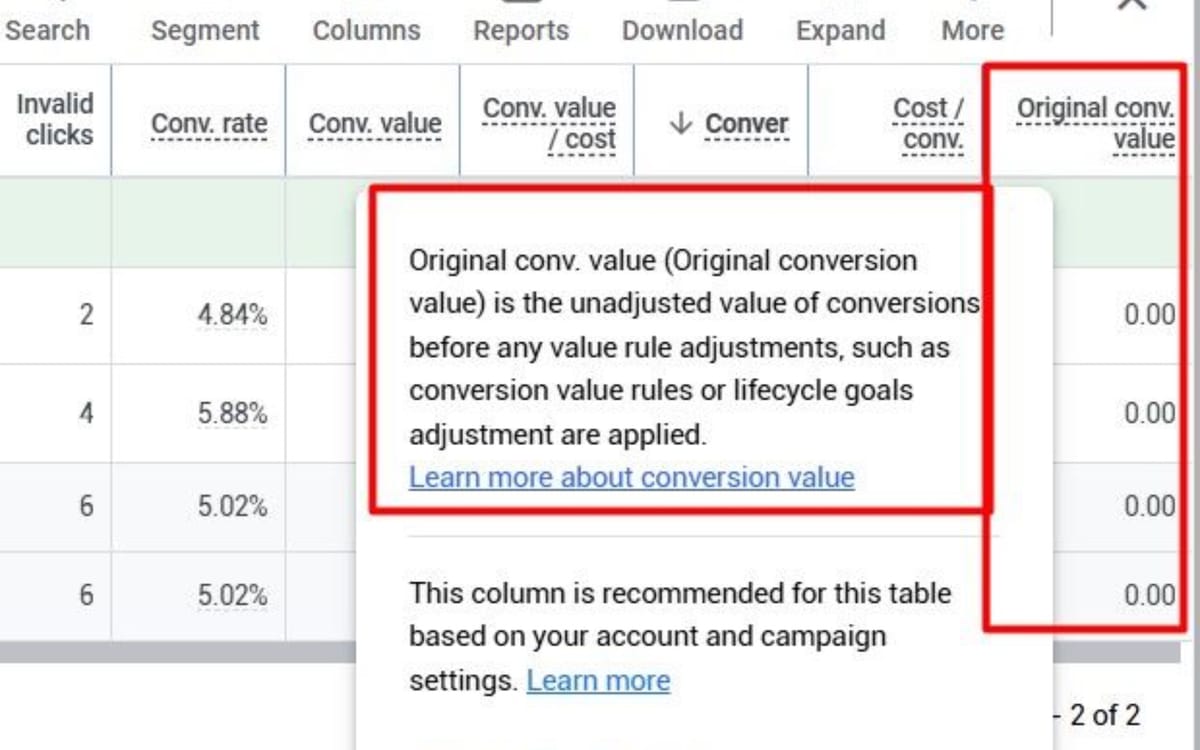
Google Ads has introduced a new reporting metric called "Original Conversion Value" that displays unadjusted conversion values before any automated value rules or lifecycle goal adjustments are applied to campaign data. The metric appeared in advertiser accounts during November 2025.
According to Natasha Kaurra, a Google Ads Specialist who first documented the feature in a LinkedIn post, "It shows the raw, unadjusted conversion value before any automated value rules or adjustments are applied." The metric provides advertisers with visibility into baseline performance data that exists prior to platform modifications.
The original conversion value metric addresses a specific transparency challenge in Google Ads reporting. When advertisers implement conversion value rules or lifecycle goal adjustments, the standard conversion value metric reflects the modified figures that automated systems use for optimization. This adjusted data can obscure whether performance changes stem from actual campaign results or from the value rules themselves.
Sign up for the free weekly newsletter
Your go-to source for digital marketing news.
No spam. Unsubscribe anytime.
Kaurra stated in her November post that the metric "gives a clearer view of true performance and helps diagnose whether value rules are hiding real shifts in results." The distinction becomes particularly relevant for advertisers using sophisticated bidding strategies that rely on conversion value data for optimization decisions.
Google's tooltip explanation within the interface describes the metric as showing "the unadjusted value of conversions before any value rule adjustments, such as conversion value rules or lifecycle goals adjustment are applied." The platform recommends the column for tables based on account and campaign settings.
Several industry practitioners have questioned the practical applications of the new metric. Yacine El Hichri, Founder at Viridian, commented that for most accounts the original conversion value will match the standard conversion value metric. "Pretty much useless to be honest," El Hichri wrote. "Sure it's nice to have for whoever wants it, but do you have a compelling example or case study on why anyone would use it?"
The metric's value becomes apparent in specific scenarios involving value rule implementation. Advertisers who apply conversion value rules to adjust reported values based on business logic—such as assigning higher values to new customers versus returning customers—can now compare unadjusted baseline performance against rule-modified figures. This comparison capability helps identify whether declining performance metrics result from actual campaign deterioration or from value rule calculations affecting the data.
Léo Provost, a Paid Media Expert specializing in the North American market, highlighted a use case for the metric: "I spotted this Original conv. value KPI a few days ago! Glad we now have this native view in Google Ads. It's very interesting to look into it when you leverage new client driven campaigns with an incremental conversion value on new customer!"
The timing of this metric's introduction aligns with Google's expansion of lifecycle goal targeting capabilities announced in April 2025. Those lifecycle goals enable differentiated bidding for new customers, high-value new customers, and win-back customers, with each category potentially carrying different conversion value adjustments that affect reported metrics.
For advertisers running campaigns with maximize conversion value or target ROAS bidding strategies, the distinction between original and adjusted conversion values affects how bidding algorithms evaluate performance. Value-based bidding strategies use conversion value data as the primary signal for optimization, making accurate attribution of value changes essential for troubleshooting campaign performance.
The metric appears as a column option in standard Google Ads reporting tables alongside other conversion metrics. Advertisers can add the "Original conv. value" column to campaign, ad group, or keyword-level reports through the columns customization interface. The platform displays the metric with a zero decimal format in the example screenshots shared by industry practitioners.
Adrian S., who helps small and medium businesses grow with data-driven PPC, noted that "For most accounts this will be the same as Conversion value." This observation underscores that the metric primarily serves advertisers who have implemented value rules or lifecycle goal adjustments rather than providing differentiated data for all account types.
The introduction follows recent expansions to conversion reporting capabilities across Google's advertising ecosystem. In October 2025, Looker Studio added seven new fields to its Google Ads connector, including conversion-by-date metrics and new versus returning customer dimensions. These reporting enhancements reflect increased advertiser demand for granular performance data that supports sophisticated attribution analysis.
Buy ads on PPC Land. PPC Land has standard and native ad formats via major DSPs and ad platforms like Google Ads. Via an auction CPM, you can reach industry professionals.
Learn more
Marketing teams troubleshooting performance anomalies can use the original conversion value metric to isolate the impact of value rules on reported metrics. When standard conversion value shows unexpected fluctuations, comparing against original conversion value reveals whether the changes reflect actual campaign results or value rule calculations affecting the data.
The metric complements Google's existing conversion tracking infrastructure, which includes standard conversion value, all conversion value, and conversion value by conversion date. Each metric serves different analytical purposes, with conversion date attribution helping advertisers understand when conversions actually occurred rather than when ad clicks happened.
For agencies managing multiple client accounts, the original conversion value metric enables standardized performance reporting that excludes client-specific value rule adjustments. This baseline data facilitates cross-client performance comparisons and benchmarking exercises that would otherwise be distorted by varying value rule implementations across different accounts.
The feature documentation within Google Ads indicates that the column recommendation system may surface the original conversion value metric for accounts and campaigns where the platform detects active value rule usage. The automated recommendation helps ensure advertisers working with adjusted values have access to the underlying baseline data.
Industry adoption of the metric remains limited as of November 2025, with early awareness concentrated among practitioners actively experimenting with advanced conversion tracking configurations. The niche application scope—primarily serving accounts with value rules or lifecycle goal adjustments—means many advertisers will not derive meaningful differentiation from the metric compared to standard conversion value reporting.
Subscribe PPC Land newsletter ✉️ for similar stories like this one
Subscribe
Timeline
Subscribe PPC Land newsletter ✉️ for similar stories like this one
Subscribe
Summary
Who: Google Ads platform and advertisers using conversion value rules or lifecycle goal adjustments, with early documentation by Natasha Kaurra and other digital advertising practitioners.
What: A new "Original Conversion Value" metric that displays unadjusted conversion values before any automated value rules or lifecycle goal adjustments are applied, enabling advertisers to compare baseline performance against rule-modified figures.
When: The metric appeared in Google Ads accounts during November 2025, with first industry documentation occurring in mid-November through social media posts by advertising specialists.
Where: Available within standard Google Ads reporting tables as a column option that can be added to campaign, ad group, or keyword-level reports across all advertiser accounts.
Why: Provides transparency into baseline conversion performance data to help advertisers diagnose whether reported metric changes stem from actual campaign results or from value rule calculations, particularly relevant for accounts using sophisticated bidding strategies and customer lifecycle targeting.
Share this article
The link has been copied!