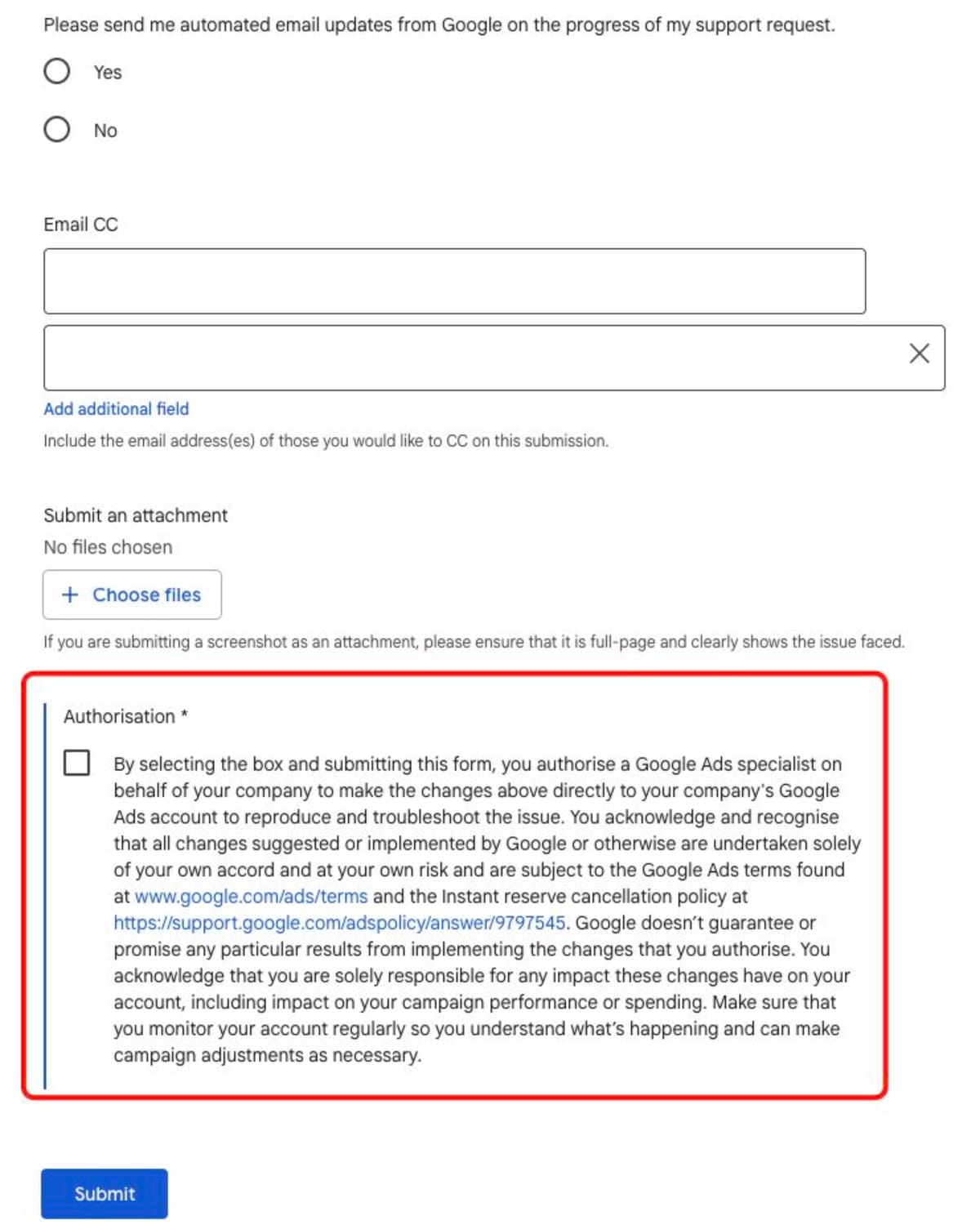
A clause embedded inside Google Ads' standard support contact form has drawn renewed attention from digital marketing professionals today, after Adriaan Dekker, a Google Ads consultant based in Rotterdam, shared a LinkedIn post originally surfaced by Arpan Banerjee, an AI-driven PPC specialist. The post highlighted an authorization section at the bottom of the form that, when selected, explicitly permits a Google Ads specialist to make direct changes to an advertiser's account - without any further confirmation step before changes are applied.
The authorization text, visible in the form screenshot shared on LinkedIn and reproduced in the attached documents, states: "By selecting the box and submitting this form, you authorise a Google Ads specialist on behalf of your company to make the changes above directly to your company's Google Ads account to reproduce and troubleshoot the issue." The same text continues: "You acknowledge and recognise that all changes suggested or implemented by Google or otherwise are undertaken solely of your own accord and at your own risk and are subject to the Google Ads terms found at www.google.com/ads/terms and the Instant reserve cancellation policy."
The clause goes further, stating that "Google doesn't guarantee or promise any particular results from implementing the changes that you authorise." It places the full burden of monitoring on the advertiser: "You acknowledge that you are solely responsible for any impact these changes have on your account, including impact on your campaign performance or spending. Make sure that you monitor your account regularly so you understand what's happening and can make campaign adjustments as necessary."
That last sentence - a form instruction telling advertisers to simply monitor their accounts after giving a specialist carte blanche - struck several commenters as deeply problematic. In the LinkedIn thread, Thibault Fayol, a consultant SEA who has managed more than €3 million in advertising budgets, responded with a simple question: "Wasn't it always there?" Banerjee replied thanking Dekker for the mention, but the broader community reaction reflected something less settled than a mere shrug.
The form itself lists several preference options before reaching the authorization box. Advertisers can specify how they would like a Google expert to respond - by phone, email, or either - and can opt in or out of automated email updates on the progress of their support request. There is also an email CC field, the ability to add additional recipients, and an attachment option for screenshots, with a note specifying that screenshots "should be full-page and clearly show the issue faced." The authorization checkbox appears at the very bottom, framed in a red-bordered box, before the Submit button.
Update - February 24, 2026 - Google Response
Ginny Marvin, Google's Ads Product Liaison, confirmed today "this is not new and has been communicated for a few years when advertisers request changes to be made by our Support teams. We value our partnerships with advertisers and will review your feedback internally." The response confirms that the authorization requirement is intentional and longstanding, while stopping short of indicating whether any changes to the form's design or consent flow are under consideration.
What the authorization clause actually covers
The language of the clause is broad. It does not specify which "changes above" it authorizes, relying instead on whatever the advertiser has described in the free-text fields earlier in the form. This means the scope of the permission granted depends entirely on how the advertiser has articulated their issue. A vaguely described campaign problem could, in theory, give a specialist a wide mandate to alter bids, budgets, ad copy, campaign settings, or bidding strategies.
This is not a hypothetical concern. The issue of Google Ads representatives making unauthorized changes to advertiser accounts has been documented before. In October 2024, Thomas Eccel, a former Google employee, shared details of a case in which a Google Ads Campaign Specialist for the UK and Ireland market made several modifications to a client's account without prior authorization from either the client or their agency. Among the modifications: ad copy changes, headline pinning adjustments, and bidding strategy shifts. Of particular concern at the time was the fact that those modifications did not appear in the account's change history, making them difficult to detect or reverse.
Navah Hopkins, a prominent paid search expert, commented on that 2024 incident: "This unfortunately isn't new. It's been going on for years and sometimes is as insidious as being hidden by NOT being documented in the change history." Maximilian vom Eyser, identifying himself as a current Google employee at the time, called unauthorized changes "absolutely also today still a major compliance flag if done without written advertiser authorization."
The support form's authorization clause, it seems, is at least partly an attempt to put that written authorization on record - before any specialist touches an account. But critics today are questioning whether the consent mechanism is sufficiently transparent, given its placement at the bottom of the form and the passive framing that surrounds it.
A pattern of expanding specialist access
The form authorization debate sits inside a broader pattern. Google has been gradually expanding agency and specialist access to advertiser accounts, while simultaneously tightening the rules around third-party partners who enable policy violations. The October 2024 policy update threatened advertising agencies with severe penalties - including immediate account suspension - for enabling significant or sustained violations of Google Ads policies. Google characterized such violations as "egregious."
At the same time, PPC agency leaders have reported persistent interference from Google representatives who contact clients directly, sometimes suggesting that the agency itself is underperforming. According to a meeting of 50 PPC agency leaders documented by PPC Land in November 2024, the pattern is systematic. Ian Harris, who hosted that meeting, described agencies as going "belly-to-belly with a £1.3 trillion business that's hell bent on unpicking their hard work." Some agencies responded by requiring all Google recommendations to be submitted in writing before any call is accepted.
The authorization clause in today's form raises a related but distinct question: when an advertiser submits a support ticket and checks that box, are they aware that a specialist may immediately implement changes without any secondary confirmation? The form provides no preview of proposed changes before submission. There is no staged authorization - no "review changes before applying" step. Once the box is checked and the form submitted, the specialist has a documented mandate to act.
The liability terms deserve attention
The specific terms referenced in the authorization clause point to two documents: the Google Ads terms at www.google.com/ads/terms, and the Instant reserve cancellation policy at https://support.google.com/adspolicy/answer/9797545. The latter governs how Google can immediately cancel reserved advertising slots - a detail that matters if a specialist modifies campaign structures that include reservation-based inventory.
The clause also explicitly disavows any guarantee of results. Google states plainly that changes made by a specialist may affect "campaign performance or spending." That caveat is standard across many service agreements, but in the context of an advertising account where a single bidding strategy change can shift thousands of euros in daily spend within hours, the practical stakes are high. Advertisers running campaigns with large budgets, complex targeting structures, or carefully calibrated automation signals face the most exposure.
This connects to a broader concern about the relationship between AI-driven campaign automation and human specialist access. Google launched its Ads Advisor tool in late 2025, extending AI-driven campaign guidance to all English-language accounts. According to Google's documentation at the time, Ads Advisor can "apply these changes directly to accounts, converting suggestions into implemented improvements within minutes" - but only "with advertiser review and approval." The support form authorization clause works differently: the approval is given in advance, not after reviewing specific proposed changes.
Verification and accountability gaps
One recurring concern in the broader discussion around Google specialist interactions involves accountability when things go wrong. The Google Ads third-party policy update from late 2024 placed heavy compliance responsibilities on agencies managing accounts on behalf of clients. But the support form authorization structure places responsibility squarely on the advertiser, regardless of who made the change.
According to the authorization text in the form: "You acknowledge that you are solely responsible for any impact these changes have on your account." That language does not distinguish between changes the advertiser explicitly requested and broader interventions a specialist might judge to be helpful while troubleshooting. It also does not specify a time window during which the authorization remains valid.
For advertisers managing accounts independently - without agency representation - this structure may be less immediately problematic. They are submitting the form themselves, describing the issue themselves, and presumably understand broadly what a specialist might do. But for accounts managed through agencies, where the person submitting a support ticket may not have full visibility into the campaign strategy, the authorization clause could create friction.
The November 2024 pattern of deteriorating agency-Google relations remains relevant here. Several agency leaders documented that Google specialists routinely implement changes that conflict with carefully planned campaign strategies - and those changes are sometimes not visible in the account's change history. The support form authorization clause, if used as a basis for such changes, at least provides a paper trail. Whether that trail is sufficient protection for advertisers is a separate question.
Context: the support form itself is changing
The scrutiny of this authorization clause arrives at a moment when the Google Ads support form is itself in transition. Search Engine Roundtable reported approximately three weeks ago that Google appears to be replacing its support form with an AI chat agent - redirecting users who visit the support form URL to a chat-based experience. Banerjee had previously noted that the form "auto-picks info from your previous support cases," suggesting existing back-end personalization.
If the support form is eventually replaced by a chat-driven agent, the authorization mechanism will presumably need to be redesigned. An interactive chat exchange is structurally different from a form with a static checkbox. Whether Google would embed an equivalent authorization step - and how it would be surfaced to users - remains unknown.
For now, advertisers using the existing contact form should read the authorization box carefully before submitting. The clause is not hidden, but its placement at the very bottom and its framing as a standard checkbox means it may not receive the scrutiny it warrants. The Instant reserve cancellation policy link embedded in the text - https://support.google.com/adspolicy/answer/9797545 - and the Google Ads terms link both deserve review before any submission, particularly for accounts with complex structures or active automation.
The discussion today on LinkedIn, while relatively contained in terms of engagement numbers - 15 reactions and 2 comments on the original share - touches a nerve that the digital marketing community has felt before. The question of who controls a Google Ads account, and under what conditions a third party can alter it, is not new. What the support form's authorization clause makes plain is that Google has, for some time, been collecting documented consent for exactly that kind of access - embedded in the moment advertisers are most likely to be distracted: when something has already gone wrong.
Timeline
- October 15, 2024 - A Google Ads Campaign Specialist makes unauthorized changes to a client account without prior authorization, raising compliance questions across the industry.
- October 15, 2024 - Google updates its third-party policy to introduce severe penalties for agencies enabling significant Google Ads policy violations, effective November 2024.
- November 24, 2024 - A meeting of 50 PPC agency leaders documents widespread concerns about Google representative interference, unauthorized account changes, and deteriorating agency relations.
- June 6, 2025 - Google updates its policies to allow individual advertiser accounts to be paused if connected manager accounts are in violation of the third-party policy.
- November 4, 2025 - Google reinforces its Circumventing Systems policy, clarifying that advertisers who provide false information during verification will lose verified status and face account suspension.
- November 12, 2025 - Google launches Ads Advisor for all English-language accounts, enabling AI-driven campaign guidance with advertiser-approved change implementation.
- February 2026 - Google reportedly begins redirecting the Google Ads support form URL to an AI chat agent experience, per Search Engine Roundtable.
- February 22, 2026 - Adriaan Dekker shares Arpan Banerjee's LinkedIn post highlighting the authorization clause in the Google Ads support contact form, triggering renewed discussion about advertiser consent and specialist account access.
Summary
Who: Adriaan Dekker, a Google Ads consultant, and Arpan Banerjee, a PPC specialist, alongside the broader digital marketing community reacting on LinkedIn. Google Ads is the platform at the center of the discussion.
What: The Google Ads support contact form contains a mandatory authorization checkbox that, when selected, grants a Google Ads specialist direct permission to make changes to an advertiser's account in order to troubleshoot issues. The clause disclaims any Google liability for resulting changes and places full monitoring responsibility on the advertiser.
When: The LinkedIn post was shared today, February 22, 2026. The authorization clause itself appears to be a longstanding feature of the form, though its presence had not previously received wide attention in the community.
Where: The clause appears within the Google Ads support contact form, accessible to advertisers when submitting a support request. Discussion took place on LinkedIn.
Why: The clause matters because it formalizes a form of advance consent for specialist account access at a moment when the industry has been actively debating unauthorized and undisclosed changes to advertiser accounts by Google representatives. The scope of the authorization is broad, the liability falls entirely on the advertiser, and no secondary confirmation step exists between submission and potential account changes.
Share this article
The link has been copied!