Google AdSense to auto-enroll publishers in consent optimization
Google AdSense will auto-activate consent message optimization for EEA publishers on May 7, 2026, unless publishers opt out within the 30-day review window.

Google notified AdSense publishers on April 7, 2026, that it will automatically enable a feature called consent message optimization across all Google CMP European regulations messages within 30 days - unless publishers explicitly turn it off. The activation date is May 7, 2026.
The notification, sent as a mandatory service announcement via email from [email protected], affects publishers whose sites reach users in the European Economic Area (EEA), the United Kingdom, and Switzerland. It marks another step in Google's expanding automation of publisher-facing consent tooling, a pattern that has accelerated over the past two years.
According to the Google AdSense Help Center, consent optimization works by analyzing past performance and session-level data - including browser type and geographic location - to determine which of two message formats is most likely to generate revenue for a given site visit. The system then automatically delivers whichever message is predicted to perform better for that specific session.
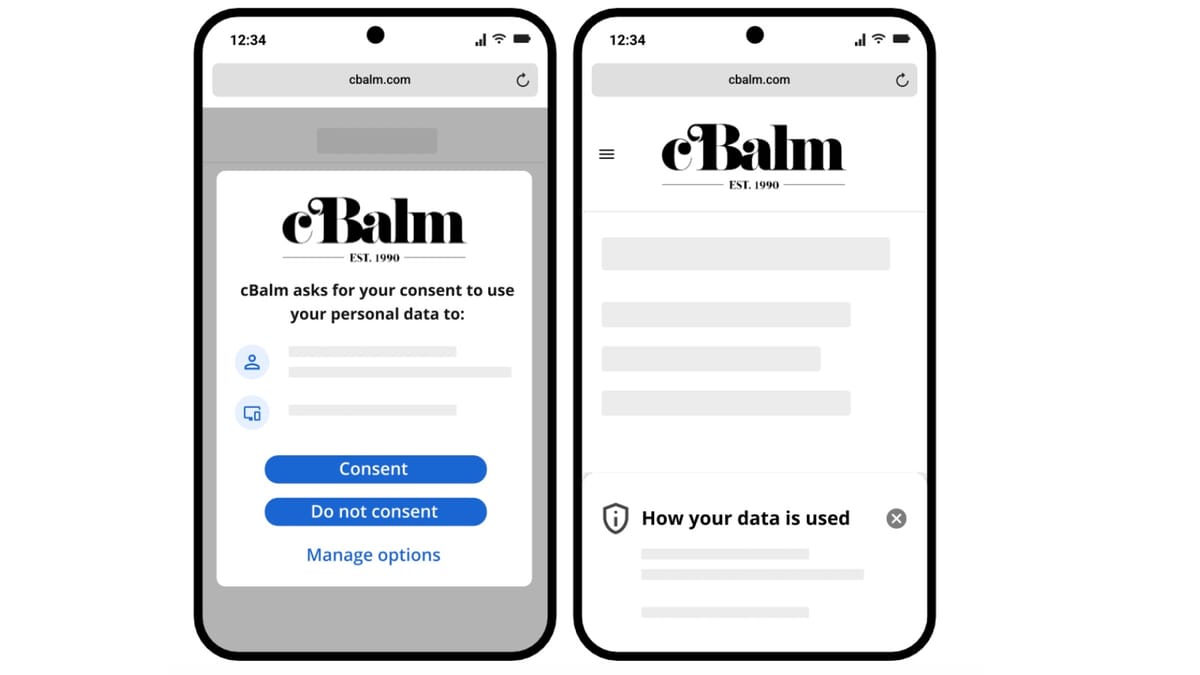
The two message types are fundamentally different in how they interact with users. A standard consent message is a blocking format: the user must make a consent decision before accessing site content. A limited message is non-blocking and allows sites to monetize users with limited ads, relying on legitimate interest rather than explicit consent as the legal basis.
The distinction matters because these two paths carry different legal and commercial implications. Personalized advertising typically generates substantially higher revenue than limited ads inventory. According to prior PPC Land coverage of flexible country controls in European consent messages, data from major advertising platforms indicates that personalized ads can deliver 50 to 70 percent higher revenue than non-personalized alternatives. The optimization feature is designed to capture more of that revenue by choosing dynamically between the two paths rather than applying one message universally.
There is, however, a technical dependency: according to the AdSense help documentation, if a publisher has turned off legitimate interest controls, Google will not serve any limited messages. That means the optimization feature, in practice, depends on legitimate interest being enabled. Publishers who have disabled those controls will only ever receive the standard blocking message regardless of how the toggle is set.
The timeline Google has communicated is precise. The email sent on April 7 informed publishers that the "Optimize my consent message" toggle would appear as ON in their European regulations message setup immediately - but that this visual change would have no effect on actual message delivery for 30 days.
During this review period, standard consent messages continue showing to all eligible users unchanged. According to the AdSense help documentation, data collected during this review period, ending May 7, 2026, may itself be used to inform the optimization feature once it activates. The period therefore functions both as a notice window and as a data-collection phase.
After May 7, the optimization selection - ON unless a publisher has explicitly switched it to OFF - will govern message delivery automatically. Publishers who do not act during the 30-day window will find their consent message presentation handled by Google's system from that date forward.
The opt-out path requires navigating to an active European regulations message, opening the setup section of the message builder, and toggling "Optimize my consent message" to OFF. That action, if taken before May 7, prevents any change to existing message behavior. Publishers can also opt out after May 7, according to the documentation, meaning the control is not a one-time window but a persistent toggle.
This announcement does not exist in isolation. It is the latest in a series of changes Google has made to its European consent infrastructure, each narrowing the space for manual publisher configuration while adding automated or default-on features.
In May 2025, Google removed the account-level control for non-personalized ads from the Privacy & messaging settings in AdSense, directing publishers toward the IAB Transparency and Consent Framework (TCF) as the primary mechanism for communicating consent decisions. That same month, the company announced it would begin showing who pays for ads in a transparency update covering EEA placements.
In November 2025, Google mandated migration to TCF v2.3 by February 28, 2026, requiring all publishers and consent management platforms to update their consent string handling. The deadline passed, and in March 2026, Google confirmed enforcement was active, with non-compliant ad requests defaulting to limited ads or being dropped entirely. That enforcement introduced a new TCF error code - 1.4 - specifically for requests where the TCF v2.3 "Disclosed vendors" segment is absent, malformed, or does not include Google (vendor ID 755).
Just days before the consent optimization email landed, Google announced an experiment to update the commonly used ad technology partner list for AdSense on April 6, 2026. That experiment could alter which vendors automatically receive user consent signals across publisher sites in the EEA, the UK, and Switzerland, with the earliest change date set for April 20, 2026.
The cumulative effect is a consent stack where more decisions - which message format to show, which vendors to include, which framework version to use - are either automated by Google or governed by Google-defined defaults. Publishers who do not actively engage with these controls are increasingly relying on what Google has decided is optimal.
The role of legitimate interest in this feature deserves specific attention. According to the AdSense help documentation for managing legitimate interest settings, publishers can choose whether to display legitimate interest controls to site visitors at all, and whether those options are turned on or off by default.
If a publisher unchecks the legitimate interest controls checkbox entirely, all ad partners are required to use consent as the legal basis for all purposes. According to the documentation, "purposes relying only on legitimate interest will not be used for consent. This may result in significantly reduced ad revenue." In that configuration, the limited message path in consent optimization becomes unavailable - Google will not serve limited messages when legitimate interest is disabled.
This creates a layered dependency. The consent optimization feature relies on the limited message path. The limited message path relies on legitimate interest being enabled. Publishers who have disabled legitimate interest - perhaps for compliance reasons or out of caution - will find that the optimization feature, even if turned on, operates only through the standard blocking message.
The interaction between these settings is not prominently surfaced in the April 7 email itself, which describes the two message types without flagging that one of them requires a separate setting to function. Publishers reviewing their configuration will need to check both the consent optimization toggle and their legitimate interest settings to understand how the system will behave in practice.
The structure of this rollout - default ON, with a 30-day window to opt out - follows a pattern Google has applied to several recent AdSense features. In December 2025, Google automatically enrolled publishers in AI-powered Offerwall optimization in an analogous way: a review period during which the toggle appeared active but did not affect delivery, followed by automatic activation. That feature claimed network-level revenue increases of 8.15 percent and conversion rate improvements of 10.2 percent.
The consent optimization feature does not provide equivalent network-level performance data in the documentation reviewed. What the email states is that the feature is "designed to help you get more from your European regulations messages with less manual effort." The framing centers on reduced effort and revenue protection rather than quantified uplift.
For publishers, the question is not simply whether the feature might increase revenue - it may well do so for some sites - but whether automated message selection is appropriate given their specific user base, legal context, and relationship with their consent management configuration. A publisher serving a high proportion of users from jurisdictions with active data protection authority scrutiny may have reasons to maintain direct control over which message format is shown.
It is also worth noting that the April 7 email states that "additional optimization capabilities managed by the same control may be introduced in the future." That language indicates the toggle is not a fixed switch for a single defined feature but a broader control that could govern additional automated behaviors as Google develops them.
For publishers who want to understand where their configuration stands before May 7, the navigation path in AdSense is through Privacy & messaging, then to the European regulations message type card, and into the setup section of the message builder, where the "Optimize my consent message" toggle is located. Legitimate interest settings are accessible through the same Privacy & messaging section, under the European regulations message type card, by adjusting the "Legitimate interest controls" settings.
Publishers using third-party consent management platforms rather than Google's own CMP should confirm with their CMP provider how the consent optimization feature interacts with their specific implementation. The AdSense help documentation addresses Google's own CMP directly but does not detail behavior for all third-party configurations.
The April 7 email was classified as a mandatory service announcement - not a marketing communication - meaning it went to all eligible AdSense accounts regardless of notification preferences. Publishers who did not see the email should check the Google AdSense Help Center's "About consent optimization" page directly, which contains the same timeline information and the navigation path to the relevant toggle.
Who: Google AdSense publishers whose sites serve users in the European Economic Area, the United Kingdom, and Switzerland. The feature operates through Google's own consent management platform (CMP) for European regulations messages.
What: Google is automatically enabling a feature called consent message optimization, which uses session data and past performance to choose between two message formats - a blocking standard consent message or a non-blocking limited message relying on legitimate interest - on a per-visit basis. The optimization toggle will appear ON across all eligible Google CMP European regulations messages. Publishers can disable it at any time by toggling "Optimize my consent message" to OFF in the message builder setup section.
When: The mandatory service email was sent on April 7, 2026. The 30-day review period runs from April 7 to May 7, 2026, during which no change to actual message delivery occurs. After May 7, 2026, the feature activates automatically for publishers who have not opted out.
Where: The feature applies to European regulations messages configured through Google AdSense's Privacy & messaging settings. It affects ad delivery to users in EEA member states, the United Kingdom, and Switzerland - the three jurisdictions covered by Google's EU user consent policy.
Why: Google states the feature is designed to increase publisher revenue from European regulations messages with less manual effort by automatically selecting the message format most likely to convert for each session. The broader context is Google's ongoing automation of publisher-facing consent and monetization controls, a pattern visible in the Offerwall optimization rollout in December 2025, the TCF v2.3 mandate enforced from March 2026, and the ad tech partner list experiment announced in April 2026.