Google Search Advocate John Mueller and Microsoft's Fabrice Canel today issued official warnings against a trending practice in the search marketing community: creating separate markdown or JSON pages specifically designed for large language model crawlers. The responses came after Lily Ray, Vice President of SEO Strategy and Research at Amsive, raised concerns about the tactic on November 23, 2025.
Ray's question addressed growing industry discussion about serving different content to bots than to human visitors. "Not sure if you can answer, but starting to hear a lot about creating separate markdown / JSON pages for LLMs and serving those URLs to bots," Ray wrote in a post directed at Mueller. "Can you share Google's perspective on this?"
The inquiry touched on fundamental tensions between emerging AI search optimization strategies and established search engine policies. Several marketing professionals have begun experimenting with creating machine-readable versions of their content, hoping to improve visibility in AI-powered search results and chatbot responses. Some practitioners claim positive results from the approach.
Mueller responded on February 5, 2026, with a characteristically direct assessment that challenges the technical rationale behind the strategy. "I'm not aware of anything in that regard," Mueller stated. "In my POV, LLMs have trained on - read & parsed - normal web pages since the beginning, it seems a given that they have no problems dealing with HTML. Why would they want to see a page that no user sees? And, if they check for equivalence, why not use HTML?"
The Google representative's response identifies a logical inconsistency in the approach. Large language models have successfully processed billions of HTML pages during their training phases. Creating separate markdown or JSON versions assumes AI systems cannot parse standard web formats - an assumption Mueller suggests lacks foundation.
More significantly, Mueller's question about serving "a page that no user sees" directly invokes Google's longstanding prohibition against cloaking. Cloaking refers to showing different content to search engine crawlers than to human visitors, a practice that has violated search engine guidelines for decades. The tactic emerged in the early 2000s as spammers attempted to manipulate rankings by showing keyword-stuffed content to crawlers while displaying different material to users.
Ray's original post revealed she had "concerns the entire time about managing duplicate content and serving different content to crawlers than to humans." Her instincts aligned with official policy. Google's systems treat content shown exclusively to bots as potential manipulation, regardless of the stated intent behind creating such pages.
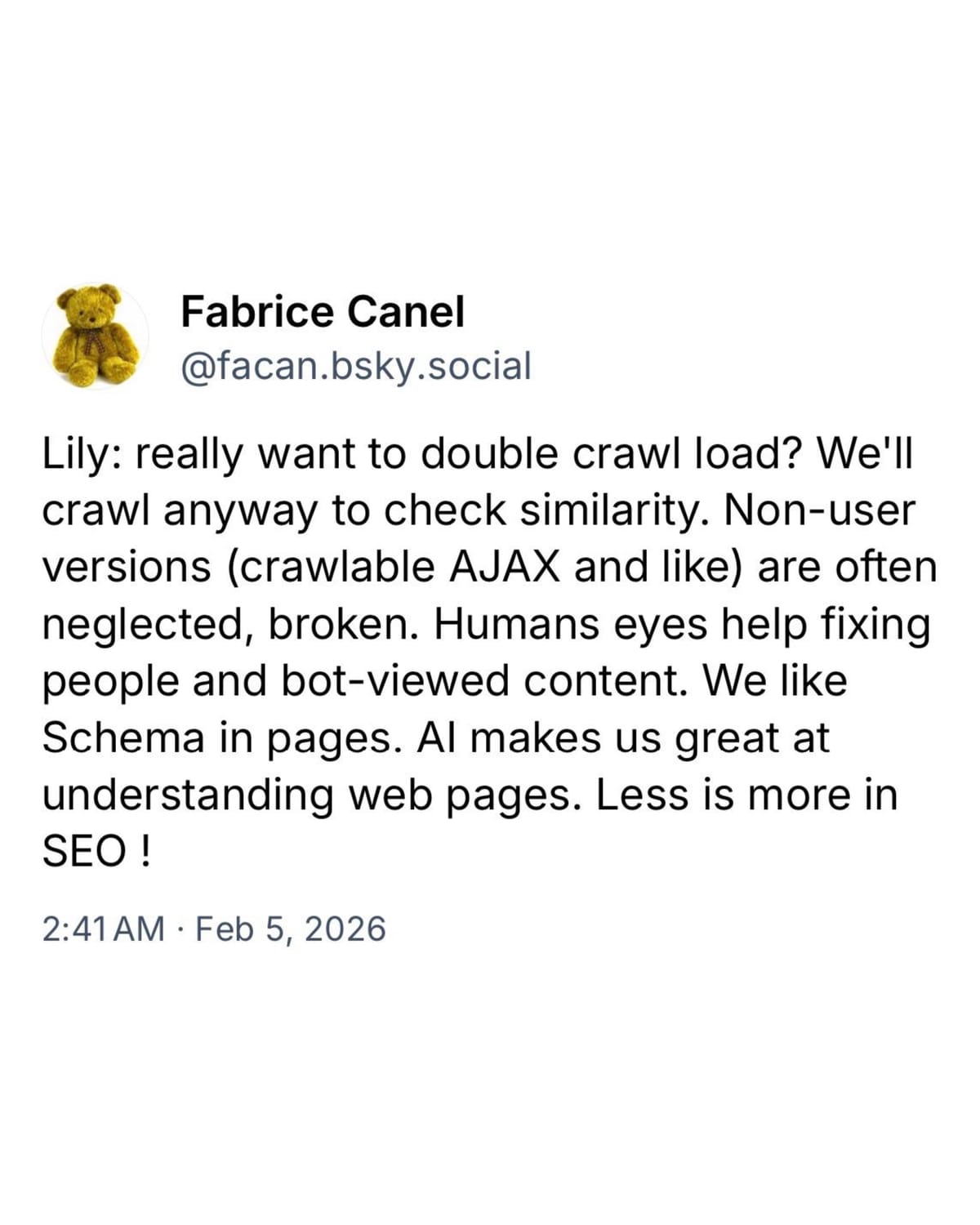
Fabrice Canel, Principal Program Manager at Microsoft Bing, provided a complementary perspective that emphasized the redundancy rather than the policy violation. "Lily: really want to double crawl load? We'll crawl anyway to check similarity," Canel wrote. "Non-user versions (crawlable AJAX and like) are often neglected, broken. Humans eyes help fixing people and bot-viewed content. We like Schema in pages. AI makes us great at understanding web pages. Less is more in SEO!"
Canel's response highlights operational realities that undermine the strategy's efficiency claims. Creating separate bot-only pages doubles the crawling burden on search engines, which will still need to verify that bot-facing content matches user-facing versions. This verification process eliminates any theoretical efficiency gains from serving simplified formats to crawlers.
The Microsoft executive's comment about "non-user versions" being "often neglected, broken" reflects accumulated industry experience. Website owners who maintain separate mobile sites, printer-friendly versions, or other parallel content structures frequently struggle to keep all versions synchronized. Content drift between versions creates quality problems that harm rather than help search visibility.
Both responses converge on a central theme: traditional HTML remains the appropriate format for both human and machine consumption. The assumption that AI systems require special formatting contradicts how these technologies actually function. Large language models have demonstrated sophisticated capabilities in parsing complex HTML structures, extracting relevant content from nested div tags, and understanding semantic relationships within standard web markup.
The exchange on November 23, 2025 occurred amid broader industry confusion about AI search optimization. Marketing professionals have encountered numerous proposals for specialized tactics supposedly required for visibility in AI-powered search features. Google's Search Relations team has consistently emphasized that traditional SEO principles remain effective, contrary to industry narratives promoting new optimization frameworks.
Ray's concern about duplicate content addresses another dimension of the problem. Websites that create both human-facing and bot-facing versions of the same information must somehow signal to search engines which version should appear in results. Without clear canonicalization, search systems may index multiple versions, fragmenting ranking signals and potentially triggering duplicate content filters that suppress both versions.
The timing of this discussion proves particularly relevant given the proliferation of AI optimization acronyms throughout 2025. Marketing consultants have proposed various frameworks including GEO (Generative Engine Optimization), AEO (Answer Engine Optimization), and AIO (AI Integration Optimization). Mueller warned on August 14, 2025, that aggressive promotion of such acronyms may indicate spam and scamming activities.
Industry experimentation with separate bot pages reflects legitimate concerns about AI search visibility. The rise of ChatGPT, Claude, and other conversational AI systems has created new discovery channels where traditional SEO signals may not apply. Platforms like Semrush have documented how optimizing content for AI mentions differs from traditional search optimization, reporting nearly tripled AI share of voice through systematic approaches.
However, the path forward does not involve creating parallel content versions. Canel's emphasis on Schema structured data provides more actionable guidance than separate page creation. Schema markup allows website owners to provide machine-readable context within standard HTML pages, giving both users and bots access to the same content with enhanced semantic understanding.
The "less is more" philosophy Canel articulated contradicts the impulse toward creating additional pages, separate formats, and specialized versions. This principle has appeared repeatedly in Google's guidance about AI search optimization, where representatives warn against complexity that serves algorithms rather than users.
Technical considerations beyond policy violations make separate bot pages impractical. Modern search engines use sophisticated similarity detection to identify cloaking attempts. Systems compare content shown to authenticated crawlers against content retrieved through proxy servers mimicking human users. Substantial differences between versions trigger manual review or algorithmic penalties.
The verification process Canel described means search engines must crawl both versions regardless. Website owners gain no bandwidth savings or crawl budget benefits from providing separate formats. Instead, they double their maintenance burden while increasing the likelihood of synchronization errors that harm search visibility.
Ray's February 5, 2026 follow-up comment expressed gratitude for the clarification while emphasizing practical benefits. "Thanks for that info," she wrote. "I liked the 'less is more in SEO' quote. It saves so much time and money to stop making duplicate pages that are just a nightmare to manage."
The SEO expert's response captures the relief many practitioners feel when official guidance validates their instincts against pursuing complex strategies. Marketing teams face constant pressure to adopt new tactics as competitors experiment with emerging approaches. Clear statements from platform representatives help professionals avoid resource-intensive implementations that violate policies.
Industry adoption patterns for the markdown page strategy remain difficult to quantify. Ray's initial observation noted she was "starting to hear a lot about" the approach, suggesting discussion rather than widespread implementation. Some practitioners claiming positive results may have confused correlation with causation, attributing visibility gains to separate pages when other factors drove improvements.
The conversation unfolded against the backdrop of broader changes in how search systems process content. Google's internal restructuring toward LLM-based search architectures became public knowledge through Department of Justice court documents in May 2025. These revelations showed Google fundamentally rethinking ranking, retrieval, and display mechanisms with large language models playing central rather than supplementary roles.
However, Google's architectural shifts do not translate into requirements for website owners to restructure their content. The company's public guidance has consistently maintained that optimizing for AI-powered search requires no fundamental changes from traditional SEO practices. Danny Sullivan, Google's Search Liaison, stated on December 17, 2025, that "everything we do and all the things that we tailor and all the things that we try to improve, it's all about how do we reward content that human beings find satisfying."
The markdown page discussion intersects with previous warnings about LLM-generated content strategies. Mueller cautioned on August 27, 2025, that using large language models to build topic clusters creates "liability" and provides "reasons not to visit any part of your site." The emphasis on human-focused content over algorithm-targeted tactics forms a consistent thread through Google's AI search guidance.
Canel's reference to Schema markup aligns with established best practices for structured data. Schema.org vocabularies provide standardized methods for describing content entities, relationships, and attributes within HTML pages. This approach gives AI systems enhanced context without requiring separate content versions.
The "humans eyes help fixing people and bot-viewed content" observation addresses quality assurance challenges. Website content that human visitors never see often accumulates errors that would be immediately obvious with visual inspection. Broken layouts, missing images, incorrect formatting, and other technical problems persist when no one actually views the affected pages. These issues harm bot comprehension just as they would impair human understanding.
Marketing professionals seeking AI search visibility face clearer guidance after these official responses. Rather than creating separate markdown or JSON pages, website owners should focus on high-quality HTML content with appropriate Schema markup. The same content should serve both human visitors and automated crawlers, maintaining alignment between user experience and bot accessibility.
The duplicate content management challenges Ray identified extend beyond simple synchronization problems. Search engines must determine which version represents the canonical source when multiple URLs contain similar information. Without clear signals, ranking authority fragments across versions rather than consolidating behind a single preferred URL.
Implementation complexity compounds the strategic problems with separate bot pages. Website owners must configure server-side logic to detect bot requests and serve different content based on user agent strings. This approach requires ongoing maintenance as search engines modify their crawler identification, creating ongoing technical debt.
The verification burden Canel described means search engines will continue accessing both versions. Crawl budget - the number of pages search engines will process from a given site during a specific timeframe - gets consumed by both human-facing and bot-facing pages. Sites with limited crawl capacity due to size, authority, or technical constraints cannot afford this duplication.
Mueller's question about LLMs' HTML processing capabilities reflects the actual training data these systems consume. OpenAI, Anthropic, Google, and other AI companies have trained their models on billions of web pages in standard HTML format. These systems have demonstrated sophisticated understanding of complex markup structures, CSS styling that affects content meaning, and JavaScript-generated content.
The assumption that simplified formats would improve AI comprehension lacks empirical support. Large language models extract semantic meaning from context clues including heading hierarchies, list structures, table relationships, and document flow - all elements naturally present in well-structured HTML. Converting to markdown or JSON removes rather than enhances these contextual signals.
Industry history provides instructive parallels. The mobile web's early years saw debates about whether separate mobile sites (m.example.com) or responsive design serving the same HTML to all devices represented the better approach. Google ultimately advocated for responsive design, citing maintenance burdens and content parity challenges with separate mobile sites. The same logic applies to separate bot pages.
Ray's role as an industry thought leader amplifies the significance of her public inquiry. With over 129,000 followers and extensive experience analyzing algorithm updates, her questions carry weight within the SEO community. Her willingness to surface concerns about trending tactics before widespread adoption potentially prevented numerous websites from implementing problematic strategies.
The conversation's public nature on social media platforms provides transparency that benefits the broader marketing community. Private communications between individual website owners and search engine representatives help specific situations but don't establish industry-wide understanding. Public exchanges create permanent records that practitioners can reference when evaluating similar decisions.
Mueller's response strategy emphasized questioning the underlying assumptions rather than simply stating policy. By asking "Why would they want to see a page that no user sees?" he encouraged critical thinking about the rationale behind separate bot pages. This pedagogical approach helps marketing professionals develop better decision-making frameworks rather than simply following rules.
Canel's mention of "crawlable AJAX" references historical challenges with JavaScript-heavy websites. Search engines initially struggled to process content generated by JavaScript after page load, leading some developers to create server-side rendered versions specifically for crawlers. Modern search engines have largely solved these problems through headless browser rendering, making such workarounds unnecessary.
The principle that AI systems make search engines "great at understanding web pages" suggests confidence in current processing capabilities. Both Google and Microsoft have invested heavily in natural language processing, computer vision, and other AI technologies that power their search systems. These investments enable sophisticated content understanding from standard formats without requiring special accommodation.
Ray's appreciation for the "less is more" guidance reflects broader industry fatigue with complexity. Marketing teams manage increasing technical debt from accumulated optimization tactics, many of which provide minimal value relative to their implementation and maintenance costs. Simplification recommendations resonate with professionals seeking efficient approaches.
The exchange demonstrates how social media enables rapid policy clarification that benefits the entire industry. Traditional communication channels required waiting for official blog posts, documentation updates, or conference presentations. Direct engagement between practitioners and platform representatives accelerates knowledge distribution.
The February 5, 2026 timing positions this guidance relatively early in the markdown page trend's lifecycle. Ray's observation about "starting to hear a lot about" the approach suggests the tactic remained in discussion rather than widespread implementation phases. Early intervention prevents the resource waste that occurs when companies invest heavily before discovering policy violations.
Industry response to the official guidance will likely include some practitioners arguing that their specific implementations differ from cloaking because they provide value to AI systems. However, the fundamental principle remains: showing different content to bots than to users violates search engine policies regardless of stated intentions.
The conversation also touches on broader questions about LLM behavior and training data. The llms.txt protocol proposed in September 2024 faced similar adoption challenges, with major AI platforms including OpenAI, Google, and Anthropic declining to support the standard. This pattern suggests AI companies prefer existing web standards over new protocols.
Marketing professionals must balance experimentation with established guidelines. Innovation drives industry progress, but violations of core policies create risks that outweigh potential benefits. The guidance from Mueller and Canel provides clear boundaries for legitimate AI search optimization while discouraging approaches that conflict with search engine policies.
The emphasis on human-focused content creation remains consistent across all recent platform guidance. Whether addressing LLM-generated topic clusters, content fragmentation for AI consumption, or separate bot pages, Google's representatives emphasize that systems reward content written for human benefit rather than algorithmic manipulation.
Timeline
- September 3, 2024: Jeremy Howard proposes llms.txt protocol for helping large language models access structured website content
- May 2, 2025: Department of Justice court documents reveal Google's fundamental search restructuring with LLMs at the core
- July 2, 2025: No major LLM providers support llms.txt despite widespread promotion by SEO tools
- August 14, 2025: John Mueller warns that aggressive AI SEO acronym promotion may indicate spam tactics
- August 27, 2025: Mueller cautions against using LLMs to build topic clusters, stating such practices create site liability
- October 17, 2025: Semrush publishes case study showing nearly tripled AI share of voice through systematic optimization
- November 23, 2025: Lily Ray questions Google and Microsoft about creating separate markdown/JSON pages for LLMs on social media
- December 17, 2025: Google Search Relations team states optimizing for AI-powered search requires no fundamental changes from traditional SEO
- January 8, 2026: Danny Sullivan explicitly warns against fragmenting content into bite-sized chunks for LLM optimization
- February 5, 2026: John Mueller and Fabrice Canel provide official responses discouraging separate markdown pages for AI crawlers
Summary
Who: Google Search Advocate John Mueller and Microsoft's Fabrice Canel responded to inquiry from Lily Ray, Vice President of SEO Strategy and Research at Amsive, regarding industry practices of creating separate content versions for large language model crawlers.
What: Both search engine representatives warned against creating dedicated markdown or JSON pages for AI bots, with Mueller questioning why LLMs would need special formats when they successfully process standard HTML, and Canel emphasizing that search engines will crawl both versions anyway to verify similarity. The practice potentially violates longstanding cloaking policies prohibiting different content for bots versus humans.
When: The exchange occurred on November 23, 2025, when Ray initially raised the question, with Mueller and Canel responding on February 5, 2026, during a period of heightened industry discussion about AI search optimization strategies.
Where: The conversation took place on social media platforms where Ray maintains significant industry influence with over 129,000 followers, providing public guidance that benefits the broader marketing community rather than remaining in private communications.
Why: The inquiry addressed growing concerns about search engine policy compliance as marketing professionals experiment with new tactics aimed at improving visibility in AI-powered search results and chatbot responses, with some practitioners claiming positive results from serving different content to bots despite traditional prohibitions against such practices.
Share this article
The link has been copied!