Google CEO's $90 billion confession: what he said about your job
Silicon Valley executive reveals unprecedented spending surge while acknowledging workers face an automated future with limited protection or guidance.

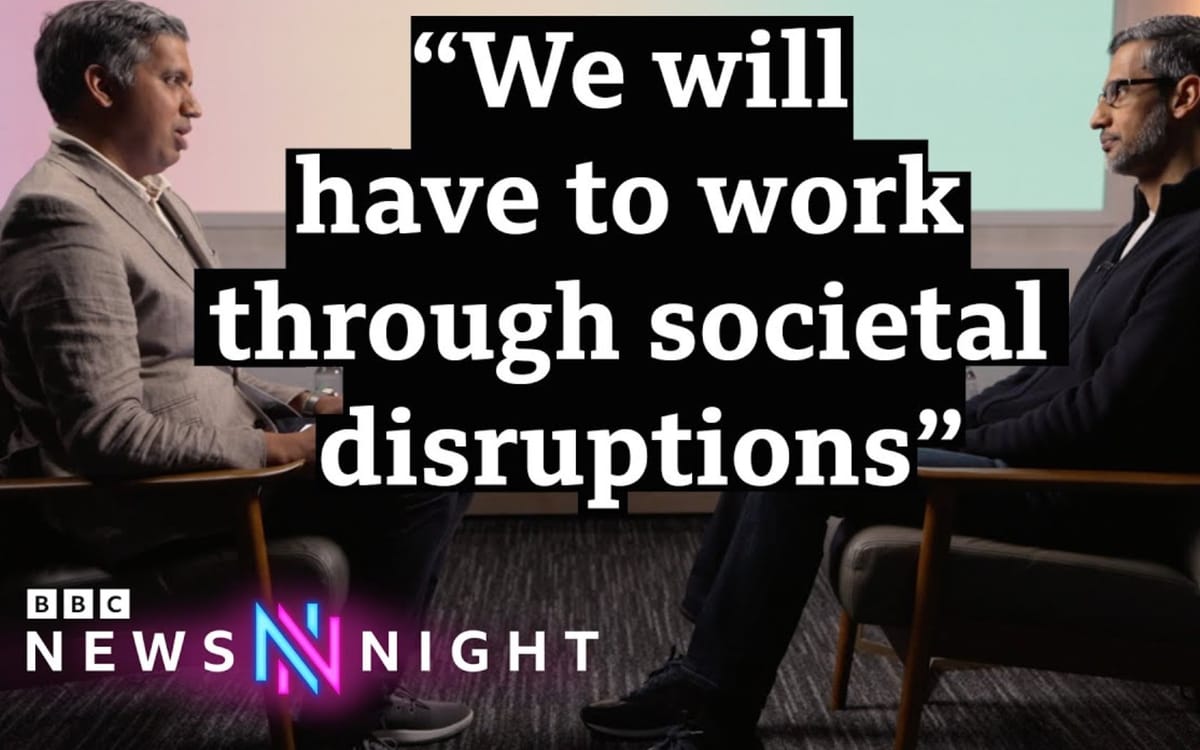
Google CEO Sundar Pichai detailed an industry-wide investment exceeding $1 trillion in artificial intelligence infrastructure during a November 19, 2025 BBC Newsnight interview, while offering limited reassurance to professionals whose careers face automation. The executive acknowledged that AI will "impact some jobs" even as he characterized the technology's arrival as "rational" and "profound."
Pichai revealed Google's capital expenditure for AI infrastructure will surpass $90 billion in 2025, up from less than $30 billion four years ago. "In the next couple of years, we'll end up building what we probably built in the past 10 to 20 years," he stated, describing a construction pace that dwarfs previous technology buildouts.
When BBC economics editor Faisal Islam pressed on specific job categories facing displacement, Pichai pivoted to historical comparisons about refrigerators and dishwashers rather than addressing which professions remain safe. "I think anybody just like YouTube has done anybody can will be able to create content you know you could be a high school student in a few years down maybe envision a featurelength movie and make it right that's extraordinary," Pichai said, characterizing job elimination as creative opportunity.
The Google executive suggested his own position might be easier to automate than other roles. "I think what a CEO does is maybe one of the easier things to maybe for a AI to do one day," Pichai stated, before immediately qualifying that workers should learn to "embrace the technology" rather than resist displacement.
Subscribe PPC Land newsletter ✉️ for similar stories like this one
The interview's timing coincides with mounting evidence that AI deployment eliminates positions across industries previously considered immune to automation. Data company Statista announced 80 layoffs October 15, 2025, targeting content teams that handle data identification and aggregation. CEO Marc Berg described the decision as necessary to "automate repetitive standard processes" despite 18% year-over-year growth.
"The uncertain economic situation, geopolitical tensions and especially the rapid rise of Gen AI and evolving customer behavior posed new challenges and opportunities," Berg explained in his LinkedIn announcement, characterizing workforce reduction as evolution rather than downsizing.
Legal professionals face similar disruption despite their specialized expertise. Federal courts documented multiple instances of attorneys submitting AI-generated fabricated citations, with Arizona Judge Alison S. Bachus revoking an attorney's pro hac vice status August 14, 2025 after finding "the majority of legal citations were fabricated by AI." The sanctions suggest even highly credentialed professionals struggle to verify AI outputs while facing pressure to adopt efficiency tools.
A Florida federal court imposed community service requirements August 14, 2025 on former Bang Energy CEO John H. Owoc after he acknowledged using AI-generated fake citations due to inability to afford legal research tools. The case illustrates how economic pressure drives professionals toward AI systems that undermine their work quality.
When pressed about which jobs remain protected, Pichai offered only generic advice. "I wouldn't change anything of how we've always thought I think you know I think there's going to be a wide variety of disciplines which will end up mattering," he stated, before suggesting people "embrace the technology learn to use it in the context of what you do."
The interview exposed fundamental limitations in systems receiving trillion-dollar investments. Islam challenged Pichai on accuracy after citing examples including glue recommended as pizza ingredient and wrongful assault accusations generated by Google's AI.
"The current state-of-the-art AI technology is prone to some errors right," Pichai acknowledged, before cautioning users to "not blindly trust everything they say." The admission reveals a striking disconnect: companies are deploying systems at massive scale while acknowledging they produce false information.
Pichai defended the technology's limitations by suggesting users must learn which tasks suit AI capabilities. "You have to learn to use these tools and for what they are good at," he stated, effectively placing responsibility on individuals to compensate for system deficiencies rather than requiring companies to deliver reliable products.
The executive repeatedly emphasized that Google maintains separate services for users requiring accurate information. "This is why people also use Google search and we have other products which are you know more grounded in providing accurate information right," Pichai explained, suggesting AI chatbots serve different purposes than traditional search despite both carrying Google branding.
Islam questioned whether Google accepts that its investment produces less reliable information than previous systems. "I think if you if you only construct systems stand alone you know and you only rely on that that would be true," Pichai responded, arguing that maintaining multiple information sources preserves accuracy.
The CEO's acknowledgment that "Truth matters. Yeah. Truth matters. Journalism matters" came only after sustained questioning about reliability, and he provided no mechanisms for ensuring AI systems honor these principles at scale.
Google's AI buildout drives energy consumption increases that forced the company to modify its 2030 sustainability commitments. Pichai confirmed the company "still has" net zero targets but acknowledged "some of the progress the rate at which we were hoping to make progress will be impacted" by faster-than-expected AI infrastructure growth.
The executive described signing "the largest corporate uh purchase for nuclear fusion energy with Commonwealth Fusion Systems" alongside agreements for small modular nuclear reactors and geothermal energy deployments. These investments represent attempts to address energy demands Pichai characterized as "so immense" they require developing entirely new power sources.
When asked directly whether AI buildout takes priority over climate commitments, Pichai insisted "this doesn't need to be a tradeoff or or a zero sum game." However, his acknowledgment that progress rates have slowed contradicts claims that environmental commitments remain unchanged.
The Google CEO suggested AI's energy demands will drive renewable technology advancement. "I think you know I am as a technologist I'm optimistic through this moment that we will have abundant sources of renewable energy in the future," Pichai stated, framing current environmental impacts as temporary inconvenience preceding technological breakthroughs.
Pichai faced questioning about Google's practice of training AI systems on copyrighted books, music, and journalism without direct compensation to creators. The CEO emphasized that Google operates "committed to uh copyright frameworks in all the countries we operate in today" while noting the company allows people to "opt out of the training."
"We are you know in the process of working with the industry to create newer frameworks as we as we move through it," Pichai stated, offering no timeline for establishing payment systems or acknowledging creator concerns about unauthorized use of their work.
Sir Elton John has characterized AI companies' content usage as "thievery on the high scale," demanding transparency about how his songs appear in training datasets. Pichai's response suggested Google already provides opt-out mechanisms rather than addressing whether artists should receive payment for existing usage.
The copyright landscape remains contentious, with Anthropic agreeing to a $1.5 billion settlement September 5, 2025 after authors alleged the company illegally used pirated books to train AI models. Federal courts have delivered mixed rulings, with some judges finding training constitutes "exceedingly transformative" fair use while others reject downloading pirated copies as legitimate research activity.
The U.S. Copyright Office released comprehensive guidance May 11, 2025 establishing frameworks for evaluating fair use claims, though political turmoil followed when President Trump allegedly dismissed Register of Copyrights Shira Perlmutter for refusing to "rubber-stamp Elon Musk's efforts to mine troves of copyrighted works to train AI models," according to Representative Joe Morelle.
Buy ads on PPC Land. PPC Land has standard and native ad formats via major DSPs and ad platforms like Google Ads. Via an auction CPM, you can reach industry professionals.
Islam questioned whether the combination of technological power and political proximity makes observers uncomfortable, referencing Pichai's attendance at President Trump's inauguration alongside other technology executives. "I think it is an extraordinary moment in terms of this AI technology," Pichai responded, characterizing government engagement as necessary given national security implications.
"President Trump has been very clear in in the importance of this technology uh and has articulated a clear AI action plan with with multiple aspects to it to deliver benefits to the country," Pichai stated, describing Google's alignment with administration priorities.
The CEO rejected concerns about consolidated power, arguing that "many many companies I would argue there are many companies many frontier models you have open source models coming in with China right so if anything I think you know so the you're right you never want if there was only one company which was building AI technology and everyone else had to use it I would be concerned about that too but we are so far from that scenario right now."
This characterization ignores that five companies dominate AI infrastructure spending, with Google, Microsoft, Meta, Amazon, and others collectively deploying over $1 trillion while smaller competitors lack capital to compete at similar scale.
The interview's implications extend directly to digital marketing professionals whose livelihoods depend on website traffic that AI systems increasingly eliminate. Google's AI Overviews reduce organic clicks by 34.5% when present in search results, according to Ahrefs analysis published April 17, 2025.
Industry analyst Dan Callis warned of a potential "Zero Result SERP" scenario where Google provides only AI-generated answers without traditional website links. "What happens if the biggest search engine in existence decides that organic listings underneath LLM-generated answers no longer need to be there?" Callis questioned in analysis published July 16, 2025.
Pichai's emphasis on "agentic experiences" where AI systems complete complex tasks autonomously suggests further traffic reductions ahead. "You know I have to go shop something. I have to buy a a birthday gift for my spouse and you know can I ask this uh chatbot to go do that right?" Pichai stated, describing scenarios where users never visit external websites.
The marketing community monitors these developments closely as Google executives hint at a unified AI search interfacethat consolidates information rather than directing traffic to publishers. Capital expenditure reaching $91-93 billion projected for 2025 demonstrates Google's commitment to AI-powered search regardless of impact on external websites.
Publishers struggle with optimization strategies as traditional SEO approaches focused on ranking individual pages become less relevant when AI systems synthesize information from multiple sources. Content creators must now optimize for inclusion within AI-generated summaries rather than pursuing top organic rankings, fundamentally changing digital marketing economics.
Pichai concluded the interview by suggesting quantum computing represents the next major technological shift. "I the progress is I think we have the state-of-the-art quantum computing efforts in the world. Uh the progress is so exciting. I would say quantum is there where maybe AI was 5 years ago," he stated.
The executive projected that "in five years from now we'll be going through you know a very exciting phase in quantum" with investments made "with a view towards that." This timeline suggests workers adapting to AI disruption will face another technological transition before fully adjusting to current changes.
Pichai's optimism about building "quantum systems I think will help us better simulate and understand nature and unlock many benefits uh for society" mirrors his characterization of AI's benefits, offering limited specifics about who receives these benefits or how displaced workers will participate in supposed prosperity.
The interview revealed a consistent pattern: technology executives deploying trillion-dollar infrastructure buildouts while placing responsibility for adaptation on individuals facing job loss, unreliable information systems, and environmental consequences. Workers must "embrace" automation, users must verify AI outputs, and society must accept "disruptions" as necessary costs of progress concentrated in corporate hands.
Subscribe PPC Land newsletter ✉️ for similar stories like this one
Subscribe PPC Land newsletter ✉️ for similar stories like this one
Who: Google CEO Sundar Pichai discussed the company's artificial intelligence investments and their implications for workers, energy consumption, and information reliability during a BBC Newsnight interview with economics editor Faisal Islam.
What: Pichai revealed Google will spend over $90 billion on AI infrastructure in 2025, part of an industry-wide investment exceeding $1 trillion, while acknowledging the technology will eliminate jobs, produce unreliable information, and force adjustments to climate commitments. The executive offered limited guidance to professionals facing automation, suggesting only that workers should "embrace" AI rather than resist displacement.
When: The November 19, 2025 interview occurred as multiple industries document job losses from AI automation, including Statista's 80-person layoff announcement October 15, 2025 and mounting federal court cases involving professionals submitting AI-generated fabricated citations.
Where: The interview took place at Google's California campus, though the implications extend globally as the company operates AI infrastructure across multiple countries while pursuing nuclear energy agreements and modifying sustainability targets due to unprecedented power demands.
Why: The discussion matters for marketing professionals and workers across industries because it reveals how technology executives frame widespread job displacement as individual adaptation challenges rather than systemic disruptions requiring policy interventions. Pichai's acknowledgment that AI systems produce errors while companies deploy them at trillion-dollar scale exposes tensions between corporate investment priorities and user needs, while his admission that climate progress rates have slowed demonstrates how AI infrastructure demands supersede previous environmental commitments despite public statements claiming otherwise.