
Google Finance AI tools reach 100+ countries with local language support
Google Finance launches AI-powered research, Deep Search, live earnings, and charting tools across 100+ countries with full local language support starting April 8, 2026.

Google Finance launches AI-powered research, Deep Search, live earnings, and charting tools across 100+ countries with full local language support starting April 8, 2026.
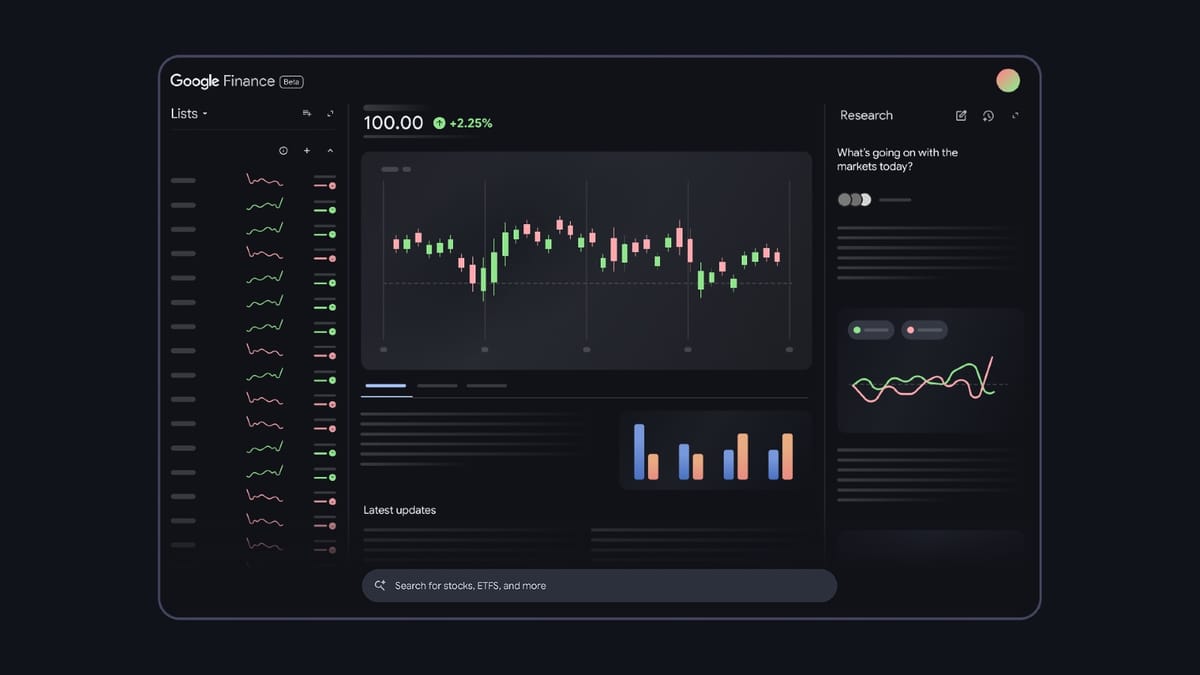
Google took its AI-powered Finance platform global on April 8, 2026, rolling out the redesigned experience to more than 100 countries with full local language support. The expansion - announced on the company's official blog, The Keyword - extends a product that had, until that point, been available only in the United States and India.
According to the announcement, the rollout covers markets including Australia, Brazil, Canada, Indonesia, Japan, and Mexico, among many others. Users in each of those territories will be able to interact with the platform in their own language, not just in English or Hindi as previously required. Google directed users to its Help Center for the most current list of supported countries as the rollout proceeds over the coming weeks.
The April 8 expansion is the latest step in a product development cycle that began on August 8, 2025, when Barine Tee, a Principal Engineer for Search, announced the start of a limited test of the new Google Finance in the United States. That initial announcement described three core capabilities: a natural language research interface, advanced charting tools, and a broadened real-time data feed covering commodities and additional cryptocurrencies. The platform was framed as a significant departure from the classic Google Finance experience, which had functioned primarily as a basic stock and portfolio tracker.
According to the April 8 announcement, users in newly supported countries gain access to four main capabilities. AI-powered research allows users to pose complex questions about specific stocks, market trends, or broader economic topics and receive a comprehensive AI-generated response with links to supporting sources. Advanced visualizationsbring technical charting tools that go beyond standard price lines, including technical indicators such as moving average envelopes and candlestick chart display modes. Real-time market intelligence is delivered through a revamped news feed alongside expanded data for commodities and cryptocurrency markets. Live earnings tracking enables users to follow corporate earnings calls through simultaneous live audio streams, synchronized transcripts, and AI-generated summaries that update before, during, and after a call.
The four features represent capabilities that had been introduced gradually in the U.S. market since August 2025. Some of the more advanced functionality - notably Deep Search and prediction markets data - launched later, in November 2025, and the April 8 announcement does not specify whether those features are part of the current international rollout or will arrive at a later stage.
The research panel embedded in Google Finance operates through a natural language interface positioned at the bottom of the screen. According to Google's Help Center documentation, users can type or select from suggested queries, and the system will generate a response drawing on information from across the web. Follow-up questions can be asked within the same thread, and previous research sessions are stored in a Thread history accessible from the top-right corner of the panel.
The most computationally intensive feature is Deep Search, which was introduced to the Finance platform on November 6, 2025, alongside prediction markets data and live earnings tools. According to that announcement, authored by Robert Dunnett, Director of Product Management for Search, Deep Search uses advanced Gemini models to issue up to hundreds of simultaneous searches, reasoning across disparate pieces of information to produce a fully cited, comprehensive response in a matter of minutes. A research plan is displayed to users while the response is being assembled, providing visibility into the system's methodology. Users can then follow links to external sites or ask follow-up questions to extend the analysis.
Deep Search access is tiered. Higher limits are available to Google AI Pro and AI Ultra subscribers, while standard users can access the feature through the Google Finance experiment in Labs. The November 6 announcement did not specify how this subscription model applies to international users now receiving the broader platform rollout.
Beyond the research interface, the platform includes chart customization tools aimed at investors who conduct technical analysis. According to Help Center documentation, users can change chart styles, compare two securities simultaneously, apply technical indicators to analyze price movements over a specific period, and use a "Key moments" overlay to track unusual price movements or trading volumes. Candlestick charts - which display open, high, low, and close values for each period and are standard on professional trading platforms - are available as a display mode toggle.
These tools position Google Finance alongside consumer-facing platforms that have traditionally offered similar functionality, though the integration with AI-generated research in a single interface is a more recent development. The original August 8 test announcement noted that moving average envelopes specifically help identify overbought and oversold conditions through upper and lower band calculations around price movements.
The earnings experience, which launched on October 30, 2025 - one week before the broader November announcement - gives users several layers of access to corporate reporting events. An "Upcoming earnings" calendar on the Finance homepage lists scheduled calls. When a stock on a user's watchlist has a live earnings call, a banner appears at the top of the screen. During the call, users can stream live audio and follow a real-time transcript.
According to Help Center documentation, the transcript includes curated highlights for a quick overview as well as the full text. After calls conclude, the recordings remain accessible through a playback timeline that allows users to jump to key audio moments. An "At a glance" section, powered by AI, provides summaries of news reports and analyst reactions, updating at three distinct stages - before, during, and after the call. Users can also access official filings through a Documents and forms section, compare the current quarter's results against historical data, and view related earnings from comparable companies.
The prediction markets feature, introduced in November 2025, integrates data from Kalshi and Polymarket - two platforms that allow users to trade contracts on future events. According to the November 6 announcement, users can ask questions such as "What will GDP growth be for 2025?" directly from the Finance search box to see current probability estimates and how they have shifted over time. The feature started rolling out to Labs users first. It represents an unconventional data layer for a financial information product, adding a real-time crowd-sourced probability signal to complement traditional market data.
The timeline from first test to international launch spans approximately eight months. The August 8, 2025 test began in the U.S. with no opt-in mechanism. On August 27, 2025, Google made the experience available to a wider group through a Search Labs opt-in, following what the company described as high demand from users who wanted early access. The Labs mechanism - a standard distribution method Google uses for experimental features - allowed controlled expansion while gathering feedback before broader deployment.
India became the first market outside the U.S. to receive the platform, with the rollout beginning the week of November 6, 2025. The India launch included English and Hindi support. The April 8, 2026 expansion takes the platform to more than 100 additional countries, completing what is now a genuinely international product. Access in each supported market requires navigating to google.com/finance/beta on mobile or desktop and signing into a Google account, though some features are accessible without sign-in.
According to Google's Help Center, certain capabilities are contingent on account sign-in. Creating a custom watchlist, accessing deeper financial insights, and unlocking full AI Research features all require a signed-in Google account. The best experience additionally depends on having Web and App Activity enabled, which allows the platform to maintain continuity between sessions - picking up where a user left off with previous searches. Without that setting, access to Google Finance remains functional, but session continuity is lost.
The documentation includes explicit disclaimers that Google Finance and its AI-powered features are designed to provide generic financial information, market data, and AI-summarized research. According to the Help Center page, the information presented is not a recommendation by Google to buy, sell, or hold any security, and AI-generated summaries are synthesized from third-party sources for informational purposes only. The documentation also notes that AI can make mistakes and directs users to independently verify financial data.
For marketers and advertising professionals, the global expansion of AI-powered Google Finance carries implications that extend beyond the investment research use case. The product sits within a broader pattern of Google building AI-first vertical experiences - dedicated interfaces for finance, travel, and search - that synthesize web content into direct answers rather than directing users to external sites.
That pattern has already drawn scrutiny. As PPC Land has documented in coverage of AI Overviews, Google currently excludes finance from the categories eligible for ads within AI-generated summaries, alongside healthcare, gambling, and other sensitive verticals. The expansion of an AI-powered Finance experience that handles complex research queries - queries that would previously have generated search traffic to financial publishers, brokers, and data providers - raises the question of what that means for the financial services advertisers and publishers who depend on those search visits.
The Deep Search feature is particularly relevant here. A single Deep Search query in Finance can, according to the November announcement, trigger hundreds of simultaneous searches. PPC Land reported in August 2025 on investor Chris Camillo's analysis suggesting that AI research requests generating large volumes of automated queries could inflate apparent search growth while not representing genuine user-initiated visits to advertiser sites. The Finance platform's Deep Search capability fits directly within that dynamic.
The advertising exclusion for finance in AI Overviews also means that the growing surface area of AI-powered financial interfaces is, for now, not a placement opportunity for financial services advertisers. Whether that policy evolves as the Finance product matures internationally remains to be seen.
For brands operating in markets now receiving the Finance rollout - Australia, Brazil, Canada, Indonesia, Japan, Mexico, and others in the 100-plus country list - the practical implication is that consumers in those markets now have a well-resourced AI research tool for financial topics sitting within the Google interface they already use. That may reduce the number of clicks flowing to independent financial content publishers and financial services sites for informational queries, continuing a trend that has affected publisher traffic since AI Overviews launched more broadly.
The addition of local language support in the April 8 rollout also matters. Previous AI search expansions from Google, including the growth of AI Mode to more than 40 countries and Search Live's global rollout, have demonstrated that localization - handling local language nuances rather than relying on translation - substantially increases adoption in non-English-speaking markets. A fully localized AI Finance platform in a market like Brazil or Japan represents a more meaningful competitive shift for local financial publishers than an English-only product would.
Who: Google, announced through its official blog The Keyword. The August 2025 posts were authored by Barine Tee, Principal Engineer for Search, and later by Robert Dunnett, Director of Product Management for Search. The April 8, 2026 global expansion announcement appeared on The Keyword without a named individual author.
What: Google Finance was expanded globally on April 8, 2026, bringing AI-powered financial research tools - including a natural language research panel, Deep Search, advanced charting with technical indicators, real-time market data, live earnings tracking, and prediction markets data from Kalshi and Polymarket - to more than 100 countries with local language support. The platform is accessible at google.com/finance/beta on mobile and desktop.
When: The expansion was announced on April 8, 2026. The development cycle began with a limited U.S. test on August 8, 2025, followed by a Search Labs opt-in on August 27, 2025, an India launch and Deep Search addition on November 6, 2025, and the global rollout on April 8, 2026.
Where: The platform is accessible globally at google.com/finance/beta. The April 8 expansion covers more than 100 countries including Australia, Brazil, Canada, Indonesia, Japan, and Mexico. The U.S. and India had been the only markets with access prior to this announcement.
Why: Google is extending AI-powered financial research tools internationally to reach users in their own languages, continuing a pattern of building AI-first vertical experiences that synthesize web content directly within the Google interface. For the marketing community, the expansion raises questions about the long-term impact on traffic to financial publishers, financial services advertisers, and the role of AI-generated research interfaces in a category where Google currently excludes advertising from AI-generated summaries.