Google rolls out six travel planning tricks nobody's talking about
Google's Canvas tool in AI Mode transforms vacation planning with custom itineraries, image-based searches, and collaborative features across 200+ countries globally.


Google's Canvas tool in AI Mode transforms vacation planning with custom itineraries, image-based searches, and collaborative features across 200+ countries globally.
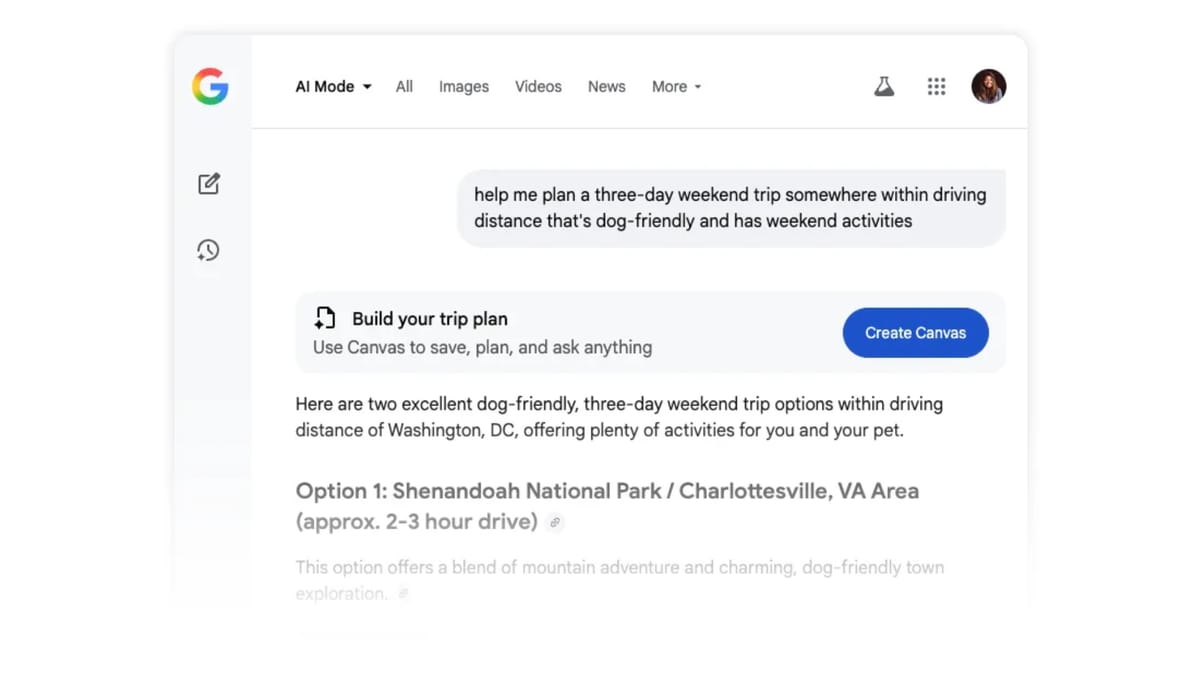
Google today detailed expanded capabilities for its Canvas tool within AI Mode, introducing comprehensive travel planning features designed to create personalized itineraries based on conversational inputs. The announcement from Molly McHugh-Johnson, Contributor at The Keyword, outlined six distinct approaches users can employ to plan trips through the artificial intelligence-powered interface.
The Canvas tool generates customized travel plans incorporating flight and hotel options alongside detailed daily schedules with restaurant recommendations, attractions, and activities. Users access the functionality by opting into the AI Mode experiment through Labs for cutting-edge features, then selecting "Create Canvas" after describing their trip requirements in AI Mode.
According to the announcement, Canvas creates a side panel workspace where travelers organize plans over extended periods. The system synthesizes real-time Search data for flights and hotels, information from Google Maps including photos and reviews, and relevant content from websites across the internet. Google expanded AI travel planning to 200+ countries with booking features in November 2025, bringing Canvas-based itinerary creation alongside global Flight Deals availability and agentic booking capabilities.
The announcement emphasized starting queries with "help me plan" to signal Canvas would provide optimal assistance. Users can describe trips comprehensively without specific formatting requirements, including details about travelers, desired activities, travel distances, and additional constraints. "The more information you provide, the more dialed in the suggestions will be," according to the announcement.
This conversational approach represents a fundamental departure from traditional search methodologies requiring specific parameters. Instead of selecting exact destinations and dates, travelers can describe trips naturally and receive suggestions matching their criteria. The system accommodates flexible planning scenarios where initial parameters may be uncertain or incomplete.
Canvas generates hotel comparisons based on pricing and amenities, restaurant suggestions, and activity ideas optimized by travel time from accommodations. Users can refine plans through follow-up questions addressing tradeoffs such as choosing hotels closer to specific activities or adjusting itineraries based on budget changes.
The iterative refinement capability addresses common travel planning challenges where initial preferences evolve during the research process. Traditional booking platforms typically require starting new searches when parameters change, while Canvas maintains conversation context and updates recommendations dynamically within the same workspace.
The Canvas interface updates in real-time as users provide additional information or modify existing parameters. According to the announcement, travelers can change their minds without restarting the planning process. For instance, users who initially specified budget travel can later indicate willingness to spend more, prompting Canvas to generate updated suggestions reflecting the new constraints.
The system allows reordering entire itineraries to match different paces or requesting comparisons between specific options for individual activities. This comparison functionality enables weighing pros and cons of different tours for the same attraction, ensuring each trip component aligns with traveler preferences.
Google's AI Mode expansion to over 40 countries and territories in October 2025 brought the feature to users across more than 200 countries total, incorporating sophisticated reasoning capabilities and diverse interaction methods through custom Gemini model architecture. The technical infrastructure employs query fan-out technique, dividing user questions into subtopics and searching for each component simultaneously across multiple data sources.
Travel planning workflows benefit particularly from this architecture because trip organization requires synthesizing information across numerous categories: transportation options, accommodation availability, dining recommendations, activity scheduling, and budget management. The system processes these parallel information streams and presents cohesive recommendations rather than forcing users to conduct separate searches for each component.
Buy ads on PPC Land. PPC Land has standard and native ad formats via major DSPs and ad platforms like Google Ads. Via an auction CPM, you can reach industry professionals.
Canvas accommodates scenarios where travelers already have portions of trips planned but need suggestions for remaining components. Users can share existing bookings or reservations and request Canvas generate recommendations for unplanned segments. According to the announcement, this approach works for situations like: "Help me plan the rest of my 5 day trip to Olympic National Park. I'm staying at the lodge on the coast and visiting in two weeks. Considering the weather and the time of year, give me an itinerary with a few hikes as well as nearby day trips to small towns with coffee shops and restaurants."
The system also integrates recommendations from other sources. When friends share suggestions from recent trips, users can provide those recommendations to Canvas and request incorporation into their own plans. This functionality bridges personal networks with artificial intelligence assistance, enabling travelers to leverage trusted advice while benefiting from comprehensive planning support.
The integration of external inputs demonstrates Canvas's flexibility beyond pure algorithmic recommendations. Travel planning frequently involves balancing algorithmic suggestions with personal preferences, trusted recommendations, and specific constraints that may not emerge through automated analysis alone.
Canvas accepts image uploads for travelers in early planning stages who want destinations matching specific aesthetics but lack concrete location preferences. Users tap the plus icon in the search box to upload images, then ask queries like "Help me plan a 10-day trip somewhere like this." According to the announcement, this option suits travelers who have saved images from the web or social media representing dream vacation aesthetics.
The multimodal capability extends beyond simple image recognition to understanding contextual elements within uploaded photos: architectural styles, landscape characteristics, climate indicators, cultural markers, and activity types visible in scenes. The system then matches these visual elements against global destination databases to identify locations sharing similar characteristics.
Google expanded multimodal capabilities in AI Mode in April 2025, building upon years of visual search development. Robby Stein, VP of Product at Google Search, explained that AI Mode "builds on our years of work on visual search and takes it a step further. With Gemini's multimodal capabilities, AI Mode can understand the entire scene in an image, including the context of how objects relate to one another and their unique materials, colors, shapes and arrangements."
This visual understanding enables matching vacation aesthetics rather than requiring travelers to articulate preferences through text descriptions. Someone attracted to Mediterranean coastal villages can upload representative images rather than specifying architectural styles, color palettes, or geographic characteristics through keywords.
Travel planning rarely occurs in single sessions. Canvas saves itineraries through AI Mode history, enabling users to resume work without starting from scratch. According to the announcement, users open AI Mode history by selecting the clock icon on the left side of the interface, then selecting the corresponding thread to continue previous planning sessions.
The persistence functionality addresses practical realities of vacation planning, which typically spans weeks or months as travelers research options, compare prices, coordinate with travel companions, and wait for optimal booking windows. Traditional search interfaces lose context between sessions, requiring users to reconstruct their research history and remember previously evaluated options.
Canvas maintains all conversation history, generated recommendations, refinements made through follow-up questions, and any notes or preferences specified during earlier sessions. This continuity enables more sophisticated planning over extended periods, where initial broad explorations gradually narrow toward specific bookings as travel dates approach.
Canvas generates public links for sharing itineraries with travel companions or others requiring updates about plans. Users click the share button to create links, which can be deleted at any time. According to the announcement, recipients can hit "Customize Canvas" to modify itineraries and send revised versions back to original creators, facilitating collaboration.
The sharing functionality also enables accessing past trip itineraries from history to share recommendations with others planning similar destinations. The announcement included an example of a winter Scandinavian trip created in Canvas that could be shared as reference material.
Collaborative features address group travel coordination challenges where multiple stakeholders need visibility into plans and ability to suggest modifications. Traditional travel planning often involves fragmented communication across email, messaging apps, and shared documents, with no centralized location for viewing current itinerary status or proposed changes.
Canvas centralizes this coordination within a single interface while maintaining flexibility for individual customization. Each collaborator can experiment with alternatives, propose modifications, and share their versions without overwriting others' work until consensus emerges around final plans.
The Canvas system integrates several Google product lines to deliver comprehensive travel planning. Google Flights provides baseline flight search infrastructure, Google Maps contributes location data and reviews, and AI Mode supplies the conversational interface and agentic capabilities. According to Google's November 2025 announcement about global travel tool expansions, this integration enables comprehensive planning from initial inspiration through booking completion.
The convergence represents a significant architectural shift from siloed product experiences toward unified workflows. Previously, travelers navigated between separate interfaces for flights, hotels, maps, and activity research, manually coordinating information across disconnected systems. Canvas synthesizes these data sources within conversational contexts, reducing cognitive overhead and enabling more nuanced tradeoff evaluations.
Google's AI Mode now counts toward Search Console totals as of June 2025, with clicks, impressions, and position data integrating into performance reports. The tracking methodology treats each AI Mode element with individual position calculations while aggregating all data under the Web Search category.
The technical implementation affects how travel businesses monitor traffic from Canvas-generated recommendations. Clicking any link to external pages within AI Mode registers as a click in Search Console, with standard impression rules applying when content appears in responses. Position calculations follow traditional search result methodology, with each component receiving its own ranking based on placement within AI-generated responses.
Traditional travel advertising through Google Ads continues operating separately from Canvas consumer-facing features. However, the integration creates competitive pressure for online travel agencies and booking platforms by reducing friction in search and discovery phases. Canvas may capture user attention earlier in planning processes, though maintained connections to existing booking systems preserve partnerships with airline and travel industry stakeholders rather than creating closed ecosystems.
Travel Feeds in Search Ads expanded to all hotel advertisers globally in October 2024, enabling comprehensive hotel data display including real-time prices, availability dates, ratings, and images within search advertisements. This expansion occurred independently of Canvas development but operates within the broader ecosystem where Canvas directs users toward booking decisions.
The advertising implications extend beyond direct booking platforms to destination marketing organizations, tour operators, activity providers, and hospitality businesses. Canvas recommendations draw from web content and Google Maps reviews, creating optimization opportunities for businesses seeking visibility within AI-generated travel suggestions.
Google's 65% surge in visual searches as AI Mode drives multimodal adoption demonstrates growing user preference for image-based discovery. The July 2025 report indicated multimodal functionality has become particularly popular among younger users who naturally transition between different input methods, with shopping and educational queries driving much of the growth.
Canvas's image upload functionality for destination discovery aligns with these behavioral patterns. Travelers photograph clothing worn by influencers to "shop the look" or capture geometry problems to receive step-by-step assistance, demonstrating how visual search extends beyond simple object identification to complex problem-solving scenarios.
The announcement did not disclose specific data handling procedures for Canvas file uploads or itinerary storage. Users participating in Labs experiments should understand that experimental features may involve different privacy protections compared to standard Google Search functionality. Canvas requires users to opt into the AI Mode experiment, limiting availability to those actively choosing experimental features.
Privacy concerns extend beyond data storage to how Canvas processes uploaded images, conversation histories, and booking preferences. The system maintains persistent records of all planning activities through AI Mode history, raising questions about data retention policies and whether this information informs broader advertising targeting or product recommendations.
Flight Deals operates exclusively for signed-in users according to November 2025 announcements, providing data collection opportunities while managing system load. Canvas functionality similarly requires AI Mode opt-in, creating gated access that enables Google to monitor adoption patterns and user feedback during experimental phases.
Canvas represents Google's response to growing competition from conversational AI platforms offering travel planning assistance. Microsoft, OpenAI, and other technology companies have developed alternative AI search platforms, creating pressure for Google to demonstrate clear technological advantages through features like Canvas that leverage existing product integrations unavailable to competitors.
Google executives hinted at unified AI search interface in November 2025, with Tom Critchlow, EVP of Audience Growth at Raptive, predicting Google would "do something radical early next year, something that looks like merging AI Mode and AI Overviews and Web Guide together." His speculation came one week after Alphabet's third quarter earnings call disclosed that AI Mode reached over 75 million daily active users following global rollout.
CEO Sundar Pichai described AI as driving "an expansionary moment for Search" during the October 2025 earnings call. "As people learn what they can do with our new AI experiences, they are increasingly coming back to search more," he stated, with company data showing AI Overviews drive meaningful query growth with effects becoming "even stronger in Q3 as users continue to learn that Google can answer more of their questions."
The strategic context positions Canvas as part of broader efforts to retain search market leadership through AI innovation. Traditional search interfaces face disruption from conversational alternatives that provide direct answers rather than lists of links, forcing Google to evolve its core products or risk losing users to more sophisticated AI-powered platforms.
Google reported users "diving deeper into complex topics and asking questions nearly three times longer than traditional searches" when engaging with AI Mode. The extended query length reflects conversational nature accommodating multi-part questions that previously required multiple separate searches. The system relies on Google Search's comprehensive understanding of web information, with responses drawing from high-quality content to improve factuality.
In situations where Canvas lacks sufficient confidence in response quality or helpfulness, the system provides sets of web links rather than generating AI-powered answers. This design acknowledges limitations inherent in early-stage AI products that don't always produce accurate results, particularly for niche destinations or highly specific travel requirements.
The behavioral data indicates fundamental shifts in user expectations and interaction patterns. Traditional SEO approaches focused on ranking individual pages become less relevant as AI systems synthesize information from multiple sources to generate comprehensive responses. Content creators must now optimize for inclusion within AI-generated summaries rather than solely pursuing top organic rankings.
Travel businesses face particular adaptation requirements because trip planning involves extended research phases spanning multiple sessions. Canvas's persistence and collaborative features enable more sophisticated planning workflows that may reduce direct website traffic while increasing booking conversion rates for businesses successfully incorporated into AI recommendations.
Canvas operates exclusively through desktop interfaces for users in the United States who have opted into the AI Mode experiment. The desktop-only limitation reflects technical complexity of displaying side-panel workspaces alongside conversational interfaces, though mobile implementations may follow as the feature matures beyond experimental status.
Users must be signed into Google accounts and be 18 years or older to access AI Mode. For enhanced personalization capabilities, users must enable Web & App Activity settings. Without this setting activated, AI Mode remains accessible but cannot reference previous searches or provide personalized suggestions based on past interactions.
Workspace users with Search and Assistant disabled face additional restrictions, as Search history becomes unavailable unless administrators enable these settings through organizational controls. These requirements create friction for some user segments while enabling Google to deliver more contextually relevant recommendations through historical data analysis.
The technical architecture demonstrates tension between personalization benefits requiring extensive data collection and privacy concerns limiting information sharing. Canvas's effectiveness improves with more user data about preferences, past searches, and interaction patterns, creating incentives for broader data access while raising questions about surveillance and commercialization of personal information.
According to Google's November 2025 announcement, Canvas travel planning, Flight Deals, and agentic booking capabilities will receive ongoing updates based on user feedback and technical refinements during experimental phases. The development trajectory suggests continued feature expansion as the company evaluates adoption patterns and identifies optimization opportunities.
The experimental status indicates Google views Canvas as still maturing rather than production-ready for general availability. This approach enables rapid iteration based on user feedback while managing expectations about stability and feature completeness. Historical precedent from other Google products suggests experimental phases lasting months or years before graduation to standard product offerings.
Future developments likely include mobile implementations, additional destination coverage, enhanced booking integrations, and refined recommendation algorithms based on user behavior analysis. The system's reliance on conversational interfaces and multimodal inputs creates opportunities for voice-based planning through smart home devices or automotive integration for road trip planning.
Google's systematic AI Mode deployment began with Search Labs experimental program in March 2025, targeting United States users with Google One AI Premium subscriptions. Broader US access began in May 2025, with international expansion commencing through India's deployment in June 2025 and United Kingdom access in July 2025.
This phased rollout strategy enables Google to refine features incrementally while gathering usage data across diverse markets. Each expansion provides feedback about localization requirements, infrastructure scaling needs, and market-specific optimization opportunities that inform subsequent deployments.
Marketing professionals express concern about traffic implications from AI-powered planning tools. Research from PPC Land shows AI search visitors demonstrate 4.4 times higher conversion value compared to traditional organic search visitors, though overall traffic volumes may decline as users receive answers directly from AI-generated summaries without visiting websites.
The measurement challenges extend to attribution and campaign optimization. Canvas recommendations synthesize information from multiple sources without clear attribution to individual websites, making it difficult for travel businesses to evaluate return on investment from content creation and SEO efforts.
Traditional SEO practices remain effective for AI-powered search features despite industry proposing new optimization acronyms. Content quality, comprehensive information, and authoritative sourcing continue driving inclusion in AI-generated responses, though optimization approaches must evolve to accommodate AI consumption patterns.
The strategic imperative for travel businesses involves balancing investment between traditional search optimization and AI-focused content strategies. Canvas's synthesis capabilities reward comprehensive, well-structured information that AI systems can parse and incorporate into recommendations, potentially favoring larger platforms with extensive content libraries over smaller specialized operators.
The announcement marks the latest development in Google's comprehensive expansion of AI-powered search capabilities throughout 2025. The company has systematically deployed AI Mode features across global markets, introduced multimodal search capabilities, and integrated conversational interfaces into existing products like Circle to Search.
Subscribe PPC Land newsletter ✉️ for similar stories like this one
Subscribe PPC Land newsletter ✉️ for similar stories like this one
Who: Google announced the Canvas travel planning features through Molly McHugh-Johnson, Contributor at The Keyword, affecting travelers planning vacations and marketing professionals in the travel industry monitoring traffic implications from AI-powered search tools.
What: Google detailed six distinct approaches for using Canvas within AI Mode to create personalized travel itineraries including conversational planning with "help me plan" queries, dynamic itinerary updates through follow-up questions, partial trip planning accepting external recommendations, image-based destination discovery, session persistence enabling planning across multiple timeframes, and collaborative features through shareable itineraries.
When: Google announced the Canvas travel planning capabilities on January 14, 2026, building upon the feature's initial introduction in July 2025 for study planning and subsequent expansion to travel planning in November 2025 when Canvas reached global availability across more than 200 countries.
Where: Canvas operates exclusively through desktop interfaces for users in the United States who have opted into the AI Mode experiment through Labs, though the underlying AI Mode infrastructure has expanded to over 40 countries and territories globally with support for more than 35 languages.
Why: Google developed Canvas travel planning to provide comprehensive trip organization through artificial intelligence rather than forcing users to conduct separate searches across multiple platforms for flights, hotels, restaurants, and activities, addressing common vacation planning challenges while competing against conversational AI platforms from Microsoft, OpenAI, and other technology companies offering travel assistance.