


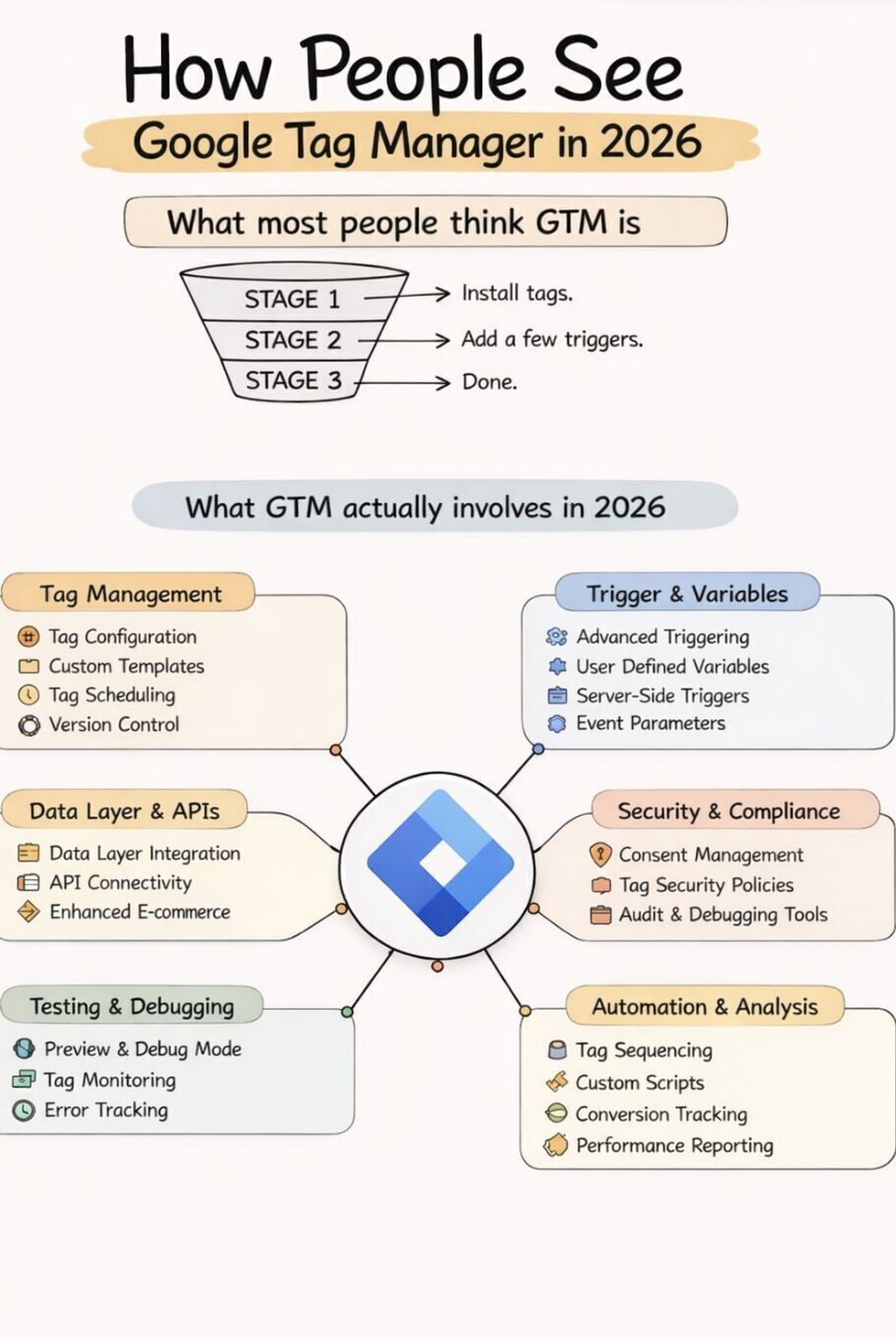
A widely shared graphic circulating in marketing communities today captures a gap that practitioners have long felt but rarely seen stated so plainly. Most people believe Google Tag Manager involves three steps: install tags, add a few triggers, done. What it actually involves in 2026, according to Google's own support documentation, is an interconnected platform spanning six distinct functional domains - each with its own sub-components, technical dependencies, and compliance requirements.
The image, which maps the full scope of GTM across Tag Management, Trigger and Variables, Data Layer and APIs, Security and Compliance, Testing and Debugging, and Automation and Analysis, is not describing a new product. It is describing the current state of a tool that many organisations still treat as a simple tag wrapper. The gap between perception and reality has grown wider with every major GTM update over the past two years.
Tag Management is not just configuration
The first domain - Tag Management - covers four components: Tag Configuration, Custom Templates, Tag Scheduling, and Version Control. Tag Configuration is the entry point most practitioners recognise, but the others carry material operational weight. Custom Templates, accessible through the Community Template Gallery, allow teams to deploy pre-built tag logic without writing raw JavaScript. The Gallery, which serves over 400,000 professional developers and teams globally, underwent a significant expansion in June 2025 when Google officially approved the Ahrefs Web Analytics (Unofficial) Tag Template for direct access through GTM containers.
Tag Scheduling allows tags to fire within defined time windows, enabling campaigns tied to specific promotional periods without requiring manual activation. Version Control - perhaps the most underappreciated component - means that every published change creates a new, named version of the container. According to Google's support documentation, this versioning structure also incorporates the Workspace paradigm, which lets teams make and test changes in isolation before pushing them live. For organisations managing multiple properties, that separation prevents a configuration change on one site from inadvertently breaking another.
Triggers go beyond page views
The Trigger and Variables domain encompasses Advanced Triggering, User Defined Variables, Server-Side Triggers, and Event Parameters. Basic GTM use typically involves page view and click triggers. Advanced Triggering extends this to scroll depth, element visibility, timer events, history changes, and JavaScript error states. Built-in variables handle standard scenarios - Click Element captures what was clicked, Scroll Depth Threshold measures how far a user has scrolled, Form ID identifies which form fired a submission event. User-defined variables add another layer, enabling custom JavaScript, lookup tables, and regular expression matching for tracking scenarios that fall outside standard patterns.
Server-Side Triggers represent a more recent and technically demanding addition. Rather than executing tag logic in the browser, server-side GTM containers run on cloud infrastructure, allowing data transformation, enrichment, and governance before signals reach Google or any other measurement endpoint. Two critical bugs documented in September 2025 illustrated the operational risk. A service worker communication error between gtag and server-side GTM containers was creating duplicate GA4 hits. Digital analytics specialist Giovani Ortolani Barbosa found that gtag was sending the suppressSuccessCallback = true parameter to the service worker, preventing proper acknowledgment and causing event duplication on all pages where the service worker had already loaded and registered.
The March 4, 2025 GTM release notes had confirmed that the Google tag began using service workers to send data to server-side containers, with the stated aim of improving performance and measurement reliability. The September 2025 bug exposed the fragility introduced by that architectural change.
Data Layer and APIs: the hidden backbone
The Data Layer and APIs domain covers Data Layer Integration, API Connectivity, and Enhanced E-commerce. The data layer is a JavaScript object that acts as an intermediary between a website's code and GTM, allowing developers to push structured data - transaction IDs, product names, user types, page categories - into the tag management environment without hardcoding values into individual tags.
API Connectivity extends GTM beyond the browser entirely. On August 1, 2025, Google introduced the readAnalyticsStorage sandbox API, a client-side JavaScript API that allows developers to read Google Analytics client and session IDs within custom templates. According to Google's release notes, the API replaced a situation where developers had been relying on reverse-engineering and custom cookie parsers - described by some practitioners as "highly suspicious spaghetti code" - to extract the same identifiers. The official API provides a stable, supported access path that does not break when Google changes its storage format.
Enhanced E-commerce is a structured schema within the data layer for tracking product impressions, clicks, add-to-cart events, checkout steps, and transactions. It requires consistent data layer pushes across every relevant page type. Gaps in that implementation - a missing product ID field on the category page, a malformed transaction object at purchase confirmation - produce incomplete attribution data that cascades into reporting inaccuracies and bidding signal degradation.
Security and Compliance: the domain that carries the most legal risk
The Security and Compliance domain - covering Consent Management, Tag Security Policies, and Audit and Debugging Tools - has become the most legally consequential area of GTM operation in the European market. A March 2025 ruling from the Verwaltungsgericht Hannover determined that Google Tag Manager itself cannot operate before explicit user consent has been obtained. The court's technical analysis found that GTM was transmitting user device data, including IP addresses, to US servers before any consent interaction occurred. That finding has prompted a number of digital marketing teams to reconsider how they sequence tag loading entirely.
The compliance picture grew more complex through 2025 and into 2026. In August 2024, Google introduced a Consent Mode Override Setting directly within GTM, allowing administrators to set a default denied consent state for chosen regions. In July 2025, Google enforced Consent Mode V2 requirements across UK and EEA advertisers - and accounts with visible, legally compliant consent banners that were not properly wired to the Google tag layer began losing attribution data permanently. Mike Teasdale, Founder and Planning Director at Harvest Digital, documented a case where a client's Google Ads conversions dropped 90% overnight with no changes to campaigns, budgets, or bidding. The root cause was a consent banner that was collecting user choices without passing the required ad_user_data and ad_personalization parameters back to Google's measurement infrastructure.
Recovery was partial. Once the signal connection was repaired, roughly 40% of the attribution data that had been invisible during the non-compliant period could be recovered. The rest was permanently lost.
Tag Security Policies govern which third-party scripts can load within a GTM container. Organisations implementing strict policies can restrict the types of tags permitted, reducing the risk of unauthorised data collection through the tag management layer. Audit and Debugging Tools complete this domain - with the unified Tag Assistant, released in December 2024 as version 24.351.13.37 after Google reversed an earlier deprecation decision, providing consent state monitoring and pop-up window debugging alongside standard tag verification. According to the Chrome Web Store documentation, the extension had already surpassed 2,000,000 users at the time of the unified release.
A further change taking effect on June 15, 2026 removes Google Signals from its role as a co-controller of advertising data, consolidating ad data authority under Consent Mode settings managed within Google Ads. For any organisation with a Google Analytics property linked to a Google Ads account - a standard configuration across digital advertising - the rules about which system controls what are changing materially. The Consent Management Platform output, specifically whether it grants or denies ad_storage and ad_personalization signals, becomes the sole governing factor.
Testing and Debugging: not optional at scale
The Testing and Debugging domain encompasses Preview and Debug Mode, Tag Monitoring, and Error Tracking. Preview Mode allows a container's changes to be tested in a live browser environment before publication, with a real-time event stream showing which tags fired, which triggers activated them, and what variable values were present at the moment of firing.
Tag Monitoring has grown in sophistication. The container quality status bar, introduced in mid-2024, provides an overview of the container's health categorised into four severity levels: Excellent, Good, Needs Attention, and Urgent. It checks for specific structural issues including additional domains that are not configured for cross-domain tracking. In October 2024, Google added two new diagnostics to the Tag Diagnostics tool - one alerting when the Google tag has stopped transmitting data within the previous 48 hours, and another flagging when tags are positioned too far down the page to fire reliably. Tag placement influences both load time and signal integrity; a tag that sits below a large content block may not activate before a user leaves.
Error Tracking logs JavaScript errors that occur during tag execution, enabling teams to identify broken implementations before they produce measurement gaps of the kind that caused the attribution collapses documented in 2025.
Automation and Analysis: four components most practitioners ignore
The Automation and Analysis domain - Tag Sequencing, Custom Scripts, Conversion Tracking, and Performance Reporting - is where GTM's operational depth becomes most visible to practitioners who have moved beyond basic setup.
Tag Sequencing allows administrators to define firing order dependencies. A tag can be configured to fire only after another specified tag has completed. This is particularly relevant for consent management workflows - a tag that depends on a consent signal being present needs a guarantee that the consent layer has executed before it attempts to fire. The Consent Initialization trigger, introduced in GTM as a distinct trigger type, addresses this at the container level by allowing tags to deploy a consent banner as the first event on page load, before any other tags in the container run.
Custom Scripts allow teams to execute arbitrary JavaScript within the GTM sandbox, enabling integrations with platforms that do not have native GTM templates. Conversion Tracking in 2026 sits within a broader measurement consolidation. As of April 2026, Google Ads began simultaneously accepting user-provided data from three distinct sources - website tags (including GTM implementations), Data Manager, and API connections - removing the previous requirement to select a single implementation method. Enhanced conversions for web and for leads are also merging into a single toggle starting June 2026, eliminating the structural split that had existed since Google launched enhanced conversions for leads in 2022.
Performance Reporting closes the loop. Tag execution speed affects page load performance directly. Tags that fire synchronously in the document head can block rendering; poorly sequenced tags that request large external scripts add measurable latency. For organisations running dozens of active tags across high-traffic properties, the cumulative performance cost of an unoptimised container is not theoretical.
First-party infrastructure: the new layer underneath all of this
Running underneath the six domains depicted in the graphic is a structural change that the image does not fully capture: the movement of tag delivery infrastructure toward first-party domains. In May 2025, Google launched the tag gateway at general availability, routing Google tags through advertisers' own servers. By January 2026, a Google Cloud Platform integration extended the tag gateway with automated External Application Load Balancer configuration. In January 2026, Akamai became the third major CDN partner for tag gateway, following Cloudflare's integration at the May 2025 general availability launch.
The architectural distinction between tag gateway and server-side GTM matters. Tag gateway routes measurement through first-party infrastructure but keeps tag execution in the browser. Server-side GTM moves execution to the cloud entirely. The two serve different use cases and carry different implementation costs. Tag gateway automates through one-click setup; full server-side deployment requires sustained technical investment. Neither approach removes the consent obligations that the March 2025 German court ruling clarified.
The image shared today maps a platform that has accumulated years of new features, regulatory responses, and infrastructure upgrades. For the large share of practitioners still treating GTM as a three-step process, the gap between that mental model and the operational reality now has measurable consequences - in attribution accuracy, compliance exposure, and measurement infrastructure resilience.
Timeline
- July 2021 - Google introduces the Consent Initialization trigger type in Tag Manager, enabling consent banners to fire before all other tags in a container
- September 2020 - Google launches Consent Mode as a beta for European advertisers
- December 2023 - Google updates Consent Mode with two new parameters - ad_user_data and ad_personalization - creating Consent Mode V2
- June 2024 - Google introduces the container quality status bar in GTM with four severity levels: Excellent, Good, Needs Attention, and Urgent (PPC Land coverage)
- August 2024 - Google introduces the Consent Mode Override Setting in GTM, allowing default denied states by region (PPC Land coverage)
- October 9, 2024 - Google launches First-party Mode beta for GTM with Cloudflare integration (PPC Land coverage)
- October 2024 - Google adds two new diagnostics to the Tag Diagnostics tool, covering data transmission gaps and tag placement issues (PPC Land coverage)
- December 2024 - Google reverses deprecation of Tag Assistant and unifies Legacy and Companion into a single Chrome extension at version 24.351.13.37 (PPC Land coverage)
- March 4, 2025 - GTM release notes confirm Google tag starts using service workers to send data to server-side containers
- March 19, 2025 - German court (Verwaltungsgericht Hannover) rules GTM cannot operate before explicit user consent under GDPR and TTDSG
- June 6, 2025 - Google integrates Tag Diagnostics into the Google Analytics consent settings hub (PPC Land coverage)
- June 24, 2025 - Google Tag Manager team officially approves the Ahrefs Web Analytics (Unofficial) Tag Template for the Community Template Gallery (PPC Land coverage)
- July 2025 - Google enforces Consent Mode V2 requirements across UK and EEA advertisers, beginning account-level enforcement for non-compliant implementations (PPC Land coverage)
- August 1, 2025 - Google announces the readAnalyticsStorage sandbox API, providing officially supported access to GA client and session IDs in custom templates (PPC Land coverage)
- August 13, 2025 - Luc Nugteren releases the "Restore GCLID" GTM template addressing Safari URL parameter stripping
- September 2025 - Duplicate GA4 hit bugs in server-side GTM documented by Matteo Zambon and Giovani Ortolani Barbosa (PPC Land coverage)
- January 5, 2026 - Google launches GCP External Application Load Balancer integration for tag gateway in beta (PPC Land coverage)
- January 29, 2026 - Google adds Akamai as the third CDN partner for tag gateway (PPC Land coverage)
- April 2026 - Google Ads begins accepting user-provided data simultaneously from tags, Data Manager, and API connections (PPC Land coverage)
- May 3, 2026 - Infographic circulates mapping the full operational scope of GTM in 2026 across six functional domains
- June 15, 2026 (upcoming) - Google removes Google Signals as co-controller of advertising data, consolidating authority under Consent Mode in Google Ads (PPC Land coverage)
- June 2026 (upcoming) - Enhanced conversions for web and leads merge into a single toggle in Google Ads; method selection screen removed (PPC Land coverage)
Summary
Who: Marketing practitioners, analytics engineers, and digital advertising teams using Google Tag Manager across web and server-side implementations.
What: An infographic published today maps the full operational scope of Google Tag Manager in 2026 across six domains - Tag Management, Trigger and Variables, Data Layer and APIs, Security and Compliance, Testing and Debugging, and Automation and Analysis - contrasting this with the common three-step perception (install tags, add triggers, done). The gap between the two pictures reflects years of platform expansion, privacy regulation responses, and first-party infrastructure development.
When: The infographic circulated on May 3, 2026, drawing on GTM capabilities and legal developments that have accumulated since at least 2021, with the most significant regulatory and infrastructure changes occurring between mid-2024 and early 2026.
Where: Google Tag Manager operates as a web-based tag management platform at tagmanager.google.com, documented at support.google.com/tagmanager. Its features span client-side browser execution, server-side cloud containers, CDN-level tag gateway infrastructure via Cloudflare, Google Cloud Platform, and Akamai, and API layers connecting to Google Analytics, Google Ads, and third-party platforms.
Why: The contrast between perceived and actual GTM complexity matters because the gap has direct consequences. Attribution data is permanently lost when consent signals are not properly wired to the tag layer. Service worker bugs create duplicate measurement events. First-party infrastructure requires active configuration choices. Court rulings in Germany have established that GTM itself requires consent before it can operate. Practitioners who treat GTM as a simple tag installer are likely running implementations that are non-compliant, incomplete, or both.


Discussion