


Google today published a guide summarising 42 lead generation-focused product launches tied to Google Marketing Live 2026, grouping them across conversational ad formats, bidding and budgeting tools, creative capabilities, brand controls, Demand Gen updates, and measurement infrastructure.
The document, authored by Ginny Marvin, Ads Product Liaison at Google, frames the set of announcements around a single diagnosis: most lead quality problems are not sales problems. According to Google, they are measurement, quality, and design problems. That framing runs through all 42 features, each of which is aimed at closing what the company describes as "the gap between a person in search of a solution and the business best positioned to serve them."
The breadth of what was announced today at Google Marketing Live 2026 is striking. It spans AI-powered conversational agents embedded inside search ads, an expanded set of intent signals, new creative tooling for Asset Studio, and a significantly restructured measurement layer that folds marketing mix modelling directly into Google Analytics 360.
Conversational formats and the changing shape of search ads
How people search has been shifting. According to Google, someone looking for a contractor specialising in historic home renovations, or a law firm with specific employment law expertise, is not simply looking for a link - they have questions. Several of the 42 launches address that directly.
Business Agent for Leads is the centrepiece of the conversational ad stack. The feature enables a real-time conversational exchange inside Search Ads, allowing prospective clients to ask specific questions about a business at any hour and receive accurate answers grounded in that business's website content. According to Google, the agent captures lead data even when a team is offline, filters for better prospects through interactive dialogue, and removes friction. The Business Agent for Leads format was announced alongside three other new search ad formats at GML 2026, each departing from the static text-and-headline structure that has defined search advertising for over two decades.
Message Ads with RCS for Business extend the click-to-message format into SMS outreach with rich, AI-driven experiences directly through iOS and Android. A Gemini-powered agent can respond in a personalised way to messages at scale, suggest actions, and send on-brand information. PPC Land has tracked the evolution of messaging-based ad formats since September 2025, when Google expanded message assets beyond WhatsApp to include additional platforms.
The click-to-call format has also been updated. Gemini can now determine whether a conversion happened on a call, automatically rule out misdials and low-intent calls, and trace each qualified call back to the specific campaign that drove it. PPC Land covered the AI-qualified call conversion feature when it was published in the Google Ads Help Center on April 21, 2026, noting that call duration had historically been an imperfect proxy for lead quality. The GML announcement represents a broader rollout of capabilities that were in limited availability just weeks ago.
Google is also testing Ads in AI Mode, surfaces that show verified details and relevant offers at the moment a user is working through a decision, while labelling them clearly as ads.
Building for lead quality, not just volume
A cluster of new features targets the quality of leads entering a pipeline, not just the quantity.
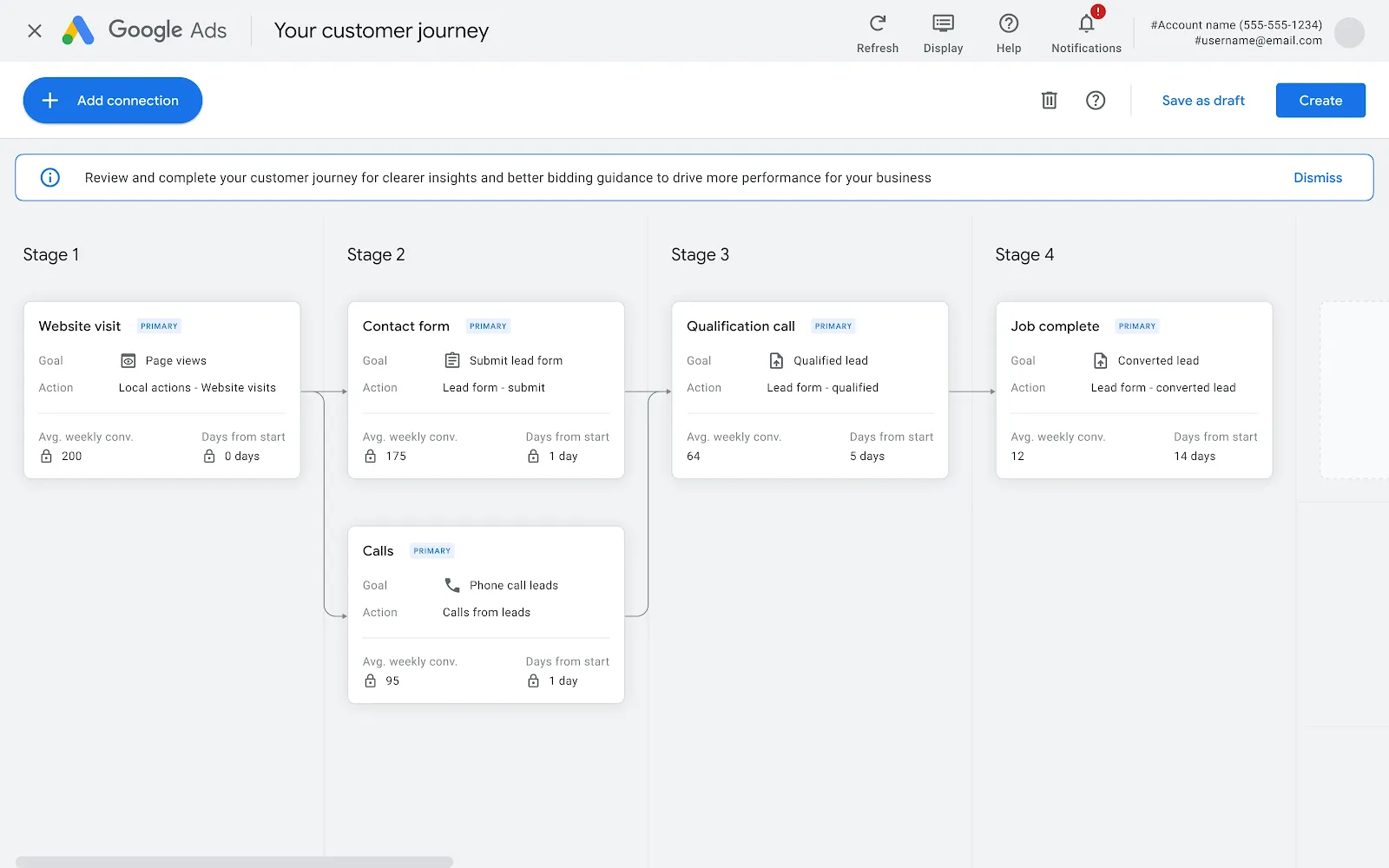
For small businesses, Leads in Google Ads will serve as a centralised command centre for managing Google-hosted form leads, providing sales teams with a lightweight built-in CRM. According to Google, the goal is ensuring no prospect falls through the cracks. Building on that, lead intent scores will surface which leads are most likely to close while filtering out spam and low-intent submissions. Lead journey mapping gives advertisers a visual picture of the full funnel, making it simpler to identify where leads are stalling.
Journey-aware bidding goes further. By sharing the full lead-to-sale journey with Google Ads, the bidding system learns from every goal along the path - not just the final conversion event. PPC Land first reported on journey-aware bidding in September 2025 when Google announced it at Think Week 2025, and covered the pre-GML update in May 2026 when the feature remained in beta without a general availability date.
Unified Enhanced Conversions brings web and lead conversion data into one framework using securely matched first-party data to recover conversions that would otherwise go unobserved. According to Google, this matters enormously in industries like automotive or finance, where someone may see an ad in January and take action in March.
Google also says it has upgraded its invalid activity filtering systems significantly. The company describes a transition to a more proactive filtering model that blocks invalid interactions faster and has raised the bar for what qualifies as an impression across its network.
Budgets that follow demand, not the calendar
Tax season, open enrolment, back-to-school: the cycles are predictable in shape but unpredictable in their moment-to-moment peaks. Demand-led budget pacing uses AI to follow interest in real time, capturing more volume on high-intent days and pulling back when demand dips, all while staying within monthly limits.
Campaign total budgets, which Google recently released, let advertisers set a fixed spend across a specific date range. According to Google, this is ideal for short-term promotions, new launches, or enrolment windows, removing the need for daily manual adjustments.
Smart Bidding Exploration is now available in both AI Max and Performance Max campaigns. It helps advertisers convert on search terms they are eligible to reach but are missing due to ROAS targets. By giving the system added bidding flexibility, advertisers can tap performance from a wider range of unique search categories and scale conversion volume while maintaining efficiency on queries already being reached.
The results cited in the document are notable. According to Google, banking institution BBVA used Smart Bidding Exploration with a 20% ROAS tolerance alongside AI Max and achieved a 155% surge in new high-quality leads while decreasing cost per lead by 3%. Guido Ekizian, Head of Acquisition at BBVA, is quoted directly: "The use of Smart Bidding Exploration with AI Max on Search campaigns was key to solving the problem of scaling efficiently and achieving our growth targets."
When paired with Value-Based Bidding, the Smart Bidding Exploration system is described as actively seeking top-tier prospects rather than simply increasing raw volume.
Asset Studio as a creative hub
According to Google, advertising creative drives nearly 49% of incremental sales - citing Circana and NCSolutions 2023 data - and remains the most critical driver of advertising effectiveness. The Asset Studio updates at GML 2026 are designed around that premise.
Multimodal capabilities in Asset Studio allow teams to generate creative by providing a URL, marketing brief, and goals. The system then transforms a single core concept into a library of tailored static ads built on performance data. Multimodal video creation, powered by Gemini, Veo, and Nano Banana, extends this to YouTube ad production. For businesses managing thousands of ads, asset generation in Google Ads API opens these capabilities programmatically. PPC Land's coverage of the Asset Studio updates noted that the global English rollout is planned for summer 2026.
One-click save and set experiment in Asset Studio turns any ad or asset group edit into a structured A/B test. Creative Capabilities in Ads Advisor deliver real-time diagnostics on individual asset performance and thematic coverage. Asset Optimisation and Insights for Demand Gen goes further still: Gemini proactively reviews creative and suggests improvements with one-click AI fixes.
For ingestion, new Asset Studio Ingestion capabilities accept PDF uploads of brand guidelines, pull existing assets from YouTube Studio, and connect to platforms like Adobe and Canva through third-party asset integration.
Brand control and compliance guardrails
For advertisers in sectors such as insurance, finance, or healthcare, automated optimisation cannot be the complete answer. Compliance requirements, legal reviews, and messaging standards exist for substantive reasons. Several of the 42 launches address that gap.
AI Brief is a new way to steer AI Max campaigns using an advertiser's own words. Through messaging guidelines, matching guidelines, and audience guidelines, an advertiser can instruct Google's AI on what ads should and should not say, which searches to pursue or avoid, and how to tailor messaging for specific audiences. According to Google, this is nuance that AI previously could not receive, now expressed in natural language.
Text disclaimers guarantee that required text always appears, even with final URL expansion enabled. Previously, including specific required text in ads meant disabling final URL expansion. The two features were mutually exclusive. That is no longer the case.
Demand Gen expands into Google Maps and new measurement tools
Demand Gen campaigns, which have been evolving steadily since absorbing YouTube Video Action campaigns in early 2025, are getting a meaningful surface expansion at GML 2026.
Google is now expanding Demand Gen into Google Maps, using non-disruptive formats like Promoted Pins. The placement targets users mid-navigation or during place discovery. According to Google, the intent is to reach high-intent users while they are actively navigating or exploring locally.
Creator partnerships boost lets advertisers turn organic creator content into ads. A new creator videos in asset pickerfeature surfaces relevant creator videos directly, reducing the effort of finding suitable partners.
The credit reporting agency Experian's case study is highlighted in Google's materials. According to Google, Experian paired brand ads with creator content on YouTube Shorts and saw 3x the watch time, 2x the interaction rate, and a 33% increase in conversions. Bryan Johnson, Digital Marketing Specialist at Experian, is quoted: "We saw meaningful impact across the funnel - from awareness to conversions. This experiment proves that native, engaging creative truly drives performance."
AI-assisted campaign creation for Demand Gen can now auto-populate settings based on existing Performance Max campaigns, accelerating the setup process.
On measurement, Campaign Type Attribution captures both immediate and downstream conversions for Demand Gen independently of other campaigns. Uplift Experiments allow advertisers to isolate the incremental value of their Demand Gen investment.
A restructured measurement layer
The measurement announcements are among the most structurally significant in the full set of 42. PPC Land covered the Meridian-into-Analytics-360 integration in detail on May 20, 2026, describing it as the most significant structural change to how Google's tools handle cross-channel performance data since Meridian became globally available in January 2025.
Two new signals are central to the measurement story. Attributed Branded Searches (ABS) prove the direct link between customers seeing or engaging with an ad and subsequently searching for a brand. According to Google, it is the clearest signal that an ad created intent. Qualified future conversions analyse key actions - follow-up searches, video views, site visits - and use AI to connect these signals to future sales, with prediction windows extending up to six months in advance. Google describes this as its most powerful ad effectiveness metric yet.
Both signals feed into Meridian, Google's open-source Marketing Mix Model, which is being integrated directly into Google Analytics 360. The integration removes the need for separate data science work. In a few clicks, advertisers can unify data from Google, Meta, and TikTok with first-party insights from Snowflake, Oracle, and BigQuery. Meridian GeoX, an open-source geo incrementality solution, enables testing of multiple tactics against a common control.
A Scenario Planner in Google Analytics 360 is being launched, natively powered by Meridian. It connects to Ask Advisor in Google Analytics, an agentic experience that functions as a personal data analyst, answering complex questions through natural conversation, generating visualisations on demand, and surfacing hidden opportunities.
Cross-channel planning and budgeting in Google Analytics automatically refines data from MMMs, platform-level attributed conversions, and external lift tests into one view of ad performance.
Google Tag Gateway routes conversion data through an advertiser's own server, improving accuracy and security, with confidential computing built in by default. Upgrading requires no changes to existing code.
Data Manager now includes new direct data integrations with Mailchimp, ActiveCampaign, Klaviyo, and Google Drive. Partners enabling connections via the Data Manager API include Adswerve, Bloomreach, Datahash, Treasure Data, TripleWhale, Scowt, Stape, Zapier, and Zeotap. According to Google, advertisers connecting offline and app data using Data Manager see a 26% average increase in incremental ROAS. Map View in Data Manager gives a visual audit of where data is being deployed across campaigns.
App strategy tools
For advertisers with apps, Deep Link AI Agent automates the technical implementation of in-app deep links, reducing what was previously a multi-day engineering task to minutes. App Connect in Ask Advisor brings agentic guidance to the full web-and-app journey, helping fix misconfigured deep links and optimise measurement without requiring a specialist on staff.
Ask Advisor as the 42nd launch
The final launch in the set is positioned as the connective tissue for all the others. Ask Advisor is described as an end-to-end agentic partner that can support advertisers through the full Google marketing ecosystem - creating campaigns, implementing bid and budget recommendations in one click, troubleshooting policy issues, and explaining the reasoning behind performance.
According to Google, execution alone will no longer be a differentiator because every advertiser will be able to leverage the same AI-powered tools. What will make a difference, according to the document, is the quality of signals shared, the depth of brand context, and the clarity of strategy.
Timeline
- September 2025 - Google announces Journey-Aware Bidding at Think Week 2025 for lead generation campaigns, with closed pilot testing scheduled for later that year (PPC Land)
- September 30, 2025 - Google introduces message asset verification requirements, with enforcement beginning October 30, 2025 (PPC Land)
- November 6, 2025 - Google Ads Editor 2.11 introduces Smart Bidding Exploration as an opt-in feature for Search campaigns (PPC Land)
- January 15, 2026 - Google expands campaign total budgets to Search, Performance Max, and Shopping campaigns globally in open beta (PPC Land)
- February 2026 - Google ends call-only ads, shifting advertisers to responsive search ads with call assets (PPC Land)
- March 23, 2026 - Google NewFront 2026 introduces the Gemini advantage across Google Marketing Platform, including Ads Advisor for all users (PPC Land)
- April 21, 2026 - Google publishes AI-qualified call conversions in the Google Ads Help Center, replacing call duration as the primary conversion signal (PPC Land)
- April 22, 2026 - Google Ads API v24 releases with nine new lead gen conversion types and cart data sales view (PPC Land)
- May 5, 2026 - Google publishes pre-GML measurement updates covering Data Manager Map View, Meridian GeoX, and Meridian Studio (PPC Land)
- May 19, 2026 - Google I/O 2026 previews AI Mode changes one day before GML 2026 (PPC Land)
- May 20, 2026 - Google Marketing Live 2026 takes place, livestreamed from Bay View campus in Mountain View to more than 100 countries (PPC Land full recap)
- May 20, 2026 - Google unveils four new AI search ad formats including Business Agent for Leads (PPC Land)
- May 20, 2026 - Meridian integrated into Google Analytics 360; Qualified Future Conversions announced (PPC Land)
- May 20, 2026 - Demand Gen expands into Google Maps with Promoted Pins format; automotive feeds and AI-assisted campaign creation announced (PPC Land)
- May 20, 2026 - Asset Studio updated with Gemini Omni integration and 1-click creative testing; global English rollout planned for summer 2026 (PPC Land)
- May 21, 2026 - Ginny Marvin, Ads Product Liaison at Google, publishes "42 Launches Redefining Lead Generation" on business.google.com, grouping the GML 2026 announcements into a lead-gen-focused framework
Summary
Who: Google, specifically Ginny Marvin (Ads Product Liaison), authored the document grouping 42 lead generation-focused launches. The features affect lead gen advertisers, B2B marketers, agencies, and service-sector businesses using Google Ads, YouTube Ads, and Google Analytics.
What: A set of 42 product launches and updates spanning conversational ad formats (Business Agent for Leads, Message Ads with RCS), bidding tools (journey-aware bidding, Smart Bidding Exploration, demand-led budget pacing), creative capabilities (Asset Studio multimodal generation, AI Brief), Demand Gen expansion to Google Maps, and a restructured measurement layer integrating Meridian directly into Google Analytics 360, alongside new signals including Attributed Branded Searches and Qualified Future Conversions.
When: The launches were announced on May 20, 2026 at Google Marketing Live 2026, with the comprehensive summary document published by Ginny Marvin on May 21, 2026 on business.google.com.
Where: Google Marketing Live 2026 was livestreamed from Google's Bay View campus in Mountain View, California, to more than 100 countries. A parallel GML EMEA event was held in Dublin, with 13 APAC city events scheduled for summer 2026.
Why: According to Google, the core challenge the 42 launches address is that lead quality problems are fundamentally measurement, quality, and design problems - not sales problems. The features collectively aim to close the gap between high-intent users and the businesses best positioned to serve them, with an emphasis on qualifying leads earlier, pacing budgets to actual demand, enabling more brand-controlled creative at scale, and connecting ad investment to downstream business outcomes through improved measurement infrastructure.


Discussion