


Google today extended its Gemini-powered Explore page in Google Trends to the mobile web, completing a rollout that began with a desktop-only launch in January 2026. The new interface, accessible at trends.google.com/explore from any mobile browser, brings AI-assisted search term discovery and trend analysis to smartphones and tablets for the first time.
The announcement was confirmed by Nir Kalush, Lead Product Manager for Google Trends, in a post on LinkedIn. According to Kalush, users can now "explore trends on google with Gemini on the go" by navigating to trends.google.com/explore from a mobile device while signed in to a Google account. The Google News Initiative, which has 68,680 followers on LinkedIn, shared the same news separately, framing the update as a development particularly relevant to journalists working in the field. According to Google News Initiative's post, "the new Gemini-powered capabilities of the redesigned Explore page are now available on the mobile web."
From desktop to pocket
The Gemini integration into the Google Trends Explore page was first introduced on January 14, 2026, in a desktop rollout covered by PPC Land. At the time, Google deployed a side panel that automatically generated up to eight relevant search terms based on a user's stated area of interest, removing the need for manual discovery. The desktop update also doubled the number of rising queries shown on each timeline and introduced dedicated icons and colors for each search term to improve readability when multiple trend lines overlapped.
Mobile availability was not addressed in that January announcement. The extension to mobile web now closes that gap, meaning a researcher or reporter on the move can open a browser on a smartphone, navigate to the Explore URL, sign in, and immediately access Gemini-powered term suggestions without needing a desktop computer or a native app.
The interface retains the same filter structure seen on desktop: users can set a geographic scope (from worldwide down to country level), a time range, and a search category. The classic version of the Explore page remains accessible via a toggle labeled "Back to classic Explore," allowing users to revert if they prefer the pre-Gemini workflow.
What the Gemini integration actually does
The core technical function is search term suggestion. When a user enters a topic of interest - a food category, a news subject, a product vertical - Gemini analyzes semantic relationships between related search concepts and surfaces terms that researchers in that space typically investigate together. The model draws on Google's search data corpus to understand which queries cluster naturally.
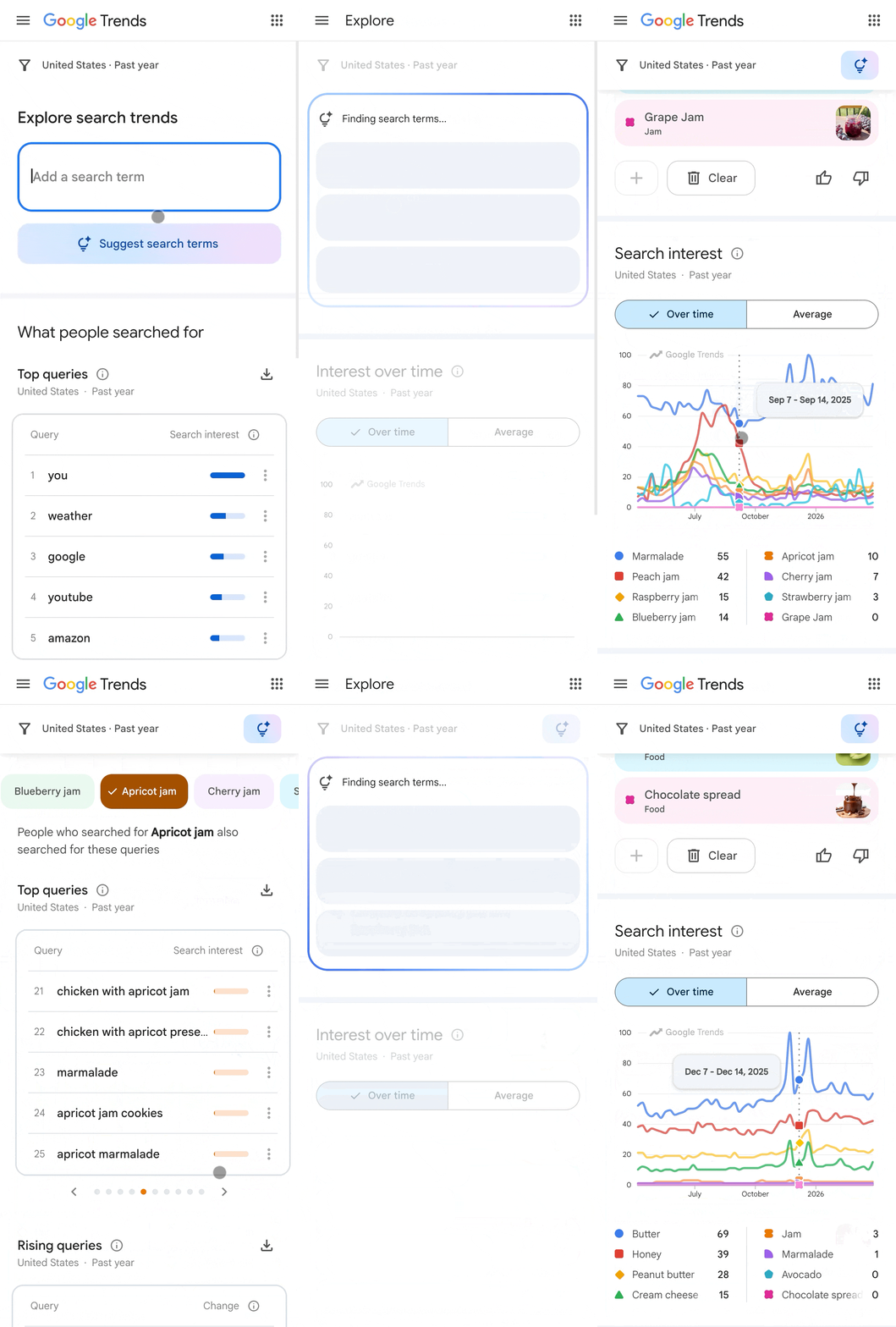
In a practical demonstration visible in Kalush's LinkedIn post, the system was used to analyze jam-related searches. The Explore output displayed comparative search interest across nine different query variations - marmalade, peach jam, raspberry jam, blueberry jam, apricot jam, cherry jam, strawberry jam, grape jam, and a highlighted leading query - plotted over a 12-month period for the United States. The chart showed a peak search interest value of 71 for the leading term, with other variants scoring between 0 and 21. The "commonly searched queries" panel below the chart surfaced three related terms: marmalade (highlighted in blue as the top query), peach jam, and raspberry jam.
This kind of output - comparative trend lines, ranked related queries, and visual differentiation by color - is now rendered directly in a mobile browser without requiring a desktop session.
The classic interface visible in one of the attached screenshots shows how the Explore page looked before the Gemini banner appeared. The page displayed a simple search input field, geographic and time filters, and a section labeled "What people searched for," which broke results into two columns: top queries (showing youtube with a +10% change over the past year) and rising queries (showing "2026" with a +4,050% change). There was no AI layer, no automatic suggestion panel, and no conversational prompt to guide term selection.
The new interface, by contrast, greets users with a notification banner reading "New! Explore search trends with Gemini. A quick and easy way to find search terms and discover trends." A "Go to new Explore" button replaces the classic entry point, though the fallback option remains available.
Rising queries capture what the numbers show
The screenshots from the current Explore page - taken from the classic view with the Gemini prompt visible as a banner - show the global trend landscape as of the past 12 months. The rising topics list is led by "2026 - Topic" at +3,700%, followed by "YouTube - YouTube channel" at +2,350%, "Gemini - Computer program" at +500%, "Claude - Language model" at +350%, and "Test - Topic" at +200%. Those figures represent the top five of 25 available topic results shown in a rising sort order.
The rising queries panel shows a parallel set of search strings. "2026" leads at +4,250%, followed by "iphone 17" at +1,400%, "ipl 2026" at +700%, "google gemini" at +550%, and "gemini ai" at +450%. Again, these are the top five of 25 available query results. The presence of both "google gemini" and "gemini ai" in the top five rising queries - at +550% and +450% respectively - points to the scale of public interest in the AI model that now powers the Explore page itself.
The data is consistent with broader patterns. Claude - listed as a language model in the topics panel - appears at position four with a +350% rise, reflecting growing search interest in Anthropic's competing AI system. The simultaneous rise of multiple AI-related terms in the same time window illustrates why researchers and marketers have found the Google Trends platform increasingly relevant for monitoring the AI competitive landscape.
Context: a series of Trends upgrades
The mobile Gemini launch is the latest in a sequence of capability expansions Google has made to the Trends platform over roughly two years. PPC Land documented the Trending Now page redesign in August 2024, when Google introduced actual search volume numbers in place of the relative interest scores that had defined the platform since its launch, alongside new filtering options for country, time range, and active versus ended trends.
In September 2024, Google released a detailed tutorial on the advanced comparison features in Google Trends, including punctuation-based language filtering, multi-market comparisons across up to five geographies simultaneously, and an embedded card format for publishing trend visualizations on third-party websites.
Journalists received dedicated coverage in October 2024, when Google's Search Advocate Daniel Waisberg and Trends Engineer Hadas Jacobi presented guidelines on using the platform to build data-driven stories. Waisberg framed the platform as providing insights into billions of Google and YouTube searches daily with regional granularity, capabilities suited to identifying trends within minutes of their emergence.
July 2025 brought a more significant infrastructure development: Google opened alpha testing for a Trends API targeting developers, researchers, and journalists seeking programmatic access to search trend data. The API provided a rolling window of 1,800 days of historical data - approximately five years - updated to within two days of the current date, with four aggregation intervals (daily, weekly, monthly, and yearly) and geographic breakdowns following the ISO 3166-2 standard. Crucially, the API removed the five-term comparison limit that restricts the website interface, allowing developers to compare dozens of terms simultaneously.
Then came the January 14, 2026 desktop integration of Gemini into the Explore page itself, the direct predecessor to today's mobile web extension.
Why mobile matters for the research workflow
The practical implications of the mobile extension are significant for anyone whose research happens away from a desk. Journalists covering breaking news from locations without laptop access, researchers attending conferences, and media buyers monitoring search demand spikes during campaign flights can now access Gemini's term suggestion capability directly from a phone browser.
The Google News Initiative's framing is pointed: "for journalists working in the field, tracking search data just got easier." That framing positions the mobile launch not as a general consumer feature but as a professional research tool reaching a new deployment surface.
For marketing professionals specifically, the ability to pull trend comparisons on mobile aligns with broader patterns in how campaign monitoring has shifted. PPC Land has noted the growing importance of real-time search intelligence for keyword strategy, competitor benchmarking, and content planning - use cases that do not always happen at a desktop terminal.
The Gemini integration also connects to a larger strategic pattern at Google. The model has been embedded across an expanding range of the company's products throughout 2025 and into 2026. Google's NewFront 2026 presentation in March positioned Gemini 3 as the underlying engine for Google Marketing Platform, encompassing Display and Video 360, Search Ads 360, Campaign Manager, and Google Analytics. Within Google Trends specifically, the January desktop rollout marked the first time a large language model was embedded in the platform's core research workflow rather than serving as an optional analytical layer.
The Trends Explore page has served as a gateway for marketers conducting keyword research because it shows normalized search interest rather than raw volume, allowing meaningful comparisons between terms regardless of their absolute scale. Adding Gemini to that gateway - and now making it mobile-accessible - means the suggestion layer is available wherever users have a browser and a Google account.
What the interface does not yet do
The current implementation is a term discovery and comparison tool. It does not generate interpretive commentary, forecast future trend trajectories, or integrate with Google Ads campaign data directly from within the Trends interface. The comparison functionality caps at a finite number of simultaneous terms as set by the existing Explore architecture, even though the API - available separately to developers in alpha - removes that constraint.
The sign-in requirement is a practical consideration. Users must be signed in to a Google account to access the new experience on mobile, a restriction that does not apply to the classic Explore interface. That condition may affect access in research contexts where individuals prefer unauthenticated browsing.
Google has not announced a timeline for bringing the Gemini Explore experience to a native mobile app. The current launch covers the mobile web browser specifically, meaning users access it through Safari, Chrome, or any other mobile browser rather than through the standalone Google Trends application if one is installed on their device.
Rising AI search terms in context
The data captured in the screenshots offers a snapshot of what global searchers were investigating over the past 12 months as of the time the tool was accessed. The +4,250% rise for "2026" as a raw query and the +3,700% rise for "2026" as a topic reflect the calendar shift in people's reference frame - searches anchored to the current year arriving at scale as January began.
Among AI-related terms, the simultaneous appearance of "Gemini - Computer program" at +500% and "Claude - Language model" at +350% in the rising topics list is notable. These are categorized as distinct entities - one a computer program, one a language model - reflecting how Google's knowledge graph classifies each product. That both appear in the top five of 25 rising topics, covering a 12-month global window, illustrates the scale at which general audiences have been searching for information about large language models.
The "iphone 17" query at +1,400% in the rising queries list sits between the two AI entries, a reminder that consumer hardware cycles and AI platform curiosity are competing for search volume at roughly comparable orders of magnitude in the current environment.
Timeline
- August 6, 2024 - Google Trends redesigns Trending Now page with actual search volume data, new filtering options, and CSV export capability
- August 28-29, 2024 - Google releases advanced comparison features for the Explore page, including punctuation-based language filtering and multi-market analysis
- October 23-24, 2024 - Google publishes dedicated journalist guidelines for using Google Trends to build data-driven stories
- July 24, 2025 - Google opens alpha testing for the Trends API, providing programmatic access to 1,800 days of search data with no five-term comparison limit
- January 14, 2026 - Google integrates Gemini into the Trends Explore page on desktop, introducing AI-powered term suggestions, color-coded trend lines, and doubled rising query counts
- March 23, 2026 - Google NewFront 2026 positions Gemini 3 as the engine across all Google Marketing Platform products
- April 2026 - Google extends the Gemini-powered Explore page to mobile web, accessible at trends.google.com/explore from any signed-in mobile browser
Summary
Who: Google, announced by Nir Kalush (Lead Product Manager, Google Trends) and the Google News Initiative on LinkedIn.
What: The Gemini-powered Explore page in Google Trends - which uses AI to suggest related search terms, display comparative trend lines, and surface rising queries - is now available on the mobile web at trends.google.com/explore. The feature was previously limited to desktop browsers following its January 14, 2026 launch.
When: The mobile web availability was announced in April 2026, with the LinkedIn posts from Nir Kalush and the Google News Initiative confirming the rollout. The underlying desktop feature launched on January 14, 2026.
Where: The experience is accessible globally through any mobile web browser at trends.google.com/explore, provided the user is signed in to a Google account. The classic Explore interface remains available via a toggle.
Why: Extending Gemini-assisted search term research to mobile browsers means journalists, marketers, and researchers can conduct AI-supported trend analysis from any location, removing the dependency on desktop access for a workflow that had previously required a laptop or desktop computer. The update reflects Google's sustained effort to embed Gemini capabilities across its data and research products, following integrations into Google Ads, Google Analytics, and the Google Marketing Platform throughout 2025 and 2026.


Discussion