Google's Preferred Sources goes global with doubled click rates
Google expands Preferred Sources globally on December 10, 2025 while launching commercial AI partnerships with publishers like The Guardian and Der Spiegel.


Google expands Preferred Sources globally on December 10, 2025 while launching commercial AI partnerships with publishers like The Guardian and Der Spiegel.
Google extended its Preferred Sources functionality worldwide on December 10, 2025, enabling users to customize which news outlets appear prominently in Top Stories sections across Search and AI Mode. The expansion marks a significant shift toward user-controlled news curation within Google's search ecosystem.
According to Nick Fox, Senior Vice President of Knowledge & Information at Google, who announced the developments via LinkedIn on December 10, the feature allows users to select sites they want to see more frequently in Top Stories sections. "We've found when people select a preferred source, they click to that site twice as often," Fox stated in his LinkedIn announcement. The functionality first launched in the United States and India on August 12, 2025, before expanding to global availability.
Subscribe PPC Land newsletter ✉️ for similar stories like this one
The Preferred Sources mechanism fundamentally changes how users interact with news content in Google Search and AI Mode. Rather than relying entirely on Google's algorithmic selections, users can explicitly designate favorite publications for increased visibility. This represents the first major user-facing customization tool for news discovery since Google introduced personalized search results based on browsing history and location signals.
The Preferred Sources mechanism enables users to customize which outlets appear prominently when searching for news topics. According to Google's official blog post published August 12 by Duncan Osborn, Product Manager for Google Search, "Everyone has their own preferences about where and how they get their news, so we're launching a new feature in Search that lets you customize your experience to see more from your favorite sites within Top Stories."
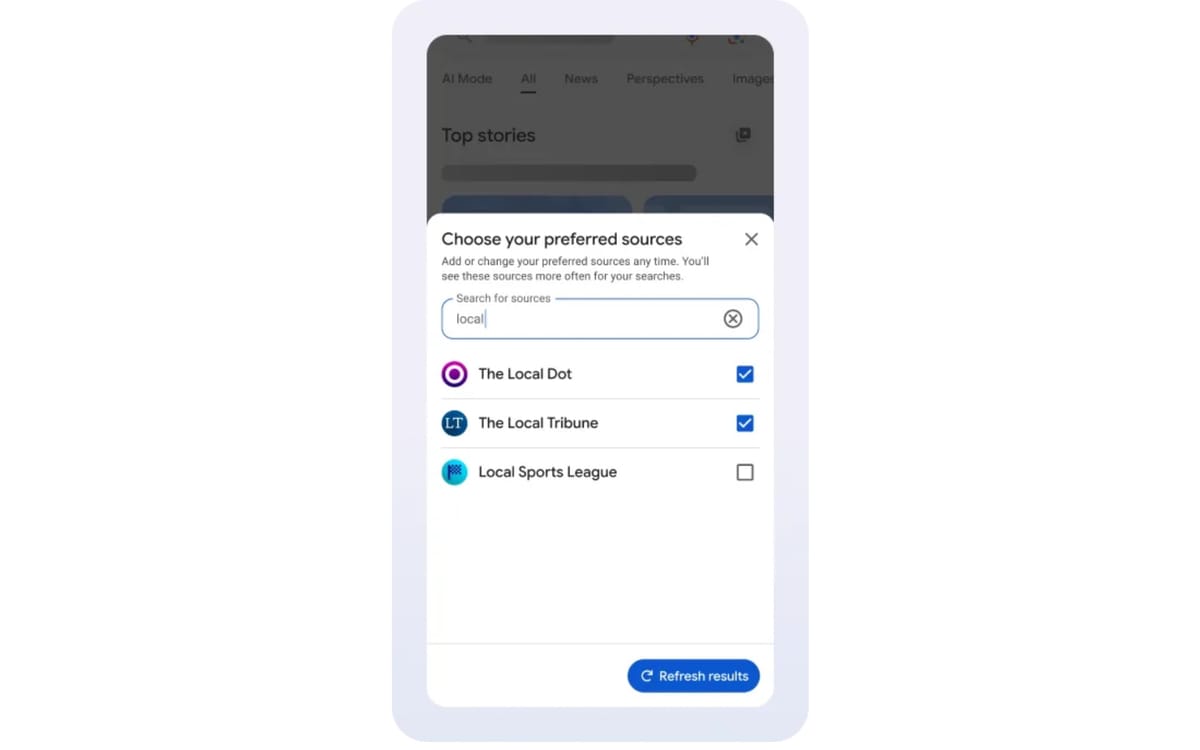
Technical implementation requires users to first search for topics currently generating news coverage. A Cards Star icon appears to the right of Top Stories headers during these searches. Clicking this icon opens an interface where users search for and select preferred sources through checkboxes. Once configured, selected outlets appear more frequently within Top Stories sections or in dedicated "From your sources" displays on search results pages.
The integration extends across multiple Google surfaces. According to Fox's announcement, preferred sources will appear not only in traditional Search results but also within AI Mode, Google's conversational search interface that provides AI-generated responses to queries. This cross-surface implementation means user preferences persist whether someone conducts a standard search or engages with Google's AI-powered search experiences.
AI Mode presents particular challenges for news visibility. The conversational interface synthesizes information from multiple sources into cohesive responses, potentially reducing the prominence of individual publisher links. Preferred Sources addresses this by ensuring that when AI Mode references news content, outlets designated as preferred by users receive prioritized placement within the response structure.
The system creates hybrid content displays rather than replacing algorithmic selections entirely. According to technical specifications detailed in Google's documentation, preferred sources "appear more frequently in Top Stories or in a dedicated 'From your sources' section on the search results page." Users continue seeing content from other outlets alongside their preferred selections, maintaining exposure to diverse news sources beyond explicitly selected publications.
Early adoption patterns demonstrated substantial user engagement with the customization functionality. "We learned from our early Labs users that people really value being able to select a range of sources — with over half of users choosing four or more," Fox noted in the August 12 announcement referenced in his LinkedIn post. Users who previously participated in Search Labs experiments automatically receive their existing selections transferred to the live feature.
The selection mechanism operates within specific technical constraints that affect how users interact with the feature. According to Google's help documentation, "Sources that aren't updated regularly may not be available," indicating algorithmic quality restrictions on which outlets qualify for user designation. This technical limitation affects smaller publishers and emerging digital outlets publishing less frequently than major news organizations, potentially reinforcing existing advantages held by established media brands with consistent publishing schedules.
The global expansion provides access to millions of additional users across all languages supported by Google Search. According to Fox's December 10 announcement, the feature "will be broadly available in the coming days" for English-language users worldwide, with all supported languages following early next year. The rollout builds upon limited testing that began in June 2025 through Google's Search Labs experimental platform before the August 12 launch in the United States and India.
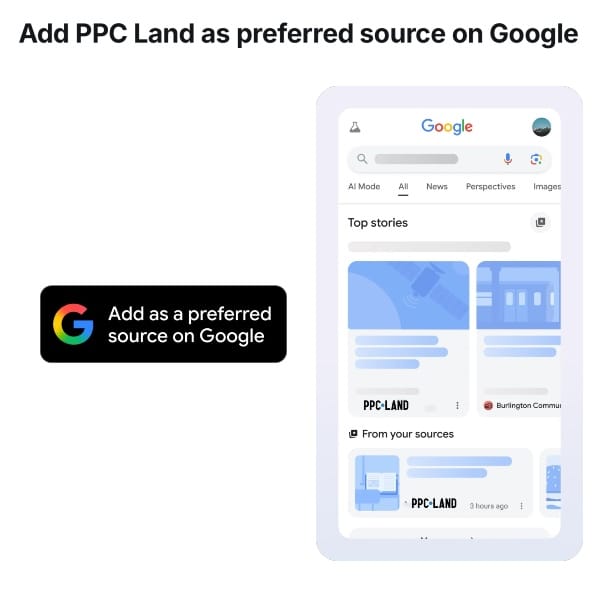
Publishers gained new audience development capabilities through the launch that directly affect their visibility in Search and AI Mode. According to Google's guidance materials, news organizations can encourage readers to select their publication as a preferred source through two primary methods: adding deeplinks to social media posts and including selection buttons directly on their websites. The deeplink system utilizes specific URL structures with the format "https://google.com/preferences/source?q=<your website URL>" to enable readers to immediately add publications to preferred sources lists.
These technical tools become particularly valuable as Search and AI Mode increasingly compete for user attention with traditional website visits. Publishers face a fundamental challenge: encouraging audiences to designate them as preferred sources requires active communication and education, transforming what was previously a passive algorithmic relationship into an active audience development strategy.
However, geographic restrictions limited access to the preference configuration system during the initial rollout. Users outside the United States and India encountered 404 errors when attempting to access these preference pages before the December 10 global expansion announcement. Google launched Preferred Sources on August 12 exclusively in those two markets, creating accessibility barriers that the worldwide rollout addresses.
Buy ads on PPC Land. PPC Land has standard and native ad formats via major DSPs and ad platforms like Google Ads. Via an auction CPM, you can reach industry professionals.
The system creates hybrid content displays rather than replacing algorithmic selections entirely. According to technical specifications detailed in Google's documentation, preferred sources "appear more frequently in Top Stories or in a dedicated 'From your sources' section on the search results page." Users continue seeing content from other outlets alongside their preferred selections, maintaining exposure to diverse news sources beyond explicitly selected publications.
Fox's announcement also highlighted several additional features designed to enhance how Preferred Sources operates within Search and AI Mode. "We're launching a new feature that highlights links from your news subscriptions so you can get more value from your subscriptions – coming soon to the Gemini App, AI Overviews, and AI Mode," according to the LinkedIn post. This functionality prioritizes content from publications where users maintain paid subscriptions, creating a second layer of personalization beyond explicit source selection.
The integration with AI Mode represents a particularly significant development for how users encounter news content. AI Mode operates as a conversational search interface where users can ask follow-up questions and receive contextual responses. Without Preferred Sources, these responses draw from Google's algorithmic assessment of authoritative and relevant content. With Preferred Sources activated, the system adjusts to incorporate user preferences into AI-generated responses.
The company simultaneously announced modifications to AI Mode functionality that affect how Preferred Sources appear within conversational search experiences. "We're increasing the number of inline links in AI Mode responses and adding a short explanation so you get more context on why the links might be helpful to visit," Fox stated. These technical changes address how AI-generated responses integrate preferred source content alongside algorithmically selected information.
Fox also referenced enhancements to Web Guide, an AI-powered feature that organizes traditional search results into categorized groupings. "We've upgraded Web Guide, which uses AI to help you discover new angles to explore and organize links on Search into topic groups (especially helpful for complex queries). We've made Web Guide twice as fast and are expanding it to more search results in the 'All' tab," according to the LinkedIn announcement. This organizational layer works alongside Preferred Sources to help users navigate complex news topics across both traditional Search and AI Mode interfaces.
The timing of the global Preferred Sources expansion reflects Google's attempt to balance algorithmic content selection with user customization demands across Search and AI Mode. The feature represents a significant philosophical shift in how Google approaches news curation, moving from purely algorithmic determination toward hybrid models where user preferences explicitly influence what appears in both traditional search results and AI-generated responses.
The implications for Search and AI Mode functionality extend beyond simple visibility changes. Preferred Sources introduces a new variable into how Google's systems determine which content appears prominently for news-related queries. Previously, Google's algorithms evaluated factors including relevance, authoritativeness, timeliness, and user location to generate Top Stories selections. Now, individual user preferences override these algorithmic assessments when explicitly configured.
This creates a bifurcated experience where users with configured Preferred Sources see fundamentally different Top Stories displays compared to users relying entirely on algorithmic selections. The distinction becomes particularly pronounced in AI Mode, where conversational responses incorporate preferred source content even when other outlets might rank higher based on traditional algorithmic signals.
Marketing implications extend beyond simple visibility increases. Success depends on publishers' ability to educate existing readership about the selection functionality rather than relying solely on algorithmic discovery mechanisms that determine which outlets appear in default Top Stories displays. Publishers with loyal audiences who actively select them as preferred sources could benefit from increased visibility and engagement, particularly given Fox's claim that selection doubles click-through rates.
The doubling of click-through rates represents the most significant quantifiable impact of Preferred Sources on Search behavior. This metric suggests that when users explicitly designate a publication as preferred, their engagement patterns fundamentally change. Rather than passively consuming whatever algorithmic selections appear in Top Stories, users actively seek content from sources they've designated, creating stronger traffic relationships between publishers and their audiences.
However, the system may amplify existing disparities between established news brands with extensive audience bases and emerging digital publishers who lack widespread name recognition. The feature requires active user participation, distinguishing it from Google's typically passive personalization approaches based on algorithmic interpretation of browsing behavior and search history. Users must know a publication exists and value it sufficiently to configure preferences, creating barriers for smaller outlets attempting to build initial audience relationships through Search discovery.
For AI Mode specifically, Preferred Sources introduces new dynamics into conversational search experiences. Users conducting research through multi-turn conversations with AI Mode will see their preferred sources incorporated into responses throughout the conversation, creating sustained visibility advantages for selected publications. This differs from traditional Search where each query operates independently, as AI Mode maintains conversation context across multiple exchanges.
For news publishers navigating Search and AI Mode changes, the Preferred Sources feature provides a mechanism for leveraging audience loyalty into sustained visibility across both traditional and conversational search interfaces. Organizations can incorporate preference selection calls-to-action into newsletters, social media posts, and on-site messaging to encourage readers to explicitly designate them as preferred sources. The deeplink functionality enables direct paths from publisher communications to preference configuration interfaces, reducing friction in the selection process.
The strategic value becomes particularly apparent when considering how Search and AI Mode serve different user needs. Traditional Search serves users seeking specific information or recent news updates, while AI Mode attracts users wanting comprehensive explanations or research assistance requiring multiple sources synthesized into coherent responses. Publishers appearing as preferred sources gain advantages in both contexts: prominent placement in Top Stories for traditional Search and prioritized inclusion in AI-generated responses for conversational queries.
The global rollout occurs against a backdrop of fundamental shifts in search referral patterns that affect both Search and AI Mode traffic distribution. Research published in August 2025 found that Google Discover had become the dominant traffic source for news and media websites, accounting for two-thirds of Google referrals while traditional Google Search traffic dropped from approximately 16% to 10% of total referrals during the period when AI Overviews rolled out to more than 100 countries.
Publishers face mounting evidence that AI features reduce traditional click-through opportunities in Search results. Dotdash Meredith reported during first quarter 2025 earnings that "AI Overviews appear on roughly a third of search results related to DDM's content" with observable performance declines. The company experienced a 3% year-over-year decline in core user sessions attributed partially to "weakening referral traffic from search platforms."
Preferred Sources offers publishers a potential mitigation strategy for these broader Search and AI Mode traffic challenges. By securing explicit user designation as a preferred source, publishers can maintain visibility even as algorithmic systems increasingly satisfy user intent within Google's interfaces rather than directing traffic to external websites. The feature creates a direct relationship between user preference and content visibility that operates independently of the algorithmic factors determining which AI features appear for specific queries.
The announcement represents Google's effort to provide user control over news curation as Search and AI Mode increasingly compete for information access. The feature acknowledges that algorithmic content selection alone no longer satisfies all user preferences, particularly as AI-generated responses provide direct answers that reduce incentives to visit multiple news sources for comparative perspectives.
For marketing professionals and digital publishers, the developments signal a continuing transformation in search-driven audience acquisition strategies that now must account for both traditional Search and conversational AI Mode experiences. Organizations must balance efforts to optimize for traditional search algorithms with new requirements including educating audiences about preference selection, maintaining consistent publishing schedules to qualify for user designation, and understanding how preferred source status affects visibility across different Google search interfaces.
The global expansion creates opportunities for publishers to leverage audience loyalty into sustained visibility within Top Stories sections across Search and AI Mode. However, the effectiveness of these efforts depends on user adoption rates for the Preferred Sources feature and whether publishers can successfully encourage their audiences to actively configure these preferences rather than relying on default algorithmic selections that may favor larger, more established news organizations with existing brand recognition and publishing scale.
Subscribe PPC Land newsletter ✉️ for similar stories like this one
Subscribe PPC Land newsletter ✉️ for similar stories like this one
Who: Google, targeting English-speaking users worldwide with expansion to all supported languages following in early 2026, affecting news publishers competing for visibility in Top Stories sections across traditional Search results and conversational AI Mode interfaces.
What: Global expansion of Preferred Sources functionality enabling users to customize Top Stories in Search and AI Mode to see content more frequently from selected news outlets, with data showing users click to preferred sources twice as often, alongside enhanced inline links in AI Mode responses, subscription highlighting features prioritizing paid publication content, and Web Guide improvements organizing search results into AI-powered topic groups.
When: Announced December 10, 2025, via Nick Fox's LinkedIn post and official Google blog posts, with Preferred Sources initially launching August 12, 2025 in United States and India following June 26, 2025 Search Labs experiment, now rolling out to English-language users worldwide in coming days with all supported languages following early 2026.
Where: Available worldwide through google.com search results, Google News pages, Gemini app, AI Overviews, and AI Mode interfaces, with Preferred Sources initially deploying to English-language markets before expanding to all supported languages, affecting how Top Stories appear in both traditional Search results and conversational AI Mode responses.
Why: Addresses fundamental shifts in how users consume news information across Search and AI Mode, seeking faster access to trusted content, more context for evaluating sources, and explicit control over which publications appear prominently in Top Stories sections, while publishers navigate traffic distribution changes requiring active audience development strategies including encouraging readers to configure explicit source preferences rather than relying solely on algorithmic discovery mechanisms that determine default Top Stories selections.