Honey loses access to 2,000 clients after Rakuten network termination
Honey browser extension terminated from Rakuten Advertising affiliate network on January 12, 2026, losing access to major retail partners including Walmart.


Honey browser extension terminated from Rakuten Advertising affiliate network on January 12, 2026, losing access to major retail partners including Walmart.
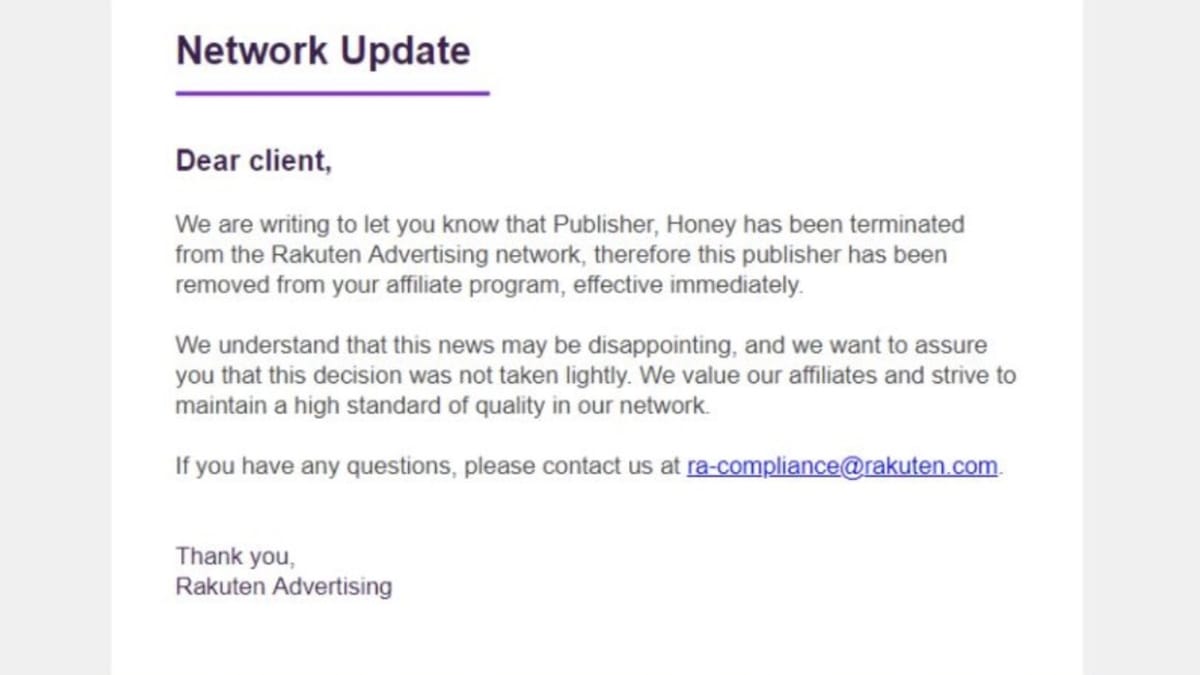
PayPal's Honey browser extension was terminated from the Rakuten Advertising affiliate network on January 12, 2026, according to an email shared by a user on LinkedIn and reported by tech journalist MegaLag on X (formerly Twitter) at 6:16 PM. The termination severs Honey's access to approximately 2,000 retail merchants and marks the most significant business consequence yet from allegations of systematic affiliate commission theft that emerged in December 2024.
MegaLag confirmed Honey's Rakuten affiliate links are no longer active. "Honey just lost ~2000 clients," the journalist wrote in announcing the termination. The affected retailers include major e-commerce brands: Walmart, NewEgg, Sephora, Uniqlo, UGG, Lego, Vans, Dyson, Cotton On, and TK Maxx in the United Kingdom.
The termination follows months of legal action, technical investigations, and declining user trust that have severely damaged Honey's reputation in the affiliate marketing industry.
The Rakuten termination caps a turbulent period for Honey that began when MegaLag published a comprehensive investigation on December 22, 2024, documenting how the browser extension allegedly manipulated coupon codes and diverted affiliate commissions from content creators. Within days, content creators filed a class action lawsuit on December 29, 2024, in the United States District Court for the Northern District of California, seeking damages exceeding $5 million.
The investigation revealed three mechanisms through which Honey allegedly diverted commissions: direct replacement of affiliate tracking cookies, incentivized diversion through the "Honey Gold" rewards program, and commission capture through interface elements. In one documented test case, Honey diverted a $35 commission on a NordVPN purchase while providing the user with just 89 cents worth of "Honey Gold" rewards points.
Further revelations emerged on December 22, 2025, when a security researcher exposed what was characterized as a sophisticated fraud detection evasion system embedded in Honey's code. The investigation documented a "selective standdown" system that allegedly adjusted the extension's behavior based on user profiling to determine whether someone was a legitimate shopper or an affiliate industry insider testing for compliance violations.
Honey's user base collapsed following these disclosures. Chrome Web Store data showed the extension dropped to 14 million users as of July 2025, down from over 20 million before the December 2024 investigation. Additional investigations revealed that Honey targeted minors in advertising while leaking business discount codes without merchant consent, adding 146,000 online stores to its platform without authorization.
Legal setbacks compounded Honey's problems. On November 7, 2025, PayPal failed to compel arbitration in the class action lawsuit, with the United States District Court for the Northern District of California ruling that PayPal's user agreements did not extend to claims involving Honey's broader business practices. Content creators then filed a comprehensive second amended complaint on January 5, 2026, including specific merchant contract terms and detailed evidence directly addressing earlier standing issues.
The Rakuten termination on January 12, 2026, represents the affiliate industry's most decisive action against Honey to date, severing the extension from one of the world's largest and most prestigious affiliate networks.
Rakuten Advertising operates one of the world's largest affiliate marketing networks. The company, formerly known as Rakuten Marketing, acquired LinkShare in 2005 for $425 million in cash, according to Bloomberg reporting from September 6, 2005. LinkShare became a wholly owned U.S. division of Rakuten, Inc., a Japanese shopping portal and internet services company.
The affiliate network was rebranded from Rakuten LinkShare to Rakuten Affiliate Network in 2014. In 2020, the parent division underwent another rebrand from Rakuten Marketing to Rakuten Advertising, reflecting the company's broader advertising technology capabilities beyond affiliate marketing.
Rakuten Advertising has maintained its position as the top-ranked affiliate network according to mThink's Blue Book rankings. The company received this designation for 11 consecutive years as of January 24, 2022, when mThink announced Rakuten Advertising as the best affiliate network based on surveys of over 25,000 advertisers, publishers, and agencies in the performance marketing industry. Prior to that, on January 21, 2020, Rakuten Marketing (as it was then known) received the same recognition for its ninth year.
Chris Trayhorn, founder and CEO of mThink, stated in the 2022 announcement: "Rakuten Affiliate Network, part of Rakuten Advertising, has been our #1 network for 11 years in a row and show no sign of slowing down. Rakuten is the favorite of our Blue Ribbon Panel of experts, and of our advertiser voting panel, demonstrating excellence across every aspect of their business."
The network's scale and reputation made it a crucial partner for browser extensions and other affiliate publishers seeking access to major retail advertisers. Over 400 networks are typically considered by mThink for their Blue Book Top 20 rankings, with winners selected based on reputation, influence, clientele, popularity, and scale.
Buy ads on PPC Land. PPC Land has standard and native ad formats via major DSPs and ad platforms like Google Ads. Via an auction CPM, you can reach industry professionals.
The termination comes months after Rakuten Advertising announced several industry-first solutions aimed at increasing transparency and compliance in affiliate marketing. On May 29, 2025, at Rakuten Optimism 2025, the company revealed new tools designed to help advertisers and publishers navigate affiliate marketing challenges.
Among these new solutions was the Affiliate Conversion Journey – Transparency API, an enhanced version of Rakuten Advertising's contribution insights solution. This API provides publishers with next-day visibility into their role in a customer's purchase journey at the order level. Nick Stamos, CEO at Rakuten Advertising, explained the rationale: "The affiliate industry is facing a critical challenge where publishers are often reliant on the last click for commissions while advertisers often use multi-touch attribution technologies. This new API will give publishers the data transparency to better understand and attribute the value they deliver for their advertiser partners."
More relevant to the Honey termination, Rakuten Advertising also launched Detect, an always-on monitoring suite for affiliate program safety and compliance. The system provides advertisers with fraud detection capabilities powered by Rakuten Advertising's data science technology and partnerships with Marcode, AdPolice, and Search Monitor. Programs are actively monitored for cases of ad hijacking and keyword bidding violations.
The Detect suite also includes anomaly detection that automatically alerts advertisers to deviations from normal affiliate performance patterns, supporting the detection and remediation of potential fraud and suspicious program activity. Additional features include program monitoring with financial product monitoring, content tracking, competitive rankings, and cashback logging capabilities.
"Rakuten Advertising Detect is an all-in-one solution that combines the strength of our partnerships with our own proprietary technologies to deliver advertisers the oversight they need to ensure their affiliate programs are protected and optimized," Stamos said in the May 2025 announcement. "By partnering with multiple third parties and leaning into our Affiliate Intelligence innovations, our clients will remain one step ahead of fraudsters and bad actors – even as AI makes them increasingly difficult to detect."
The Rakuten termination demonstrates the affiliate industry's increasing willingness to enforce compliance standards even when removing high-volume publishers. On November 27, 2025, IAB Australia released an affiliate program compliance framework developed by a working group that included Rakuten among its representatives, alongside Afterpay, Are Media, Commission Factory, Future, Impact, ND Agency, News Corp Australia, Nine, Partnerize, and Skimlinks.
The framework establishes standards for maintaining affiliate program quality through structured application screening, comprehensive terms and conditions, ongoing monitoring protocols, transaction validation procedures, and documented breach response processes. Application screening forms the first line of defense, with recommendations to verify that traffic sources and websites load correctly, assess content relevance to industry verticals, and analyze traffic levels alongside social media presence.
Continuous monitoring requirements include review of declared traffic sources against audience engagement metrics, referring URLs and traffic source data in transaction reports, conversion origin countries with associated IP addresses, sudden spikes in conversions or traffic, and unusually high order values or conversion rates. The guide emphasizes that high void rates trigger investigation, with monthly transaction validation at minimum.
These standards align directly with the transparency tools Rakuten Advertising emphasized in its May 2025 product launches. The Detect monitoring suite addresses precisely the types of problematic publisher behavior that Honey allegedly engaged in, including ad hijacking, keyword bidding violations, and performance anomalies that deviate from normal affiliate patterns.
The termination of a major publisher like Honey from the Rakuten network carries significant implications for the affiliate marketing industry. Browser extensions have become increasingly important distribution channels for affiliate offers, providing convenience to consumers while generating substantial revenue through affiliate commissions and referral fees.
Honey's business model centers on automatically finding and applying coupon codes at checkout while users shop online. The extension monetizes through affiliate partnerships, earning commissions when users complete purchases through retailer links. Access to major retail partners through networks like Rakuten Advertising is essential to this model's functionality and revenue generation.
The loss of approximately 2,000 retail partners represents a substantial portion of Honey's merchant network. Major retailers like Walmart, which has significant e-commerce volume, are particularly valuable affiliate partners due to high transaction volumes and broad product selections. The termination forces Honey to either negotiate direct relationships with these retailers, find alternative affiliate networks, or accept reduced coverage in its coupon and cashback offerings.
For Rakuten Advertising's retail partners, the termination of a high-volume publisher could affect their affiliate program performance in the short term. However, commission payments that previously went to Honey may be redistributed among other publishers in the network, including competing browser extensions, coupon sites, and cashback platforms.
The affiliate marketing industry has faced ongoing challenges around transparency and attribution. Publishers often compete for the final click before purchase, sometimes through practices that advertisers view as interruptive or value-dilutive. Browser extensions in particular have faced scrutiny over their role in the customer journey, with questions about whether they truly influence purchase decisions or simply capture commissions by inserting affiliate links at the point of transaction.
Rakuten Advertising's emphasis on transparency tools and fraud detection suggests a broader industry effort to address these concerns. The company's investments in attribution data, anomaly detection, and program monitoring reflect advertiser demand for greater control and visibility into affiliate program performance.
The May 2025 launch of the Storefronts influencer marketing solution also indicates Rakuten Advertising's strategy to diversify beyond traditional affiliate models. By connecting advertisers with hand-selected creators through shoppable experiences, the company is positioning itself at the intersection of influencer marketing and performance-based advertising – potentially reducing dependence on controversial publisher types like browser extensions.
Industry observers on social media responded to the Honey termination with mixed reactions. Some praised MegaLag's investigative reporting, while others suggested this could be an opportune moment for Rakuten Advertising to pursue legal action. One commenter noted: "Now would be the best time for Rakuten to hit them with a lawsuit. Twist the knife."
Another user raised questions about industry-wide practices, commenting: "I still can't understand why you care so much more about attacking Honey than exposing the fact that this has been industry standard for awhile. All the other companies are thanking you for being so narrow minded."
The termination appears to have been executed swiftly, with Honey's Rakuten affiliate links becoming inactive shortly after the network sent termination notices. For a browser extension with millions of users, this creates immediate operational challenges in maintaining service functionality for affected retailers.
Browser extensions like Honey typically maintain databases of merchant affiliate links across multiple networks. When a user visits a supported retailer's website, the extension identifies the merchant and retrieves relevant coupon codes and affiliate links. The loss of Rakuten network access means Honey must either remove those retailers from its supported merchant list or replace Rakuten links with alternatives from other affiliate networks or direct partnerships.
The scale of the disruption – approximately 2,000 merchant relationships – suggests significant technical work will be required to restore full functionality. Each merchant requires specific affiliate link formatting, commission structures, and integration parameters. Rebuilding these relationships through alternative channels could take weeks or months depending on negotiation complexity and technical requirements.
For users of the Honey extension, the immediate impact may be reduced coupon availability and cashback earning potential at major retailers. If Honey cannot quickly establish alternative affiliate relationships for terminated merchants, users shopping at stores like Walmart, Sephora, or Lego may find fewer working coupon codes or no cashback offers through the extension.
The termination email shared on LinkedIn, which MegaLag referenced in the initial X post, presumably contained specific reasons for Rakuten Advertising's decision. However, the public reporting focused on the fact of termination rather than detailed justification. Typical grounds for affiliate network terminations include violation of program terms, fraudulent activity, advertiser complaints, or breach of network policies.
Rakuten Advertising's recent emphasis on fraud detection and program monitoring suggests the company has invested heavily in identifying problematic publisher behavior. The Detect suite's capabilities for detecting ad hijacking, keyword bidding violations, and performance anomalies provide infrastructure for identifying publishers that violate network or advertiser policies.
Rakuten Advertising's consistent recognition as the top affiliate network underscores its dominant position in performance marketing. The company's sustained excellence across 11 years of mThink rankings demonstrates both stability and continuous innovation in a competitive industry.
Julie Van Ullen, managing director for the U.S. at Rakuten Marketing, stated in the January 2020 announcement: "The mThink Best Affiliate Network listing remains competitive, and we're honored to again be ranked as best affiliate network. As Rakuten Marketing continues to evolve and lead the cost-per-sale and affiliate industry, this listing recognizes our commitment to providing publishers and advertisers with transformative solutions to meet their sales and campaign goals."
The network's reputation rests on multiple factors including technology infrastructure, publisher quality, advertiser satisfaction, and service teams. In the 2022 mThink announcement, the research noted that survey respondents reported "increasing satisfaction with Rakuten Marketing, particularly in the quality of the programs available and the service provided."
Rakuten Advertising's parent company, Rakuten Inc., operates as one of the world's leading internet service companies with diverse media properties and audiences. This corporate backing provides resources for continued technology investment and global expansion. The company maintains offices throughout EMEA, APAC, LATAM, and North America, with headquarters in San Mateo, California.
The affiliate division's strategic direction under CEO Nick Stamos has emphasized "Affiliate Intelligence" – using technology and data to help brands and publishers optimize program performance amid changing competitive environments and economic conditions. The May 2025 product launches exemplified this approach, combining proprietary technology with third-party partnerships to address industry challenges around transparency, fraud, and creator marketing.
Beyond traditional affiliate marketing, Rakuten Advertising offers display advertising, influencer marketing, media buying, paid search, and paid social capabilities. This integrated approach positions the company to serve advertisers seeking coordinated performance marketing across multiple channels rather than isolated affiliate programs.
The company's investments in AI-driven analytics, evidenced by the Insights and Analytics Prompt tool announced in May 2025, reflect broader industry trends toward automated optimization and real-time reporting. These capabilities help advertisers and publishers respond quickly to performance changes and market dynamics.
The Honey termination occurs against a backdrop of increasing scrutiny of browser extensions and affiliate marketing practices. Regulatory attention to data privacy, consumer protection, and online advertising has intensified across multiple jurisdictions. Browser vendors like Google, Apple, and Mozilla have implemented restrictions on extension capabilities, particularly around tracking and data collection.
Affiliate marketing itself continues evolving as advertisers seek more sophisticated attribution models and performance measurement. The traditional last-click attribution that benefits browser extensions increasingly competes with multi-touch attribution approaches that distribute credit across the customer journey. Rakuten Advertising's transparency initiatives directly address this tension by providing publishers with visibility into their contribution beyond the final click.
The convergence of affiliate and influencer marketing, exemplified by Rakuten's Storefronts solution, represents another significant industry trend. Creators and content producers offer authentic audience relationships that differ from the transaction-focused interactions of browser extensions and coupon sites. Advertisers increasingly view creator partnerships as strategic brand-building investments rather than pure performance marketing.
For Honey specifically, the Rakuten termination represents a significant operational and financial challenge. The company must rapidly rebuild merchant relationships, communicate with users about service disruptions, and potentially adjust its business model. Alternative affiliate networks exist, including CJ Affiliate (formerly Commission Junction), ShareASale, Impact, and others, but replacing 2,000 merchant relationships requires substantial business development effort.
The incident also raises questions about publisher concentration risk in affiliate marketing. Relying heavily on a single network for merchant access creates vulnerability if that relationship terminates. Diversification across multiple networks and direct partnerships provides resilience but increases operational complexity and management overhead.
From Rakuten Advertising's perspective, the termination demonstrates willingness to enforce network policies even when removing high-volume publishers. This stance may strengthen relationships with advertisers concerned about program quality and brand safety, even if it reduces short-term network volume metrics.
The public nature of the termination, announced through social media rather than official press releases, reflects the modern information ecosystem where industry developments often surface through individual reporters and commentators. MegaLag's investigative journalism approach has brought transparency to affiliate marketing practices that traditionally operated behind confidential business agreements.
As the affiliate marketing industry continues maturing, tension between transparency and complexity will likely intensify. Advertisers want clear visibility into publisher value and program performance. Publishers need sustainable business models that recognize their contribution across the customer journey. Networks like Rakuten Advertising occupy the middle ground, building infrastructure and policies that balance these sometimes competing interests.
The Honey termination may represent an inflection point where major affiliate networks more aggressively enforce quality standards and compliance requirements. If so, other publishers employing similar practices could face increased scrutiny and potential terminations. Alternatively, this could be an isolated incident specific to Honey's operations within the Rakuten network.
What remains clear is that affiliate marketing's fundamental economics – connecting consumers with merchants through third-party intermediaries – continue evolving. Technology changes, regulatory pressures, consumer expectations, and competitive dynamics all shape how these connections are made and valued. Networks that successfully navigate this complexity while maintaining advertiser and publisher satisfaction will determine the industry's future direction.
Subscribe PPC Land newsletter ✉️ for similar stories like this one
Subscribe PPC Land newsletter ✉️ for similar stories like this one
Who: PayPal's Honey browser extension, Rakuten Advertising affiliate network, tech journalist MegaLag, content creators Wendover Productions LLC and Businessing LLC, retail partners including Walmart, NewEgg, Sephora, Uniqlo, UGG, Lego, Vans, Dyson, Cotton On, and TK Maxx, security researchers, and affected consumers
What: Rakuten Advertising terminated Honey from its affiliate network, deactivating Honey's affiliate links and removing access to approximately 2,000 retail merchant partners. The termination followed months of investigations revealing systematic affiliate commission diversion, fraud detection evasion systems, unauthorized merchant code leaking, and targeted data collection from minors. Legal proceedings include a federal class action lawsuit seeking damages exceeding $5 million, with content creators providing detailed merchant contracts as evidence of alleged violations.
When: January 12, 2026, at 6:16 PM, when MegaLag posted the breaking news on X with information from a LinkedIn user who shared the termination email. The termination followed a December 22, 2024 investigation that initially exposed Honey's practices, a December 29, 2024 lawsuit filing, a November 7, 2025 court ruling denying arbitration, subsequent technical investigations through December 2025, and a January 5, 2026 second amended complaint.
Where: The termination affects Honey's operations globally across the Rakuten Advertising network, which maintains offices throughout EMEA, APAC, LATAM, and North America with headquarters in San Mateo, California. Major affected retail partnerships include United States retailers and TK Maxx in the United Kingdom. Legal proceedings are ongoing in the United States District Court for the Northern District of California. The browser extension's user base declined from over 20 million Chrome users to 14 million as of July 2025, with further losses anticipated.
Why: While Rakuten Advertising has not issued an official statement explaining the termination decision, the action occurred amid extensive documentation of alleged policy violations, systematic affiliate commission theft through cookie manipulation, fraud detection evasion systems designed to hide problematic behavior from compliance testing, unauthorized merchant code leaking affecting 146,000 stores representing over 80% of Honey's supported retailers, and legal proceedings demonstrating specific merchant contract violations. The timing follows Rakuten Advertising's May 2025 launch of comprehensive fraud detection and compliance monitoring tools through its Detect suite, which provides automated alerts for ad hijacking, keyword bidding violations, and performance anomalies. The company's participation in IAB Australia's November 2025 affiliate compliance framework development and its 11-year streak as the world's top-ranked affiliate network suggest a strategic emphasis on program quality and advertiser protection that would make Honey's alleged practices particularly incompatible with network standards.