HubSpot's Loop Marketing data reveals how 1,800 marketers adapt to AI
HubSpot surveyed 1,800+ marketers in Q4 2025, revealing 51% lack clear brand positioning while 93% say personalization drives leads amid AI-driven marketing shifts.


HubSpot surveyed 1,800+ marketers in Q4 2025, revealing 51% lack clear brand positioning while 93% say personalization drives leads amid AI-driven marketing shifts.
HubSpot Research surveyed global marketers in Q4 2025 to understand how professionals navigate an advertising landscape where 60% of searches never leave Google and artificial intelligence answers questions before prospects click through to company websites. The findings, published in December 2025, introduce Loop Marketing as a four-stage framework combining AI efficiency with human authenticity to drive growth.
According to the research, 51% of global marketers say their brand has a clear, documented, and unique value proposition that differentiates them from competitors. The remaining marketers either have only a "good idea" of their positioning or report that their value proposition differs depending on who you ask within the organization.
Kipp Bodnar, Chief Marketing Officer at HubSpot, characterized the challenge facing marketing professionals. "The old buyer journey assumed customers would come to you," Bodnar stated in the report. "They visit your website, read your blog, and convert on your terms. But when 60% of searches never leave Google and AI answers questions before prospects even click, that playbook is broken."
The Loop Marketing framework consists of four stages: Express, which focuses on clarity before complexity; Tailor, which emphasizes personalization at scale; Amplify, which maximizes brand visibility across diversified channels; and Evolve, which enables real-time optimization through rapid learning and iteration.
Marketers on teams that regularly exceed goals are more than twice as likely to have a clear and documented unique value proposition compared to marketers who say their teams underperform, according to the survey data. Additionally, marketers on underperforming teams are 500% more likely to say their brand doesn't have a value proposition at all.
Teams significantly exceeding their goals most often audit, review, and refine their brand positioning quarterly, according to 53% of high-performing respondents. For these teams, AI comes into play with brainstorming and ideation support, used extensively by 23% of United States marketers and 25% of non-U.S. marketers, alongside market research and competitor analysis, used extensively by 21% of U.S. marketers and 25% of non-U.S. marketers.
To ensure brand positioning resonates, marketers in the United States monitor changes in engagement metrics after positioning updates, according to 31% of respondents, and analyze customer surveys specifically about brand perception, according to 30% of respondents. United States marketers validate positioning through A/B testing different positioning statements at 11%, customer surveys specifically about brand perception at 30%, monitoring changes in engagement metrics after positioning updates at 31%, sales team feedback on prospect reactions at 18%, and 11% don't formally validate their positioning.
The research found that most marketers told researchers that a quarter of their brand's monthly content incorporates personalization or segmentation. Ninety-three percent of United States marketers who use some level of personalization or segmentation in their marketing say it has a moderate to high positive impact on marketing-driven leads or purchases.
Subscribe PPC Land newsletter ✉️ for similar stories like this one
The most popular strategies for catering marketing plays to the right audiences are basic personalizations, like low-lift and often automated elements such as customers' names appearing in a marketing email. United States marketers say the most effective channels for segmentation and personalization are brand awareness campaigns and email marketing. Marketers outside the United States say social media shopping tools are the most effective at 29%, with organic and paid social media content tying for second place, both at 26%.
Fifty-nine percent already use AI to create tailored, personalized customer experiences beyond simple automations. When it comes to supercharging tailor plays, marketers most frequently use AI for text and visual content creation.
Fifty-two percent of marketers on high-performing teams say they use at least one or more advanced tailoring strategies, including content catered to multiple audience segments or ideal buyer types, and hyper-personalized messages, recommendations, or content based on deeper details like shopping habits, site behavior, or purchase history.
When digging deeper into high-performing marketers specifically, the research found that 28% say that more than half of their content includes personalizations based on buyer personas or demographic details, compared to 11% of marketers on teams who fall short of this goal. Basic demographics at 43% and shopping habits at 36% are the most valuable data type to have when developing personalized plays.
High-performing teams most commonly deploy segmented or more advanced personalized content via multichannel brand awareness campaigns at 67%, email marketing channels at 61%, and paid social media at 47%.
Forty-three percent of marketers in the United States say "strategic use of multiple marketing channels" was the Loop Marketing play that aligned most with their brand needs. Most marketers, at 73%, use between three and eight distinct channels in their overall marketing strategy.
Forty-eight percent of global respondents leverage three to five channels on average. United States marketers take a maximalist approach, with 55% focusing on 5+ channels, compared to 37% of global respondents.
Marketers' most extensive uses of AI in the amplify stage include using AI for text and image-based content creation, market research and competitor analysis, and SEO optimization for traditional and AI-powered search engines.
United States marketers on goal-exceeding teams say the most effective channel diversification strategy is moving from broad platforms to niche communities. They're also expanding from digital-only to traditional media channels. The same pattern appears for marketers outside the United States.
To expand the reach of their content beyond initial publication, goal-exceeding teams in the United States are investing in community engagement and sharing incentives at 37% and influencer/partner distribution networks at 20%. Marketers outside the United States take a different first approach, with paid amplification of top-performing organic content being the most effective strategy at 34%.
The research found that marketers analyze performance data on a weekly and monthly basis, and the most popular performance optimization techniques are audience segmentation refinement at 34% and budget reallocation based on performance. Potential impact analysis, measuring effort versus reward, and areas with the largest performance gaps are the top factors influencing performance optimization opportunities for United States marketers to prioritize.
Buy ads on PPC Land. PPC Land has standard and native ad formats via major DSPs and ad platforms like Google Ads. Via an auction CPM, you can reach industry professionals.
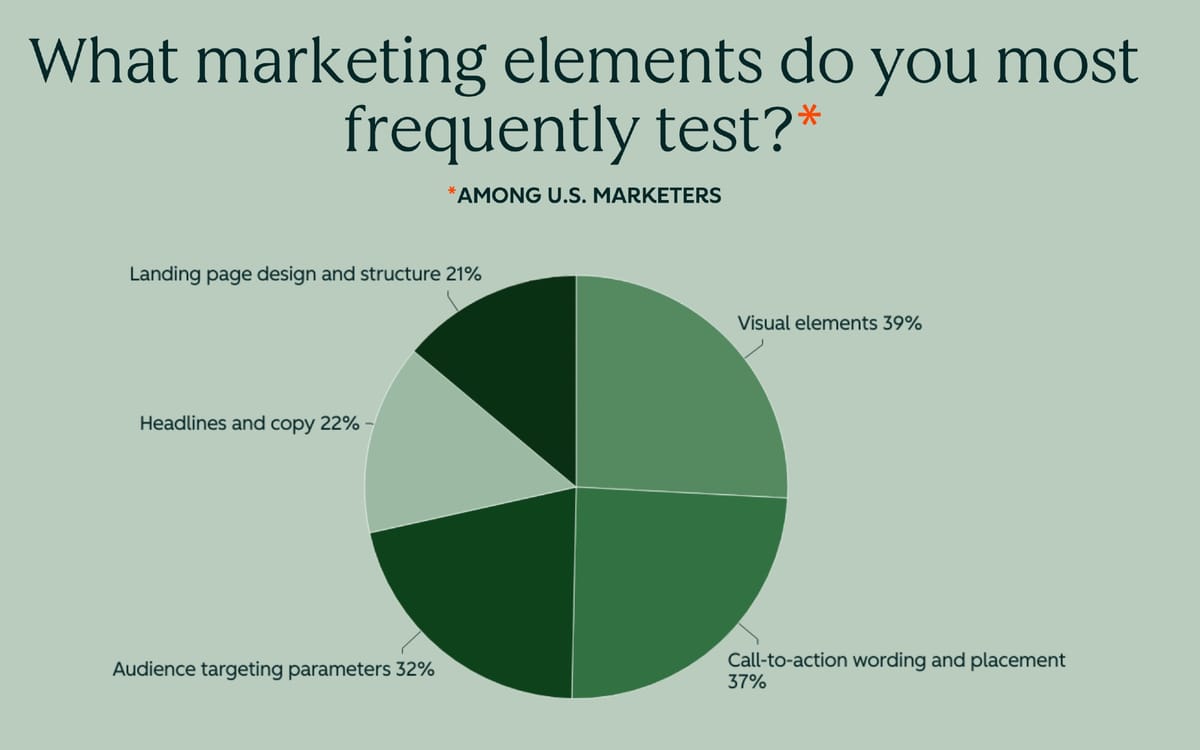
When it comes to what's being tested, marketers often experiment with visual elements like images, videos, and colors, call-to-action wording and placement, and audience targeting parameters.
Most marketers are using AI for data analysis and reporting automation. The processes marketers most want to start using AI for in 2026 are aligned with Evolve-stage tasks: advertising and automation optimization at 23% and campaign performance auditing and optimization at 22%.
The most effective teams in the United States analyze and refine marketing efforts weekly, which helps them remain agile and optimize processes quickly. Once they've conducted their analyses, teams can implement and measure changes to active campaigns and marketing plays within days.
Marketers on goal-exceeding teams have a diversified testing approach, with 50%+ saying they use at least six performance optimization techniques for different experiments, compared to 50% of goal-missing teams using three optimization strategies.
Marketers on teams that exceed goals reported that 31% can implement and measure campaign changes within hours, 40% within days, 17% within weeks, 9% at the next campaign cycle or practical time, and 3% have processes that do not allow mid-campaign or marketing play adjustments. For teams that meet goals, 23% reported implementing changes within hours, 45% within days, 23% within weeks, 5% at the next campaign cycle, and 4% cannot make mid-campaign adjustments. Teams that missed goals showed 18% within hours, 39% within days, 21% within weeks, 17% at the next campaign cycle, and 6% unable to make mid-campaign adjustments.
The report emphasizes that the Loop never ends. Once marketers reach the Evolve stage, they feed their learnings into their playbook and jump right back into the Loop again. Every time marketers get back to the Express stage, their marketing becomes smarter, more efficient, and optimized to drive results.
Almost a quarter of marketers plan to adopt AI for advertising automation and optimization. Nearly 1 in 4 plan to use AI for campaign performance auditing and optimization. Twenty-one percent of marketers intend to start using AI for market research and competitor analysis. One-fifth of marketers plan to leverage AI for lead scoring and customer segmentation.
The AI-powered marketing capabilities have been expanding throughout 2025, with multiple platforms introducing autonomous systems designed to handle campaign management and optimization functions. The timing of HubSpot's Loop Marketing introduction aligns with broader industry shifts toward AI agents across marketing technology platforms.
McKinsey data indicates $1.1 billion in equity investment flowed into agentic AI during 2024, with job postings related to the technology increasing 985 percent from 2023 to 2024. Multiple advertising technology vendors have announced similar autonomous capabilities throughout 2025.
The Loop Marketing framework addresses challenges marketers face as email marketing experiences renewed investmentalongside widespread artificial intelligence integration across marketing operations. Research released in late 2025 surveyed 100 senior business leaders across retail, direct-to-consumer brands, and B2B companies, finding that 65% of organizations plan to reinvest in email marketing as a reliable owned channel.
The emphasis on brand positioning and unique value propositions aligns with research showing that brand marketing drives favorability, boosting customer acquisition and sales growth long-term. TransUnion and MMA Global released a whitepaper on October 2, 2025, presenting findings that traditional measurement tools may undervalue brand marketing's contribution to sales by as much as 83%.
The personalization capabilities described in the Loop Marketing framework reflect growing sophistication in AI-driven customer targeting. Implementation considerations for marketing professionals include balancing automation efficiency with strategic oversight, developing first-party data strategies supporting AI-driven personalization, and establishing internal benchmarks for responsible AI usage.
HubSpot acquired XFunnel on October 31, 2025, to strengthen answer engine optimization capabilities. According to the announcement, AI-driven leads at HubSpot convert three times better than traditional search leads. The acquisition coincided with HubSpot's launch of Loop Marketing.
The multi-channel approach recommended in the Amplify stage addresses fragmentation challenges agencies face. Research from September 2025 found that 80% of strategists manage three or more platforms simultaneously, with 43% handling four or more.
The optimization and testing practices described in the Evolve stage align with industry measurement challenges. Funnel research reveals 86% of in-house marketers cannot determine channel impact, while cultural resistance and AI preparation gaps threaten effectiveness.
Specific skill deficiencies include market mix modeling at 15% adoption, incrementality testing at 18%, and attribution modeling at 27%. Despite low adoption rates, 70% of marketers say they want to improve data analysis skills on teams, particularly by developing marketing mix modeling capabilities.
The research arrives as marketing measurement confidence stalls despite data growth. TransUnion and EMARKETER survey of 196 marketing professionals shows 54.1% reported no change in their measurement confidence compared to the previous year, while 14.3% said confidence actually declined.
The Loop Marketing framework's emphasis on continuous evolution addresses the reality that 49% of marketers adjust their media strategy only once a quarter or less. Another 28.6% make monthly adjustments, while 11.7% update bi-weekly. Only 8.2% adjust weekly and 2.6% make daily changes.
The personalization and segmentation capabilities described in the Tailor stage reflect commerce media network development across industries. Koddi study reveals only 13% of commerce media networks are trailblazers while 49% remain nascent, despite projected $1.3 trillion market by 2030.
Eighty-seven percent of financial services respondents identify improving targeting and personalization using first-party data as a high or critical priority. Strong compliance and consent frameworks give them a durable advantage in privacy-focused landscapes.
The HubSpot survey was conducted in Q4 2025 and examined global marketers' approaches to each Loop Marketing stage. The research provides quantitative evidence about how marketing professionals are adapting their strategies and tactics as AI reshapes customer discovery patterns and engagement models.
Subscribe PPC Land newsletter ✉️ for similar stories like this one
Subscribe PPC Land newsletter ✉️ for similar stories like this one
Who: HubSpot Research surveyed over 1,800 global marketers in Q4 2025, with separate analysis of United States marketers and non-U.S. marketers across organizations of varying performance levels. Kipp Bodnar, Chief Marketing Officer at HubSpot, provided commentary on the findings.
What: The Loop Marketing Landscape Report reveals how marketers combine AI efficiency and human authenticity across four stages: Express (brand clarity and positioning), Tailor (personalization at scale), Amplify (multi-channel visibility), and Evolve (real-time optimization). Key findings show 51% of marketers have clear brand positioning, 93% report personalization drives leads, 73% use between three and eight marketing channels, and teams exceeding goals analyze performance weekly while implementing changes within days.
When: The survey was conducted in Q4 2025, with the report published in December 2025. The research examined current marketing practices and future intentions for 2026, capturing the state of marketing during a period of rapid AI adoption and platform transformation.
Where: The research surveyed global marketers with separate analysis comparing United States marketers to those outside the U.S., revealing different channel preferences, AI usage patterns, and optimization strategies across geographic markets. The findings apply to marketing organizations operating across digital channels including email, social media, search, display advertising, and emerging AI-powered platforms.
Why: The research addresses fundamental shifts in customer behavior where 60% of searches never leave Google and AI answers questions before prospects click through to company websites. Marketing professionals need new frameworks to navigate a landscape where traditional buyer journeys no longer apply, AI reshapes discovery patterns, and measurement capabilities struggle to keep pace with channel complexity. The Loop Marketing approach provides a structured methodology for combining AI automation with human creativity to maintain effectiveness amid these transformations.