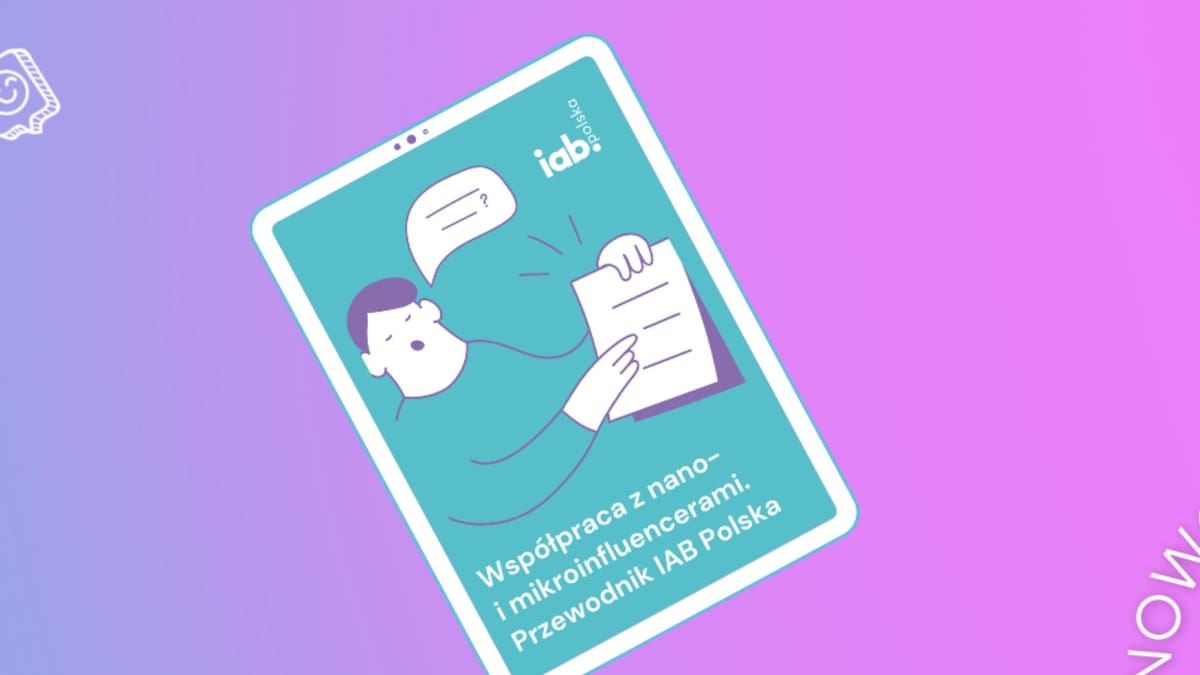
IAB Polska released a detailed guide on working with nano and microinfluencers on March 19, 2026, as new data from the organization's own research shows that trust in influencer content in Poland remains low despite record spending in the channel globally.
The publication, titled "Wspolpraca z nano- i mikroinfluencerami. Przewodnik IAB Polska" (Cooperation with nano- and microinfluencers. IAB Polska Guide), was prepared by the Influencer Marketing Working Group of IAB Polska and is available free of charge as a PDF download and as part of the influencermarketing.org.pl platform. The guide covers creator definitions, collaboration models, legal and tax obligations, best practices for briefs, market trends, and case studies. It is published under the patronage of UOKiK, Poland's consumer protection authority.
The release comes as IAB Polska has been steadily building its library of practical market resources. In January 2026, the organization released a 300-page AI guide covering large language models and performance marketing applications and published an interactive digital advertising industry map listing over 400 companies across nine market segments.
The trust problem at the center of this guide
The document does not treat nano and microinfluencers as a budget-saving workaround. Its framing is more pointed than that. According to IAB Polska's own "Polacy w social mediach" (Poles in Social Media) research, only 30% of social media users in Poland declare trust in content published by influencers. More than half - 52% - say they either mostly or definitely do not trust influencer content. The problem is sharpest among users over 30 years old, who are described as significantly more skeptical than younger demographics.
That distrust exists alongside a market that, by any measure, keeps growing. According to the Influencer Marketing Hub's Influencer Marketing Benchmark Report from January 2025, the global influencer marketing market was estimated at approximately $33 billion USD in 2025. Projections cited in the guide indicate the figure will exceed $40 billion USD in 2026. In Poland specifically, research from media agency Wavemaker cited in the publication shows that working with influencers has become the fourth most frequently used form of marketing communication among Polish brands, ahead of television and out-of-home advertising.
The tension between expanding budgets and declining trust is precisely what the guide is designed to address. According to Matylda Szymalska, CEO of Streetcom Poland and deputy head of IAB Polska's Influencer Marketing Working Group, "brands are moving away from one-off collaborations based purely on reach and are beginning to build long-term relationships with creators who have real influence over their communities. Nano and microinfluencers play a key role here - their communities are smaller but significantly more engaged, which translates into real influence on purchasing decisions."
According to Wlodzimierz Schmidt, president of IAB Polska, "influencer marketing in Poland is entering a phase of mature development. We see not only growing budgets and the increasing role of creators in brand communication strategies, but also rapid ordering of the entire market ecosystem." Schmidt pointed to the recently established Association of Influencer Marketing Professionals (SPIM) as one marker of that maturation, alongside IAB Polska's own work on an influencer marketing certification system, which was still in development at the time of the guide's release.
Who is a nanoinfluencer, and who is a microinfluencer
The guide establishes clear definitions that apply throughout its content. A nanoinfluencer is defined as a creator with up to 5,000 followers. The smaller community enables more personal and engaged relationships with audiences. Nanoinfluencer accounts are often private in character. According to the guide, campaigns involving nanoinfluencers are typically executed at scale - involving 200 to 5,000 or more creators simultaneously - and usually require specialized platforms to manage selection, communication, and reporting.
A microinfluencer is defined as a creator with between 5,000 and 50,000 followers on Instagram, or up to 70,000 on TikTok, specializing in communication with niche communities. Microinfluencers typically build their followings around specific knowledge and passion - categories like beauty, sport, parenting, or technology. The guide characterizes them as creators who have moved well beyond the "cheaper alternative" label: their higher-quality content, greater professionalism, and access to platform analytics make them measurably different from their nano counterparts in operational terms.
The guide also defines a third category - content creators - as multimedia content producers (photos, video, graphics, podcasts) published in online channels. Unlike influencers, content creators do not necessarily have their own social communities. Their value, according to the guide, lies in the quality and creativity of the materials they produce rather than in their reach.
What nanoinfluencers actually deliver - and what they do not
The guide's section on collaboration specifics is systematic. For nanoinfluencers, the listed advantages include authenticity of message (content derived from personal experience, treated as inspiration rather than a corporate script), close relationships with audiences (nanoinfluencers are described as "almost always available" to their followers, responding to direct messages and offline conversations), scalability (hundreds or thousands of creators can be activated simultaneously, generating collective reach that often exceeds single collaborations with larger influencers), favorable return on investment (smaller creators act from enthusiasm and genuine affinity for a brand rather than primarily from financial motivation), and strong potential for user-generated content and consumer insights.
The challenges listed are equally candid. Content quality varies across creators. Many nanoinfluencers lack professional accounts, which limits access to individual platform statistics. Mass campaigns require intensive coordination that is practically impossible to execute manually at scale; the guide recommends specialized agencies or platforms that can automate selection, communication, and reporting.
Microinfluencers bring a different profile. They are positioned as credible experts within their niches, whose recommendations carry documented influence over purchasing decisions. They typically operate professional creator accounts, enabling precise campaign measurement: number of posts, stories, reels, and TikToks; combined reach and impressions; interactions (likes, comments, saves, shares); link clicks from stories or bio. The guide notes that microinfluencer paid collaborations cover CPM, CPC, CTR, and cost-per-interaction metrics when integrated with paid promotion through Meta or TikTok Ads, alongside conversion tracking via UTM links, affiliate codes, and pixel data from Google Analytics, Meta Pixel, or TikTok Pixel. The single noted challenge: microinfluencer rates are higher than those of nano creators, though the guide notes that barter arrangements remain possible even in this tier.
Three collaboration models and how they work
The guide identifies three primary compensation structures. Barter involves exchanging a product or service for promotional content. It is the starting point for many nano collaborations and remains common among micro creators in categories like hospitality, beauty, and wellness, where services are exchanged for authentic reviews. Even barter arrangements require formal documentation for tax purposes: both parties must issue invoices, the value of the exchange must be specified, and VAT treatment follows the rules of equivalent paid transactions.
Financial compensation means a fixed agreed sum for defined promotional actions. Content goes through a brand approval process before publication. This model is described in the guide as providing the greatest control over content quality, scheduling adherence, and creator accountability. Microinfluencer fees range from several hundred Polish zlotys to tens of thousands per publication, depending on follower count and quality, number of posts, rights transferred, and any exclusivity clauses.
Affiliate programs pay a commission for every conversion generated from a creator's unique link, discount code, or tracking ID. The attribution window typically runs from 1 to 15 days, during which purchases linked to the creator's promotional materials are credited to that creator. The guide lists essential program components: a unique sales identifier per creator, a defined attribution window, a commission model (percentage of basket value, fixed amount per transaction, or a hybrid with bonuses for hitting volume thresholds), a real-time reporting panel, and a defined payment threshold and monthly settlement schedule. The affiliate model appears more frequently with microinfluencers, less so with nanoinfluencers, whose value lies more in product trial and word-of-mouth recommendation than in direct conversion mechanics.
Legal and tax obligations
The guide dedicates significant space to obligations that brands and creators must navigate. Polish tax treatment depends entirely on the legal structure of the collaboration. A creator working through a civil law contract (umowa zlecenia or umowa o dzielo) triggers withholding obligations on the part of the commissioning brand: income tax advance payments at the 12% or 32% rate based on tax scale, standard income costs deduction of 20% (or 50% if intellectual property rights to the content are being transferred, for example rights to a post, video, or graphic), and ZUS contributions for commission agreements where applicable. The brand must issue a PIT-11 information form.
A creator operating as a registered business (B2B model) handles their own tax and social insurance obligations independently, issues invoices, and the commissioning brand bears no withholding requirement. The guide recommends verifying the creator's NIP number, VAT status, and bank account against Poland's official VAT taxpayer register (the "white list") before payment. From 2026, the Polish VAT exemption threshold for small businesses is set at 240,000 zlotys annually.
For foreign influencers working with Polish brands, the standard withholding tax rate is 20% of gross income, reduced only if the creator provides a valid tax residency certificate. Polish companies classified as active VAT payers must recognize the import of services and report it in their JPK_V7 filing under the reverse charge mechanism. EU-registered influencers can be verified through the VIES system.
The guide includes a comprehensive tax compliance checklist covering over fifteen separate verification points, including confirmation that all content has been documented (posts, screenshots, statistics), that B2B agreements include provisions confirming the creator's independence, and that foreign-influencer payments have resolved residency certificate status before settlement.
How brands should select creators
Effective creator selection, according to the guide, requires four sequential steps. The first is defining campaign goals - reach versus engagement, brand awareness versus conversion, user-generated content generation, or product testing. The second is establishing a precise target audience profile by age, gender, interests, lifestyle, and location, with explicit guidance to match the demographics and values of the creator's followers rather than only the creator's own demographic.
The third step is setting selection criteria. For microinfluencers, the guide specifies: follower count between 5,000 and 50,000, engagement rate of at least 3% to 5% (likes, comments, saves, shares), authentic and natural style with no suspicious follower growth patterns, content quality in terms of aesthetics and storytelling, brand alignment and absence of controversy, and review of past brand collaborations. The guide recommends analytical tools including Influtool, HypeAuditor, and Modash for verification.
The fourth step covers profile analysis and authenticity verification, with specific emphasis on avoiding creators with suspiciously high follower growth rates or low engagement relative to follower count. Brief development follows: the guide specifies that nano- and microinfluencers typically lack managers and often work alongside employment or education, which means outreach should include all relevant information in a single message, with minimum attachments and flexible timelines.
Current trends shaping the market
The trends chapter documents several measurable developments. One is the shift toward ambassador models rather than one-off campaign posts. According to the guide, 73% of marketers in 2025 identified microinfluencers as the best partners, citing a combination of high engagement and reasonable cost. In 87% of campaigns involving these creators, short video formats (TikTok, Instagram Reels, YouTube Shorts) appeared as the primary content format in 2025.
Social search is another trend the guide treats in detail. Social media platforms - particularly TikTok, Instagram, and YouTube Shorts - increasingly function as content search engines, especially for younger users. Microinfluencers who structure their posts as guides ("5 reasons why...", "How I use...", "My tips for...") with well-constructed titles, descriptions, and hashtags generate content that behaves like mini-blogs, generating long-term organic visibility within platform search results.
The guide also documents the emergence of nano and microinfluencer involvement in digital product co-creation: brands involving creators not just in promotion but in collaborative development of PDFs, e-books, training plans, playlists, and limited-edition accessories designed specifically for their communities. Multi-channel publishing - a single creator naturally distributing content across Instagram Reels and Stories, TikTok, and YouTube simultaneously - is positioned as a budget efficiency advantage for brands seeking cross-platform reach without multiple production runs.
Case studies: measurable results
The guide includes three case studies with specific figures. A Nestle Purina Gourmet campaign executed by Streetcom Poland engaged 1,020 creators - 1,000 nanoinfluencers and 20 microinfluencers drawn from a half-million-strong InStars community. The campaign generated more than 9.6 million online views, more than 65,000 units of offline reach through recommendation conversations, 3,500 pieces of user-generated content, and the opportunity to product-test for more than 6,000 members of the target audience. The mechanism was a customized advent calendar packaging allowing a single shipment to showcase all 24 product variants simultaneously.
A L'Oreal PRO campaign managed by Collab Management involved microinfluencer Zuzanna Iwanowska, selected for her beauty expert positioning and audience demographics matching women aged 18 to 24. The campaign generated 14,564 interactions and more than 12,000 likes, with an engagement rate of 6.55%.
A Wittchen campaign executed by Territory Influence selected 300 nano and microinfluencers from a pool of 150,000, generating 830 UGC pieces across Instagram and TikTok. The campaign achieved 90,750 interactions and 4.2 million units of online reach. According to the social listening analysis covering November 4 to December 10, 2024, 261 brand mentions were recorded using the campaign hashtags. 100% of participants said they would recommend Wittchen products, with a Net Promoter Score of 97, and 99% stated they planned further purchases.
Why this matters for the marketing industry
The IAB Polska guide arrives during a period of active regulatory and industry standardization across European influencer markets. In November 2025, IAB Croatia published comprehensive influencer marketing disclosure guidelinesestablishing mandatory labeling protocols. Also in November 2025, BVDW published Germany's first influencer marketing market landscape categorizing the ecosystem into five segments. In March 2026, Austria's IAA Creator Hub released its own 40-page influencer marketing guide covering legal, tax, and disclosure obligations.
The IAB Polska guide is broader in scope than most of these parallel efforts: it addresses not just disclosure mechanics but commercial relationship structures, tax compliance, creator selection methodology, measurement frameworks across both nano and micro tiers, and trend documentation through 2025 data. The decision to publish it under UOKiK patronage signals that Polish authorities view this guidance as aligned with consumer protection objectives.
For marketers, agencies, and brands working in the Polish market or considering the region, the guide provides an operationally useful reference point. The trust deficit documented in the guide - with 52% of Polish social media users distrusting influencer content - is not a reason to abandon the channel but a quantified benchmark that explains why the shift toward smaller, more authentic creators has strategic logic beyond cost considerations. The document frames nano and microinfluencers not as a discounted tier but as partners whose value lies precisely in the qualities that large-reach creators cannot replicate at scale: community proximity, content authenticity, and the willingness to engage in direct dialogue with followers.
Timeline
- January 2025 - Influencer Marketing Hub publishes Influencer Marketing Benchmark Report, estimating global market at approximately $33 billion USD in 2025
- January 8, 2026 - IAB Polska releases AI Guide 2.0, a 300-page resource covering large language models and performance marketing applications
- January 20, 2026 - IAB Polska publishes its Interactive Digital Advertising Industry Map, listing over 400 companies across nine market segments
- November 3, 2025 - IAB Croatia publishes comprehensive influencer marketing disclosure guidelines
- November 13, 2025 - BVDW publishes Germany's first influencer marketing market landscape
- March 3, 2026 - Austria's IAA Creator Hub publishes its first comprehensive influencer marketing guide
- March 19, 2026 - IAB Polska's Influencer Marketing Working Group publishes the Nano and Microinfluencer Cooperation Guide, available free at influencermarketing.org.pl and as a downloadable PDF
Summary
Who: IAB Polska's Influencer Marketing Working Group, coordinated by Matylda Szymalska (CEO, Streetcom Poland) with contributions from experts at Lifetube, Territory Influence, Collab Management, indaHash, FormUp, GetHero, Spacecat, Euvic Media, Influence That Matters, and tax advisors at MDDP.
What: A 59-page practical guide covering definitions of nano, micro, and content creator categories; creator selection methodology; collaboration models (barter, financial compensation, affiliate programs); legal, ethical, and tax obligations under Polish law; brief-writing best practices; current market trends; and three case studies with measurable campaign results.
When: Published March 19, 2026, as part of the influencermarketing.org.pl platform developed under IAB Polska's Influencer Marketing Working Group, with UOKiK patronage.
Where: Available in Poland at influencermarketing.org.pl and as a free PDF download. The guide applies primarily to the Polish market but addresses EU-wide regulatory frameworks including VAT and GDPR compliance, making portions of it relevant to broader European advertisers.
Why: The guide responds to a documented trust deficit - 52% of Polish social media users distrust influencer content - alongside a global market projected to exceed $40 billion USD in 2026. It aims to professionalise how Polish brands, agencies, and media houses select, brief, compensate, and measure nano and microinfluencer campaigns, as the broader ecosystem moves from reach-focused tactics toward engagement-driven, authenticity-based partnerships.
Share this article
The link has been copied!