
IAB Polska's SEMbook 2026 maps new rules for search marketing in the age of AI
IAB Polska released SEMbook 2026 on April 9, addressing AI agents, CPC cost spikes, Performance Max, ROAS limits, and OneSearch for Polish search marketers.

IAB Polska released SEMbook 2026 on April 9, addressing AI agents, CPC cost spikes, Performance Max, ROAS limits, and OneSearch for Polish search marketers.
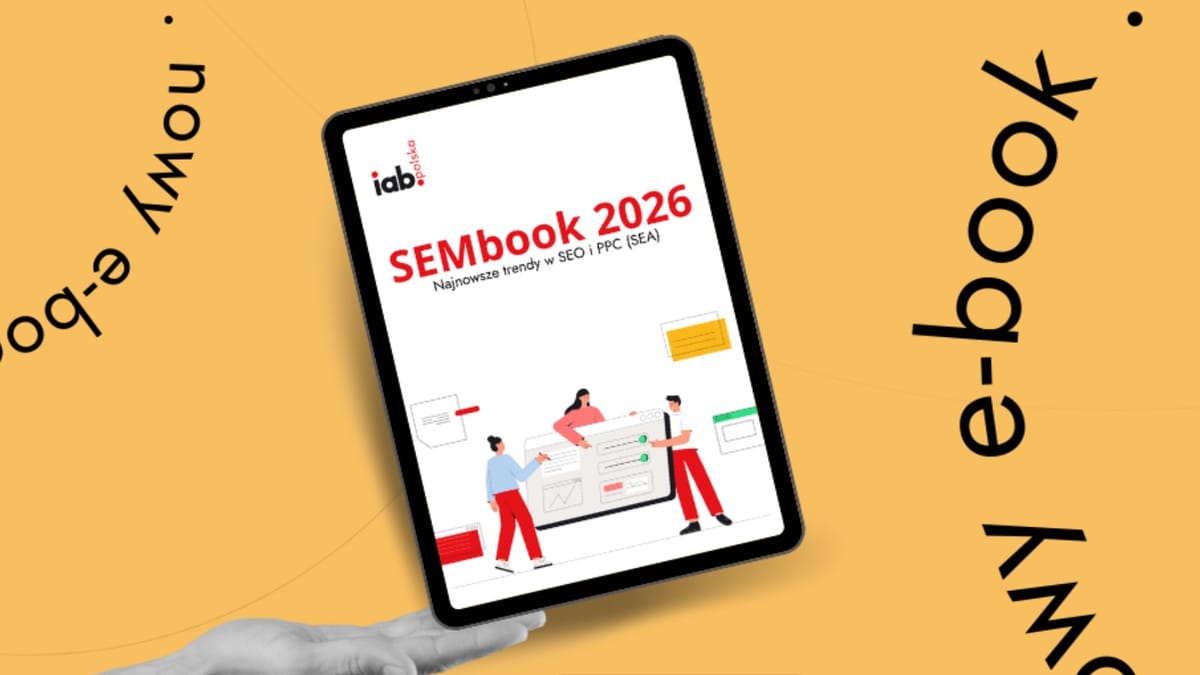
IAB Polska released SEMbook 2026 on April 9, 2026, a nearly 150-page guide produced by the organization's SEO and PPC Working Group that maps the structural changes reshaping search marketing in Poland and beyond. The publication covers AI agents in marketing, new CPC cost dynamics, the redefinition of the PPC specialist role, local advertising, e-commerce automation, and a range of SEO topics including Content Authority, the OneSearch framework, and how to maintain visibility in AI-generated search results.
The announcement was published on the IAB Polska website with a date of April 9, 2026. According to the announcement, the guide is available as a free download and represents the latest edition of an annual series developed by the SEO&PPC Working Group.
"SEMbook is for our group something more than a one-time publication - it is a permanent element of work that we have been developing and refining for years, describing the real challenges of our industry," according to Szymon Rydelski, Product Manager at WeNet Group and head of the SEO&PPC IAB Polska Working Group.
The volume is divided into four main sections: best practices in PPC, PPC case studies, best practices in SEO, and SEO case studies. Campaign analyses in the publication cover brands including BRW, Intimissimi, AdMed Medical Partner, mAuto, and Prezent Marzeń.
One of the more technically dense chapters addresses AI agents and their application in day-to-day marketing work. Krzysztof Radzikowski, an R&D SEM specialist, examines tools like Claude Code and Gemini CLI - both of which were designed originally for software developers but are increasingly used by marketing teams. The chapter focuses on the Model Context Protocol (MCP), an open standard created by Anthropic that enables AI applications to connect to external data sources and tools.
According to the publication, MCP allows agents to connect to databases, integrate with APIs of external services, retrieve data from marketing tools, and execute actions in external systems. Available MCP servers described in the chapter include integrations for Google Drive, Slack, Gmail, Google Sheets, Google Analytics, Search Console, CRM systems, Asana, Notion, Salesforce, and WordPress.
The chapter describes practical marketing applications across six areas: content marketing and SEO automation, multi-source data reporting, campaign preparation, repetitive task automation, industry research, and personalised content generation at scale. According to the publication, a single agent instruction can trigger a sequence covering data retrieval from multiple platforms, trend analysis, and report creation in a standardised Excel format with charts and recommendations.
The publication also references the Agentic AI Foundation initiative (available at aaif.io) and the Agent Skills standard (agentskills.io) as part of an emerging standardisation layer for AI agent ecosystems. A list of over 30,000 ready-made skills is catalogued at skillsmp.com, according to the document.
Challenges listed include a learning curve for non-technical marketers, API costs that rise with MCP server usage, data security management when integrating multiple tools, and the need for human verification of all AI-generated output before publication.
A chapter by Oleksandra Klyha, Senior SEM Specialist at iProspect (dentsu Polska), documents a CPC surge that affected a large share of PPC professionals in 2025. According to the publication, in many industries the increases were not minor percentage corrections but jumps exceeding 100% year on year.
The publication identifies two primary causes. First, Google introduced changes to its algorithm for evaluating landing page user experience from the beginning of 2025, with navigation, content readability and structure, and page loading speed becoming real factors influencing auction position. According to the document, a poor landing page results in lower Quality Score, worse ad position, and the need to raise CPC bids to maintain visibility. Second, the expansion of AI Overview into search results accelerated zero-click search behaviour, reducing the pool of available clicks and intensifying competition for the remaining paid traffic.
The document draws a direct connection between landing page quality and auction cost: "CPC has become an indicator of the health of the entire ecosystem: ads, landing pages, and user experiences." The publication notes that until 2024, a single-product landing page often sufficed for non-e-commerce sectors, but from 2025 onward multi-product sites with expanded content, easy navigation, and additional user pathways perform better.
Practical recommendations cover heading hierarchy (H1-H3), compressed and lazy-loaded images, minified CSS and JavaScript, full mobile responsiveness, structured data to help AI understand page content, and site accessibility through readable fonts and appropriate contrast. According to the authors, improvements to landing pages can take roughly a month to feed through into Quality Score and CPC changes.
PPC Land has tracked the broader shift toward value-based bidding and Performance Max transparency developments as context for these rising cost pressures.
A chapter by Monika Mlodawska, Senior Expert at WPP Media, argues that the role of a PPC specialist is not disappearing but transforming. The document frames the shift around four trends in automation: the move toward Broad Match and Smart Bidding combinations under a "keywordless" approach, the dominance of Performance Max campaigns across all Google placements, AI-generated ad assets through features like AI Max's Asset Optimization, and aggregated video formats in new YouTube campaign types that consolidate In-stream, In-feed, and Shorts into single goals.
According to the publication, the specialist role has shifted from operating a machine to controlling and engineering it. The document states that "value-based bidding is non-negotiable" and that the specialist's value lies in strategic management of automation, analytical assessment of its effectiveness, understanding of the integrated search ecosystem, and technical awareness.
The publication describes three new core competencies. First, defining and translating business goals into language algorithms can act on - including decisions about which conversion actions to track and how to structure omnichannel objectives. Second, rapid adaptation to platform changes, including the ongoing monitoring of new features, A/B experiment design using Google's native templates and lift measurement studies (Brand Lift, Search Lift, Conversion Lift). Third, cross-channel understanding that accounts for how YouTube or TikTok campaigns affect branded search volume on Google, how marketplace queries are captured by Amazon or Allegro, and how SEO and AI Overviews presence interacts with paid search performance.
The document also addresses the technical layer: Enhanced Conversions, Consent Mode, Google Tag Gateway, Server-Side GTM, and first-party data strategies including Customer Match lists and audience segmentation by user value.
A chapter by Katarzyna Jarosz, SEM Excellence and Innovation Senior Expert at WPP Media, sets out the case for supplementing ROAS with three additional metrics: LTV (Customer Lifetime Value), CAC (Customer Acquisition Cost), and mROAS (Marginal ROAS).
According to the publication, the universally accepted optimal ratio of LTV to CAC is at least 3:1. A ratio below 1:1 means the business loses money on each new customer. A ratio above 5:1 or 10:1 may indicate underinvestment in acquisition. The document provides worked examples: if a business spends 100 PLN to acquire a customer (CAC) and that customer generates 300 PLN over their relationship with the brand (LTV), the ratio is 3:1. If LTV is only 80 PLN, the ratio falls to 0.8:1 and each new customer represents a loss.
The mROAS formula - defined as the ratio of incremental revenue to incremental cost - answers whether additional budget still generates positive returns. According to the publication, if adding 100 PLN to a campaign produces 400 PLN in additional revenue, mROAS equals 4. Once mROAS falls below 1, additional spend produces less than 1 PLN of revenue per 1 PLN spent.
The document warns against common calculation errors: LTV is frequently overstated because businesses base average relationship length on their best customers rather than the median, and CAC is understated by omitting indirect costs such as customer service, tooling, and agency commissions.
Smart Bidding in Google Ads and Automated Bidding in Microsoft Ads are described in the publication as using conversion value data dynamically. The system, according to the document, learns from historical signals (location, device, time of day, user type) to identify high-LTV user patterns and raises bids in auctions where conversion probability for those users is greatest. Configuration steps include Conversion Value Rules or conversion tag API setup in Google Ads, Universal Event Tracking (UET) tag in Microsoft Advertising with transaction values or projected LTV, Offline Conversion Import from CRM systems, Enhanced Conversions or UET precision mapping, and Customer Match segmentation by value tier.
Google's 25-year shift toward AI-driven bidding and new customer value calculation tools tracked by PPC Land provide wider context for these developments.
A chapter by Malgorzata Szulc, Biddable Platforms Excellence and Innovation Director at WPP Media, examines Performance Max for store goals - a campaign type that uses anonymised, aggregated location history data from logged-in users to estimate whether someone who interacted with an ad subsequently visited a physical location. The model creates a statistical estimate from a sample of users' location signals rather than tracking individuals directly.
According to the publication, AI Overviews and large language models are already changing local advertising: LLMs can process more complex, conversational queries, which requires advertisers to populate their Google Business Profile attributes in detail - including features such as Wi-Fi availability and dietary options - so that AI-generated responses can match ad content to user intent. The document notes that ads within AI Overviews are not yet available in Poland (status as of December 2025), but their eventual arrival is described as a "game changer" for local PPC strategy.
The chapter also covers a Demand Gen campaign option that allows budget to focus exclusively on Google Maps placements - a relatively recent capability that adds to the standard toolkit of location extensions and Search-triggered map appearances.
The SEO half of SEMbook 2026 opens with a detailed examination of Bing's market position. According to Bartlomiej Matulewicz, Product Manager at WeNet Group, Bing has steadily expanded its desktop market share since 2020, and at one point Google's share dropped below 80% of the desktop search market - a level not previously seen in Statcounter data going back to 2009.
The publication presents revenue data from several Polish e-commerce sites. For a site in the medical sector (B2B), Bing accounted for 7% of revenue. Its conversion rate exceeded 1% compared to 0.5% from Google, and average revenue per user from Bing was more than three times higher than from Google. Average transaction value was 25% higher from Bing than from Google. The chapter also documents Bing's strong performance in Czech Republic, Germany, and Romania markets, while noting that Bing on mobile "practically does not exist."
Technical recommendations for Bing optimisation include implementing Bing Webmaster Tools and IndexNow, closer adherence to keyword phrases in title tags, H1 headings, and meta descriptions, stronger use of meta tags, social signals, and Bing Places registration. The document notes that Bing does not yet support mobile-first indexing in the same way as Google, making desktop page performance a relevant factor.
The OneSearch chapter repositions search from a channel to a consumer behaviour. According to the publication, search now encompasses traditional web search, social search on TikTok and Reddit, LLM-based search via ChatGPT and Gemini, and commerce search on platforms like Amazon and Allegro. The implication for marketers is that a Google Ads or SEO strategy in isolation misses a large portion of the search behaviour relevant to a purchase decision.
Content Authority - the SEMbook's term for topical depth and credibility signals - is described as the new ranking factor in AI-driven environments. The document argues that AI systems assess not just individual pages but the overall authority of a source across a topic cluster, and that brand reputation and third-party mentions now function as ranking inputs rather than supplementary signals.
The publication also contains a chapter on SEO and PR integration, arguing that the era when SEO and PR could ignore each other is over. As AI systems increasingly draw on editorial coverage, expert mentions, and structured entity data to build generative responses, earning media coverage and brand references has direct SEO consequences.
According to the publication's introduction, authored by Michal Herok, CEO of SEOgroup and coordinator of SEMbook's editorial process: "This publication not only diagnoses our current reality but sets new directions for development."
IAB Polska published a 300-page AI Guide 2.0 in January 2026, as covered by PPC Land, expanding the organisation's library of practical resources for Polish digital marketing professionals. SEMbook 2026 complements that guide with a focus specifically on search - both paid and organic - at a moment when AI Overviews, large language models, and automated campaign management are restructuring the discipline from the ground up.
For PPC professionals, the practical pressure is immediate: CPC increases of over 100% year on year in competitive sectors force a reassessment of what constitutes an acceptable cost structure. The shift from ROAS to LTV-based optimisation requires CRM integration and new data pipelines that many teams have not yet built. Performance Max is now a default rather than a test, and understanding how its store visit attribution model works - and what its limits are - is a core operational skill.
For SEO professionals, the challenge is different. AI Overviews reduce clicks even when content ranks well, as documented in research covered by PPC Land. The SEMbook's framing of Content Authority and brand reputation as AI ranking signals reflects an emerging consensus that topical credibility and entity recognition matter as much as traditional on-page factors.
The OneSearch perspective connects both disciplines: as search behaviour fragments across Google, LLMs, social platforms, and marketplaces, the artificial separation between paid search and organic search becomes increasingly difficult to justify as a planning structure.
Who: IAB Polska's SEO&PPC Working Group, led editorially by Michal Herok (CEO of SEOgroup), with chapters from specialists at WPP Media, iProspect (dentsu Polska), WeNet Group, and other organisations.
What: SEMbook 2026 - a nearly 150-page annual guide covering best practices and case studies across PPC and SEO, with new material on AI agents via Model Context Protocol, CPC cost increases exceeding 100% year on year in some sectors, the shift from ROAS to LTV-CAC-mROAS measurement, Performance Max for store goals, Bing as a supplementary SEO channel, OneSearch as a consumer behaviour framework, and Content Authority in AI-generated search environments.
When: Published on April 9, 2026 and available as a free download through IAB Polska's website.
Where: Published by IAB Polska (ul. Pulawska 39/77, 02-508 Warsaw), targeting Polish-language marketing professionals including SEO and PPC specialists, digital marketers on the client side, performance strategists, agencies, and media houses.
Why: The guide addresses a moment when AI Overviews, LLMs, Performance Max automation, and rising CPC costs are forcing practitioners to reconstruct their measurement frameworks, technical skills, and strategic planning. The convergence of SEO, PPC, and PR under AI-driven discovery patterns makes cross-channel coordination a practical operational requirement rather than an aspirational goal.