IAB Tech Lab releases Deals API to streamline programmatic transactions
IAB Tech Lab opens Deals API specification for public comment until January 31, 2026, addressing manual entry, transparency gaps in curated programmatic deals.

IAB Technology Laboratory released its Deals API specification version 1.0 for public comment on December 5, 2025. The specification enters a comment period extending through January 31, 2026.
According to the specification documentation, the API streamlines operations by clarifying high-level terms of each deal, reducing manual data entry and supporting automated configuration. The framework enhances visibility into curated deals, offering transparency not currently present in the bid stream.
Subscribe PPC Land newsletter ✉️ for similar stories like this one
The specification aims to decrease manual entry of deal information across systems by providing a way for deal terms to be input and sent to the system that will deliver the deal. The framework describes what the selling system deal includes at a high level and identifies which parties were involved in curating and selling the package.
Hillary Slattery, Senior Director of Programmatic Product Management at IAB Tech Lab, explained the motivation in a blog post. Media buyers typically manage 17 systems, five supply-side platforms, three demand-side platforms, and numerous deal flows, according to her December 5 analysis. Each SSP names deals differently, with their own notations requiring what she described as telepathic decoding.
The standardized specification provides a common language for deals instead of a "Tower of Babel across your eleventy billion stacks," according to Slattery. One set of fields allows everyone to read deal parameters the same way.
The specification establishes an HTTP POST endpoint implemented by receiving systems to accept data pushed from origin systems. Configuration of push calls remains the responsibility of the origin system.
Version 1.0 operates as a one-party design for origin systems to push information into receiving systems from where deals were created. This typically flows from SSP to DSP. The same system can query the receiving system for deal status after initial send.
The framework does not support differential overrides. This separate API operates outside OpenRTB Request/Response and does not include real-time information contained in bid requests or determine whether deals apply. Implementers should validate conditions laid out through this deal with OpenRTB requests to ensure expectations are met.
The specification does not support proposals, revisions, or negotiations in version 1.0. Future iterations may include discoverability features, bi-directional communications, or deal proposals and negotiations.
The Deal object contains a unique identifier required in the origin's namespace, along with recommended fields including deal name, creation timestamp, and seller status. Status values indicate whether deals are active, paused, or archived.
Three key domain fields define transaction participants. The origin attribute identifies the advertising system domain receiving bid responses, typically the SSP hosting the API. The seller attribute specifies the canonical domain of the business entity who sold the deal. The curator attribute names the entity that packaged inventory, technology, and data.
According to the specification guidance, distinguishing these three entities provides critical transparency. When a saleshouse sources demand, a curator packages the deal with data providers, and an SSP hosts the deal entry, all three domains can differ.
The Terms object specifies start and end dates, countries where deals are available, deal floor prices, guaranteed status, and pricing type. Pricing types include dynamic auction, first price, second price plus, and fixed price. For guaranteed deals, the specification requires unit count and total cost over the specified period.
The Inventory object provides high-level information about included inventory types, device types, seller identifiers, site domains, app bundles, and content categories. The specification limits this object to static inventory sets.
The Curation object addresses a significant gap in current bid stream information. This object identifies the curator domain and specifies the fee type applied for curation services.
Fee types include percentage of spend, flat fee, CPM, or no fee for curation services. According to implementation guidance, if a curator charges a $5 CPM, the fee type value equals 3 because it represents CPM. If charging a $100 flat fee, the value equals 2 for flat fee.
Three auxiliary attributes provide additional transparency. The auxdata field indicates whether non-publisher data layers are applied with associated fees and whether they may change after deal launch. The pubcount field communicates whether deals span single or multiple publishing companies. The dinventory field indicates whether inventory may update dynamically after deals go live.
According to example scenarios in the specification, a publisher packaging owned-and-operated inventory and data without other parties involved would use specific combinations of these values. A curation company charging CPM fees to aggregate inventory across multiple publishers with optimization services and changing data partners throughout flights would use different value combinations.
Buy ads on PPC Land. PPC Land has standard and native ad formats via major DSPs and ad platforms like Google Ads. Via an auction CPM, you can reach industry professionals.
Industry adoption accelerated following IAB Tech Lab's December 16, 2024 announcement of formal curation standards, though the framework had existed since early 2023. Major platforms including Google Ad Manager, Microsoft Advertising, and various supply-side platforms integrated curation frameworks throughout 2024 and 2025.
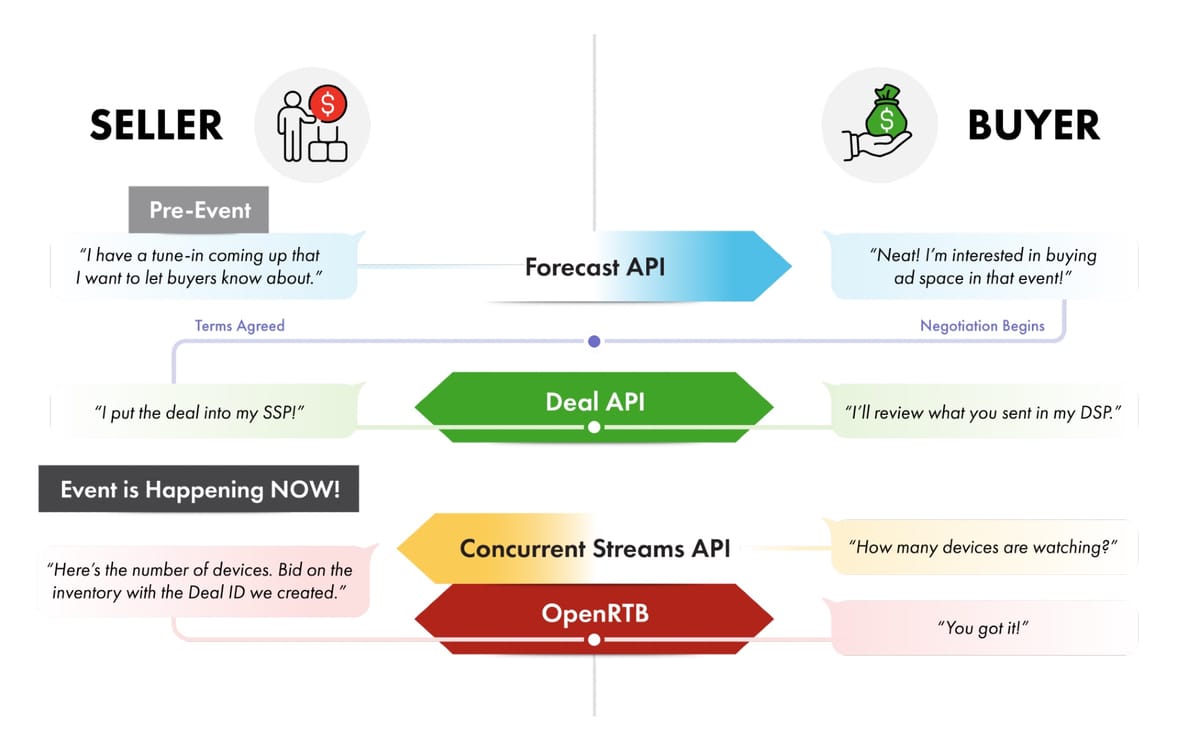
The Deals API specification works alongside other IAB Tech Lab APIs forming the LEAP framework for live event advertising. These include Concurrent Streams API, Forecasting API coming in early 2026, and Biddable API arriving mid-2026. The specifications work as sidecars to core OpenRTB, callable independently and asynchronously from main planning and operations workflows.
According to Slattery's analysis, the specifications form a powerful foundation whose whole is greater than the sum of parts. Pre-event forecasting enables audience planning. Terms agreements create deal structures. Real-time concurrent streams provide device counts during events. OpenRTB delivers actual bidding.
The standardized approach addresses transparency deficits that have plagued programmatic deals. Supply-side platforms maintain strategic advantages in curation services due to direct publisher relationships and inventory access. SSPs can pre-qualify inventory and consolidate targeting parameters under single deal IDs, streamlining programmatic buying while preserving data integrity.
The specification emphasizes that some level of trust is required when buying any deal ID. Buyers must compare information from the Deals API with information contained in OpenRTB bid requests to ensure expectations are met.
Deal criteria provided via this channel are not guaranteed to be accurately reflected in bid requests containing associated deal IDs. According to the specification, buyers should always apply targeting matching the terms outlined in any deal on their side. If a deal covers US-only inventory, buyers should include that targeting in their DSP when trafficking campaigns.
Supply chain validation should always use the Supply Chain object from OpenRTB. If this information is unavailable, implementers should proceed with extreme caution understanding there is no mechanism to know if a given path is authorized to sell inventory.
The specification notes it is not possible to validate that parties selling inventory have been authorized without including app bundle or site ID matching publishers' ads.txt files. Deal IDs receiving requests without that information should be used rarely and closely monitored.
Authorization mechanisms and sending and receiving information protocols remain out of scope for version 1.0. Implementers may choose to accept incoming webhooks to their API endpoints for events.
Version 1.0 does not support deal revisions. However, some attributes may be subject to change over deal flight. Conversations between implementers should address which attributes, if any, may change after deals go live.
The deal.id from both sender and receiver should match the deal.id in OpenRTB requests when bidding. Implementers should use the deal ID from the origin system that did the push.
The standardized specification addresses known friction in programmatic transactions. Deal IDs enable advertisers to access specific audience segments or inventory types while maintaining campaign control. Rather than open marketplace bidding, curated deals provide guaranteed access to defined inventory pools with predetermined pricing or bidding parameters.
The specification provides matching guidance for bid requests to deals. Deal ID matching should occur between the API specification and OpenRTB bid request deal IDs. Implementers should validate that bid requests containing deal IDs conform to deal criteria outlined in the API.
The Deals API represents a fundamental shift in how programmatic advertising infrastructure handles deal information. Programmatic advertising investment continues expanding, with 72% of marketers planning to increase programmatic spending in 2025, marking a rise from 62% in 2024.
Manual deal entry creates operational bottlenecks and error opportunities. Standardizing deal metadata transmission between systems reduces setup time, decreases mismatched deals and failed auctions, and enables faster debugging when problems occur.
The curation transparency components address an information asymmetry that has troubled the programmatic ecosystem. Buyers purchasing curated deals have lacked visibility into which entities performed packaging, what fees apply, and whether data layers may change. The specification's structured fields for curator domains and fee types provide this missing context.
IAB Tech Lab has maintained an active standards development program throughout 2025. The organization announced its 2025 product roadmap on January 29, planning to deliver 31 new specifications or updates. The organization completed 79 initiatives in 2024, developed with input from over 800 member companies.
The Deals API joins other recent IAB Tech Lab initiatives including Publisher Advertiser Identity Reconciliation protocolreleased September 2024, Attribution Data Matching Protocol released October 2024, and ID-Less Solutions Guidance released July 2025.
Compatibility with existing implementations was a design priority. According to Slattery's analysis, every field in the standardized API either already exists in ways that do not conflict or represents new concepts like the Curation object. Implementers will map their fields to specification fields. The relatively small scope of version 1.0 facilitates adoption.
Subscribe PPC Land newsletter ✉️ for similar stories like this one
Subscribe PPC Land newsletter ✉️ for similar stories like this one
Who: IAB Technology Laboratory, a nonprofit research and development consortium, released the specification through its programmatic advertising standards working groups. Hillary Slattery, Senior Director of Programmatic Product Management at IAB Tech Lab, authored the accompanying blog post explaining the specification's purpose.
What: The Deals API specification version 1.0 establishes a standardized framework for transmitting programmatic deal metadata between advertising systems. The specification defines object structures for deal terms, inventory details, curation information, and buyer status. The API enables origin systems to push deal information to receiving systems and query deal status after initial transmission.
When: IAB Tech Lab released the specification for public comment on December 5, 2025. The public comment period extends through January 31, 2026. Future versions may expand functionality to include bi-directional communications, deal proposals, revisions, negotiations, and marketplace discoverability features.
Where: The specification targets the global programmatic advertising ecosystem, focusing on connections between supply-side platforms and demand-side platforms. Implementation will occur within programmatic infrastructure operated by exchanges, SSPs, DSPs, and other advertising technology providers participating in real-time bidding markets.
Why: The specification addresses operational inefficiencies and transparency gaps in programmatic deal management. Manual entry of deal information across systems creates errors, delays, and inconsistencies. Curated deals lack visibility into which parties performed packaging, what fees apply, and whether inventory or data may change. Standardizing deal metadata transmission reduces setup time, improves accuracy, and provides buyers with transparency into deal structure and participants that current bid stream information does not provide.