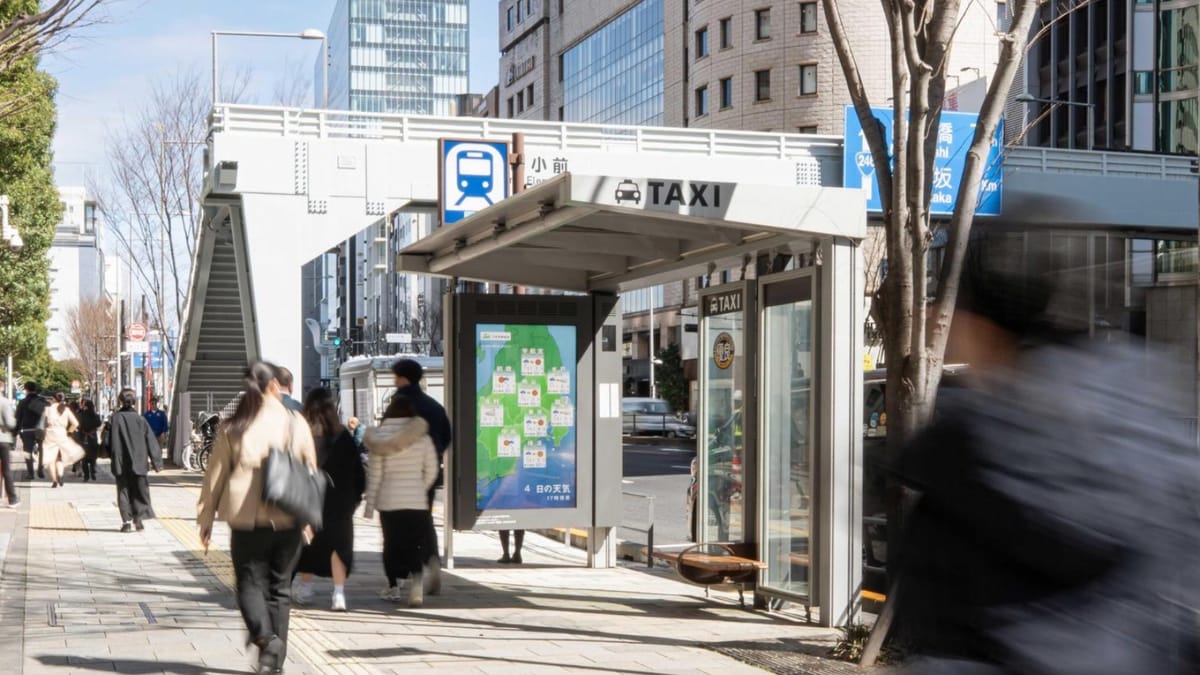
JCDecaux acquires Tokyo taxi shelter operator VISTA COMMUNICATIONS
JCDecaux signed an agreement on March 30, 2026 to acquire VISTA COMMUNICATIONS Inc., adding 29 taxi shelters and 58 advertising faces in Tokyo to MCDecaux.

JCDecaux SE last week announced it has signed an agreement to acquire VISTA COMMUNICATIONS Inc., a Tokyo-based company that has operated advertising on taxi shelters in the Japanese capital since 2012. The deal, signed on March 30, 2026, extends the French outdoor advertising giant's street furniture footprint in one of the world's most densely populated metropolitan areas.
The acquisition adds 29 taxi shelters to the MCDecaux portfolio - JCDecaux's joint-venture operation in Japan. Those shelters carry 58 advertising faces in total, of which 7 are digital screens. They sit in some of Tokyo's highest-traffic districts: Shibuya, Roppongi, Shinjuku, Shinagawa, Akihabara and Ueno. For a company whose global strategy is increasingly tied to premium urban locations and digital inventory, the asset profile fits squarely within that template.
Taxi shelters occupy a specific niche in the street furniture ecosystem. Unlike bus shelters, which serve mass transit passengers, taxi shelters attract a predominantly business-oriented audience - corporate travellers, international visitors and city dwellers choosing on-demand transport. In Tokyo, where taxi use remains substantial and the districts covered by VISTA's infrastructure include major entertainment and business hubs, that audience profile carries particular value for advertisers targeting affluent or internationally mobile consumers.
VISTA has managed these structures on behalf of Tokyo Taxi Center since 2012. The shelters provide functional utility - protection from rain, seating, and wayfinding - while carrying advertising panels visible to both waiting passengers and passing pedestrians and vehicles. According to the announcement, the acquisition will allow MCDecaux to increase the number of advertising shelters at taxi stops managed by Tokyo Taxi Center, while delivering "a more comprehensive and consistent design, cleaning and maintenance proposition."
That last point matters in operational terms. Street furniture concessions typically bundle advertising rights with maintenance obligations. Unified management under a single operator - as opposed to multiple vendors handling different shelter types across a city - allows for standardised cleaning schedules, consistent branding of the shelters themselves, and coordinated digital content delivery across a connected screen network. For advertisers planning city-wide campaigns, it simplifies buying.
MCDecaux currently operates more than 850 B-Stop® units in Tokyo. B-Stop® is MCDecaux's name for its advertising bus shelters in Japan. Beyond Tokyo, MCDecaux operates B-Stop® and CIP® (City Information Panels) in 43 cities across Japan, including every city in the top 10 by population: Tokyo, Yokohama, Osaka, Nagoya, Sapporo, Fukuoka, Kawasaki, Kobe, Kyoto and Hiroshima.
The VISTA acquisition marks the joint-venture's entry into the taxi shelter segment specifically, adding a format that complements the existing bus shelter and city information panel inventory. In physical terms, the addition of 29 taxi shelters is relatively modest against a base of 850-plus bus shelters in Tokyo alone. But the strategic logic is about format diversification and location quality rather than volume. Taxi shelters in Roppongi and Shibuya - two of Tokyo's most internationally recognised districts, associated with nightlife, luxury retail, and concentrated corporate activity - carry audience characteristics that differ meaningfully from bus shelter audiences elsewhere in the city.
Seven of the 58 advertising faces are digital. That is roughly 12% of the acquired inventory, a proportion that reflects the current state of digitisation in Tokyo's street furniture market. Japan's outdoor advertising sector has historically been more cautious about digital deployment than European or North American markets, partly due to regulatory constraints and partly due to aesthetic preferences in urban planning. The VISTA acquisition does not immediately transform MCDecaux's digital footprint in Tokyo, but it brings a nucleus of digital inventory in prime locations that can serve as a foundation for further upgrades.
Jean-Charles Decaux, Co-CEO of JCDecaux, described the deal as "fully in line with JCDecaux's selective external growth strategy focused on premium assets located in high-traffic urban environments." He added: "By becoming the leading operator of taxi shelters in Tokyo, MCDecaux is strengthening its footprint in a key market at the heart of one of the world's largest metropolitan areas."
The language of "selective external growth" is deliberate. JCDecaux has been active with bolt-on acquisitions and contract wins across multiple markets in the past twelve months. In March 2026, the company won a 10-year advertising contract at Denver International Airport. Earlier that same month, it renewed the Yarra Trams contract in Melbourne for up to 14 years. These moves, along with the VISTA deal, reflect a pattern of reinforcing existing geographic presences rather than entering entirely new markets. The pace has been consistent: multiple transactions across different continents within weeks of each other.
The Tokyo acquisition is particularly coherent because it builds on infrastructure already in place. MCDecaux is the operating vehicle; the relationship with Tokyo Taxi Center is pre-existing through VISTA; and the districts covered are already within MCDecaux's operational geography. The integration should therefore be relatively straightforward compared with greenfield market entries.
JCDecaux reported 2025 full-year revenue of €3,967.1 million, according to results published on March 13, 2026. The company is ranked number one in outdoor advertising worldwide and holds that position in street furniture specifically, with 636,625 advertising panels in that category alone. It reaches a daily audience of 850 million people across 79 countries and maintains 1,105,906 advertising panels in total across street furniture, transport, and billboard segments.
Street furniture - which includes bus shelters, city information panels, and now taxi shelters in Tokyo - is the company's largest segment by panel count globally. The company is present in 3,895 cities with populations above 10,000 and employs 11,894 people. JCDecaux is listed on the Euronext Paris exchange under the ticker DEC and is part of the SBF 120 and CAC Mid 60 indexes. Its carbon reduction trajectory has been approved by the Science Based Targets initiative (SBTi), and the company has joined the Euronext Paris CAC® SBT 1.5° index. Extra-financial ratings include CDP A-List, MSCI AAA, Sustainalytics 11.1, and Gold Medal status from EcoVadis.
For media buyers and advertisers operating in Japan, the consolidation of taxi shelter and bus shelter management under MCDecaux has practical implications. A single operator controlling multiple street furniture formats across Tokyo's key districts makes it easier to plan integrated out-of-home campaigns that span different dwell-time contexts - bus shelter audiences in transit versus taxi shelter audiences waiting, with different average contact times and different surrounding environments.
The 7 digital faces that come with VISTA's inventory are also potentially relevant to programmatic buyers. JCDecaux has been accelerating its programmatic DOOH capabilities globally through its VIOOH supply-side platform, which by the end of 2025 was connected to 57 demand-side platforms across 35 countries and processing €180.5 million in programmatic revenue annually. Tokyo's digital street furniture inventory, including the screens acquired through VISTA, is part of the broader estate that could eventually feed into those programmatic systems - though no announcement has been made specifically about connecting MCDecaux's Tokyo digital inventory to VIOOH.
Japan represents a market where outdoor advertising digitisation has moved more gradually than in Europe. The VISTA acquisition's inclusion of 7 digital faces - positioned in premium, high-footfall locations - gives MCDecaux a small but well-positioned digital inventory in districts where advertiser demand for digital formats is strongest. DOOH's share of JCDecaux group revenue reached 41.7% in 2025, with the fourth quarter pushing that figure to 44.8%. Tokyo's taxi shelter screens, modest in number though they are, sit within that global digitisation trajectory.
Tokyo is the world's most populous metropolitan area, with a population exceeding 37 million in the greater urban region. The density and complexity of the city's transport infrastructure - overlapping rail, subway, bus, and taxi networks - creates both challenges and opportunities for outdoor advertisers. Physical space for advertising is constrained by strict urban planning regulations, which means that existing concessions carry structural value beyond the panels themselves. VISTA's 14 years of operating history and its established relationship with Tokyo Taxi Center represents exactly that kind of embedded concession value.
The concentration of VISTA's shelters in Shibuya, Roppongi, Shinjuku, Shinagawa, Akihabara and Ueno is not incidental. These are districts with outsized advertiser interest. Shibuya is a fashion and youth culture hub. Roppongi hosts a concentration of foreign embassies, international hotels, and luxury nightlife venues. Shinjuku is both a major transport interchange and a retail and entertainment district. Shinagawa serves as a gateway between central Tokyo and Haneda Airport. Akihabara draws technology and electronics advertisers. Ueno functions as a cultural and tourist hub. The geographic spread means that VISTA's 29 shelters, though small in number, cover a disproportionate share of Tokyo's premium advertising real estate. That concentration in high-value districts is what makes the deal strategically meaningful well beyond its headline panel count.
Who: JCDecaux SE (Euronext Paris: DEC), the world's largest outdoor advertising company, acting through its Japanese joint-venture MCDecaux, is acquiring VISTA COMMUNICATIONS Inc., a Tokyo-based company that has operated taxi shelter advertising in Japan's capital since 2012.
What: JCDecaux has signed an agreement to acquire VISTA COMMUNICATIONS Inc. and its portfolio of 29 taxi shelters carrying 58 advertising faces - including 7 digital screens - located in six major Tokyo districts. The deal marks MCDecaux's entry into the taxi shelter advertising segment in Japan and adds a new street furniture format to its existing network of more than 850 B-Stop® bus shelters in Tokyo.
When: The acquisition agreement was signed on March 30, 2026. The public announcement was made on April 1, 2026.
Where: The assets are located in Tokyo, Japan, specifically in the districts of Shibuya, Roppongi, Shinjuku, Shinagawa, Akihabara and Ueno. MCDecaux, the operating entity, covers 43 cities across Japan.
Why: JCDecaux is pursuing selective acquisitions of premium street furniture assets in high-traffic urban environments as part of its stated external growth strategy. The VISTA acquisition deepens MCDecaux's presence in Tokyo by adding a complementary format - taxi shelters - to its existing bus shelter and city information panel portfolio, consolidating management under a single operator and reinforcing the company's position in one of the world's largest and most commercially significant metropolitan advertising markets.